
Verwandte Artikel zu Before The Fallout: From Marie Curie to Hiroshima
Inhaltsangabe
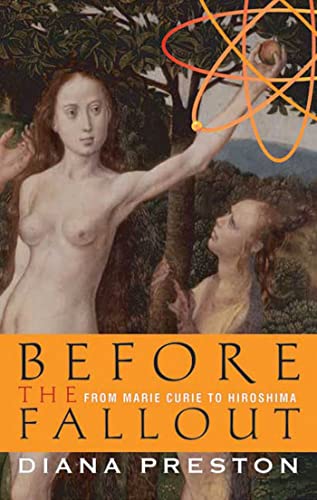
The Human Chain Reaction That Led To The Atom Bomb
On December 26, 1898, Marie Curie announced the discovery of radium and observed that "radioactivity seems to be an atomic property." A mere 47 years later, "Little Boy"exploded over Hiroshima. Before the Fallout is the epic story of the intervening half century, during which an exhilarating quest to unravel the secrets of the material world revealed how to destroy it, and an open, international, scientific adventure transmuted overnight into a wartime sprint for the bomb.
Weaving together history, science, and biography, Diana Preston chronicles a human chain reaction of scientists and leaders whose discoveries and decisions forever changed our lives. The early decades of the 20th century brought Einstein's relativity theory, Rutherford's discovery of the atomic nucleus, and Heisenberg's quantum mechanics, and scientists of many nations worked together to tease out the secrets of the atom. Only 12 years before Hiroshima, one leading physicist dismissed the idea of harnessing energy from atoms as "moonshine." Then, on the eve of World War II, the power of atomic fission was revealed, alliances were broken, friendships sundered, and science co-opted by world events.
Preston interviewed the surviving scientists, and she offers new insight into the fateful wartime meeting between Heisenberg and Bohr, along with a fascinating conclusion examining what might have happened had any number of events occurred differently. She also provides a rare portrait of Hiroshima before the blast.
As Hiroshima's 60th anniversary approaches, Before the Fallout compels us to consider the threats and moral dilemmas we face in our still dangerous world.
Die Inhaltsangabe kann sich auf eine andere Ausgabe dieses Titels beziehen.
Über die Autorin bzw. den Autor
Diana Preston is an acclaimed historian and author of A First Rate Tragedy, The Boxer Rebellion, and A Pirate of Exquisite Mind. She lives in London
Rezensionen
Nuclear weapons have been an immutable aspect of the world for the past 60 years. The story of how they came to be, and the race between the Allied and Axis nations to be the first to harness the destructive power of the atom, is wonderfully told by British historian Preston (A First Rate Tragedy; Lusitania; etc.). She weaves together history, physics, politics and military strategies to convey both the monumental scientific achievement the bomb represented and, at the same time, the ethical and humanitarian implications of creating such a wild power. Preston is an impeccable researcher with a gift for choosing small details that illuminate and humanize the bomb's world-changing effects. She quotes a doctor in Hiroshima saying the mass of burned flesh around him smelled like "dried squid when it is grilled--the squid we like so much to eat"; elsewhere, Preston relates that the potential explosive effect of a chain-reaction atomic bomb was first calculated on the back of a napkin. This is a story with a reservoir of events heroic and horrible and a fabulous cast of characters that includes scientists Einstein, Robert Oppenheimer, Edward Teller and Hans Bethe, and world leaders Roosevelt, Churchill, Truman, Stalin, Emperor Hirohito and Hitler. Preston presents each with rare insight and expertise. But her rarer achievement is to capture not only the work of making the bomb with its myriad ramifications for humankind, but also the ineffably human qualities--curiosity, ambition, fear, patriotism--that animated the participants in the great drama. 50 b&w illus.
Copyright © Reed Business Information, a division of Reed Elsevier Inc. All rights reserved.
On a sunny August morning 60 years ago, a young Japanese mother named Futaba Kitayama looked up to see "an airplane as pretty as a silver treasure flying from East to West in the cloudless pure blue sky." As she watched, the plane released an object from its bomb bay that soon exploded into "an indescribable light." It was the device dubbed "Little Boy" -- the first deadly and fearsome display of the true power of the atom. Kitayama saw her own flesh peel off her body. Some 140,000 men, women and children in the city of Hiroshima were killed, either by the immediate blast or, within months, from radiation. It would have taken 3,000 B-29s carrying conventional bombs to equal the might of that single atomic explosion.
Given the enormity of that event -- military, political and historical -- it is not surprising that the quest to unravel the secrets of the atom has been the subject of dozens of books over the years. In Before the Fallout, the British historian Diana Preston draws on many of those works but also adds her own archival research and interviews. While her book provides no startling revelations, Preston artfully distills the key moments of the pre-atomic-bomb era, both scientific and biographic, and weaves them into an absorbing narrative. The result is a concise and very readable overview of the human chain reaction that began in 1896 with the innocent observation that uranium salts could fog a photographic plate and culminated half a century later in the most potent weapon the world had ever seen.
Preston opens her tale in a rundown Parisian courtyard, where the Polish-born scientist Marie Curie spent many months huddled over her cauldrons, processing mounds of pitchblende (a heavy, black ore rich in compounds of uranium) in search of the yet unknown elements that she was sure it contained. It took her more than three years to crystallize a mere tenth of a gram of radium, but after that 1902 achievement, progress came quickly. The purity of her samples, with their high levels of radioactivity, enabled scientists in Europe and America to probe various materials with the penetrating rays and begin dissecting the atom. In 1911, physicists came up with the now familiar model: a tiny nucleus of protons and neutrons, surrounded by orbiting electrons. This newly discovered atomic world soon took on an Alice-in-Wonderland quality, where matter turned out to be frozen energy (as quantified in Einstein's equation E = mc{+2}) and elements that were once considered immutable could disintegrate into a hail of elementary particles.
By 1933, scientists were already speculating about whether nuclear transformations could be explosive, but notable physicists such as Ernest Rutherford and Niels Bohr called such talk "moonshine" and "beyond the reach of experiments." At the time they were right, but Preston lucidly describes how swiftly the situation changed. Just six years later, the Austrian theorist Lise Meitner figured out that a heavy nucleus could split apart like an amoeba dividing into two. It didn't take long for many in the field, such as J. Robert Oppenheimer, to realize that this fission "could make bombs": A single neutron splits a uranium nucleus, which releases more neutrons, which in turn hit other uranium nuclei, triggering a self-sustaining reaction of lethal potential. In 1940, Otto Frisch and Rudolf Peierls gave the British government their secret and influential three-page document, "On the Construction of a 'Superbomb,' " which outlined its feasibility.
Was building the bomb inevitable? Probably. Various pieces of the puzzle were being discerned by scientists in a number of countries around the same time. And wartime pressures forced them to pursue it, if only to create a nuclear deterrent that put fear into their enemies. In the United States, the pursuit was quite aggressive; in Nazi Germany, it was more desultory. In Preston's account, Werner Heisenberg, a leading member of the German team, appears as capricious in the Nazi quest for nuclear weapons as the uncertainty principle he had earlier established in quantum physics. Preston provides just enough scientific details to make us appreciate the complexity of the task, and her portraits of the major players help us understand their motivations, concerns and misgivings.
As she chronicles this race for the bomb, Preston never lets us forget the ultimate tragedy to come. She returns to Hiroshima several times over the course of her book, presenting vignettes of its ongoing life. In the 1920s, the city flourished as both an academic and a manufacturing center. By 1944, she writes, "Bramble shoots were stripped of their prickles and chewed. Reeds from the city's rivers were boiled and eaten." We come to see that the city's inhabitants were deprived and defeated even before the blast.
In the end she asks, "What if?" What if certain scientists had died prematurely? What if the bomb's construction had taken a year longer? What if the bomb had been invented but never used? Such speculations are fascinating, but what lingers are the personal stories: British physicist James Chadwick, imprisoned by the Germans during World War I, using toothpaste containing thorium to carry out jailhouse experiments on radioactivity; Bohr, fleeing Nazi-ruled Denmark, dissolving in acid some gold Nobel medals left to him for safekeeping; the rear gunner of the Enola Gay comparing the plane's steep turn to safety after the Hiroshima bomb drop to "the cyclone rollercoaster ride at the Coney Island amusement park."
"History," writes Preston, " . . . is inherently about people, how they thought, what they did with their thoughts, and how they interacted with the individuals immediately around them." With Before the Fallout, she conveys that history with both style and compassion.
Reviewed by Marcia Bartusiak
Copyright 2005, The Washington Post Co. All Rights Reserved.
Readers won’t mind that this book offers nothing new about a subject that has been thoroughly examined. Preston’s what-if scenarios are as fascinating as her portraits of the players, from Albert Einstein and Robert Oppenheimer to FDR, Emperor Hirohito, and Hitler. Preston’s focus on the lesser-known personalities, including physicist Werner Heisenberg, chemist Ida Noddack, and Lise Meitner (who explained nuclear fission for the first time), distinguishes Before the Fallout from other accounts of the creation of the nuclear bomb. Preston, author of The Boxer Rebellion and Lusitania, also describes the underlying science well, rarely failing to connect it to its social implications. "In this 60th-anniversary year, when new books about the bomb are as ubiquitous as self-help tomes," writes the San Francisco Chronicle, "Preston’s achievement is a rare one."
Copyright © 2004 Phillips & Nelson Media, Inc.
*Starred Review* Chronicles of the making of the atomic bomb never fail to arouse astonishment and horror, and there is still so much more to tell. Popular and gifted British historian Preston covers all facets of this complex, dramatic tale of revolutionary science, new extremes in tyranny and war, unprecedented global politics, and the gathering of a diverse group of scientists as eccentric as they were brilliant in a fast-paced and galvanizing narrative lustrous with heroics and shadowed with evil. Beginning with the unusual personalities and staggering discoveries of Marie Curie, Ernest Rutherford, and Albert Einstein, Preston not only profiles and puts in motion all the major players in this world-changing saga but also introduces intriguing lesser-known figures as she chronicles covert actions, including daring missions to sabotage Germany's atomic project. Both working on the quantum level, as it were, and drawing the big picture, Preston brings pre-apocalypse Hiroshima and Japan's atomic effort into crisp focus, as well as life at Los Alamos. Avidly researched and gracefully constructed, Preston's revelatory history is rich in telling moments, powerful personalities, intense confrontations, and indelible images of the devastation delivered by nuclear weapons, our Damoclean sword. Donna Seaman
Copyright © American Library Association. All rights reserved
„Über diesen Titel“ kann sich auf eine andere Ausgabe dieses Titels beziehen.
Suchergebnisse für Before The Fallout: From Marie Curie to Hiroshima

Beispielbild für diese ISBN
Before The Fallout: From Marie Curie to Hiroshima
Anbieter: World of Books (was SecondSale), Montgomery, IL, USA
Verkäuferbewertung 5 von 5 Sternen

Zustand: Good. Item in good condition. Textbooks may not include supplemental items i.e. CDs, access codes etc. Artikel-Nr. 00105616590
Gebraucht kaufen
EUR 6,01
Versand gratis
Versand innerhalb von USA
Versand innerhalb von USA
Anzahl: 1 verfügbar
Beispielbild für diese ISBN
Before The Fallout: From Marie Curie to Hiroshima
Anbieter: ThriftBooks-Dallas, Dallas, TX, USA
Verkäuferbewertung 5 von 5 Sternen
Hardcover. Zustand: Very Good. No Jacket. Missing dust jacket; May have limited writing in cover pages. Pages are unmarked. ~ ThriftBooks: Read More, Spend Less. Artikel-Nr. G0802714455I4N01
Gebraucht kaufen
EUR 6,13
Versand gratis
Versand innerhalb von USA
Versand innerhalb von USA
Anzahl: 1 verfügbar
Beispielbild für diese ISBN
Before The Fallout: From Marie Curie to Hiroshima
Anbieter: ThriftBooks-Atlanta, AUSTELL, GA, USA
Verkäuferbewertung 5 von 5 Sternen
Hardcover. Zustand: Very Good. No Jacket. Missing dust jacket; May have limited writing in cover pages. Pages are unmarked. ~ ThriftBooks: Read More, Spend Less. Artikel-Nr. G0802714455I4N01
Gebraucht kaufen
EUR 6,13
Versand gratis
Versand innerhalb von USA
Versand innerhalb von USA
Anzahl: 1 verfügbar
Beispielbild für diese ISBN
Before The Fallout: From Marie Curie to Hiroshima
Anbieter: Wonder Book, Frederick, MD, USA
Verkäuferbewertung 5 von 5 Sternen
Zustand: Very Good. Very Good condition. Good dust jacket. A copy that may have a few cosmetic defects. May also contain light spine creasing or a few markings such as an owner's name, short gifter's inscription or light stamp. Artikel-Nr. L05B-02620
Gebraucht kaufen
EUR 6,43
Versand gratis
Versand innerhalb von USA
Versand innerhalb von USA
Anzahl: 1 verfügbar
Beispielbild für diese ISBN
Before the Fallout : From Marie Curie to Hiroshima
Anbieter: Better World Books, Mishawaka, IN, USA
Verkäuferbewertung 5 von 5 Sternen
Zustand: Good. Former library copy. Pages intact with minimal writing/highlighting. The binding may be loose and creased. Dust jackets/supplements are not included. Includes library markings. Stock photo provided. Product includes identifying sticker. Better World Books: Buy Books. Do Good. Artikel-Nr. GRP16510070
Gebraucht kaufen
EUR 7,59
Versand gratis
Versand innerhalb von USA
Versand innerhalb von USA
Anzahl: 1 verfügbar
Beispielbild für diese ISBN
Before the Fallout: From Marie Curie to Hiroshima
Anbieter: AwesomeBooks, Wallingford, Vereinigtes Königreich
Verkäuferbewertung 5 von 5 Sternen
Hardcover. Zustand: Very Good. Before the Fallout: From Marie Curie to Hiroshima This book is in very good condition and will be shipped within 24 hours of ordering. The cover may have some limited signs of wear but the pages are clean, intact and the spine remains undamaged. This book has clearly been well maintained and looked after thus far. Money back guarantee if you are not satisfied. See all our books here, order more than 1 book and get discounted shipping. Artikel-Nr. 7719-9780802714459
Gebraucht kaufen
EUR 7,17
EUR 4,87 Versand
Versand von Vereinigtes Königreich nach USA
Versand von Vereinigtes Königreich nach USA
Anzahl: 2 verfügbar
Foto des Verkäufers
Before the Fallout
Verlag:
Walker Publishing Co., Inc., 2005
ISBN 10: 0802714455
ISBN 13: 9780802714459
Gebraucht
Hardcover
Anbieter: Dolly's Bookstore, Cedaredge, CO, USA
Verkäuferbewertung 4 von 5 Sternen

Hardcover. Zustand: As New. Zustand des Schutzumschlags: As New. From Marie Curie to Hiroshima. Artikel-Nr. DBS219
Gebraucht kaufen
EUR 4,60
EUR 9,37 Versand
Versand innerhalb von USA
Versand innerhalb von USA
Anzahl: 1 verfügbar
Foto des Verkäufers
Before The Fallout: From Marie Curie To Hiroshima
Anbieter: WeBuyBooks, Rossendale, LANCS, Vereinigtes Königreich
Verkäuferbewertung 5 von 5 Sternen
hardcover. Zustand: Good. Most items will be dispatched the same or the next working day. A copy that has been read but remains in clean condition. All of the pages are intact and the cover is intact and the spine may show signs of wear. The book may have minor markings which are not specifically mentioned. Artikel-Nr. rev2231694636
Gebraucht kaufen
EUR 5,53
EUR 10,03 Versand
Versand von Vereinigtes Königreich nach USA
Versand von Vereinigtes Königreich nach USA
Anzahl: 1 verfügbar
Beispielbild für diese ISBN
Before the Fallout: From Marie Curie to Hiroshima
Anbieter: Bahamut Media, Reading, Vereinigtes Königreich
Verkäuferbewertung 4 von 5 Sternen
Hardcover. Zustand: Very Good. This book is in very good condition and will be shipped within 24 hours of ordering. The cover may have some limited signs of wear but the pages are clean, intact and the spine remains undamaged. This book has clearly been well maintained and looked after thus far. Money back guarantee if you are not satisfied. See all our books here, order more than 1 book and get discounted shipping. Artikel-Nr. 6545-9780802714459
Gebraucht kaufen
EUR 7,35
EUR 8,25 Versand
Versand von Vereinigtes Königreich nach USA
Versand von Vereinigtes Königreich nach USA
Anzahl: 2 verfügbar
Beispielbild für diese ISBN
Before the Fallout : From Marie Curie to Hiroshima
Anbieter: Anytime Books, London, Vereinigtes Königreich
Verkäuferbewertung 5 von 5 Sternen
Cloth. Zustand: As New. Zustand des Schutzumschlags: As New. Well received study of the development Atomic Bomb. pp400. Brodarted. Artikel-Nr. 003213
Gebraucht kaufen
EUR 24,34
EUR 35,44 Versand
Versand von Vereinigtes Königreich nach USA
Versand von Vereinigtes Königreich nach USA
Anzahl: 1 verfügbar