
Verwandte Artikel zu The Weight of Your Words: Measuring the Impact of What...
Inhaltsangabe
Politics isn't a four-letter word.
Everyone's been at that dinner party. The conversation takes a political turn. The arguments start, the atmosphere grows tense, and all that remains is a hopeless stalemate and an awkward silence. Makes you wonder . . . is thoughtful and productive dialogue about politics even possible?
In Honoring God in the Red or Blue, Dr. Amy Black addresses the debaters as well as those intimidated or annoyed by the debaters; political junkies and the contented uninvolved. She explains the purposes and limitations of our system and helps readers create realistic expectations for government. While God's truth is perfect, human application of it is not, a reality that shouldn't deter us from engaging in debate and staying informed. Rather, it should challenge us to raise our standards for how we speak about the issues-and those in office.
It's time to approach political divides with an extra measure of grace. Success begins with seeking God's honor first and foremost, regardless of where we fall on the political spectrum. Don't limit yourself to chatting about the weather.
Die Inhaltsangabe kann sich auf eine andere Ausgabe dieses Titels beziehen.
Über die Autorin bzw. den Autor
DR. JOSEPH M. STOWELL has a distinguished career in higher education and church leadership. He has served as President of Moody Bible Institute and Cornerstone University and has had the honor of pastoring several churches in the Midwest. An internationally recognized conference speaker, Joe has written devotionals for Our Daily Bread and authored several books, including Strength for the Journey, The Trouble with Jesus, Simply Jesus, and Redefining Leadership: Character-Driven Habits of Effective Leaders. He and his wife, Martie, enjoy the pleasure of three children and ten grandchildren.
Auszug. © Genehmigter Nachdruck. Alle Rechte vorbehalten.
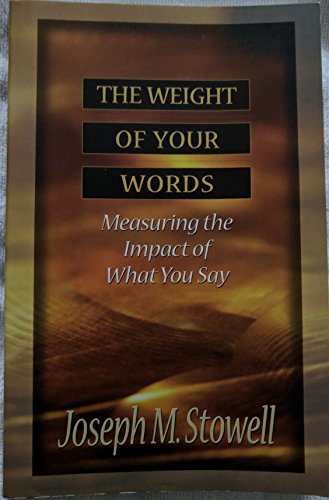
The Weight of Your Words
Measuring the Impact of What You Say
By Joseph M. StowellMoody Press
Copyright © 1998 Joseph M. Stowell
All rights reserved.
ISBN: 978-0-8024-9015-5All rights reserved.
Contents
INTRODUCTION,
1. A WORD'S WORTH,
2. TO TELL THE TRUTH,
3. MALICIOUSLY SPEAKING,
4. THE EGO IN OUR MOUTHS,
5. CROSS WORDS,
6. EXPLETIVES DELETED,
7. HEART TALK,
8. SPEAKING OUT FOR NUMBER ONE,
9. DEFUSING ANGER,
10. PATIENCE APPLIED,
11. THE TRUST-LOVE LIFE,
12. APPLES OF GOLD,
STUDY GUIDE,
CHAPTER 1
A WORD'S WORTH
The "Problem" Tongue Exposed
Insurance adjusters like to collect unique statements from the claims of people asked to describe their accidents in the fewest words possible. Here are a few of my favorites:
• "I pulled from the side of the road, glanced at my mother-in-law, and headed for the embankment."
• "The pedestrian had no idea which way to run, so I ran over him."
• "The guy was all over the road; I had to swerve a number of times before I hit him."
• "The telephone pole was approaching fast. I was attempting to swerve out of its path when it struck my front end."
• "Coming home, I drove into the wrong house and collided with a tree I don't have."
The words are simple enough, but sometimes we have trouble putting them together to say what we really mean—to communicate. Communication is the process of expressing how we feel and what we think. Most of our communication is nonverbal as others watch our facial expressions and body language to get an impression of our thoughts and feelings.
However, it's usually verbal communication that causes the most problems for us. When used appropriately, our words have the power to heal, encourage, help, and teach. On the other hand, words can also confuse, embarrass, and hurt.
Here is one man's testimony of the destructive potential that words possess:
My junior high school had scheduled its annual operatic production. Talented students were quick to try out for the various parts. I was not so certain of my abilities and had decided that singing in an operetta wasn't really for me.
Then Mrs. Wilson, my music teacher, asked me to try out. It was not a coveted role, but it did have three solos.
I am certain that my audition was only mediocre. But Mrs. Wilson reacted as if she had just heard a choir of heavenly angels. "Oh, that was just beautiful. It was perfect. You are just right for the role. You will do it, won't you?" I accepted.
When the time came for the next year's operetta, most of the students who had played the leads the year before had graduated. And Mrs. Wilson had transferred to another school. In her place was a rather imposing figure who had an excellent singing voice and a sound knowledge of music theory.
As the tryouts began, I was ready. I felt confident that my talent was just what the operetta needed. With approximately 150 of my peers assembled, I knew everything would go well.
But if I live for an eternity I will never forget the words spoken on that day. When my audition was completed, the teacher asked, "Who told you you could sing?"
The timid youth of a year earlier was suddenly reborn. I was totally destroyed. Harsh words are bad enough under any circumstances. To a young idealistic boy, they can be devastating. From the time those six words were stated, it took eight years and the coaxing of my fiancée before my voice was raised in song again.
You can probably recall similar instances from your own past where a few words—either positive or negative—made a significant difference in your life. Words have tremendous weight. Recent studies tend to disprove the saying many of us grew up with: "Sticks and stones may break my bones, but names will never hurt me." Adults polled said they had gotten over most of the physical pains of childhood. But many had never fully recovered from the hurtful words, names, and labels that had been placed on them. Physical wounds heal, as is evidenced from the scars we carry. But verbal wounds frequently refuse to close, oozing pain and keeping us tender and vulnerable.
In spite of all of Job's physical and emotional suffering, the verbal jabs of his so-called friends made his situation even worse. He challenged one of them: "How long will you torment me and crush me with words?" (Job 19:2).
We must be constantly aware that our words carry an impact. They affect our children, our students, our spouses, our friends, our neighbors, and our business associates. That's why God holds me accountable for "every careless word" (Matthew 12:36). Yet controling the words that come out of my mouth is a huge challenge.
For one thing, the stress of everyday encounters gets the better of us. We quickly say things we don't really mean. In addition, most of us are exposed to negative patterns of speech on a daily basis. From the demeaning words of an angry boss to the crude language of prime-time television, from sarcastic conversation with a neighbor to careless chatter among Christians, many of us have regular exposure to corrupted communication. The problem is that such verbal habits are highly contagious. Unfortunately, our tongues often recycle the input and, to our chagrin, the destructive words are out of our mouths before we know it—occasionally in front of people who can't believe what they're hearing!
Whether the reason is unintentional confusion, careless destruction, survival in chaos, or subconscious submission to environmental patterns of speech, inappropriate words are always destructive. Having a tongue is like having dynamite in our dentures—it's got to be reckoned with. It influences three major dimensions of our lives: our relationship with God, our relationship with those we treasure the most, and even our relationship with ourselves.
God's Word describes the tremendous task we face. James wrote, "No one can tame the tongue" (3:8). This statement is not intended to cause despair or to justify continued failure, but rather to let us know that self-initiated effort is worthless. To make matters worse, we read that the tongue is "set on fire by hell" (v. 6). In our desire to transform the tongue from a hellish fire to an instrument of constructive communication, we find ourselves up against a task of supernatural proportions. In this arena in particular, "our struggle is not against flesh and blood," but against an organized hierarchy of satanic power (Ephesians 6:12).
Therefore, transforming our tongues requires supernatural strength. Victory demands taking up supernatural arms—being "strong in the Lord and in the strength of His might" (v. 10). Being strong in the Lord is no mystical, hocuspocus process. In fact, we have a number of solid resources available to us. These resources are what Paul calls the armor of God (vv. 14–17), and the first piece of the armor he lists is truth. Scripture teaches that the truth of God is our source of spiritual energy and growth (Matthew 4:4; 1 Peter 2:2). As we discover and digest God's Word, the indwelling Spirit uses it to stimulate growth that produces spiritual, victorious strength.
God has blessed us with a wealth of truth in regard to the tongue. As we respond to His truth, it warns, convicts, and transforms us. One of the most instructive sections of truth concerning the tongue is James 3. In this passage, five principles unfold that make us more aware of the gravity of our words.
PRINCIPLE 1: CONTROLLED SPEECH IS A MEASURE OF MATURITY
"We all stumble in many ways. If anyone does not stumble in what he says, he is a perfect man, able to bridle the whole body as well" (James 3:2).
The word stumble means "to fall or to trip." Feet that stumble can bring your whole body crashing to the ground, and a tongue that stumbles is no less a threat. One little trip can do a lot of damage. When our sheepdog, Paddington, was a puppy, he tripped over everything in his path. His clumsiness reflected his immaturity. Similarly, a stumbling tongue reflects spiritual immaturity. Unfortunately, we not only trip ourselves as we talk our way through life, but we also trip others.
Perhaps some of us feel more comfortable with stumbling speech patterns if the people around us tend to be "tongue-trippers" as well. We may assume that the normal Christian experience is to leave behind us a large body count of people felled by our words. After all, doesn't everyone have trouble with their tongue? Yet we are not to measure our spiritual maturity by the communication patterns of those around us, but by the standards of God's Word.
The word perfect literally means complete or mature. We are never spiritually mature until we no longer trip people up with our words, proving that we are able to bring our entire body under control.
Certain skills are known as priority skills. If you master one, other related skills come quite naturally. For example, a marathon runner has no difficulty running a mile. A professional golfer can sink two-foot putts consistently. And if we master the tongue, we have the capacity to master other areas of our lives with far less effort.
Have you ever seen someone revive a drowning victim with mouth-to-mouth resuscitation? What a thrill it would be to bring renewed life to our relationships by learning the skill of mouth-to-mouth maturity.
PRINCIPLE 2: THE TONGUE IS SMALL BUT SIGNIFICANT
"If we put the bits into the horses' mouths so that they will obey us, we direct their entire body as well. Look at the ships also, though they are so great and are driven by strong winds, are still directed by a very small rudder wherever the inclination of the pilot desires" (James 3:3–4).
Small words have started wars, resulting in thousands of lives lost. Marriages that once set sail on a joyous adventure have been steered onto the rocks by a faulty rudder. I cannot recall one counseling situation I've conducted where the problem was not either ignited or seriously complicated by negative words.
We tend to think that small things are insignificant. How can a few words do serious damage? But ignoring the problem is like ignoring termites nesting in your house. The insects are small and normally unseen, yet they chew their way through the accumulated equity of many homes. James says the tongue is like that—small but significant. He demonstrates the significance of small things with the illustrations of a bit, a rudder, and a spark. He then concludes, "The tongue is a small part of the body, and yet it boasts of great things" (v. 5).
The neighborhood kids say it best by naming the local tattletale "Mr. Bigmouth." His title isn't a reference to the size of his mouth, but rather a colorful description of the heap of trouble that his little mouth produces.
PRINCIPLE 3: OUR WORDS ARE POTENTIALLY COMBUSTIBLE
"The tongue is a fire, the very world of iniquity; the tongue is set among our members as that which defiles the entire body, and sets on fire the course of our life, and is set on fire by hell" (James 3:6).
To celebrate the end of school in 1996, a teenager in Norway decided to show his exuberance by burning his textbooks. He made a bonfire out of his book bag during a recess on the last day of school. But the book bag was a bit too close to a shed ... which was a little too close to the school. The end result of his action was that he accidentally burned down the whole school.
We tend to tolerate a bit of "fire" in our speech, thinking it can do no harm. But fire spreads quickly—often before we realize it. And after a raging fire has done its damage, it doesn't matter whether or not it was intentional.
Living in Chicago as I do, I have heard several discussions about the great fire that took place here in 1871. (Mrs. O'Leary's cow was recently cleared of the offense, by the way.) Fire is one of the few forces that does irreparable damage, and signs of it are still evident around our city even 125 years later. Fiery words often destroy relationships that, even when restored, are never again as strong. Families, businesses, churches, friends, wealth, security, happiness, and peace are all vulnerable to the defilement of the tongue. We should wear signs that say, "CAUTION: LIFE IS A COMBUSTIBLE COMMODITY. PLEASE DOUSE YOUR TONGUE!"
The seriousness of the tongue's destructive potential is revealed in the truth that it is "set on fire by hell." It is "the very world of iniquity," literally an entire network of sin. We have an organized crime syndicate right in our mouths. Our tongues have the capacity to corrupt our entire beings. Nothing is exempt from the damage our tongues can cause.
PRINCIPLE 4: THE TONGUE IS LIKE A WILD AND DEADLY BEAST
"Every species of beasts and birds, of reptiles and creatures of the sea, is tamed, and has been tamed by the human race. But no one can tame the tongue; it is a restless evil and full of deadly poison" (James 3:7–8).
I get a kick out of how much effort we put into taming animals. We have elephant soccer, donkey basketball, dogs that bark "Jingle Bells," chimps that communicate in sign language, birds that talk, and porpoises that shoot baskets better than I do.
But more difficult—and more essential—than any of these things is the priority of taming the tiger in our tongues. If we do not bring our speech habits under the Spirit's control, our tongues will be "full of deadly poison." When referring to sinful people, Paul borrowed from an Old Testament reference, "The poison of asps is under their lips" (Romans 3:13; cf. Psalm 140:3).
In regions of South America lives a reptile called the "Two-Step" snake. If it bites you, you seldom take more than two steps before you die. Its venom swiftly paralyzes your nervous system and stops your heart. Words can be like that. They have the potential to quickly kill a relationship, paralyze love, poison minds, destroy faith, stain purity, and deface reputations.
PRINCIPLE 5: THE TONGUE TENDS TO PROMOTE A DOUBLE STANDARD
"With [the tongue] we bless our Lord and Father, and with it we curse men, who have been made in the likeness of God; from the same mouth come both blessing and cursing. My brethren, these things ought not to be this way. Does a fountain send out from the same opening both fresh and bitter water? Can a fig tree, my brethren, produce olives, or a vine produce figs? Neither can salt water produce fresh" (James 3:9–12).
Someone has said that most tongues are tied in the middle, wagging at both ends. Perhaps this was the image in Paul's mind when he warned Timothy to avoid positioning "double-tongued" men as church leaders (1 Timothy 3:8). It's amazing how we can verbally poison other people all the way to church, but as soon as we pull into the parking lot we begin to speak out of the pious side of our mouths. Then we hardly finish singing the doxology until we start complaining again. "My brethren, these things ought not to be this way."
Even nature doesn't act so incongruously. It is impossible for wells to produce both salt and freshwater, or for fig trees to bear olives! We would be utterly disappointed to expect a cold drink of pure water, only to draw up a bucket full of salty and undrinkable seawater. Similarly, God must be disappointed whenever His "new creatures" (see 2 Corinthians 5:17) continue to issue "old words."
KEEPING OUR TONGUES IN CHECK
In these five principles James categorizes the dark and shifty potential of the tongue. The first step toward victory is to permit these truths to penetrate our minds and hearts. The warning is clear: A transformed tongue must be a top priority for those committed to spiritual growth.
James's warning, however, takes on added weight when we realize that many Christians are insensitive to the problems of destructive speech. We excuse one another with a number of rationalizations. For example, perhaps you have heard someone say something derogatory about another person, yet accompany the damaging statement with one of the following disclaimers:
• "Well, it's the truth, isn't it?"
• "If they didn't want people to talk, they never should have done it."
• "Let me share this with you so we can pray more intelligently."
• "I heard this from a reliable source, or I wouldn't be repeating it."
This desensitization process opens the floodgates to communication sins. By making careless communication an acceptable part of our lives, we strive for spiritual maturity while exempting the tongue from the process. Yet the word-sparks that fly from an untamed tongue can leave an entire life (or lives) in ashes. Until we get serious about bringing our tongues under the control of the Holy Spirit, our churches, schools, homes, friendships, and relationships with God will all be victimized.
Sins such as beguilement, deceit, lying, and false witness need to be understood from God's point of view. Social sins of the tongue, including gossip and slander, must be checked. Verbal ego trips, such as boasting, flattery, and exaggeration, are clearly out of bounds. The cancer of a murmuring, contentious tongue needs to be removed. Expletives that violate the dignity of God's name and our sensitivity to moral purity must be deleted.
The following chapters will go into further detail in all these areas. But first let me provide a recent illustration of how serious we need to be about controlling our speech. A favorite sportswriter of mine once analyzed a fine levied on a local baseball manager for verbally chewing out the commissioner. His column defended the manager by saying, "After all, they were just words." At the time I thought, Just words? There's no such thing. It's like saying, "After all, it's just an atom bomb!"
Years later a front-page story in the Chicago Tribune reported on the aftermath of a high school state play-off football game in northwestern Illinois. The article ran ten days after the game, and the facts that had come to light since the game were alarming. The game had been close and went into overtime. When one team finally won, the fans of the defeated team were naturally disappointed. However, some had gone out of their way to place the blame on a particular referee. One fan followed him home (a distance of sixty-five miles) and sat outside his house for two hours. In the days that followed, parents and teachers from the town of the losing team sent hostile letters and made cruel phone calls. As a result, the thirty-six-year-old referee tried to kill himself. Thankfully, his suicide attempt was unsuccessful.
(Continues...)
Excerpted from The Weight of Your Words by Joseph M. Stowell. Copyright © 1998 Joseph M. Stowell. Excerpted by permission of Moody Press.
All rights reserved. No part of this excerpt may be reproduced or reprinted without permission in writing from the publisher.
Excerpts are provided by Dial-A-Book Inc. solely for the personal use of visitors to this web site.
„Über diesen Titel“ kann sich auf eine andere Ausgabe dieses Titels beziehen.
Suchergebnisse für The Weight of Your Words: Measuring the Impact of What...

Beispielbild für diese ISBN
The Weight of Your Words: Measuring the Impact of What You Say
Anbieter: World of Books (was SecondSale), Montgomery, IL, USA
Verkäuferbewertung 5 von 5 Sternen

Zustand: Good. Item in good condition. Textbooks may not include supplemental items i.e. CDs, access codes etc. Artikel-Nr. 00100207387
Gebraucht kaufen
EUR 3,62
Versand gratis
Versand innerhalb von USA
Versand innerhalb von USA
Anzahl: 7 verfügbar
Beispielbild für diese ISBN
The Weight of Your Words: Measuring the Impact of What You Say
Anbieter: World of Books (was SecondSale), Montgomery, IL, USA
Verkäuferbewertung 5 von 5 Sternen
Zustand: Good. Item in good condition and has highlighting/writing on text. Used texts may not contain supplemental items such as CDs, info-trac etc. Artikel-Nr. 00099789885
Gebraucht kaufen
EUR 3,62
Versand gratis
Versand innerhalb von USA
Versand innerhalb von USA
Anzahl: 4 verfügbar
Beispielbild für diese ISBN
The Weight of Your Words: Measuring the Impact of What You Say
Anbieter: World of Books (was SecondSale), Montgomery, IL, USA
Verkäuferbewertung 5 von 5 Sternen
Zustand: Acceptable. Item in acceptable condition! Textbooks may not include supplemental items i.e. CDs, access codes etc. Artikel-Nr. 00104471612
Gebraucht kaufen
EUR 3,62
Versand gratis
Versand innerhalb von USA
Versand innerhalb von USA
Anzahl: 1 verfügbar
Beispielbild für diese ISBN
The Weight of Your Words: Measuring the Impact of What You Say
Verlag:
Moody Publishers (edition ), 1998
ISBN 10: 0802490158
ISBN 13: 9780802490155
Gebraucht
Paperback
Anbieter: BooksRun, Philadelphia, PA, USA
Verkäuferbewertung 5 von 5 Sternen
Paperback. Zustand: Fair. The item might be beaten up but readable. May contain markings or highlighting, as well as stains, bent corners, or any other major defect, but the text is not obscured in any way. Artikel-Nr. 0802490158-7-1
Gebraucht kaufen
EUR 4,27
Versand gratis
Versand innerhalb von USA
Versand innerhalb von USA
Anzahl: 2 verfügbar
Beispielbild für diese ISBN
The Weight of Your Words : Measuring the Impact of What You Say
Anbieter: Better World Books, Mishawaka, IN, USA
Verkäuferbewertung 5 von 5 Sternen
Zustand: Good. Pages intact with minimal writing/highlighting. The binding may be loose and creased. Dust jackets/supplements are not included. Stock photo provided. Product includes identifying sticker. Better World Books: Buy Books. Do Good. Artikel-Nr. 3950752-6
Gebraucht kaufen
EUR 6,03
Versand gratis
Versand innerhalb von USA
Versand innerhalb von USA
Anzahl: 1 verfügbar
Beispielbild für diese ISBN
The Weight of Your Words : Measuring the Impact of What You Say
Anbieter: Better World Books: West, Reno, NV, USA
Verkäuferbewertung 5 von 5 Sternen
Zustand: Good. Former library copy. Pages intact with minimal writing/highlighting. The binding may be loose and creased. Dust jackets/supplements are not included. Includes library markings. Stock photo provided. Product includes identifying sticker. Better World Books: Buy Books. Do Good. Artikel-Nr. 9500320-6
Gebraucht kaufen
EUR 6,03
Versand gratis
Versand innerhalb von USA
Versand innerhalb von USA
Anzahl: 1 verfügbar
Beispielbild für diese ISBN
The Weight of Your Words : Measuring the Impact of What You Say
Anbieter: Better World Books: West, Reno, NV, USA
Verkäuferbewertung 5 von 5 Sternen
Zustand: Very Good. Former library copy. Pages intact with possible writing/highlighting. Binding strong with minor wear. Dust jackets/supplements may not be included. Includes library markings. Stock photo provided. Product includes identifying sticker. Better World Books: Buy Books. Do Good. Artikel-Nr. 11821000-6
Gebraucht kaufen
EUR 6,03
Versand gratis
Versand innerhalb von USA
Versand innerhalb von USA
Anzahl: 1 verfügbar
Beispielbild für diese ISBN
The Weight of Your Words: Measuring the Impact of What You Say
Anbieter: ThriftBooks-Phoenix, Phoenix, AZ, USA
Verkäuferbewertung 5 von 5 Sternen
Paperback. Zustand: Very Good. No Jacket. May have limited writing in cover pages. Pages are unmarked. ~ ThriftBooks: Read More, Spend Less. Artikel-Nr. G0802490158I4N00
Gebraucht kaufen
EUR 6,22
Versand gratis
Versand innerhalb von USA
Versand innerhalb von USA
Anzahl: 1 verfügbar
Beispielbild für diese ISBN
The Weight of Your Words: Measuring the Impact of What You Say
Anbieter: ThriftBooks-Dallas, Dallas, TX, USA
Verkäuferbewertung 5 von 5 Sternen
Paperback. Zustand: Very Good. No Jacket. May have limited writing in cover pages. Pages are unmarked. ~ ThriftBooks: Read More, Spend Less. Artikel-Nr. G0802490158I4N00
Gebraucht kaufen
EUR 6,22
Versand gratis
Versand innerhalb von USA
Versand innerhalb von USA
Anzahl: 1 verfügbar
Beispielbild für diese ISBN
The Weight of Your Words: Measuring the Impact of What You Say
Anbieter: ThriftBooks-Reno, Reno, NV, USA
Verkäuferbewertung 5 von 5 Sternen
Paperback. Zustand: Very Good. No Jacket. May have limited writing in cover pages. Pages are unmarked. ~ ThriftBooks: Read More, Spend Less. Artikel-Nr. G0802490158I4N00
Gebraucht kaufen
EUR 6,22
Versand gratis
Versand innerhalb von USA
Versand innerhalb von USA
Anzahl: 1 verfügbar