
Verwandte Artikel zu Holiness (Abridged): Its Nature, Hindrances, Difficulties,...
Inhaltsangabe
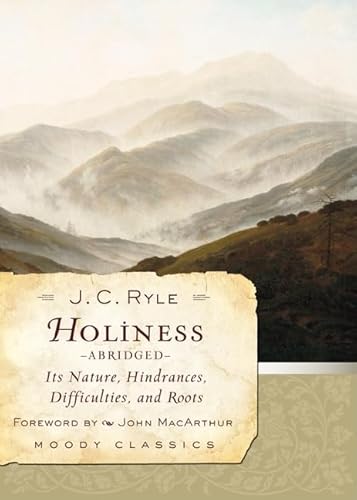
Now with a new foreword by John MacArthur.<br/><br/>J.C. Ryle's Holiness has imparted a standing challenge to Christians for 130 years. In this new, slimmed-down series of excerpts from Ryle's masterwork, we aim to present his original message to a whole new generation. Holiness, Ryle argued, was not simply a matter of believing and feeling, but of doing.
Die Inhaltsangabe kann sich auf eine andere Ausgabe dieses Titels beziehen.
Über die Autorin bzw. den Autor
JOHN CHARLES RYLE (1816-1900) was born in Cheshire County, England. He attended Eton and then went on to Oxford, finishing his Oxford studies in 1837. In 1841 Ryle was ordained as a minister in the Anglican Church, and in 1880 he was named the first Bishop of Liverpool. Throughout his ministry he became known and beloved as a defender of the evangelical reformed faith.
Auszug. © Genehmigter Nachdruck. Alle Rechte vorbehalten.
Holiness
Its Nature, Hindrances, Difficulties, and RootsBy J. C. RyleMoody Publishers
Copyright © 2010 The Moody Bible Institute Of ChicagoAll right reserved.
ISBN: 978-0-8024-5455-3
Contents
Foreword......................................7Biographical Introduction.....................151. Sin........................................192. Sanctification.............................453. Holiness...................................794. The Fight..................................1095. The Cost...................................1376. Growth.....................................1637. The Ruler of the Waves.....................1918. "Lovest Thou Me?"..........................2259. "Christ Is All"............................247
Chapter One
Sin* * *
"Sin is the transgression of the law." (1 John 3:4)
He who wishes to attain right views about Christian holiness must begin by examining the vast and solemn subject of sin. He must dig down very low if he would build high. A mistake here is most mischievous. Wrong views about holiness are generally traceable t{} wrong views about human corruption. I make no apology for beginning this volume about holiness by making some plain statements about sin.
The plain truth is that a right knowledge of sin lies at the root of all saving Christianity. Without it such doctrines as justification, conversion, sanctification, are "words and names" that convey no meaning to the mind. The first thing, therefore, that God does when He makes anyone a new creature in Christ is to send light into his heart and show him that he is a guilty sinner. The material creation in Genesis began with "light," and so also does the spiritual creation. God "shines into our hearts" by the work of the Holy Ghost, and then spiritual life begins (2 Cor. 4:6). Dim or indistinct views of sin are the origin of most of the errors, heresies, and false doctrines of the present day. If a man does not realize the dangerous nature of his soul's disease, you cannot wonder if he is content with false or imperfect remedies. I believe that one of the chief wants of the church has been, and is, clearer, fuller teaching about sin.
(1) I shall begin the subject by supplying some definition of sin. We are all of course familiar with the terms "sin" and "sinners." We talk frequently of "sin" being in the world, and of men committing "sins." But what do we mean by these terms and phrases? Do we really know? I fear there is much mental confusion and haziness on this point. Let me try, as briefly as possible, to supply an answer.
I say, then, that "sin," speaking generally, is, as the Ninth Article of our Church [the Church of England] declares, the fault and corruption of the nature of every man who is naturally engendered of the offspring of Adam; whereby man is very far gone [quam longissime is the Latin] from original righteousness, and is of his own nature inclined to evil, so that the flesh lusts always against the spirit; and, therefore, in every person born into the world, it deserves God's wrath and damnation.
Sin, in short, is that vast moral disease that affects the whole human race, of every rank, and class, and name, and nation, and people, and tongue; a disease from which there never was but one born of woman who was free. Need I say that One was Christ Jesus the Lord?
I say, furthermore, that "a sin," to speak more particularly, consists in doing, saying, thinking, or imagining, anything that is not in perfect conformity with the mind and law of God. "Sin," in short, as the Scripture says, is "the transgression of the law" (1 John 3:4). The slightest outward or inward departure from absolute mathematical parallelism with God's revealed will and character constitutes a sin, and at once makes us guilty in God's sight.
Of course I need not tell anyone who reads his Bible with attention, that a man may break God's law in heart and thought, when there is no overt and visible act of wickedness. Our Lord has settled that point beyond dispute in the Sermon on the Mount (Matt. 5:21-28). Even a poet of our own has truly said, "A man may smile and smile, and be a villain."
Again, I need not tell a careful student of the New Testament that there are sins of omission as well as commission, and that we sin, as our Prayer Book justly reminds us, by "leaving undone the things we ought to do," as really as by "doing the things we ought not to do." The solemn words of our Master in the Gospel of St. Matthew place this point also beyond dispute. It is there written, "Depart, ye cursed, into everlasting fire"; "for I was an hungered, and ye gave me no meat; I was thirsty, and ye gave me no drink" (Matt. 25:41-42). It was a deep and thoughtful saying of holy Archbishop Ussher, just before he died-"Lord, forgive me all my sins, and specially my sins of omission."
But I do think it necessary in these times to remind my readers that a man may commit sin and yet be ignorant of it, and fancy himself innocent when he is guilty. I fail to see any scriptural warrant for the modern assertion that "Sin is not sin to us until we discern it and are conscious of it." On the contrary, in the fourth and fifth chapters of that unduly neglected book, Leviticus, and in the fifteenth of Numbers, I find Israel distinctly taught that there were sins of ignorance, which rendered people unclean, and needed atonement (Lev. 4:1-35; 5:14-19; Num. 15:25-29). And I find our Lord expressly teaching that "the servant who knew not his master's will and did it not" was not excused on account of his ignorance, but was "beaten" or punished (Luke 12:48). We shall do well to remember that when we make our own miserably imperfect knowledge and consciousness the measure of our sinfulness, we are on very dangerous ground. A deeper study of Leviticus might do us much good.
(2) Concerning the origin and source of this vast moral disease called "sin," I must say something. I fear the views of many professing Christians on this point are sadly defective and unsound. I dare not pass it by. Let us, then, have it fixed down in our minds that the sinfulness of man does not begin from without, but from within. It is not the result of bad training in early years. It is not picked up from bad companions and bad examples, as some weak Christians are too fond of saying. No! it is a family disease, which we all inherit from our first parents, Adam and Eve, and with which we are born. Created "in the image of God," innocent and righteous at first, our parents fell from original righteousness and became sinful and corrupt. And from that day to this all men and women are born in the image of fallen Adam and Eve, and inherit a heart and nature inclined to evil. "By one man sin entered into the world." "That which is born of the flesh is flesh." "We are by nature children of wrath." "The carnal mind is enmity against God." "Out of the heart [naturally as out of a fountain] proceed evil thoughts, adulteries," and the like (Rom. 5:12; John 3:6; Eph. 2:3; Rom. 8:7; Mark 7:21). The fairest babe who has entered life this year, and become the sunbeam of a family, is not, as its mother perhaps fondly calls it, a little "angel," or a little "innocent," but a little "sinner." Alas! as it lies smiling and crowing in its cradle, that little creature carries in its heart the seeds of every kind of wickedness! Only watch it carefully, as it grows in stature and its mind develops, and you will soon detect in it an incessant tendency to that which is bad, and a backwardness to that which is good. You will see in it the buds and germs of deceit, evil temper, selfishness, self-will, obstinacy, greediness, envy, jealousy, passion, which, if indulged and let alone, will shoot up with painful rapidity. Who taught the child these things? Where did he learn them? The Bible alone can answer these questions! Of all the foolish things that parents say about their children there is none worse than the common saying, "My son has a good heart at the bottom. He is not what he ought to be; but he has fallen into bad hands. Public schools are bad places. The tutors neglect the boys. Yet he has a good heart at the bottom." The truth, unhappily, is diametrically the other way. The first cause of all sin lies in the natural corruption of the boy's own heart, and not in the school.
(3) Concerning the extent of this vast moral disease of man called sin, let us beware that we make no mistake. The only safe ground is that which is laid for us in Scripture. "Every imagination of the thoughts of his heart" is by nature evil and that "continually." "The heart is deceitful above all things, and desperately wicked" (Gen. 6:5; Jet. 17:9). Sin is a disease that pervades and runs through every part of our moral constitution and every faculty of our minds. The understanding, the affections, the reasoning powers, the will, are all more or less infected. Even the conscience is so blinded that it cannot be depended on as a sure guide, and is as likely to lead men wrong as right, unless it is enlightened by the Holy Ghost. In short, "from the sole of the foot even unto the head there is no soundness" about us (Isa. 1:6). The disease may be veiled under a thin covering of courtesy, politeness, good manners, and outward decorum; but it lies deep down in the constitution.
I admit fully that man has many grand and noble faculties left about hint, and that in arts and sciences and literature he shows immense capacity. But the fact still remains that in spiritual things he is utterly "dead," and has no natural knowledge, or love, or fear of God. His best things are so interwoven and intermingled with corruption, that the contrast only brings out into sharper relief the truth and extent of the Fall. That one and the same creature should be in some things so high and in others so low-so great and yet so little-so noble and yet so mean-so grand in his conception and execution of material things, and yet so groveling and debased in his affections-that he should be able to plan and erect buildings like those at Carnac and Luxor in Egypt, and the Parthenon at Athens, and yet worship vile gods and goddesses, and birds, and beasts, and creeping things-that he should be able to produce tragedies like those of Aeschylus and Sophocles, and histories like that of Thucydides, and yet be a slave to abominable vices like those described in the first chapter of the Epistle to the Romans-all this is a sore puzzle to those who sneer at "God's Word written," and scoff at us as bibliolaters. But it is a knot that we can untie with the Bible in our hands. We can acknowledge that man has all the marks of a majestic temple about him-a temple in which God once dwelt, but a temple that is now in utter ruins-a temple in which a shattered window here, and a doorway there, and a column there, still give some faint idea of the magnificence of the original design, but a temple that from end to end has lost its glory and fallen from its high estate. And we say that nothing solves the complicated problem of man's condition but the doctrine of original or birth-sin and the crushing effects of the Fall.
Let us remember, besides this, that every part of the world bears testimony to the fact that sin is the universal disease of all mankind. Search the globe from east to west and from pole to pole-search every nation of every clime in the four quarters of the earth-search every rank and class in our own country from the highest to the lowest-and under every circumstance and condition, the report will be always the same. The remotest islands in the Pacific Ocean, completely separate from Europe, Asia, Africa, and America, beyond the reach alike of Oriental luxury and Western arts and literature-islands inhabited by people ignorant of books, money, steam, and gunpowder-uncontaminated by the vices of modern civilization, these very islands have always been found, when first discovered, the abode of the vilest forms of lust, cruelty, deceit, and superstition. If the inhabitants have known nothing else, they have always known how to sin! Everywhere the human heart is naturally "deceitful above all things, and desperately wicked" (Jer. 17:9). For my part, I know no stronger proof of the inspiration of Genesis and the Mosaic account of the origin of man, than the power, extent, and universality of sin. Grant that mankind have all sprung from one pair, and that this pair fell (as Gen. 3 tells us), and the state of human nature everywhere is easily accounted for. Deny it, as many do, and you are at once involved in inexplicable difficulties. In a word, the uniformity and universality of human corruption supply one of the most unanswerable instances of the enormous "difficulties of atheism."
After all, I am convinced that the greatest proof of the extent and power of sin is the pertinacity with which it cleaves to man even after he is converted and has become the subject of the Holy Ghost's operations. To use the language of the Ninth Article, "this infection of nature doth remain-yea, even in them that are regenerate." So deeply planted are the roots of human corruption, that even after we are born again, renewed, "washed, sanctified, justified," and made living members of Christ, these roots remain alive in the bottom of our hearts, and, like the leprosy in the walls of the house, we never get rid of them until the earthly house of this tabernacle is dissolved. Sin, no doubt, in the believer's heart, has no longer dominion. It is checked, controlled, mortified, and crucified by the expulsive power of the new principle of grace. The life of a believer is a life of victory and not of failure. But the very struggles that go on within his bosom, the fight that he finds it needful to fight daily, the watchful jealousy that he is obliged to exercise over his inner man, the contest between the flesh and the spirit, the inward "groanings" that no one knows but he who has experienced them-all, all testify to the same great truth, all show the enormous power and vitality of sin. Mighty indeed must that foe be who even when crucified is still alive! Happy is that believer who understands it, and while he rejoices in Christ Jesus has no confidence in the flesh; and while he says, "Thanks be unto God who giveth us the victory," never forgets to watch and pray lest he fall into temptation!
(4) Concerning the guilt, vileness, and offensiveness of sin in the sight of God, my words shall be few. I say "few" advisedly. I do not think, in the nature of things, that mortal man can at all realize the exceeding sinfulness of sin in the sight of that holy and perfect One with whom we have to do. On the one hand, God is that eternal Being who "chargeth his angels with folly," and in whose sight the very "heavens are not clean." He is One who reads thoughts and motives as well as actions, and requires "truth in the inward parts" (Job 4:18; 15:15; Ps. 51:6). We, on the other hand-poor blind creatures, here today and gone tomorrow, born in sin, surrounded by sinners, living in a constant atmosphere of weakness, infirmity, and imperfection-can form none but the most inadequate conceptions of the hideousness of evil. We have no line to fathom it, and no measure by which to gauge it. The blind man can see no difference between a masterpiece of Titian or Raphael and the Queen's head on a village signboard. The deaf man cannot distinguish between a penny whistle and a cathedral organ. The very animals whose smell is most offensive to us have no idea that they are offensive, and are not offensive to one another. And man, fallen man, I believe, can have no just idea what a vile thing sin is in the sight of that God whose handiwork is absolutely perfect-perfect whether we look through telescope or microscope perfect in the formation of a mighty planet like Jupiter, with his satellites, keeping time to a second as he rolls round the sun-perfect in the formation of the smallest insect that crawls over a foot of ground. But let us nevertheless settle it firmly in our minds that sin is "the abominable thing that God hates"-that God "is of purer eyes than to behold iniquity, and cannot look upon that which is evil"-that the least transgression of God's law makes us "guilty of all"-that "the soul that sinneth shall die"-that "the wages of sin is death"-that God shall "judge the secrets of men"-that there is a worm that never dies, and a fire that is not quenched that "the wicked shall be turned into hell" and "shall go away into everlasting punishment"-and that "nothing that defiles shall in any wise enter heaven" (Jer. 44:4; Hab. 1:13; James 2:10; Ezek. 18:4; Rom. 6:23; 2:16; Mark 9:44; Ps. 9:17; Matt. 25:46; Rev. 21:27). These are indeed tremendous words, when we consider that they are written in the book of a most merciful God!
No proof of the fullness of sin, after all, is so overwhelming and unanswerable as the cross and passion of our Lord Jesus Christ, and the whole doctrine of His substitution and atonement. Terribly black must that guilt be for which nothing but the blood of the Son of God could make satisfaction. Heavy must that weight of human sin be that made Jesus groan and sweat drops of blood in agony at Gethsemane, and cry at Golgotha, "My God, my God, why hast thou forsaken me?" (Matt. 27:46). Nothing, I am convinced, will astonish us so much, when we awake in the resurrection day, as the view we shall have of sin, and the retrospect we shall take of our own countless shortcomings and defects. Never till the hour when Christ comes the second time shall we fully realize the "sinfulness of sin." Well might George Whitefield say, "The anthem in heaven will be, What hath God wrought!"
(Continues...)
Excerpted from Holinessby J. C. Ryle Copyright © 2010 by The Moody Bible Institute Of Chicago. Excerpted by permission.
All rights reserved. No part of this excerpt may be reproduced or reprinted without permission in writing from the publisher.
Excerpts are provided by Dial-A-Book Inc. solely for the personal use of visitors to this web site.
„Über diesen Titel“ kann sich auf eine andere Ausgabe dieses Titels beziehen.
Suchergebnisse für Holiness (Abridged): Its Nature, Hindrances, Difficulties,...

Beispielbild für diese ISBN
Holiness (Abridged) : Its Nature, Hindrances, Difficulties, and Roots
Anbieter: Better World Books, Mishawaka, IN, USA
Verkäuferbewertung 5 von 5 Sternen

Zustand: Good. Pages intact with minimal writing/highlighting. The binding may be loose and creased. Dust jackets/supplements are not included. Stock photo provided. Product includes identifying sticker. Better World Books: Buy Books. Do Good. Artikel-Nr. 9185250-6
Gebraucht kaufen
EUR 6,56
Versand gratis
Versand innerhalb von USA
Versand innerhalb von USA
Anzahl: 1 verfügbar
Beispielbild für diese ISBN
Holiness (Abridged) : Its Nature, Hindrances, Difficulties, and Roots
Anbieter: Better World Books: West, Reno, NV, USA
Verkäuferbewertung 5 von 5 Sternen
Zustand: Good. Pages intact with minimal writing/highlighting. The binding may be loose and creased. Dust jackets/supplements are not included. Stock photo provided. Product includes identifying sticker. Better World Books: Buy Books. Do Good. Artikel-Nr. 9185250-6
Gebraucht kaufen
EUR 6,56
Versand gratis
Versand innerhalb von USA
Versand innerhalb von USA
Anzahl: 1 verfügbar
Beispielbild für diese ISBN
Holiness (Abridged)
Anbieter: World of Books (was SecondSale), Montgomery, IL, USA
Verkäuferbewertung 5 von 5 Sternen
Paperback. Zustand: Very Good. In Holiness, JC Ryle speaks to the heart and soul of every man. In a winning, approachable style, he wields the sword of the Spirit like a skillful surgeon, piercing to the division of soul and spirit, of joints and marrow. JC Ryle addresses hard and trying subjects which most modern evangelicals have chosen to ignore: the power and depth of indwelling sin, the necessity of holiness, the struggle and fight of faith, counting the cost of following Christ. and that's only in the first 5 chapters JC Ryle's treatment of the texts which head the chapters is based on plain interpretation, common-sense exegesis and practical application. He does not side-step the difficult issues, but takes them head on, making Christian theology and the principles of holiness seem so simple, obvious and straight-forward that readers will wonder what other Bible truths they've been missing all these years. Christian, read JC Ryle. You will not regret it. He is a man who first and foremost loved the Lord Jesus Christ. This is the vital center of all his teaching and writing and the sole reason for his great power in ministry. Whether you are an erudite scholar or a hard-laboring farmer, a pastor or a layman, a spiritual elder or a babe in Christ--no matter where you are--JC Ryle's writings on holiness are for you. The love of Christ and the faith of this great 18th century saint cling to every page like an aromatic perfume. Artikel-Nr. 00108495183
Gebraucht kaufen
EUR 8,48
Versand gratis
Versand innerhalb von USA
Versand innerhalb von USA
Anzahl: 2 verfügbar
Beispielbild für diese ISBN
Holiness (Abridged)
Anbieter: PBShop.store US, Wood Dale, IL, USA
Verkäuferbewertung 5 von 5 Sternen
PAP. Zustand: New. New Book. Shipped from UK. Established seller since 2000. Artikel-Nr. GB-9780802454553
Beispielbild für diese ISBN
Holiness (Abridged)
Anbieter: PBShop.store UK, Fairford, GLOS, Vereinigtes Königreich
Verkäuferbewertung 5 von 5 Sternen
PAP. Zustand: New. New Book. Shipped from UK. Established seller since 2000. Artikel-Nr. GB-9780802454553
Neu kaufen
EUR 13,29
EUR 4,96 Versand
Versand von Vereinigtes Königreich nach USA
Versand von Vereinigtes Königreich nach USA
Anzahl: 2 verfügbar
Beispielbild für diese ISBN
Holiness Abridged PB (Moody Classics): Its Nature, Hindrances, Difficulties, and Roots
Anbieter: WorldofBooks, Goring-By-Sea, WS, Vereinigtes Königreich
Verkäuferbewertung 5 von 5 Sternen
Paperback. Zustand: Very Good. The book has been read, but is in excellent condition. Pages are intact and not marred by notes or highlighting. The spine remains undamaged. Artikel-Nr. GOR009708845
Gebraucht kaufen
EUR 16,22
EUR 6,68 Versand
Versand von Vereinigtes Königreich nach USA
Versand von Vereinigtes Königreich nach USA
Anzahl: 1 verfügbar
Beispielbild für diese ISBN
Holiness: Its Nature, Hindrances, Difficulties, and Roots
Anbieter: Revaluation Books, Exeter, Vereinigtes Königreich
Verkäuferbewertung 5 von 5 Sternen
Paperback. Zustand: Brand New. abridged edition. 276 pages. 7.00x5.00x0.75 inches. In Stock. Artikel-Nr. __0802454550
Neu kaufen
EUR 11,22
EUR 11,93 Versand
Versand von Vereinigtes Königreich nach USA
Versand von Vereinigtes Königreich nach USA
Anzahl: 2 verfügbar
Beispielbild für diese ISBN
Holiness: Its Nature, Hindrances, Difficulties, and Roots
Anbieter: Revaluation Books, Exeter, Vereinigtes Königreich
Verkäuferbewertung 5 von 5 Sternen
Paperback. Zustand: Brand New. abridged edition. 276 pages. 7.00x5.00x0.75 inches. In Stock. Artikel-Nr. xr0802454550
Neu kaufen
EUR 13,17
EUR 11,93 Versand
Versand von Vereinigtes Königreich nach USA
Versand von Vereinigtes Königreich nach USA
Anzahl: 1 verfügbar
Beispielbild für diese ISBN
Holiness (Abridged): Its Nature, Hindrances, Difficulties, and Roots (Moody Classics)
Anbieter: Kennys Bookstore, Olney, MD, USA
Verkäuferbewertung 5 von 5 Sternen
Zustand: New. . 2010. Abridged. Paperback. . . . . Books ship from the US and Ireland. Artikel-Nr. V9780802454553
Neu kaufen
EUR 16,12
EUR 9,36 Versand
Versand innerhalb von USA
Versand innerhalb von USA
Anzahl: 2 verfügbar
Beispielbild für diese ISBN
Holiness (Abridged): Its Nature, Hindrances, Difficulties, and Roots (Moody Classics)
Anbieter: Ria Christie Collections, Uxbridge, Vereinigtes Königreich
Verkäuferbewertung 5 von 5 Sternen
Zustand: New. In English. Artikel-Nr. ria9780802454553_new
Neu kaufen
EUR 15,38
EUR 11,17 Versand
Versand von Vereinigtes Königreich nach USA
Versand von Vereinigtes Königreich nach USA
Anzahl: 2 verfügbar