
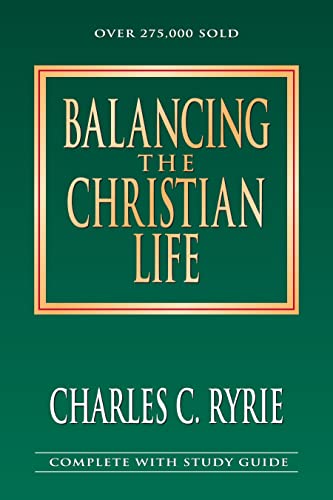
Inhaltsangabe
Genuine and wholesome spirituality is the goal of all Christian living. It sounds so simple, doesn't it?
Perhaps the principle may be, but living by the principle is another matter altogether. In Balancing the Christian Life, Charles Ryrie reminds you that "the Bible must be the guide and test for all our experiences in the spiritual life... and if any experience fails to pass that test, it must be discarded." He warns that "an unbalanced application of the doctrines related to spirituality will result in an unbalanced Christian life."
Ryrie examines numerous key issues of spirituality, including:
- The old and the new life
- Sanctification
- Using your gifts
- Routine faithfulness
- Wiles of the Devil
- Temptation
- Confession
- Forgiveness
For more than 40 years, Balancing the Christian Life has been changing lives worldwide. Take time to read this classic study and allow it to change yours.
Includes a 32-page study guide.
Die Inhaltsangabe kann sich auf eine andere Ausgabe dieses Titels beziehen.
Über die Autorin bzw. den Autor
CHARLES C. RYRIE (A.B., Haverford College; Th.M. and Th.D., Dallas Theological Seminary; Ph.D., University of Edinburgh; Litt.D., Liberty Baptist Theological Seminary) was a renowned author and scholar. He wrote numerous books, including The Ryrie Study Bible, Basic Theology, Balancing the Christian Life, The Holy Spirit, Dispensationalism Today, Revelation, Survey of Bible Doctrine, and So Great Salvation, which rank among his best-selling titles.
Auszug. © Genehmigter Nachdruck. Alle Rechte vorbehalten.
Balancing the Christian Life
By Charles C. RyrieMoody Publishers
Copyright © 1994 The Moody Bible Institute of Chicago
All rights reserved.
ISBN: 978-0-8024-0887-7All rights reserved.
Contents
Publisher's Preface to the 25th Anniversary Edition,
Part 1: SOME BIBLICAL CONCEPTS,
CHAPTER,
1. A Proposition,
2. What Is Spirituality?,
3. What Is Man?,
4. The Old and the New,
5. United with Christ,
Part 2: SOME PERSONAL RESPONSIBILITIES,
6. How Are We Sanctified?,
7. Dedication,
8. Money and the Love of God,
9. Using Your Gifts,
10. Routine Faithfulness,
Part 3: SOME PRACTICAL PROBLEMS,
11. How Can I Know If I Am Filled with the Spirit?,
12. The Wiles of the Devil,
13. Temptation,
14. Confessing and Forgiving,
15. Legal or Legalistic?,
16. Should I Seek to Speak in Tongues?,
17. Must Christ Be Lord to Be Savior?,
18. The Balanced Christian Life,
Study Guide,
Selected Scripture Index,
CHAPTER 1
A PROPOSITION
HERE IS A BASIC PROPOSAL or, if you wish, the thesis of this book: Genuine and wholesome spirituality is the goal of all Christian living.
It is possible that the very simplicity of the proposition might either deceive or at the least fail to make a proper impression on the one who reads it; so let us examine its key words.
By the word genuine I mean biblical, for only in the Bible do we have truth that is indisputably reliable. For this reason, the Bible must be the guide and test for all of our experiences in the spiritual life, for biblical spirituality is the only genuine spirituality. The practical importance of this is simply that all experiences of the spiritual life must be tested by biblical truth, and if any experience, no matter how real it may have been, fails to pass that test, it must be discarded. Of course, this is much easier said than done, but it is the only road to genuine or biblical spirituality.
A second key word in the original proposition is the word wholesome. By wholesome I mean balanced. There is nothing more devastating to the practice of spiritual living than an imbalance. One of my former teachers repeatedly reminded us that an imbalance in theology was the same as doctrinal insanity. The same applies to the realm of Christian living. An unbalanced application of the doctrines related to biblical spirituality will result in an unbalanced Christian life. Too much emphasis on the mystical may obscure the practicality of spiritual living, while an overemphasis on practicality may result in a lack of vision. A constant reiteration of the need for repeated rededications could lead to a stagnant Christian life in which there is no consistent and substantial growth. An overemphasis on confession could cause unhealthy introspection, while an under-emphasis might tend to make one insensitive to sin. Balance is the key to a wholesome spiritual life.
If this is to be a book about spirituality, it is necessary at the outset to consider some general features of the word spiritual. The word is, of course, built on the root word for spirit and thus means "pertaining to spirit". Actually it has a rather wide range of uses, all of which are consistent with this basic idea of pertaining to spirit. (1) In one instance (Eph. 6:12) the word spiritual is used of the demonic hosts who, as spirit beings, are distinct from human beings. (2) In another usage the Mosaic Law is characterized as being spiritual (Rom. 7:14). This reference indicates that the law was intended to have prospered the spiritual life of the Israelites to whom it was given. (3) The future resurrection body of the believer is termed a spiritual body in contrast to the natural body which he has until death (1 Cor. 15:44). The use of the word in this connection forbids defining the word only in terms of the incorporeal. The spiritual body is one which like the Lord's after His resurrection has flesh and bones but which is of a new and different resurrection quality (Luke 24:39).
Furthermore, (4) a rather wide range of activities and relationships of the believer are called spiritual. His ministry is discharged through the exercise of spiritual gifts which are bestowed by the Holy Spirit (Rom. 1:11; 1 Cor. 12:1; 14:1). The unity of all Christians as stones in the building is designated a spiritual house by Peter who also states that believers are to offer up spiritual sacrifices acceptable to God (1 Peter 2:5). The sustenance of the children of Israel was called spiritual meat and drink, and Christ is designated the spiritual "Rock" that followed them (1 Cor. 10:3–4). The Christian expresses his praise in songs, hymns and spiritual songs (Col. 3:16). His mind is to be filled with spiritual wisdom (Col. 1:9), and his position in the heavenlies includes having been blessed with all spiritual blessings (Eph. 1:3).
However, a distinctive use (5) in the New Testament of the word spiritual is in connection with the believer's growth and maturing in the Christian life. A spiritual man must first of all be one who has experienced the regenerating work of the Holy Spirit giving him a new life in Christ. The Apostle Paul contrasts the spiritual man with the natural man (1 Cor. 2:14–15), who, having not the Holy Spirit, is apparently an unregenerate individual (cf. Jude 19). But spirituality involves more than regeneration, and it is the purpose of this book to discuss these matters. This will of necessity involve studying certain doctrines of the Bible. Without this basis our conclusions might not lead to genuine spirituality. It will also demand consideration of certain individual responsibilities and practical problems in the outworking of biblical truth in the life in a balanced way. Too, it will be helpful to consider some contemporary misemphases in order to avoid the same pitfalls and in order to bring the truth into sharper focus. All of these matters should give a proper perspective on biblical spirituality.
It goes without saying (or does it?) that a subject like this one especially requires the teaching ministry of the Holy Spirit if it is to be learned fruitfully. Here is an area in which the need for proper balance can be illustrated. Some seem to feel that the teaching ministry of the Spirit overrides the need for study, while others conclude the sufficient study eliminates the need for the teaching ministry of the Spirit. The ministry of the Holy Spirit in teaching the truth of God is indispensable. But the Scriptures which speak of it (John 16:13; 1 Cor. 2:12) do not say that this ministry is always direct. In fact, nothing is said about the means the Spirit may use in order to teach us. It may be direct, as one quietly meditates on a passage, but it may also be through intermediate means. Some of these means are the books of men, the teachers given to the church, concordances and even English dictionaries. Ultimately, it is the Spirit who does the teaching whether He chooses to use intermediate means or not. And He must do it if we are to grasp the truth.
CHAPTER 2WHAT IS SPIRITUALITY?
ODDLY ENOUGH, the concept of spirituality, though the subject of much preaching, writing and discussion, is seldom defined. Usually anything that approaches a definition merely describes the characteristics of spirituality, but one searches in vain for a concise definition of the concept itself. The reason for this is that the concept includes several factors, and it is not easy to weave these together into a balanced definition. Too, the only verse in the Bible that...
„Über diesen Titel“ kann sich auf eine andere Ausgabe dieses Titels beziehen.
Weitere beliebte Ausgaben desselben Titels

Suchergebnisse für Balancing the Christian Life

Beispielbild für diese ISBN
Balancing the Christian Life: A Survey of Spiritual Disciplines
Anbieter: ThriftBooks-Dallas, Dallas, TX, USA
Verkäuferbewertung 5 von 5 Sternen

Paperback. Zustand: Good. No Jacket. Pages can have notes/highlighting. Spine may show signs of wear. ~ ThriftBooks: Read More, Spend Less. Artikel-Nr. G0802408877I3N00
Gebraucht kaufen
EUR 5,57
Versand gratis
Versand innerhalb von USA
Versand innerhalb von USA
Anzahl: 2 verfügbar
Beispielbild für diese ISBN
Balancing the Christian Life: A Survey of Spiritual Disciplines
Anbieter: ThriftBooks-Reno, Reno, NV, USA
Verkäuferbewertung 5 von 5 Sternen
Paperback. Zustand: Very Good. No Jacket. May have limited writing in cover pages. Pages are unmarked. ~ ThriftBooks: Read More, Spend Less. Artikel-Nr. G0802408877I4N00
Gebraucht kaufen
EUR 5,57
Versand gratis
Versand innerhalb von USA
Versand innerhalb von USA
Anzahl: 1 verfügbar
Beispielbild für diese ISBN
Balancing the Christian Life: A Survey of Spiritual Disciplines
Anbieter: ThriftBooks-Reno, Reno, NV, USA
Verkäuferbewertung 5 von 5 Sternen
Paperback. Zustand: Good. No Jacket. Pages can have notes/highlighting. Spine may show signs of wear. ~ ThriftBooks: Read More, Spend Less. Artikel-Nr. G0802408877I3N00
Gebraucht kaufen
EUR 5,57
Versand gratis
Versand innerhalb von USA
Versand innerhalb von USA
Anzahl: 2 verfügbar
Beispielbild für diese ISBN
Balancing the Christian Life: A Survey of Spiritual Disciplines
Anbieter: ThriftBooks-Phoenix, Phoenix, AZ, USA
Verkäuferbewertung 5 von 5 Sternen
Paperback. Zustand: Very Good. No Jacket. May have limited writing in cover pages. Pages are unmarked. ~ ThriftBooks: Read More, Spend Less. Artikel-Nr. G0802408877I4N00
Gebraucht kaufen
EUR 5,57
Versand gratis
Versand innerhalb von USA
Versand innerhalb von USA
Anzahl: 1 verfügbar
Beispielbild für diese ISBN
Balancing the Christian Life: A Survey of Spiritual Disciplines
Anbieter: ThriftBooks-Dallas, Dallas, TX, USA
Verkäuferbewertung 5 von 5 Sternen
Paperback. Zustand: Fair. No Jacket. Readable copy. Pages may have considerable notes/highlighting. ~ ThriftBooks: Read More, Spend Less. Artikel-Nr. G0802408877I5N00
Gebraucht kaufen
EUR 5,57
Versand gratis
Versand innerhalb von USA
Versand innerhalb von USA
Anzahl: 1 verfügbar
Beispielbild für diese ISBN
Balancing the Christian Life: A Survey of Spiritual Disciplines
Anbieter: ThriftBooks-Dallas, Dallas, TX, USA
Verkäuferbewertung 5 von 5 Sternen
Paperback. Zustand: Very Good. No Jacket. May have limited writing in cover pages. Pages are unmarked. ~ ThriftBooks: Read More, Spend Less. Artikel-Nr. G0802408877I4N00
Gebraucht kaufen
EUR 5,57
Versand gratis
Versand innerhalb von USA
Versand innerhalb von USA
Anzahl: 1 verfügbar
Beispielbild für diese ISBN
Balancing the Christian Life: A Survey of Spiritual Disciplines
Anbieter: ThriftBooks-Atlanta, AUSTELL, GA, USA
Verkäuferbewertung 5 von 5 Sternen
Paperback. Zustand: Good. No Jacket. Pages can have notes/highlighting. Spine may show signs of wear. ~ ThriftBooks: Read More, Spend Less. Artikel-Nr. G0802408877I3N00
Gebraucht kaufen
EUR 5,57
Versand gratis
Versand innerhalb von USA
Versand innerhalb von USA
Anzahl: 2 verfügbar
Beispielbild für diese ISBN
Balancing the Christian Life: A Survey of Spiritual Disciplines
Anbieter: ThriftBooks-Phoenix, Phoenix, AZ, USA
Verkäuferbewertung 5 von 5 Sternen
Paperback. Zustand: Good. No Jacket. Pages can have notes/highlighting. Spine may show signs of wear. ~ ThriftBooks: Read More, Spend Less. Artikel-Nr. G0802408877I3N00
Gebraucht kaufen
EUR 5,57
Versand gratis
Versand innerhalb von USA
Versand innerhalb von USA
Anzahl: 1 verfügbar
Beispielbild für diese ISBN
Balancing the Christian Life: A Survey of Spiritual Disciplines
Anbieter: ThriftBooks-Atlanta, AUSTELL, GA, USA
Verkäuferbewertung 5 von 5 Sternen
Paperback. Zustand: Very Good. No Jacket. May have limited writing in cover pages. Pages are unmarked. ~ ThriftBooks: Read More, Spend Less. Artikel-Nr. G0802408877I4N00
Gebraucht kaufen
EUR 5,57
Versand gratis
Versand innerhalb von USA
Versand innerhalb von USA
Anzahl: 1 verfügbar
Beispielbild für diese ISBN
Balancing the Christian Life
Anbieter: Better World Books, Mishawaka, IN, USA
Verkäuferbewertung 5 von 5 Sternen
Zustand: Good. 25 Anv. Pages intact with minimal writing/highlighting. The binding may be loose and creased. Dust jackets/supplements are not included. Stock photo provided. Product includes identifying sticker. Better World Books: Buy Books. Do Good. Artikel-Nr. GRP102277089
Gebraucht kaufen
EUR 5,64
Versand gratis
Versand innerhalb von USA
Versand innerhalb von USA
Anzahl: 3 verfügbar