
Verwandte Artikel zu Amy Carmichael: Let the Little Children Come
Inhaltsangabe
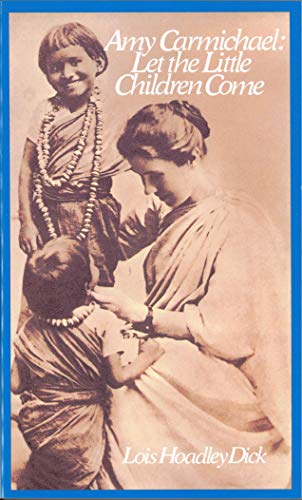
Arriving in India, Amy Carmichael sees little children married to pagan priests for temple prostitution. Amy rescues these children and provides a safe, healthy home for them.
Die Inhaltsangabe kann sich auf eine andere Ausgabe dieses Titels beziehen.
Über die Autorin bzw. den Autor
LOIS DICK is a freelance writer with over thirty years of experience. She specializes in historical biography. In addition to numerous articles and lessons for such organizations as Child Evangelism Fellowship, Inc., she is the author of several books, including Mercy at Midnight, False Coin, True Coin, Isobel Kuhn, Devil on the Deck, and Amy Carmichael. Lois resides in New Jersey.
Auszug. © Genehmigter Nachdruck. Alle Rechte vorbehalten.
Amy Carmichael: Let the Little Children Come
By Lois Hoadley DickMoody Publishers
Copyright © 1984 The Moody Bible Institute of Chicago
All rights reserved.
ISBN: 978-0-8024-0433-6All rights reserved.
Contents
Publisher's Preface,
Preface,
Introduction,
1. The Mine (1895-1897, India),
2. The Miner (1867-1888, Ireland, England, Japan),
3. The Keeper of the Jewels (Five thousand years of Hinduism),
4. The Search for the Jewels (1901-1904, India),
5. Jewels Stripped Off (1899, India),
6. Jewels of Victory (1899, India),
7. Broken Jewels (1915-1927, The years of public outcry),
8. A Choice Jewel (1902-1938, Dohnavur's growth),
9. Polishing the Jewels (1902-1929, The Father's children),
10. Jewels of the Ledger (1900-1935, The Father's provision),
11. Crown Jewels (1900-1935, The Father's silence),
12. The Jeweler (1931-1951, The Father's plan),
Significant Dates,
Glossary,
Sources,
CHAPTER 1
The Mine
1895-1897, India
She was five years old, and she wanted her mother. Light-skinned and pretty, with a mop of black curly hair, she was a high-caste child living in the temple women's house next door to the powerful bastion whose heavy carved door was the gate to hell for hundreds of little ones inside. She had enormous, perfectly round eyes like a deep-water pearl, and so she was called Pearleyes.
The temple was in a village called Perungulam, dedicated to the worship of the god Perumal. Shut away behind closed doors, Pearleyes was given picture books to look at, scenes of the vileness and depravity, and when she pushed them away the temple woman beat her soft shoulders with a stick.
But she was only five years old, and she wanted to go home to Tuticorin, twenty miles away. Watching her chance, she ran out into the street one day when the door was accidentally left open by a careless servant, but the temple woman was swiftly beside her. "Aiyo! Ungrateful one! Should a servant of the gods run about in the streets?"
And because it was not the first time she had disobeyed, she was dragged into the courtyard, where the woman heated an iron rod in the flame and branded her on the back of both hands.
Pearleyes lay on her mat that night, and even though another temple woman rubbed some oil on the burns, she cried. But her cry was only one in many thousands, for this was India.
India, turning the corner into the twentieth century, was little different from India through almost five thousand years of history. On the surface were colorful layers of tapestry but underneath—the mud floor and muck and dark corners and crawling things. To a new arrival, India was hot, dry air that parched the throat, filling the mouth with dust that could neither be swallowed nor coughed up.
India was a mosaic of scenes. Early morning with the sun's rays splayed out, scintillating over the marketplace, where streets teemed with noisome life, stinking of garbage, ginger, goat urine, the vendors' smoky food, incense, sweat, hot curry. A bewitchment of color. Lavish, inflammatory rug colors were set against a background of dullest squalor. Shopkeepers spilled out wares into the streets: Watery sweets speckled with flies. Ivory carvings. Leather goods and brassware. Large, practical jugs in red and blue and earth colors, mounded to stack one atop the other. Turbans purpural. Rainbowed saris hung on racks, pretty as pink tinsel. Filigreed jewelry, glass bangles, and loops of silver; golden ornaments poured out without measure on a merchant's table. Amber, the size of knuckles, strung on thong. Carnelian. Jade drops, like liquid grass.
A snake charmer with a turban as huge as last week's laundry, offering to charm poisonous snakes out of old walls, sat cross-legged before a cobra, its hood spread, the creature rising and swaying from side to side, eyes following the piping flute of its owner.
Tired, bony cows jostled against people in the streets, their eyes stupid and full of hopeless resignation. A fungus-spread of wasted beggar bodies—bodies—bodies—skeletal bodies as far as eye could see. A vast, open-air morgue.
Beyond the marketplace sprawled the factories making cotton goods, built by the British East India Company, who also traded in indigo and spices. Hundreds of thousands of Indians lived on the company land.
In the countryside and villages, the leitmotiv of early morning in India was the pungent smell of burning fuel cakes and blue smoke. And the women squatting with spread-apart knees, patting the cow dung into wagon-wheel-sized slabs, storing them in batooras, eye-high rooms of baked clay.
In the south were palm trees and propagated rice cultivation—slips of plants pegged down for firm growth. Short, dark little people with curly hair, descendants of ancient Dravidians, threshed grain with bullocks or plowed with a wood stick near fields of sugar cane, flocks of goats, hawks overhead.
Millions of Untouchables—the outcastes—who "were all horrible sinners in eons past, deserving now neither help nor sympathy while they work out their curse," any Indian would explain.
India's temples, carved from solid rock, served as sermons in stone for 92 percent of the population who were illiterate, keeping alive the deeds (and misdeeds) of the holy ones—thirty million or so—as centuries flowed over them. Outwardly imposing and stolid with an ugly barbaric beauty, some of them, like the tower of a temple in Madras, depicted eight hundred life-like figures, astonishing the beholder with its workmanship.
A Brahmin pathologist, educated in European universities, gave his opinion of the temples: "As evil as the ooze of the riverbanks. I myself went within them to the point where one is obliged to take off one's shoes, because of sanctity. Beyond lay the shrines, rising out of the mud, decaying food, and human filth. I would not walk in it. I said, No! But hundreds of thousands do take off their shoes, walk in it, worship, walk out, and put their shoes upon their unwashed feet. And I, a Hindu and a doctor, must bear witness to that!"
There was civilization and Hinduism in India over four thousand years ago. The Vedic writings of religious ceremonies and sacrifices are as old as the book of Genesis. At the turn of the century, India still had no common language. Languages and dialects numbered more than 850.
India has always been a country of villages, 500,000 of them. Over 250 million people, at the time, lived in villages or cities. Seventy percent of the people were farmers.
Madras was a large, very old seaport on the east coast of India in the Bay of Bengal, founded in 1639 by the East India Company. In November 1895, a discouraged, confused, and ill young Irish woman, Amy Carmichael, arrived just in time for the coolness of the rainy season, when water poured as if from sluices from a gray, low-bellied sky. Steamers and brigs, fishing boats and dhows clogged the harbor.
She was twenty-eight years old. Behind her lay a definite call to the mission field—but also a year's term of service in Japan, a breakdown, a holiday in China, a worsening of her condition, a trial at Ceylon, then by Christmas 1894 all the way back to England right where she had started from.
The Christian Literature Society was in Madras, and Amy stayed there three weeks getting rested up with a missionary family. She then traveled to Bangalore, where a nurse friend had written that the climate and surroundings were "delightfull!" On the way she...
„Über diesen Titel“ kann sich auf eine andere Ausgabe dieses Titels beziehen.
Suchergebnisse für Amy Carmichael: Let the Little Children Come

Beispielbild für diese ISBN
Amy Carmichael: Let the Little Children Come
Anbieter: World of Books (was SecondSale), Montgomery, IL, USA
Verkäuferbewertung 5 von 5 Sternen

Paperback. Zustand: Fair. Arriving in India, Amy Carmichael sees little children married to pagan priests for temple prostitution. Amy rescues these children and provides a safe, healthy home for them. Artikel-Nr. 00104642203
Gebraucht kaufen
EUR 3,80
Versand gratis
Versand innerhalb von USA
Versand innerhalb von USA
Anzahl: 1 verfügbar
Beispielbild für diese ISBN
Amy Carmichael: Let the Little Children Come
Verlag:
Moody Publishers (edition First Edition), 1984
ISBN 10: 0802404332
ISBN 13: 9780802404336
Gebraucht
Paperback
Erstausgabe
Anbieter: BooksRun, Philadelphia, PA, USA
Verkäuferbewertung 5 von 5 Sternen
Paperback. Zustand: Very Good. First Edition. It's a well-cared-for item that has seen limited use. The item may show minor signs of wear. All the text is legible, with all pages included. It may have slight markings and/or highlighting. Artikel-Nr. 0802404332-8-1
Gebraucht kaufen
EUR 4,10
Versand gratis
Versand innerhalb von USA
Versand innerhalb von USA
Anzahl: 1 verfügbar
Beispielbild für diese ISBN
Amy Carmichael: Let the Little Children Come
Verlag:
Moody Publishers, 1984
ISBN 10: 0802404332
ISBN 13: 9780802404336
Gebraucht
Mass Market Paperback
Anbieter: ThriftBooks-Dallas, Dallas, TX, USA
Verkäuferbewertung 5 von 5 Sternen
Mass Market Paperback. Zustand: Very Good. No Jacket. Former library book; May have limited writing in cover pages. Pages are unmarked. ~ ThriftBooks: Read More, Spend Less. Artikel-Nr. G0802404332I4N10
Gebraucht kaufen
EUR 6,07
Versand gratis
Versand innerhalb von USA
Versand innerhalb von USA
Anzahl: 1 verfügbar
Beispielbild für diese ISBN
Amy Carmichael: Let the Little Children Come
Verlag:
Moody Publishers, 1984
ISBN 10: 0802404332
ISBN 13: 9780802404336
Gebraucht
Mass Market Paperback
Anbieter: ThriftBooks-Atlanta, AUSTELL, GA, USA
Verkäuferbewertung 5 von 5 Sternen
Mass Market Paperback. Zustand: Very Good. No Jacket. May have limited writing in cover pages. Pages are unmarked. ~ ThriftBooks: Read More, Spend Less. Artikel-Nr. G0802404332I4N00
Gebraucht kaufen
EUR 6,07
Versand gratis
Versand innerhalb von USA
Versand innerhalb von USA
Anzahl: 1 verfügbar
Beispielbild für diese ISBN
Amy Carmichael : Let the Little Children Come
Anbieter: Better World Books, Mishawaka, IN, USA
Verkäuferbewertung 5 von 5 Sternen
Zustand: Good. Former library copy. Pages intact with minimal writing/highlighting. The binding may be loose and creased. Dust jackets/supplements are not included. Includes library markings. Stock photo provided. Product includes identifying sticker. Better World Books: Buy Books. Do Good. Artikel-Nr. GRP97772132
Gebraucht kaufen
EUR 6,17
Versand gratis
Versand innerhalb von USA
Versand innerhalb von USA
Anzahl: 1 verfügbar
Beispielbild für diese ISBN
Amy Carmichael : Let the Little Children Come
Anbieter: Better World Books, Mishawaka, IN, USA
Verkäuferbewertung 5 von 5 Sternen
Zustand: Good. Pages intact with minimal writing/highlighting. The binding may be loose and creased. Dust jackets/supplements are not included. Stock photo provided. Product includes identifying sticker. Better World Books: Buy Books. Do Good. Artikel-Nr. 2498155-6
Gebraucht kaufen
EUR 6,17
Versand gratis
Versand innerhalb von USA
Versand innerhalb von USA
Anzahl: 1 verfügbar
Beispielbild für diese ISBN
Amy Carmichael: Let the Little Children Come
Anbieter: Wonder Book, Frederick, MD, USA
Verkäuferbewertung 5 von 5 Sternen
Zustand: Very Good. Very Good condition. A copy that may have a few cosmetic defects. May also contain light spine creasing or a few markings such as an owner's name, short gifter's inscription or light stamp. Bundled media such as CDs, DVDs, floppy disks or access codes may not be included. Artikel-Nr. F18OS-01060
Gebraucht kaufen
EUR 9,49
Versand gratis
Versand innerhalb von USA
Versand innerhalb von USA
Anzahl: 1 verfügbar
Beispielbild für diese ISBN
Amy Carmichael: Let the Little Children Come
Anbieter: WorldofBooks, Goring-By-Sea, WS, Vereinigtes Königreich
Verkäuferbewertung 5 von 5 Sternen
Paperback. Zustand: Very Good. The book has been read, but is in excellent condition. Pages are intact and not marred by notes or highlighting. The spine remains undamaged. Artikel-Nr. GOR003545744
Gebraucht kaufen
EUR 3,78
EUR 6,68 Versand
Versand von Vereinigtes Königreich nach USA
Versand von Vereinigtes Königreich nach USA
Anzahl: 1 verfügbar
Beispielbild für diese ISBN
Amy Carmichael: Let the Little Children Come
Anbieter: Revaluation Books, Exeter, Vereinigtes Königreich
Verkäuferbewertung 5 von 5 Sternen
Paperback. Zustand: Brand New. new edition edition. 160 pages. 7.25x4.50x0.50 inches. In Stock. Artikel-Nr. 0802404332
Neu kaufen
EUR 22,74
EUR 11,92 Versand
Versand von Vereinigtes Königreich nach USA
Versand von Vereinigtes Königreich nach USA
Anzahl: 1 verfügbar