
Verwandte Artikel zu Letters to a Teacher
Inhaltsangabe
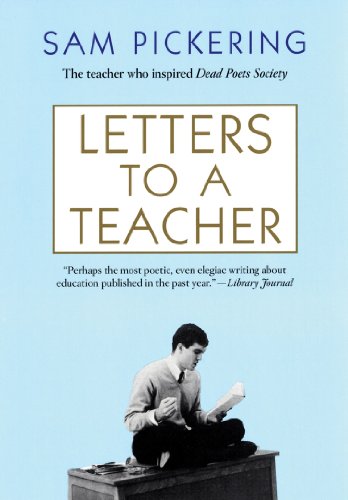
Sam Pickering has been teaching, guiding, performing, and inspiring for more than forty years. As a young English teacher at Montgomery Bell Academy in Tennessee, his musings on literature and his maverick pedagogy touched a student named Tommy Schulman, who later wrote the screenplay for Dead Poets Society. Letters to a Teacher is a welcome reminder that teaching is a joy and an art. In ten graceful yet conversational letters addressed to teachers of all types, Pickering shares compelling, funny, always elucidating anecdotes from a lifetime in the classrooms of school and universities. His priceless, homespun observations touch on topics such as competition, curiosity, enthusiasm, and truth. More than a how-to guide, Letters to a Teacher is an invitation into the hearts and minds of an extraordinary educator and his students, and an irresistible call to reflection for the teacher who knows he or she must be compassionate, optimistic, respectful, firm, and above all dynamic. This is an indispensable guide for teachers and laymen alike.
Die Inhaltsangabe kann sich auf eine andere Ausgabe dieses Titels beziehen.
Über die Autorin bzw. den Autor
Sam Pickering teaches English at the University of Connecticut.
Auszug. © Genehmigter Nachdruck. Alle Rechte vorbehalten.
Letters to a Teacher
By Samuel F. PickeringGrove Press
Copyright © 2005 Samuel F. PickeringAll right reserved.
ISBN: 9780802142276
Chapter One
Letter One: The Teacher's LifeDEAR TEACHER,
The heartache of being human is that often when we act selflessly and with good intentions we bruise others. For teachers surrounded by children who at times seem sadly vulnerable the heartache rarely ends. No matter how well intentioned teachers are, they will bump those about them. Two things enable teachers to cope. The first is simply forgetfulness. Life pushes so much at us that a specific event rarely clogs the mind for a long time. In Kenneth Grahame's The Wind in the Willows, Mole and Ratty search for Portly, a lost baby otter. They rescue Portly, finding him sleeping between the hooves of Pan, the deity of the natural world. Before he vanishes, Pan bestows the gift of forgetfulness upon Mole and Rat, "lest," Grahame writes, "the awful remembrance should remain and grow, and overshadow mirth and pleasure, and the great haunting memory should spoil all the after-lives of little animals helped out of difficulties, in order that they should be happy and light-hearted as before."
Forgetfulness is a great boon. The person forever conscious of the presence of a god can never relax and be spontaneous, cannot embody the spontaneity of consciousness that the nineteenth-century critic Matthew Arnold said brought sweetness and light into our lives, and, indeed, into the lives of others. If the mistakes of the past were always present, no teacher could act. If I recalled all the regrettable things I've done as soon as I woke up in the morning, I wouldn't be able to get out of bed, much less go to class. Indeed if side dishes heaped with all the tiffs of the past accompanied meals to the dinner table, marriages would not endure to dessert.
The pleasures of forgetfulness often brighten small moments. Many years ago outside an apartment in Nashville, my father and I met Norvell Skipworth and his wife unloading their car. The Skipworths had returned from a vacation in Georgia. Neither Norvell nor his wife was young, and after handing the key to the trunk of the car to his wife, Norvell turned and seeing Father said, "Sam, good morning. This is a surprise, and how was your trip?" Norvell then paused and looked puzzled for a moment before shaking his head in mild exasperation and adding, "Aw shucks, I got that wrong. I went on the trip."
The other matter that helps teachers bounce into class is that the real effects of teaching remain mysterious, something that complicates attempts to define good teaching. Almost never do teachers know exactly how their words, or actions, affect students. Moreover, if we really believed that everything we said shaped students, we would be too terrified to speak. Still, the ways of words and interpretations of words sometimes startle us. "Six years have passed since I was in your class," a girl once wrote me from Torrington, "and I want to tell you that you handled me the right way. I did not think so then, but now that I am older and have thought about it for a long time I realize you were correct. Thank you for doing me such a service." I did not recall the girl until I looked in my grade book. She was one of fifty-four students and received a B in the course. She wrote three B+ papers, then a B, and finally a C paper. She made 86 on the final examination. In class she was silent, a faceless gray student who never talked. Indeed the semester passed without my speaking to her except when I returned papers. From my perspective the handling that I accomplished so memorably did not occur. From her point of view, an offhand remark of mine must have seemed directed at her and provoked thought that rolled through years.
Recently I taught a course on the short story. A tough-looking boy sat in the back row in the right-hand corner of the room. The boy always wore a blue baseball cap with an orange bill. Printed across the front of the cap was "Danbury." Instead of removing the cap when class began, the boy pushed it around so that the bill pointed behind him, toward the wall. Then he leaned forward on his elbows and glared at me for fifty minutes, his expression never changing, scorn furrowing his brow. A month after the semester ended, he came to my office. He wore the same cap. In his hand he carried an empty tin can, the top of which had been sliced off. "Hope you don't mind," the boy said, sitting down and then raising the can to his mouth and spitting, "I chew." "I came to tell you," he continued, "that your course was the best I had in this university. Funniest damn course in the world. Thought I would bust a gut laughing. Told all my friends to take it. I won't forget you," the boy said, abruptly standing and shifting the can into his left hand in order to shake hands. "I won't forget you either," I said.
To know the effects of a class upon students or rather how students think a class affects them would be disturbing. Thirty years ago at Dartmouth if I had known how my class affected Gail, my children would not be named Francis, Edward, and Eliza. I was young and unmarried. All I remember about Gail is that she had brown hair, sat in the first row, once wore a yellow dress, and that I was in love with her. I was so in love I could not bear to look at her, much less speak to her. When she missed class, the room seemed empty. At the end of the semester Gail vanished. At a reunion five years later, George, another student from that class, visited me. "Sam," he said, as we sat in my living room, "do you remember a girl in your class named Gail? She sat in the front row and had brown hair." "Yes, slightly," I said, feeling uncomfortable. "Goodness," George exclaimed, "was she in love with you! The whole class knew it. Some days she couldn't face you and wouldn't attend. Isn't that the darnedest thing?" "Yes, George," I said, "the darnedest thing."
If not the place for mongrel love, the classroom is a place for unrequited liking. More important even than knowing a subject well is the capacity for liking students. Of course exceptions exist to this and to all I write. The person teaching medical school must insure that students know the difference between heart and colon. Otherwise his pupils will perform extraordinary bypasses. Although I think personality combined with knowledge is essential in a teacher, to a great degree we teachers don't matter. In comparison to students we exist to be outgrown and forgotten, alas, like parents. On sunny days I explore graveyards. Engraved on a tombstone I saw in Missouri was a tribute praising a man for achieving "sweet oblivion of self," a state almost never achieved but perhaps one to be wished for. Although the teacher's "self" affects classrooms, students matter more than we do.
I have aged into buying used books. Clean, pressed pages appear uninformed and smack of naoveti and its sometime companion cruelty. Nowadays I prefer books worn and watermarked, tattered like me, their margins beaten into seams, their words seemingly bruised into wisdom by handling. Because I hope to find wisdom, I usually find it. Recently I bought In Nature's Realm, published in 1900 and written by Charles Conrad Abbott, a once popular but now obscure naturalist and scientist. "Ascribe infallibility to the professor," Abbott wrote, "and you become at best his echo, and condemn to slavery what should be free as the air, your own mind." Abbott's remark applies more to college and graduate students than it does to children in elementary and high...
„Über diesen Titel“ kann sich auf eine andere Ausgabe dieses Titels beziehen.
Suchergebnisse für Letters to a Teacher

Beispielbild für diese ISBN
Letters to a Teacher
Verlag:
Grove Press / Atlantic Monthly Press, 2005
ISBN 10: 0802142273
ISBN 13: 9780802142276
Gebraucht
Paperback
Anbieter: World of Books (was SecondSale), Montgomery, IL, USA
Verkäuferbewertung 5 von 5 Sternen

Paperback. Zustand: Very Good. Sam Pickering has been teaching, guiding, performing, and inspiring for more than forty years. As a young English teacher at Montgomery Bell Academy in Tennessee, his musings on literature and his maverick pedagogy touched a student named Tommy Schulman, who later wrote the screenplay for Dead Poets Society. Letters to a Teacher is a welcome reminder that teaching is a joy and an art. In ten graceful yet conversational letters addressed to teachers of all types, Pickering shares compelling, funny, always elucidating anecdotes from a lifetime in the classrooms of school and universities. His priceless, homespun observations touch on topics such as competition, curiosity, enthusiasm, and truth. More than a how-to guide, Letters to a Teacher is an invitation into the hearts and minds of an extraordinary educator and his students, and an irresistible call to reflection for the teacher who knows he or she must be compassionate, optimistic, respectful, firm, and above all dynamic. This is an indispensable guide for teachers and laymen alike. Artikel-Nr. 00105134488
Gebraucht kaufen
EUR 6,15
Versand gratis
Versand innerhalb von USA
Versand innerhalb von USA
Anzahl: 2 verfügbar
Beispielbild für diese ISBN
Letters to a Teacher
Verlag:
Grove Press / Atlantic Monthly Press, 2005
ISBN 10: 0802142273
ISBN 13: 9780802142276
Gebraucht
Paperback
Anbieter: World of Books (was SecondSale), Montgomery, IL, USA
Verkäuferbewertung 5 von 5 Sternen
Paperback. Zustand: Good. Sam Pickering has been teaching, guiding, performing, and inspiring for more than forty years. As a young English teacher at Montgomery Bell Academy in Tennessee, his musings on literature and his maverick pedagogy touched a student named Tommy Schulman, who later wrote the screenplay for Dead Poets Society. Letters to a Teacher is a welcome reminder that teaching is a joy and an art. In ten graceful yet conversational letters addressed to teachers of all types, Pickering shares compelling, funny, always elucidating anecdotes from a lifetime in the classrooms of school and universities. His priceless, homespun observations touch on topics such as competition, curiosity, enthusiasm, and truth. More than a how-to guide, Letters to a Teacher is an invitation into the hearts and minds of an extraordinary educator and his students, and an irresistible call to reflection for the teacher who knows he or she must be compassionate, optimistic, respectful, firm, and above all dynamic. This is an indispensable guide for teachers and laymen alike. Artikel-Nr. 00083839960
Gebraucht kaufen
EUR 6,15
Versand gratis
Versand innerhalb von USA
Versand innerhalb von USA
Anzahl: 1 verfügbar
Beispielbild für diese ISBN
Letters to a Teacher
Verlag:
Grove/Atlantic, Incorporated, 2005
ISBN 10: 0802142273
ISBN 13: 9780802142276
Gebraucht
Softcover
Anbieter: Better World Books, Mishawaka, IN, USA
Verkäuferbewertung 5 von 5 Sternen
Zustand: Very Good. Reprint. Former library copy. Pages intact with possible writing/highlighting. Binding strong with minor wear. Dust jackets/supplements may not be included. Includes library markings. Stock photo provided. Product includes identifying sticker. Better World Books: Buy Books. Do Good. Artikel-Nr. 53259195-6
Gebraucht kaufen
EUR 6,16
Versand gratis
Versand innerhalb von USA
Versand innerhalb von USA
Anzahl: 1 verfügbar
Beispielbild für diese ISBN
Letters to a Teacher
Verlag:
Grove/Atlantic, Incorporated, 2005
ISBN 10: 0802142273
ISBN 13: 9780802142276
Gebraucht
Softcover
Anbieter: Better World Books: West, Reno, NV, USA
Verkäuferbewertung 5 von 5 Sternen
Zustand: Good. Reprint. Pages intact with minimal writing/highlighting. The binding may be loose and creased. Dust jackets/supplements are not included. Stock photo provided. Product includes identifying sticker. Better World Books: Buy Books. Do Good. Artikel-Nr. 2497518-6
Gebraucht kaufen
EUR 6,16
Versand gratis
Versand innerhalb von USA
Versand innerhalb von USA
Anzahl: 1 verfügbar
Beispielbild für diese ISBN
Letters to a Teacher
Verlag:
Grove/Atlantic, Incorporated, 2005
ISBN 10: 0802142273
ISBN 13: 9780802142276
Gebraucht
Softcover
Anbieter: Better World Books, Mishawaka, IN, USA
Verkäuferbewertung 5 von 5 Sternen
Zustand: Good. Reprint. Pages intact with minimal writing/highlighting. The binding may be loose and creased. Dust jackets/supplements are not included. Stock photo provided. Product includes identifying sticker. Better World Books: Buy Books. Do Good. Artikel-Nr. 2497518-6
Gebraucht kaufen
EUR 6,16
Versand gratis
Versand innerhalb von USA
Versand innerhalb von USA
Anzahl: 1 verfügbar
Beispielbild für diese ISBN
Letters to a Teacher
Anbieter: ThriftBooks-Atlanta, AUSTELL, GA, USA
Verkäuferbewertung 5 von 5 Sternen
Paperback. Zustand: Good. No Jacket. Pages can have notes/highlighting. Spine may show signs of wear. ~ ThriftBooks: Read More, Spend Less. Artikel-Nr. G0802142273I3N00
Gebraucht kaufen
EUR 7,82
Versand gratis
Versand innerhalb von USA
Versand innerhalb von USA
Anzahl: 1 verfügbar
Beispielbild für diese ISBN
Letters to a Teacher
Verlag:
Grove/Atlantic, Incorporated, 2005
ISBN 10: 0802142273
ISBN 13: 9780802142276
Gebraucht
Softcover
Anbieter: Better World Books Ltd, Dunfermline, Vereinigtes Königreich
Verkäuferbewertung 5 von 5 Sternen
Zustand: Very Good. Reprint. Former library copy. Pages intact with possible writing/highlighting. Binding strong with minor wear. Dust jackets/supplements may not be included. Includes library markings. Stock photo provided. Product includes identifying sticker. Better World Books: Buy Books. Do Good. Artikel-Nr. 53259195-6
Gebraucht kaufen
EUR 8,08
EUR 5,87 Versand
Versand von Vereinigtes Königreich nach USA
Versand von Vereinigtes Königreich nach USA
Anzahl: 1 verfügbar
Beispielbild für diese ISBN
Letters to a Teacher
Anbieter: Revaluation Books, Exeter, Vereinigtes Königreich
Verkäuferbewertung 5 von 5 Sternen
Paperback. Zustand: Brand New. reprint edition. 242 pages. 7.25x5.00x0.75 inches. In Stock. Artikel-Nr. x-0802142273
Neu kaufen
EUR 17,46
EUR 11,73 Versand
Versand von Vereinigtes Königreich nach USA
Versand von Vereinigtes Königreich nach USA
Anzahl: 2 verfügbar
Foto des Verkäufers
Letters to a Teacher
Anbieter: AHA-BUCH GmbH, Einbeck, Deutschland
Verkäuferbewertung 5 von 5 Sternen
Taschenbuch. Zustand: Neu. Neuware - Sam Pickering has been teaching, guiding, performing, and inspiring for more than forty years. As a young English teacher at Montgomery Bell Academy in Tennessee, his musings on literature and his maverick pedagogy touched a student named Tommy Schulman, who later wrote the screenplay for Dead Poets Society. Letters to a Teacher is a welcome reminder that teaching is a joy and an art. In ten graceful yet conversational letters addressed to teachers of all types, Pickering shares compelling, funny, always elucidating anecdotes from a lifetime in the classrooms of school and universities. His priceless, homespun observations touch on topics such as competition, curiosity, enthusiasm, and truth. More than a how-to guide, Letters to a Teacher is an invitation into the hearts and minds of an extraordinary educator and his students, and an irresistible call to reflection for the teacher who knows he or she must be compassionate, optimistic, respectful, firm, and above all dynamic. This is an indispensable guide for teachers and laymen alike. Artikel-Nr. 9780802142276
Neu kaufen
EUR 18,22
EUR 35,00 Versand
Versand von Deutschland nach USA
Versand von Deutschland nach USA
Anzahl: 2 verfügbar
Foto des Verkäufers
Letters to a Teacher
Anbieter: moluna, Greven, Deutschland
Verkäuferbewertung 5 von 5 Sternen
Zustand: New. KlappentextrnrnAn English teacher at a boys school in Tennessee, Pickering was the inspiration for the film Dead Poets Society. In ten eloquent essays addressed to teachers of all types, Pickering shares compelling, funny, always elucidating . Artikel-Nr. 898723982
Neu kaufen
EUR 16,76
EUR 48,99 Versand
Versand von Deutschland nach USA
Versand von Deutschland nach USA
Anzahl: Mehr als 20 verfügbar