
Verwandte Artikel zu Babel: Around the World in Twenty Languages
Inhaltsangabe
Die Inhaltsangabe kann sich auf eine andere Ausgabe dieses Titels beziehen.
Über die Autorin bzw. den Autor
Gaston Dorren is a linguist, journalist, and polyglot. He speaks Dutch, Limburgish, English, German, French, and Spanish, and reads nine more languages. He is the author of Lingo: Around Europe in Sixty Languages, as well as two books in Dutch and the app, The Language Lover's Guide to Europe. Dorren lives in the Netherlands.
Auszug. © Genehmigter Nachdruck. Alle Rechte vorbehalten.
When people speak Japanese, their gender matters a great deal. A good number of words and grammatical constructions are associated with either women or men. For starters, women are more likely to use slightly longer versions of words that make them—the words, and consequently the speakers—sound polite. Think of it as not only saying the refined word ‘luncheon’ instead of the more workaday ‘lunch’, but making the difference systematic by also saying ‘tableon’ instead of ‘table’ and ‘flowereon’ instead of ‘flower’. In Japanese, this politeness syllable is added not at the end, but at the front: hana ‘flower’ becomes ohana.
Next, women and men will use different pronouns to refer to themselves: while watashi is a formal word for ‘I’ or ‘me’ that both genders can use, atashi is clearly a women’s word and ore, boku and oira are men’s. Both genders will use the word for ‘be’ differently: in a sentence like ‘this is a spider’, men will include da for ‘is’ (‘this da a spider’), whereas women will omit it (‘this a spider’). They will use different interjections: for example, ‘Hey, you’ translates as Ne, chotto for women, but as Oi chotto or yo chotto for men; both men and women can use a where English would have ‘oh’ (as in ‘Oh, how beautiful’), but only women may also choose ara or ma. Men may pronounce the diphthong /ai/ (rhyming with English lie) as /e/ (rhyming with lay), whereas it would be unladylike for a woman to do so.
Speakers do not exactly break a hard-and-fast grammar rule when using elements normally used by the opposite gender, but they certainly break a social convention: they bend both a rule and their gender.
„Über diesen Titel“ kann sich auf eine andere Ausgabe dieses Titels beziehen.
Suchergebnisse für Babel: Around the World in Twenty Languages

Beispielbild für diese ISBN
Babel
Anbieter: World of Books (was SecondSale), Montgomery, IL, USA
Verkäuferbewertung 5 von 5 Sternen

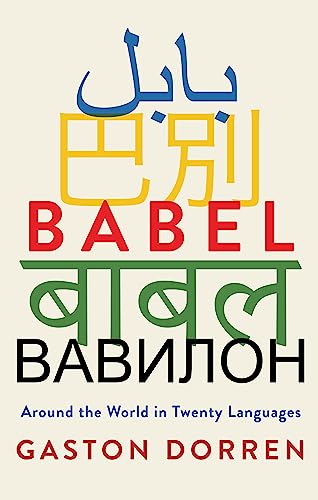
Hardback. Zustand: Good. English is the world language, except that most of the world doesn't speak it--only one in five people does. Dorren calculates that to speak fluently with half of the world's 7.4 billion people in their mother tongues, you would need to know no fewer than twenty languages. He sets out to explore these top twenty world languages, which range from the familiar (French, Spanish) to the surprising (Malay, Javanese, Bengali). Babel whisks the reader on a delightful journey to every continent of the world, tracing how these world languages rose to greatness while others fell away and showing how speakers today handle the foibles of their mother tongues. Whether showcasing tongue-tying phonetics or elegant but complicated writing scripts, and mind-bending quirks of grammar, Babel vividly illustrates that mother tongues are like nations: each has its own customs and beliefs that seem as self-evident to those born into it as they are surprising to the outside world. Among many other things, Babel will teach you why modern Turks can't read books that are a mere 75 years old, what it means in practice for Russian and English to be relatives, and how Japanese developed separate "dialects" for men and women. Dorren lets you in on his personal trials and triumphs while studying Vietnamese in Hanoi, debunks ten widespread myths about Chinese characters, and discovers that Swahili became the lingua franca in a part of the world where people routinely speak three or more languages. Witty, fascinating and utterly compelling, Babel will change the way you look at and listen to the world and how it speaks. Artikel-Nr. 00098537944
Gebraucht kaufen
EUR 4,56
Versand gratis
Versand innerhalb von USA
Versand innerhalb von USA
Anzahl: 6 verfügbar
Beispielbild für diese ISBN
Babel : Around the World in Twenty Languages
Verlag:
Grove/Atlantic, Incorporated, 2018
ISBN 10: 0802128793
ISBN 13: 9780802128799
Gebraucht
Hardcover
Anbieter: Better World Books: West, Reno, NV, USA
Verkäuferbewertung 5 von 5 Sternen
Zustand: Good. Former library copy. Pages intact with minimal writing/highlighting. The binding may be loose and creased. Dust jackets/supplements are not included. Includes library markings. Stock photo provided. Product includes identifying sticker. Better World Books: Buy Books. Do Good. Artikel-Nr. 18712109-6
Gebraucht kaufen
EUR 6,34
Versand gratis
Versand innerhalb von USA
Versand innerhalb von USA
Anzahl: 2 verfügbar
Beispielbild für diese ISBN
Babel : Around the World in Twenty Languages
Verlag:
Grove/Atlantic, Incorporated, 2018
ISBN 10: 0802128793
ISBN 13: 9780802128799
Gebraucht
Hardcover
Anbieter: Better World Books, Mishawaka, IN, USA
Verkäuferbewertung 5 von 5 Sternen
Zustand: Very Good. Former library copy. Pages intact with possible writing/highlighting. Binding strong with minor wear. Dust jackets/supplements may not be included. Includes library markings. Stock photo provided. Product includes identifying sticker. Better World Books: Buy Books. Do Good. Artikel-Nr. 17467175-6
Gebraucht kaufen
EUR 6,34
Versand gratis
Versand innerhalb von USA
Versand innerhalb von USA
Anzahl: 1 verfügbar
Beispielbild für diese ISBN
Babel: Around the World in Twenty Languages
Anbieter: Wonder Book, Frederick, MD, USA
Verkäuferbewertung 5 von 5 Sternen
Zustand: Very Good. Very Good condition. Good dust jacket. A copy that may have a few cosmetic defects. May also contain light spine creasing or a few markings such as an owner's name, short gifter's inscription or light stamp. Artikel-Nr. V18A-05587
Gebraucht kaufen
EUR 6,41
Versand gratis
Versand innerhalb von USA
Versand innerhalb von USA
Anzahl: 1 verfügbar
Beispielbild für diese ISBN
Babel: Around the World in Twenty Languages
Anbieter: Wonder Book, Frederick, MD, USA
Verkäuferbewertung 5 von 5 Sternen
Zustand: Very Good. Very Good condition. Very Good dust jacket. A copy that may have a few cosmetic defects. May also contain light spine creasing or a few markings such as an owner's name, short gifter's inscription or light stamp. Artikel-Nr. Q03Q-00828
Gebraucht kaufen
EUR 6,41
Versand gratis
Versand innerhalb von USA
Versand innerhalb von USA
Anzahl: 1 verfügbar
Beispielbild für diese ISBN
Babel: Around the World in Twenty Languages
Anbieter: ThriftBooks-Atlanta, AUSTELL, GA, USA
Verkäuferbewertung 5 von 5 Sternen
Hardcover. Zustand: Very Good. No Jacket. May have limited writing in cover pages. Pages are unmarked. ~ ThriftBooks: Read More, Spend Less. Artikel-Nr. G0802128793I4N00
Gebraucht kaufen
EUR 6,96
Versand gratis
Versand innerhalb von USA
Versand innerhalb von USA
Anzahl: 1 verfügbar
Beispielbild für diese ISBN
Babel: Around the World in Twenty Languages
Anbieter: ThriftBooks-Dallas, Dallas, TX, USA
Verkäuferbewertung 5 von 5 Sternen
Hardcover. Zustand: Fair. No Jacket. Former library book; Readable copy. Pages may have considerable notes/highlighting. ~ ThriftBooks: Read More, Spend Less. Artikel-Nr. G0802128793I5N10
Gebraucht kaufen
EUR 6,96
Versand gratis
Versand innerhalb von USA
Versand innerhalb von USA
Anzahl: 1 verfügbar
Beispielbild für diese ISBN
Babel: Around the World in Twenty Languages
Anbieter: ThriftBooks-Dallas, Dallas, TX, USA
Verkäuferbewertung 5 von 5 Sternen
Hardcover. Zustand: Fair. No Jacket. Missing dust jacket; Readable copy. Pages may have considerable notes/highlighting. ~ ThriftBooks: Read More, Spend Less. Artikel-Nr. G0802128793I5N01
Gebraucht kaufen
EUR 6,96
Versand gratis
Versand innerhalb von USA
Versand innerhalb von USA
Anzahl: 1 verfügbar
Beispielbild für diese ISBN
Babel: Around the World in Twenty Languages
Anbieter: Magers and Quinn Booksellers, Minneapolis, MN, USA
Verkäuferbewertung 5 von 5 Sternen
hardcover. Zustand: Very Good. May have light to moderate shelf wear and/or a remainder mark. Complete. Clean pages. Artikel-Nr. 1157577
Gebraucht kaufen
EUR 6,86
EUR 3,55 Versand
Versand innerhalb von USA
Versand innerhalb von USA
Anzahl: 1 verfügbar
Beispielbild für diese ISBN
Babel: Around the World in Twenty Languages
Anbieter: Revaluation Books, Exeter, Vereinigtes Königreich
Verkäuferbewertung 5 von 5 Sternen
Hardcover. Zustand: Brand New. 320 pages. 9.00x5.75x1.25 inches. In Stock. Artikel-Nr. 0802128793
Neu kaufen
EUR 28,67
EUR 11,86 Versand
Versand von Vereinigtes Königreich nach USA
Versand von Vereinigtes Königreich nach USA
Anzahl: 1 verfügbar