
Verwandte Artikel zu Exposure
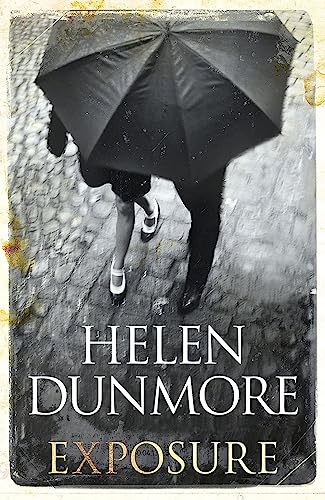
Inhaltsangabe
“Dunmore so cleverly interweaves each of the character's stories that as the tale unfolds it has the chilling ring of absolute authenticity. It’s gripping and page turning and all those things you expect in a Spy Drama—but always laced with her trademark humanity. I was totally caught up in the story which is paced perfectly. Her best book yet.”—Mavis Cheek
Virtuoso storyteller Helen Dunmore returns with a thrilling Cold War espionage tale in which the closest ties are called into question and nobody is quite who they seem.
It’s London, 1960. The Cold War is at its height, and a spy may be a friend or neighbor, colleague or lover. Two colleagues, Giles Holloway and Simon Callington, face a terrible dilemma over a missing top-secret file. At the end of a suburban garden, in the pouring rain, Simon’s wife, Lily, buries a briefcase containing the file deep in the earth. She believes that in doing so she is protecting her family. What she will learn is that no one is immune from betrayal or the devastating consequences of exposure.
Virtuoso storyteller Helen Dunmore returns with a thrilling Cold War espionage tale in which the closest ties are called into question and nobody is quite who they seem.
It’s London, 1960. The Cold War is at its height, and a spy may be a friend or neighbor, colleague or lover. Two colleagues, Giles Holloway and Simon Callington, face a terrible dilemma over a missing top-secret file. At the end of a suburban garden, in the pouring rain, Simon’s wife, Lily, buries a briefcase containing the file deep in the earth. She believes that in doing so she is protecting her family. What she will learn is that no one is immune from betrayal or the devastating consequences of exposure.
Die Inhaltsangabe kann sich auf eine andere Ausgabe dieses Titels beziehen.
Über die Autorinnen und Autoren
Helen Dunmore is the author of twelve books, including The Lie, The Greatcoat; The Betrayal,a New York Times Editors’ Choice; The Siege, a bestseller and finalist for the Whitbread Novel of the Year Award; and A Spell of Winter, winner of the Orange Prize.
Helen Dunmore is the author of twelve books, including The Lie, The Greatcoat; The Betrayal,a New York Times Editors' Choice; The Siege, a bestseller and finalist for the Whitbread Novel of the Year Award; and A Spell of Winter, winner of the Orange Prize.
Auszug. © Genehmigter Nachdruck. Alle Rechte vorbehalten.
Exposure
By Helen DunmoreGrove Atlantic, Inc.
Copyright © 2016 Helen Dunmore
All rights reserved.
ISBN: 978-0-8021-2493-7All rights reserved.
Contents
Cover,
Also by Helen Dunmore,
Title Page,
Copyright,
Prologue,
1 The Whistle Blows,
2 The Oddity of the Flat,
3 Nil by Mouth,
4 I am a Friend of Giles,
5 The Cartridge Burns,
6 One Way Out,
7 A Contamination,
8 The Single Bed,
9 You Are in England Now,
10 Sunday,
11 Do You Speak German?,
12 The Charge,
13 Shadows under the Lamp-posts,
14 Who Can Tell Me What 'Patriot' Means?,
15 Plan B,
16 Dr Maggot,
17 HM's Spy,
18 How Prison Works,
19 A Bendix in the Scullery,
20 Can You Hear the Sea?,
21 Don't Get Cold,
22 The Full Picture,
23 The Owl,
24 A Useful Idiot,
25 Cold Obstruction,
26 Points of Desperation,
27 Monsieur Nuage,
28 There's No Ship,
29 Perfect Aim,
30 Arrival,
Acknowledgements,
Back Cover,
CHAPTER 1
The Whistle Blows
November, 1960
It starts with the whistle of a train, shearing through the cold, thick dusk of a November afternoon. Lily Callington hears it as she digs over her vegetable patch at the bottom of her garden in Muswell Hill. For a second she's startled, because the whistle sounds so close, as if a train is rushing towards her along the disused railway line at the bottom of the garden. She straightens and listens intently, frowning. The whistle goes through her, touching nerves so deep that Lily doesn't even know where they are. The children! They aren't here. She can't see them, touch them, keep them safe —
Stop it, you fool. They are not babies any more. Paul is ten, Sally almost nine. Even Bridget is five. They're at school. What could be safer than a primary school in Muswell Hill? She'll walk down there for three-thirty, and wait in the Infants' playground with the other mothers until the little ones spill out of the doorway. Always, there's a half-second when the appearance of Bridget startles her, as if the daughter in her head doesn't quite match the boisterous schoolchild whom her teacher calls 'a chatterbox'. Lily wants to kneel down and open her arms for Bridget to hurtle into them. She wants to fold herself around the sturdy little body. Of course, she never does. She smiles, and waves, like the other mothers. She smoothes Bridget's dark curls, and asks if she has remembered her PE bag.
They're not babies. She, Lily, is a married woman in her thirties with a house and a job. Her feet are planted in safely mortgaged earth. Lily smiles at herself, a little derisively, as the wind shifts and the noise of the train whistle is carried out of hearing. The train is far away now. She puts her right foot on the shaft of the fork, jiggles the handle slightly and eases the tines deep into heavy clay. Her heart steadies. You should drink less coffee, she tells herself. All those years and still the old panic blazing up in her veins. She looks down at the clods of London clay that cling to the fork. There's three-quarters of the patch left to do, and she likes digging. The soil must be opened up for the winter frosts to work on it. You are standing on your own patch of earth. Your name is Lily Callington. You are in England now.
Giles Holloway hears the train whistle too, as he mooches through Finsbury Park. He's close to the main line and the sound is clear. There it goes, getting up speed for the race to the north.
Giles wears a midnight-blue overcoat which might have been elegant on a more elegant figure, but even the skill of his tailor hasn't been able to overcome Giles's crude bulk of chest, shoulder and belly. In these streets, he and his coat draw second glances. He might be a landlord, in search of a couple more houses to cram with Irish labourers. Giles hears the train whistle, and to him it says, as it always does: Elsewhere. He knows exactly which train he will catch, if ever he needs to disappear. He won't go anywhere near the Channel ports. King's Cross to Newcastle, and then the ferry to Bergen.
Everything that surrounds him is provisional. It won't and can't last: history has already decided that. But it's decades since Giles was introduced to that way of thinking, and, like his overcoat, the cover of such thoughts doesn't quite fit over the weight of what life has done to him – or, to be fair, what he's done to life. From time to time, he stubs his mind against the solidity of this world that history has decided against, as they used to say in secret, smoky, ardent meetings all those years ago. They were so certain then. Nothing had touched them. What they believed was as fresh as a sheet of paper with nothing written on it. Fascism must be defeated, and be replaced by a new and better world.
Of course they had no illusions. They understood that omelettes couldn't be made without breaking eggs. Sacrifice – even the sacrifice of others – was heroic, correctly understood. How they struggled for the correct viewpoint, overcoming the handicap of their class origins and bourgeois culture. Actions that appeared grubby, even furtive, would be revealed in all their clarity once history had swept away the debris of capitalism. For the time being, there must be secrecy. Concealment was an art you had to learn, and then you saw it everywhere, although you'd never suspected its existence until you began to be part of it. Giles remembers Julian Clowde's rather cold, self-satisfied smile as he took stock of Giles and made him understand what was what.
It was passionately exciting, but you never showed it. An inner ring within an inner ring. If you didn't know that the inner ring was there, you saw nothing. It was there in plain sight, but camouflaged. You saw a group of friends on the summer grass by the river, laughing, and you passed on with a quick, ignoble pang because you were not one of them. You had to be beckoned in. Initiated. Julian had beckoned him in. Julian had watched Giles, got to know him, tested him as you test an inner tube in a bowl of water to see where the puncture is. Giles had had a lot to learn. First of all, he had to learn to become silent about his opinions. He became humorous about his young self and its ludicrous pronouncements on politics. Now he'd grown up and seen the world as it was. He knew that others were doing the same, and that they wouldn't necessarily even recognise one another for what they were. They had learned everything about concealment in the open.
Julian smoothed Giles's way, and Giles glided into place. Lunches were had in quiet clubs, overtures were made and accepted, and there you were, old boy, lodged in position, vouched for by men who had the ear of everyone who mattered. Have you come across Giles Holloway? I'd like you to meet him.
There you were, and no one knew what you were. Giles was a pirate then, flying his own flag under the very bows of the great ship of state. He'd always rather fancied that notion. And then there was the war.
Nineteen forty-seven. Back to London. Back to the Admiralty and back under Julian's wing. Older now, though. The years were going by. On it all went: those documents, those damned dingy documents, on and on. The sails of Giles's little ship hung limp.
Here he is still, after all those years. On goes the world, blithe and satisfied with itself. London is more grey and massive than ever, and it's tiered with chaps whose opinion of Giles Holloway is no longer as sanguine as it once...
„Über diesen Titel“ kann sich auf eine andere Ausgabe dieses Titels beziehen.
Suchergebnisse für Exposure

Beispielbild für diese ISBN
Exposure
Anbieter: World of Books (was SecondSale), Montgomery, IL, USA
Verkäuferbewertung 5 von 5 Sternen

Zustand: Good. Item in good condition. Textbooks may not include supplemental items i.e. CDs, access codes etc. Artikel-Nr. 00053455993
Gebraucht kaufen
EUR 3,10
Versand gratis
Versand innerhalb von USA
Versand innerhalb von USA
Anzahl: 2 verfügbar
Beispielbild für diese ISBN
Exposure
Anbieter: ThriftBooks-Dallas, Dallas, TX, USA
Verkäuferbewertung 5 von 5 Sternen
Hardcover. Zustand: As New. No Jacket. Pages are clean and are not marred by notes or folds of any kind. ~ ThriftBooks: Read More, Spend Less. Artikel-Nr. G0802124933I2N00
Gebraucht kaufen
EUR 6,28
Versand gratis
Versand innerhalb von USA
Versand innerhalb von USA
Anzahl: 1 verfügbar
Beispielbild für diese ISBN
Exposure
Anbieter: ThriftBooks-Atlanta, AUSTELL, GA, USA
Verkäuferbewertung 5 von 5 Sternen
Hardcover. Zustand: Good. No Jacket. Former library book; Pages can have notes/highlighting. Spine may show signs of wear. ~ ThriftBooks: Read More, Spend Less. Artikel-Nr. G0802124933I3N10
Gebraucht kaufen
EUR 6,28
Versand gratis
Versand innerhalb von USA
Versand innerhalb von USA
Anzahl: 1 verfügbar
Beispielbild für diese ISBN
Exposure
Verlag:
Grove/Atlantic, Incorporated, 2016
ISBN 10: 0802124933
ISBN 13: 9780802124937
Gebraucht
Hardcover
Erstausgabe
Anbieter: Better World Books: West, Reno, NV, USA
Verkäuferbewertung 5 von 5 Sternen
Zustand: Very Good. 1St Edition. Former library copy. Pages intact with possible writing/highlighting. Binding strong with minor wear. Dust jackets/supplements may not be included. Includes library markings. Stock photo provided. Product includes identifying sticker. Better World Books: Buy Books. Do Good. Artikel-Nr. 9363913-75
Gebraucht kaufen
EUR 6,50
Versand gratis
Versand innerhalb von USA
Versand innerhalb von USA
Anzahl: 1 verfügbar
Beispielbild für diese ISBN
Exposure
Verlag:
Grove/Atlantic, Incorporated, 2016
ISBN 10: 0802124933
ISBN 13: 9780802124937
Gebraucht
Hardcover
Erstausgabe
Anbieter: Better World Books, Mishawaka, IN, USA
Verkäuferbewertung 5 von 5 Sternen
Zustand: Very Good. 1St Edition. Former library copy. Pages intact with possible writing/highlighting. Binding strong with minor wear. Dust jackets/supplements may not be included. Includes library markings. Stock photo provided. Product includes identifying sticker. Better World Books: Buy Books. Do Good. Artikel-Nr. 9363913-75
Gebraucht kaufen
EUR 6,50
Versand gratis
Versand innerhalb von USA
Versand innerhalb von USA
Anzahl: 3 verfügbar
Beispielbild für diese ISBN
Exposure
Verlag:
Grove/Atlantic, Incorporated, 2016
ISBN 10: 0802124933
ISBN 13: 9780802124937
Gebraucht
Hardcover
Erstausgabe
Anbieter: Better World Books, Mishawaka, IN, USA
Verkäuferbewertung 5 von 5 Sternen
Zustand: Good. 1St Edition. Former library copy. Pages intact with minimal writing/highlighting. The binding may be loose and creased. Dust jackets/supplements are not included. Includes library markings. Stock photo provided. Product includes identifying sticker. Better World Books: Buy Books. Do Good. Artikel-Nr. 9276668-6
Gebraucht kaufen
EUR 6,50
Versand gratis
Versand innerhalb von USA
Versand innerhalb von USA
Anzahl: 1 verfügbar
Beispielbild für diese ISBN
Exposure
Anbieter: WorldofBooks, Goring-By-Sea, WS, Vereinigtes Königreich
Verkäuferbewertung 5 von 5 Sternen
Paperback. Zustand: Very Good. The book has been read, but is in excellent condition. Pages are intact and not marred by notes or highlighting. The spine remains undamaged. Artikel-Nr. GOR008820344
Gebraucht kaufen
EUR 2,62
EUR 6,52 Versand
Versand von Vereinigtes Königreich nach USA
Versand von Vereinigtes Königreich nach USA
Anzahl: 2 verfügbar
Beispielbild für diese ISBN
Exposure
Anbieter: AwesomeBooks, Wallingford, Vereinigtes Königreich
Verkäuferbewertung 5 von 5 Sternen
Hardcover. Zustand: Very Good. Exposure This book is in very good condition and will be shipped within 24 hours of ordering. The cover may have some limited signs of wear but the pages are clean, intact and the spine remains undamaged. This book has clearly been well maintained and looked after thus far. Money back guarantee if you are not satisfied. See all our books here, order more than 1 book and get discounted shipping. Artikel-Nr. 7719-9780802124937
Gebraucht kaufen
EUR 5,24
EUR 4,79 Versand
Versand von Vereinigtes Königreich nach USA
Versand von Vereinigtes Königreich nach USA
Anzahl: 2 verfügbar
Beispielbild für diese ISBN
Exposure
Verlag:
Grove/Atlantic, Incorporated, 2016
ISBN 10: 0802124933
ISBN 13: 9780802124937
Gebraucht
Hardcover
Erstausgabe
Anbieter: Better World Books Ltd, Dunfermline, Vereinigtes Königreich
Verkäuferbewertung 5 von 5 Sternen
Zustand: Good. 1St Edition. Pages intact with minimal writing/highlighting. The binding may be loose and creased. Dust jackets/supplements are not included. Stock photo provided. Product includes identifying sticker. Better World Books: Buy Books. Do Good. Artikel-Nr. GRP94864068
Gebraucht kaufen
EUR 5,58
EUR 5,82 Versand
Versand von Vereinigtes Königreich nach USA
Versand von Vereinigtes Königreich nach USA
Anzahl: 2 verfügbar
Beispielbild für diese ISBN
Exposure
Anbieter: Bahamut Media, Reading, Vereinigtes Königreich
Verkäuferbewertung 5 von 5 Sternen
Hardcover. Zustand: Very Good. This book is in very good condition and will be shipped within 24 hours of ordering. The cover may have some limited signs of wear but the pages are clean, intact and the spine remains undamaged. This book has clearly been well maintained and looked after thus far. Money back guarantee if you are not satisfied. See all our books here, order more than 1 book and get discounted shipping. Artikel-Nr. 6545-9780802124937
Gebraucht kaufen
EUR 5,55
EUR 8,12 Versand
Versand von Vereinigtes Königreich nach USA
Versand von Vereinigtes Königreich nach USA
Anzahl: 2 verfügbar