
Verwandte Artikel zu Beyond Political Correctness: Toward the Inclusive...
Inhaltsangabe
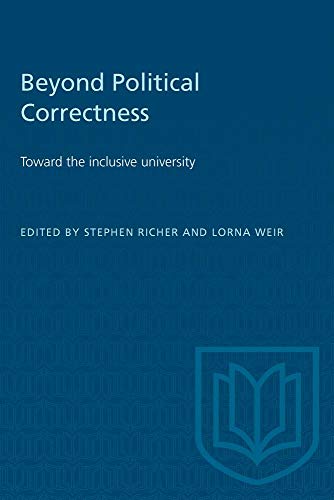
The term ‘political correctness’ has lately been transformed into a weapon of neo-conservatism. Once used to poke fun at social movements and civil-rights group for occasional lapses into rigidity, it has since become a popular handle for the neoconservative critique of higher education. Aimed at anti-racist and anti-sexist initiatives within universities, colleges, and other major social institutions, the term is used to discredit such innovations as employment equity, selective recruitment of students from groups that have suffered systemic discrimination, sexual harassment policies, and women’s studies programs, casting these as forms of tyranny that destroy academic freedom and merit.
This anthology is the first sociological analysis of political correctness and the first study of the phenomenon in Canada. Contributors argue on behalf of an inclusive university, showing that recent reforms not only work toward broadening human rights but provide a welcome reorganization of knowledge. All but two papers have been written specifically for this text.
Part One explores the history and social organization of the discourse, with the accent on Canadian material. The essays explore what the term has signified to different groups and to what ends they have used it. This section moves from an overview of political-correctness discourse to its explicit manifestation within universities in debates concerning academic ideals. Part Two looks at the classroom, a major site for building the inclusive university. Here, contributors explore feminist and anti-racist teaching and the limitations to such teaching imposed by the economic and political contexts of contemporary universities.
As these scholars trenchantly reveal, the political-correctness debate will ultimately affect the lives of everyone. This book offers insight into the values, ideals, and motives of both sides.
Die Inhaltsangabe kann sich auf eine andere Ausgabe dieses Titels beziehen.
Über die Autorinnen und Autoren
Stephen Richer is a professor in the Department of Sociology and Anthropology, Carleton University. Lorna Weir is an associate professor in the Department of Sociology, York University.
Lorna Weir is an associate professor in the Department of Sociology, York University.
„Über diesen Titel“ kann sich auf eine andere Ausgabe dieses Titels beziehen.
Suchergebnisse für Beyond Political Correctness: Toward the Inclusive...

Foto des Verkäufers
Beyond Political Correctness: Toward the Inclusive University
Verlag:
University of Toronto Press, 1995
ISBN 10: 080207748X
ISBN 13: 9780802077486
Gebraucht
Paperback
Anbieter: Southampton Books, Sag Harbor, NY, USA
Verkäuferbewertung 5 von 5 Sternen

Paperback. Zustand: Very Good. FIRST THUS. First Edition Thus, First Printing. Not price-clipped. Published by University of Toronto Press, 1995. Octavo. Paperback. Book is very good with very light edgewear. 100% positive feedback. 30 day money back guarantee. NEXT DAY SHIPPING! Excellent customer service. Please email with any questions. All books packed carefully and ship with free delivery confirmation/tracking. All books come with free bookmarks. Ships from Sag Harbor, New York. Artikel-Nr. 312856
Gebraucht kaufen
EUR 17,93
EUR 4,34 Versand
Versand innerhalb von USA
Versand innerhalb von USA
Anzahl: 1 verfügbar
Beispielbild für diese ISBN
Beyond Political Correctness : Towards the Inclusive University
Anbieter: Majestic Books, Hounslow, Vereinigtes Königreich
Verkäuferbewertung 4 von 5 Sternen

Zustand: New. pp. 272. Artikel-Nr. 108269195
Neu kaufen
EUR 38,48
EUR 7,58 Versand
Versand von Vereinigtes Königreich nach USA
Versand von Vereinigtes Königreich nach USA
Anzahl: 3 verfügbar
Beispielbild für diese ISBN
Beyond Political Correctness: Toward the inclusive university (Heritage)
Anbieter: Ria Christie Collections, Uxbridge, Vereinigtes Königreich
Verkäuferbewertung 5 von 5 Sternen
Zustand: New. In English. Artikel-Nr. ria9780802077486_new
Neu kaufen
EUR 41,33
EUR 13,17 Versand
Versand von Vereinigtes Königreich nach USA
Versand von Vereinigtes Königreich nach USA
Anzahl: Mehr als 20 verfügbar
Beispielbild für diese ISBN
Beyond Political Correctness: Toward the Inclusive University (Heritage)
Anbieter: Kennys Bookstore, Olney, MD, USA
Verkäuferbewertung 5 von 5 Sternen
Zustand: New. 1995. First Edition. paperback. . . . . . Books ship from the US and Ireland. Artikel-Nr. V9780802077486
Neu kaufen
EUR 45,53
EUR 9,14 Versand
Versand innerhalb von USA
Versand innerhalb von USA
Anzahl: Mehr als 20 verfügbar
Foto des Verkäufers
Richer, S: Beyond Political Correctness
Anbieter: moluna, Greven, Deutschland
Verkäuferbewertung 5 von 5 Sternen
Zustand: New. Artikel-Nr. 660594883
Neu kaufen
EUR 51,65
EUR 48,99 Versand
Versand von Deutschland nach USA
Versand von Deutschland nach USA
Anzahl: Mehr als 20 verfügbar
Foto des Verkäufers
Beyond Political Correctness | Toward the inclusive university
Verlag:
University of Toronto Press, 1995
ISBN 10: 080207748X
ISBN 13: 9780802077486
Neu
Taschenbuch
Anbieter: preigu, Osnabrück, Deutschland
Verkäuferbewertung 5 von 5 Sternen
Taschenbuch. Zustand: Neu. Beyond Political Correctness | Toward the inclusive university | Stephen Richer (u. a.) | Taschenbuch | Einband - flex.(Paperback) | Englisch | 1995 | University of Toronto Press | EAN 9780802077486 | Verantwortliche Person für die EU: Mare Nostrum Group B.V., Doelen 72, 4831 GR BREDA, NIEDERLANDE, gpsr[at]mare-nostrum[dot]co[dot]uk | Anbieter: preigu. Artikel-Nr. 132409776
Neu kaufen
EUR 33,80
EUR 70,00 Versand
Versand von Deutschland nach USA
Versand von Deutschland nach USA
Anzahl: 5 verfügbar
Foto des Verkäufers
Beyond Political Correctness : Toward the inclusive university
Verlag:
University Of Toronto Press Mai 1995, 1995
ISBN 10: 080207748X
ISBN 13: 9780802077486
Neu
Taschenbuch
Anbieter: AHA-BUCH GmbH, Einbeck, Deutschland
Verkäuferbewertung 5 von 5 Sternen
Taschenbuch. Zustand: Neu. Neuware - The term 'political correctness' has lately been transformed into a weapon of neo-conservatism. Once used to poke fun at social movements and civil-rights group for occasional lapses into rigidity, it has since become a popular handle for the neoconservative critique of higher education. Aimed at anti-racist and anti-sexist initiatives within universities, colleges, and other major social institutions, the term is used to discredit such innovations as employment equity, selective recruitment of students from groups that have suffered systemic discrimination, sexual harassment policies, and women's studies programs, casting these as forms of tyranny that destroy academic freedom and merit. This anthology is the first sociological analysis of political correctness and the first study of the phenomenon in Canada. Contributors argue on behalf of an inclusive university, showing that recent reforms not only work toward broadening human rights but provide a welcome reorganization of knowledge. All but two papers have been written specifically for this text. Part One explores the history and social organization of the discourse, with the accent on Canadian material. The essays explore what the term has signified to different groups and to what ends they have used it. This section moves from an overview of political-correctness discourse to its explicit manifestation within universities in debates concerning academic ideals. Part Two looks at the classroom, a major site for building the inclusive university. Here, contributors explore feminist and anti-racist teaching and the limitations to such teaching imposed by the economic and political contexts of contemporary universities. As these scholars trenchantly reveal, the political-correctness debate will ultimately affect the lives of everyone. This book offers insight into the values, ideals, and motives of both sides. Artikel-Nr. 9780802077486
Neu kaufen
EUR 95,55
EUR 30,50 Versand
Versand von Deutschland nach USA
Versand von Deutschland nach USA
Anzahl: 2 verfügbar