
Verwandte Artikel zu Views of Transition: Liturgy and Illumination in Medieval...
Inhaltsangabe
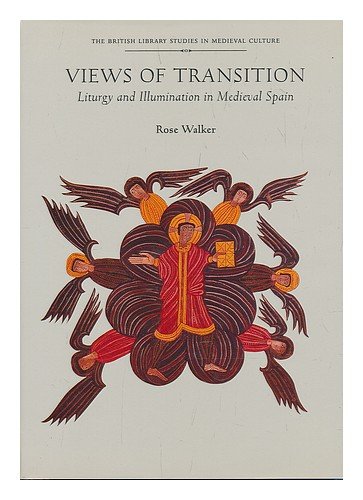
How did a society whose intellectual framework was founded on stasis and regression accommodate innovation? The Spanish Church of the eleventh century was confronted with precisely this problem when it was required to abandon the Mozarabic liturgy in favour of Roman texts.
By examining liturgical manuscripts contemporary with the change, this innovative comparative study reveals ways in which the new liturgy was introduced and received. Dr. Walker has chosen a group of liturgical manuscripts from the Silos corpus held in The British Library as the subject of her investigation. They are set alongside three missals from Spanish libraries, including the notable Missal of San Facundo. By analysing the content, presentation, and style of these little known manuscripts, she builds up a series of snap-shots of the textual and visual strategies employed in implementing liturgical change.
Die Inhaltsangabe kann sich auf eine andere Ausgabe dieses Titels beziehen.
Über die Autorin bzw. den Autor
Dr. Rose Walker is Academic Registrar of the Courtauldd Institute of Art, London.
„Über diesen Titel“ kann sich auf eine andere Ausgabe dieses Titels beziehen.
Suchergebnisse für Views of Transition: Liturgy and Illumination in Medieval...

Beispielbild für diese ISBN
Views of Transition: Liturgy and Illumination in Medieval Spain
Verlag:
Downsview, Ontario, Canada: Univ of Toronto Pr, 1998
ISBN 10: 0802043682
ISBN 13: 9780802043689
Gebraucht
Hardcover
Erstausgabe
Anbieter: Atticus Books, Toronto, ON, Kanada
Verkäuferbewertung 4 von 5 Sternen

Hardcover. Zustand: Very Good. Zustand des Schutzumschlags: Very Good. 1st Edition. The supplied photo is wrong. This is a heavily illustrated volume. A very heavy volume printed on coated paper that will require additional postage. "Change Was a Difficult Concept in Medieval Society; the Introduction of new or different ideas and approaches was generally viewed with suspicion, and could leave an innovator open to the charge of novitas, or innovation, or even heresy. Yet, change did occur. Rose Walker investigates the mechanism of change in the Middle Ages through the study of one particular innovation: the shift from the Mozarabic to the Roman liturgy in Spain after 1080. Walker focuses on the joint northern Spanish kingdoms of Leon and Castile to examine how the liturgical shift, initiated by the reforms of Pope Gregory VII, was reflected in the liturgical manuscripts of the time. By analysing the text and images in manuscripts of the Mozarabic and Roman liturgies produced in Spain before, during, and after the change in liturgy, she demonstrates how the presentation and decoration of liturgical texts helps to determine ways in which change was expressed, and to illuminate the perspective of those who had to put it into practice. " (Publisher). Artikel-Nr. H5220BK
Gebraucht kaufen
EUR 13,46
EUR 6,93 Versand
Versand von Kanada nach USA
Versand von Kanada nach USA
Anzahl: 1 verfügbar