
Verwandte Artikel zu The Cult of Remembrance and the Black Death: Six Renaissance...
Inhaltsangabe
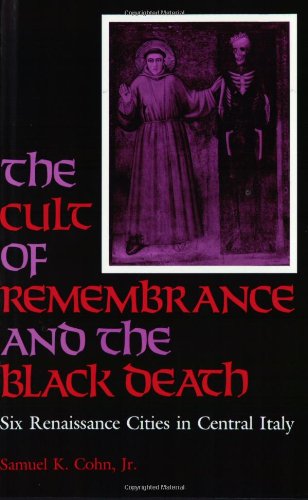
A comparative study of six Italian city-states--Arezzo, Florence, Perugia, Assisi, Pisa, and Siena--shows the rise of a new Renaissance cult of remembrance.
Die Inhaltsangabe kann sich auf eine andere Ausgabe dieses Titels beziehen.
Über die Autorin bzw. den Autor
Samuel K. Cohn, Jr., is professor of medieval history at the University of Glasgow, Scotland, and the author of The Laboring Classes in Renaissance Florence and co-editor of Portraits of Medieval and Renaissance Living: Essays in Memory of David Herlihy. His Women in the Streets: Essays on Sex and Power in the Italian Renaissance and Death and Property in Siena, winner of the Catholic Historical Association's Howard R. Marraro Prize for Italian History, are also available from Johns Hopkins.
Von der hinteren Coverseite
In his award-winning study, Death and Property in Siena, historian Samuel K. Cohn, Jr., used close analysis of last wills to chart transformations in mentalities over a six-hundred-year history. Now, in The Cult of Remembrance and the Black Death, Cohn applies the same methodology to fashion a comparative history of six Italian city-states - Arezzo, Florence, Perugia, Assisi, Pisa, and Siena - showing the rise of a new Renaissance cult of remembrance. In 1363 the Black Death devastated central Italy for the second time, causing a detectable shift in notions of afterlife and patterns of charitable giving. Throughout Tuscany and Umbria, patricians and peasants alike abandoned the practice of dividing their bequests into small sums, combining them instead into last gifts to enhance their "fame and glory". But this new cult of remembrance, Cohn argues, does not support Burckhardt's thesis of Renaissance "individualism". Instead, the new piety grew in tandem with reverence for ancestors and a strong sense of family identity founded on the importance of male blood lines. But rather than retreat into the religious pessimism of earlier times, survivors of the plague would develop into a new generation of art patrons, albeit one with a taste for distinctively cruder and more regimented forms of religious art. From the supposed center of Renaissance culture - Florence - to the citadel of Franciscan devotion - Assisi - the widespread change of sentiment created a new demand for monumental burials, testamentary commissions for art, and other efforts to exert control over the living from beyond the grave.
„Über diesen Titel“ kann sich auf eine andere Ausgabe dieses Titels beziehen.
Suchergebnisse für The Cult of Remembrance and the Black Death: Six Renaissance...

Beispielbild für diese ISBN
The Cult of Remembrance and the Black Death: Six Renaissance Cities in Central Italy
Verlag:
Johns Hopkins University Press, 1997
ISBN 10: 080185606X
ISBN 13: 9780801856068
Gebraucht
Soft cover
Anbieter: Twice Read Books, Napa, CA, USA
Verkäuferbewertung 5 von 5 Sternen

Soft cover. Zustand: Fine. Excellent condition, like new. Artikel-Nr. 002012
Gebraucht kaufen
EUR 13,69
Versand gratis
Versand innerhalb von USA
Versand innerhalb von USA
Anzahl: 1 verfügbar
Beispielbild für diese ISBN
The Cult of Remembrance and the Black Death: Six Renaissance Cities in Central Italy
Verlag:
Johns Hopkins University Press, 1997
ISBN 10: 080185606X
ISBN 13: 9780801856068
Gebraucht
Paperback
Anbieter: ThriftBooks-Atlanta, AUSTELL, GA, USA
Verkäuferbewertung 5 von 5 Sternen
Paperback. Zustand: As New. No Jacket. Pages are clean and are not marred by notes or folds of any kind. ~ ThriftBooks: Read More, Spend Less. Artikel-Nr. G080185606XI2N00
Gebraucht kaufen
EUR 14,82
Versand gratis
Versand innerhalb von USA
Versand innerhalb von USA
Anzahl: 1 verfügbar
Foto des Verkäufers
The Cult of Remembrance and the Black Death: Six Renaissance Cities in Central Italy
Verlag:
Johns Hopkins University Press, 1992
ISBN 10: 080185606X
ISBN 13: 9780801856068
Gebraucht
Paperback
Anbieter: BoundlessBookstore, Wallingford, Vereinigtes Königreich
Verkäuferbewertung 5 von 5 Sternen
Paperback. Zustand: Good. Good condition paperback with minimal wear. Contents are clean. Artikel-Nr. 9999-999106522853
Gebraucht kaufen
EUR 10,37
EUR 8,21 Versand
Versand von Vereinigtes Königreich nach USA
Versand von Vereinigtes Königreich nach USA
Anzahl: 1 verfügbar
Foto des Verkäufers
The Cult of Remembrance and the Black Death: Six Renaissance Cities in Central Italy
Anbieter: crealivres, La fontennelle, Frankreich
Verkäuferbewertung 5 von 5 Sternen
Zustand: Good. Envoi rapide Bon état tranche un peu ternie quelques légères rousseurs intérieur propre. 15 24x2 79x22 61cm. 1997. Broché. 448 pages. Good. Artikel-Nr. 100126320
Gebraucht kaufen
EUR 17,00
EUR 14,00 Versand
Versand von Frankreich nach USA
Versand von Frankreich nach USA
Anzahl: 1 verfügbar
Beispielbild für diese ISBN
The Cult of Remembrance and the Black Death: Six Renaissance Cities in Central Italy
Verlag:
Johns Hopkins University Press, 1997
ISBN 10: 080185606X
ISBN 13: 9780801856068
Gebraucht
Paperback
Erstausgabe
Anbieter: Prior Books Ltd, Cheltenham, Vereinigtes Königreich
Verkäuferbewertung 5 von 5 Sternen
Paperback. Zustand: Very Good. First Edition. Original stiff card covers; in very good shape; no tears, chips or creases, just mildly rubbed and edge-worn. Contents sound and clean; no pen-marks. Not from a library so no such stamps or labels. Artikel-Nr. 208337
Gebraucht kaufen
EUR 12,12
EUR 25,89 Versand
Versand von Vereinigtes Königreich nach USA
Versand von Vereinigtes Königreich nach USA
Anzahl: 1 verfügbar
Foto des Verkäufers
The cult of remembrance and the Black Death. Six Renaissance cities in central Italy
Verlag:
Baltimore : Johns Hopkins University Press, 1992
ISBN 10: 080185606X
ISBN 13: 9780801856068
Gebraucht
Originalbroschur.
Anbieter: Borkert, Schwarz und Zerfaß GbR, Berlin, Deutschland
Verkäuferbewertung 5 von 5 Sternen
Originalbroschur. Zustand: Gut. XIII, 429 S. Einband leicht berieben. - In 1363 the Black Death struck central Italy for the second time, causing a detectable shift in notions of the afterlife and patterns of charitable giving. Throughout Tuscany and Umbria, patricians and peasants alike abandoned their previous practice of dividing bequests into small sums, combining them instead into last gifts to enhance their "fame and glory" and that of their lineages. Illustrative of the new mentality, religious art patronage spread to new social classes, touching even peasants, who sought to be represented "in their very likeness" at the feet of their patron saints. From the center of Renaissance culture-Florence-to the citadel of Franciscan devotion-Assisi-this change in sentiment spurred new levels of demand for monumental burials, testamentary commissions for art, and other efforts to exert control over the living from the grave. In his award-winning study, Death and Property in Siena, historian Samuel K. Cohn, Jr., used close analysis of last wills to chart transformations in mentalities over a six-hundred-year history. In The Cult of Remembrance and the Black Death, he applies the same methods to compare six Italian city-states-Arezzo, Florence, Perugia, Assisi, Pisa, and Siena-showing the rise of a new Renaissance cult of remembrance. But this new cult was not Burckhardt's Renaissance "individualism" tout court. Instead, the new piety grew in tandem with reverence for the ancestors and a strong sense of family identity that flowed down male blood lines. ISBN 9780801856068 Sprache: Englisch Gewicht in Gramm: 550. Artikel-Nr. 1089577
Gebraucht kaufen
EUR 27,00
EUR 40,00 Versand
Versand von Deutschland nach USA
Versand von Deutschland nach USA
Anzahl: 2 verfügbar