
Verwandte Artikel zu Pandora's Daughters: The Role & Status of Women...
Pandora's Daughters: The Role & Status of Women in Greek & Roman Antiquity: The Role and Status of Women in Greek and Roman Antiquity (Ancient Society and History) - Hardcover
Inhaltsangabe
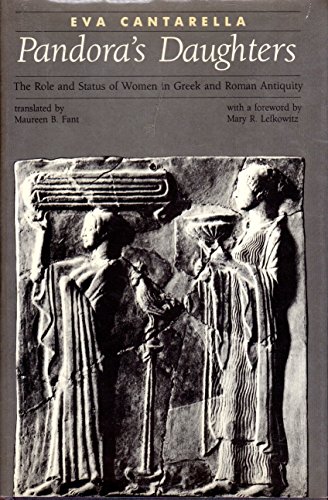
Expanded and updated for this English-language translation, Pandora's Daughters offers the first history of women in ancient Greece and Rome to be written from a legal perspective. Moving outward from an examination of the legal evidence―the laws governing marriage and divorce, sexual behavior, and inheritance―Cantarella demonstrates how literary, anecdotal, and juridical sources can and cannot be used to discover what Greek and Roman men thought about women. She offers a provocative feminist interpretation of the sociological information that can be derived from law codes, lawyers' speeches, records and discussions of custom, and legislation to determine the status of women in society. At the same time she draws upon the evidence of myth, ritual, and literature to question whether women were actually subjugated to the extent that the alws imply.
Cantarella also provides a balanced evaluation of one of the most controversial issues in women's history, the question of matriarchy in prehistoric Greece and Rome. She considers the original sources that have been used as evidence while taking into account the historical contexts in which modern theories of women's societies have been produces.
By examining the structures of Greek and Roman society, Pandora's Daughters reveals the points at which sexual roles became codified and came to be viewed as biological rather than cultural. The societies of ancient Greece and Rome, Cantarella demonstrates, were violently misogynistic. Yet in many respects the position of women in pagan antiquity was higher than it would be under Christianity.
Die Inhaltsangabe kann sich auf eine andere Ausgabe dieses Titels beziehen.
Über die Autorinnen und Autoren
Eva Cantarella has taught at the universities of Camerino and Milan and currently holds the chair in the history of Roman law at the University of Parma.
Maureen B. Fant studied classics and archaeology at the University of Michigan and is now a writer and editor living in Rome, Italy.
„Über diesen Titel“ kann sich auf eine andere Ausgabe dieses Titels beziehen.
Suchergebnisse für Pandora's Daughters: The Role & Status of Women...

Beispielbild für diese ISBN
Pandora's Daughters : The Role and Status of Women in Greek and Roman Antiquity
Verlag:
Johns Hopkins University Press, 1986
ISBN 10: 0801831938
ISBN 13: 9780801831935
Gebraucht
Hardcover
Erstausgabe
Anbieter: Better World Books, Mishawaka, IN, USA
Verkäuferbewertung 5 von 5 Sternen

Zustand: Good. 1st. Former library copy. Pages intact with minimal writing/highlighting. The binding may be loose and creased. Dust jackets/supplements are not included. Includes library markings. Stock photo provided. Product includes identifying sticker. Better World Books: Buy Books. Do Good. Artikel-Nr. 4748220-6
Gebraucht kaufen
EUR 8,13
Versand gratis
Versand innerhalb von USA
Versand innerhalb von USA
Anzahl: 3 verfügbar
Beispielbild für diese ISBN
Pandora's Daughters: The Role and Status of Women in Greek and Roman Antiquity
Verlag:
The Johns Hopkins University Press, 1987
ISBN 10: 0801831938
ISBN 13: 9780801831935
Gebraucht
Hardcover
Anbieter: ThriftBooks-Dallas, Dallas, TX, USA
Verkäuferbewertung 5 von 5 Sternen
Hardcover. Zustand: Good. No Jacket. Former library book; Pages can have notes/highlighting. Spine may show signs of wear. ~ ThriftBooks: Read More, Spend Less. Artikel-Nr. G0801831938I3N10
Gebraucht kaufen
EUR 9,16
Versand gratis
Versand innerhalb von USA
Versand innerhalb von USA
Anzahl: 1 verfügbar
Beispielbild für diese ISBN
PANDORA'S DAUGHTERS; The Role and Status of Women in Greek and Roman Antiquity
Verlag:
The Johns Hopkins University Press, 1987
ISBN 10: 0801831938
ISBN 13: 9780801831935
Gebraucht
Hardcover
Anbieter: Ancient World Books, Toronto, ON, Kanada
Verkäuferbewertung 5 von 5 Sternen
Hardcover. Zustand: Very Good. Zustand des Schutzumschlags: Very Good. Minor shelfwear.; Ancient Society and History; 248 pages. Artikel-Nr. 29019
Gebraucht kaufen
EUR 11,02
EUR 6,69 Versand
Versand von Kanada nach USA
Versand von Kanada nach USA
Anzahl: 2 verfügbar
Beispielbild für diese ISBN
Pandora's Daughters: The Role and Status of Women in Greek and Roman Antiquity
Verlag:
The Johns Hopkins University Pre, 1987
ISBN 10: 0801831938
ISBN 13: 9780801831935
Gebraucht
Hardcover
Anbieter: Books From California, Simi Valley, CA, USA
Verkäuferbewertung 4 von 5 Sternen

Hardcover. Zustand: Good. Artikel-Nr. mon0004206026
Gebraucht kaufen
EUR 13,50
EUR 4,45 Versand
Versand innerhalb von USA
Versand innerhalb von USA
Anzahl: 1 verfügbar
Beispielbild für diese ISBN
Pandora's Daughters. The Role and Status of Women in Greek and Roman Antiquity. Translated by M.B. Fant. With a foreword by M.R. Lefkowitz.
Verlag:
The Johns Hopkins University Press, 1987
ISBN 10: 0801831938
ISBN 13: 9780801831935
Gebraucht
Hardcover
Anbieter: Scrinium Classical Antiquity, Aalten, Niederlande
Verkäuferbewertung 5 von 5 Sternen
Johns Hopkins University Press, Baltimore / London, 1987. XIV,229p. Paperback. 'This work 'traces women's positions and male attitudes toward women in ancient Greek and Roman society, while touching on a broader time period (?). Hesiod's description of Pandora - she is viewed as outwardly beautiful but inwardly malevolent and a curse to man - aptly states the opinion of the vast majority of ancient male writers. Women were a necessary evil, an evil that was needed only for purposes of reproduction. The misogyny of the ancients is clearly seen in their legal documents, literature, speeches, and customs. (?) Cantarella begins with a look at matriarchy from the earliest times, glancing at the Paleolithic and Neolithic (?), but she concentrates on the Minoan period (?). Clearly, women held an elevated position in Minoan society as seen by the fact that they were not segregated and enjoyed social gatherings with men; goddesses were prevalent, if not dominant. (?) It is with the Mycenaean society (?) with its stronger emphasis on male gods and the rise of military power that we begin to see the decline of the status of women. This decline picked up speed with the rise of the polis, and reached its height (?) during the classical period.' (KARLENE JONES-BLEY in NWSA Journal, 1992, p.387). Artikel-Nr. 59038
Gebraucht kaufen
EUR 20,00
EUR 27,50 Versand
Versand von Niederlande nach USA
Versand von Niederlande nach USA
Anzahl: 1 verfügbar