
Verwandte Artikel zu "If the Workers Took a Notion": The Right to...
Inhaltsangabe
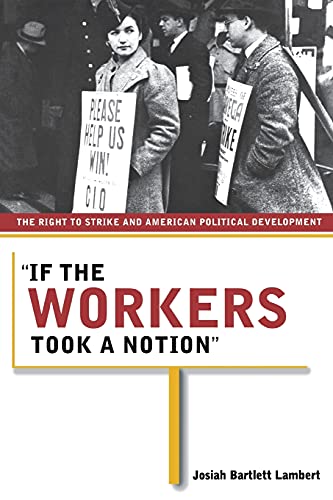
Once a fundamental civic right, strikes are now constrained and contested. In an unusual and thought-provoking history, Josiah Bartlett Lambert shows how the ability to strike was transformed from a fundamental right that made the citizenship of working people possible into a conditional and commercialized function. Arguing that the executive branch, rather than the judicial branch, was initially responsible for the shift in attitudes about the necessity for strikes and that the rise of liberalism has contributed to the erosion of strikers' rights, Lambert analyzes this transformation in relation to American political thought. His narrative begins before the Civil War and takes the reader through the permanent striker replacement issue and the alienation of workplace-based collective action from community-based collective action during the 1960s. "If the Workers Took a Notion" maps the connections among American political development, labor politics, and citizenship to support the claim that the right to strike ought to be a citizenship right and once was regarded as such. Lambert argues throughout that the right to strike must be protected. He challenges the current "law turn" in labor scholarship and takes into account the role of party alliances, administrative agencies, the military, and the rise of modern presidential powers.
Once a fundamental civic right, strikes are now constrained and contested. In an unusual and thought-provoking history, Josiah Bartlett Lambert shows how the ability to strike was transformed from a fundamental right that made the citizenship of working people possible into a conditional and commercialized function. Arguing that the executive branch, rather than the judicial branch, was initially responsible for the shift in attitudes about the necessity for strikes and that the rise of liberalism has contributed to the erosion of strikers' rights, Lambert analyzes this transformation in relation to American political thought. His narrative begins before the Civil War and takes the reader through the permanent striker replacement issue and the alienation of workplace-based collective action from community-based collective action during the 1960s.
"If the Workers Took a Notion" maps the connections among American political development, labor politics, and citizenship to support the claim that the right to strike ought to be a citizenship right and once was regarded as such. Lambert argues throughout that the right to strike must be protected. He challenges the current "law turn" in labor scholarship and takes into account the role of party alliances, administrative agencies, the military, and the rise of modern presidential powers.
Die Inhaltsangabe kann sich auf eine andere Ausgabe dieses Titels beziehen.
Über die Autorin bzw. den Autor
Josiah Bartlett Lambert is Assistant Professor of Political Science at St. Bonaventure University.
„Über diesen Titel“ kann sich auf eine andere Ausgabe dieses Titels beziehen.
Suchergebnisse für "If the Workers Took a Notion": The Right to...

Beispielbild für diese ISBN
If the Workers Took a Notion: The Right to Strike and American Political Development
Anbieter: Magers and Quinn Booksellers, Minneapolis, MN, USA
Verkäuferbewertung 5 von 5 Sternen

paperback. Zustand: Very Good. May have light to moderate shelf wear and/or a remainder mark. Complete. Clean pages. Artikel-Nr. 1559167
Gebraucht kaufen
EUR 8,23
EUR 3,55 Versand
Versand innerhalb von USA
Versand innerhalb von USA
Anzahl: 1 verfügbar
Beispielbild für diese ISBN
If the Workers Took a Notion : The Right to Strike and American Political Development
Verlag:
Cornell University Press, 2005
ISBN 10: 0801489458
ISBN 13: 9780801489457
Gebraucht
Softcover
Anbieter: Better World Books, Mishawaka, IN, USA
Verkäuferbewertung 5 von 5 Sternen
Zustand: Good. Pages intact with minimal writing/highlighting. The binding may be loose and creased. Dust jackets/supplements are not included. Stock photo provided. Product includes identifying sticker. Better World Books: Buy Books. Do Good. Artikel-Nr. 17043642-20
Gebraucht kaufen
EUR 12,71
Versand gratis
Versand innerhalb von USA
Versand innerhalb von USA
Anzahl: 1 verfügbar
Foto des Verkäufers
"If the Workers Took a Notion": The Right to Strike and American Political Development.
Anbieter: Kloof Booksellers & Scientia Verlag, Amsterdam, Niederlande
Verkäuferbewertung 4 von 5 Sternen

Zustand: very good. Ithaca :ILR Press, 2005. Paperback. 272 pp. Once a fundamental civic right, strikes are now constrained and contested. In an unusual and thought-provoking history, Josiah Bartlett Lambert shows how the ability to strike was transformed from a fundamental right that made the citizenship of working people possible into a conditional and commercialized function. Arguing that the executive branch, rather than the judicial branch, was initially responsible for the shift in attitudes about the necessity for strikes and that the rise of liberalism has contributed to the erosion of strikers' rights, Lambert analyzes this transformation in relation to American political thought. His narrative begins before the Civil War and takes the reader through the permanent striker replacement issue and the alienation of workplace-based collective action from community-based collective action during the 1960s. "If the Workers Took a Notion" maps the connections among American political development, labor politics, and citizenship to support the claim that the right to strike ought to be a citizenship right and once was regarded as such. Lambert argues throughout that the right to strike must be protected. He challenges the current "law turn" in labor scholarship and takes into account the role of party alliances, administrative agencies, the military, and the rise of modern presidential powers. Condition : very good copy. ISBN 9780801489457. Keywords : RECHT, English law. Artikel-Nr. 279698
Gebraucht kaufen
EUR 16,95
EUR 30,00 Versand
Versand von Niederlande nach USA
Versand von Niederlande nach USA
Anzahl: 1 verfügbar
Beispielbild für diese ISBN
"If the Workers Took a Notion" The Right to Strike and American Political Development
Anbieter: Revaluation Books, Exeter, Vereinigtes Königreich
Verkäuferbewertung 5 von 5 Sternen
Paperback. Zustand: Brand New. illustrated edition. 272 pages. 9.00x6.00x0.75 inches. In Stock. Artikel-Nr. x-0801489458
Neu kaufen
EUR 62,40
EUR 14,67 Versand
Versand von Vereinigtes Königreich nach USA
Versand von Vereinigtes Königreich nach USA
Anzahl: 2 verfügbar
Foto des Verkäufers
IF THE WORKERS TOOK A NOTION
Anbieter: moluna, Greven, Deutschland
Verkäuferbewertung 5 von 5 Sternen
Zustand: New. Once a fundamental civic right, strikes are now constrained and contested. In an unusual and thought-provoking history, Josiah Bartlett Lambert shows how the ability to strike was transformed from a fundamental right that made the citizenship of.K. Artikel-Nr. 867667188
Neu kaufen
EUR 48,25
EUR 48,99 Versand
Versand von Deutschland nach USA
Versand von Deutschland nach USA
Anzahl: Mehr als 20 verfügbar
Foto des Verkäufers
"\"If the Workers Took a Notion\" : The Right to Strike and American Political Development"
Verlag:
Cornell University Press Sep 2005, 2005
ISBN 10: 0801489458
ISBN 13: 9780801489457
Neu
Taschenbuch
Anbieter: AHA-BUCH GmbH, Einbeck, Deutschland
Verkäuferbewertung 5 von 5 Sternen
Taschenbuch. Zustand: Neu. Neuware - He challenges the current 'law turn' in labor scholarship and takes into account the role of party alliances, administrative agencies, the military, and the rise of modern presidential powers. Artikel-Nr. 9780801489457
Neu kaufen
EUR 62,74
EUR 35,00 Versand
Versand von Deutschland nach USA
Versand von Deutschland nach USA
Anzahl: 2 verfügbar