
Verwandte Artikel zu The Life Informatic: Newsmaking in the Digital Era...
The Life Informatic: Newsmaking in the Digital Era (Expertise: Cultures and Technologies of Knowledge) - Softcover
Buch 5 von 17: Expertise: Cultures and Technologies of Knowledge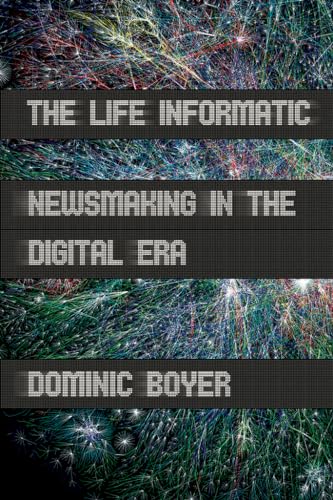
Inhaltsangabe
News journalism is in the midst of radical transformation brought about by the spread of digital information and communication technology and the rise of neoliberalism. What does it look like, however, from the inside of a news organization? In The Life Informatic, Dominic Boyer offers the first anthropological ethnography of contemporary office-based news journalism. The result is a fascinating account of journalists struggling to maintain their expertise and authority, even as they find their principles and skills profoundly challenged by ever more complex and fast-moving streams of information.
Boyer conducted his fieldwork inside three news organizations in Germany (a world leader in digital journalism) supplemented by extensive interviews in the United States. His findings challenge popular and scholarly images of journalists as roving truth-seekers, showing instead the extent to which sedentary office-based "screenwork" (such as gathering and processing information online) has come to dominate news journalism. To explain this phenomenon Boyer puts forth the notion of "digital liberalism"—a powerful convergence of technological and ideological forces over the past two decades that has rebalanced electronic mediation from the radial (or broadcast) tendencies of the mid-twentieth century to the lateral (or peer-to-peer) tendencies that dominate in the era of the Internet and social media. Under digital liberalism an entire regime of media, knowledge, and authority has become integrated around liberal principles of individuality and publicity, both unmaking and remaking news institutions of the broadcast era. Finally, Boyer offers some scenarios for how news journalism will develop in the future and discusses how other intellectual professionals, such as ethnographers, have also become more screenworkers than fieldworkers.
News journalism is in the midst of radical transformation brought about by the spread of digital information and communication technology and the rise of neoliberalism. What does it look like, however, from the inside of a news organization? In The Life Informatic, Dominic Boyer offers the first anthropological ethnography of contemporary office-based news journalism. The result is a fascinating account of journalists struggling to maintain their expertise and authority, even as they find their principles and skills profoundly challenged by ever more complex and fast-moving streams of information.Boyer conducted his fieldwork inside three news organizations in Germany (a world leader in digital journalism) supplemented by extensive interviews in the United States. His findings challenge popular and scholarly images of journalists as roving truth-seekers, showing instead the extent to which sedentary office-based "screenwork" (such as gathering and processing information online) has come to dominate news journalism. To explain this phenomenon Boyer puts forth the notion of "digital liberalism"—a powerful convergence of technological and ideological forces over the past two decades that has rebalanced electronic mediation from the radial (or broadcast) tendencies of the mid-twentieth century to the lateral (or peer-to-peer) tendencies that dominate in the era of the Internet and social media. Under digital liberalism an entire regime of media, knowledge, and authority has become integrated around liberal principles of individuality and publicity, both unmaking and remaking news institutions of the broadcast era. Finally, Boyer offers some scenarios for how news journalism will develop in the future and discusses how other intellectual professionals, such as ethnographers, have also become more screenworkers than fieldworkers.
Die Inhaltsangabe kann sich auf eine andere Ausgabe dieses Titels beziehen.
Über die Autorin bzw. den Autor
Dominic Boyer is Associate Professor of Anthropology at Rice University. He is the author of Understanding Media: A Popular Philosophy and Spirit and System: Media, Intellectuals and the Dialectic in Modern German Culture.
„Über diesen Titel“ kann sich auf eine andere Ausgabe dieses Titels beziehen.
Suchergebnisse für The Life Informatic: Newsmaking in the Digital Era...

Beispielbild für diese ISBN
The Life Informatic: Newsmaking in the Digital Era
Verlag:
Cornell University Press, 2013
ISBN 10: 0801478588
ISBN 13: 9780801478581
Gebraucht
Paperback
Anbieter: ThriftBooks-Atlanta, AUSTELL, GA, USA
Verkäuferbewertung 5 von 5 Sternen

Paperback. Zustand: Good. No Jacket. Former library book; Pages can have notes/highlighting. Spine may show signs of wear. ~ ThriftBooks: Read More, Spend Less. Artikel-Nr. G0801478588I3N10
Gebraucht kaufen
EUR 21,74
Versand gratis
Versand innerhalb von USA
Versand innerhalb von USA
Anzahl: 1 verfügbar
Beispielbild für diese ISBN
The Life Informatic Newsmaking in the Digital Era
Anbieter: Revaluation Books, Exeter, Vereinigtes Königreich
Verkäuferbewertung 5 von 5 Sternen
Paperback. Zustand: Brand New. 1st edition. 240 pages. 9.25x6.00x0.75 inches. In Stock. Artikel-Nr. x-0801478588
Neu kaufen
EUR 71,25
EUR 11,67 Versand
Versand von Vereinigtes Königreich nach USA
Versand von Vereinigtes Königreich nach USA
Anzahl: 2 verfügbar
Beispielbild für diese ISBN
The Life Informatic: Newsmaking in the Digital Era
Anbieter: Kennys Bookstore, Olney, MD, USA
Verkäuferbewertung 5 von 5 Sternen
Zustand: New. Series: Expertise: Cultures and Technologies of Knowledge. Num Pages: 240 pages, 12, 10 black & white halftones, 2 line drawings. BIC Classification: JFD. Category: (G) General (US: Trade). Dimension: 228 x 152 x 14. Weight in Grams: 336. . 2013. 1st Edition. Paperback. . . . . Books ship from the US and Ireland. Artikel-Nr. V9780801478581
Neu kaufen
EUR 81,66
EUR 9,26 Versand
Versand innerhalb von USA
Versand innerhalb von USA
Anzahl: 6 verfügbar
Foto des Verkäufers
LIFE INFORMATIC
Anbieter: moluna, Greven, Deutschland
Verkäuferbewertung 5 von 5 Sternen
Zustand: New. A fascinating account of journalists struggling to maintain their expertise and authority, even as they find their principles and skills profoundly challenged by ever more complex and fast-moving streams of information.KlappentextrnrnDomi. Artikel-Nr. 595003963
Neu kaufen
EUR 55,05
EUR 48,99 Versand
Versand von Deutschland nach USA
Versand von Deutschland nach USA
Anzahl: 5 verfügbar
Foto des Verkäufers
The Life Informatic : Newsmaking in the Digital Era
Verlag:
Cornell University Press Mai 2013, 2013
ISBN 10: 0801478588
ISBN 13: 9780801478581
Neu
Taschenbuch
Anbieter: AHA-BUCH GmbH, Einbeck, Deutschland
Verkäuferbewertung 5 von 5 Sternen
Taschenbuch. Zustand: Neu. Neuware - Dominic Boyer is Associate Professor of Anthropology at Rice University. He is the author of Understanding Media: A Popular Philosophy and Spirit and System: Media, Intellectuals and the Dialectic in Modern German Culture. Artikel-Nr. 9780801478581
Neu kaufen
EUR 72,86
EUR 35,00 Versand
Versand von Deutschland nach USA
Versand von Deutschland nach USA
Anzahl: 1 verfügbar