
Verwandte Artikel zu Plutonium: A History of the World's Most Dangerous...
Inhaltsangabe
When plutonium was first manufactured at Berkeley in the spring of 1941, there was so little of it that it was not visible to the naked eye. It took a year to accumulate enough so that one could actually see it. Now so much has been produced that we don't know what to do to get rid of it. We have created a monster.
The history of plutonium is as strange as the element itself. When scientists began looking for it, they did so simply in the spirit of inquiry, not certain whether there were still spots to fill on the periodic table. But the discovery of fission made it clear that this still-hypothetical element would be more than just a scientific curiosity-it could be the main ingredient of a powerful nuclear weapon.
As it turned out, it is good for almost nothing else. Plutonium's nuclear potential put it at the heart of the World War II arms race-the Russians found out about it through espionage, the Germans through independent research, and everybody wanted some. Now it is warehoused around the world-the United States alone possesses about forty-seven metric tons-but it has almost no practical use outside its role in nuclear weaponry. How did the product of scientific curiosity become such a dangerous burden?
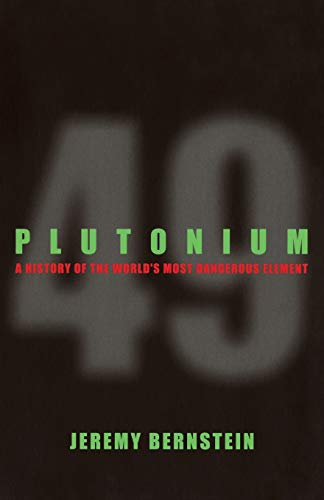
In his history of this complex and dangerous element, noted physicist Jeremy Bernstein describes the steps that were taken to transform plutonium from a laboratory novelty into the nuclear weapon that destroyed Nagasaki. This is the first book to weave together the many strands of plutonium's story, explaining not only the science but also the people involved.
When plutonium was first manufactured at Berkeley in the spring of 1941, there was so little of it that it was not visible to the naked eye. It took a year to accumulate enough so that one could actually see it. Now so much has been produced that we don't know what to do to get rid of it. We have created a monster.The history of plutonium is as strange as the element itself. When scientists began looking for it, they did so simply in the spirit of inquiry, not certain whether there were still spots to fill on the periodic table. But the discovery of fission made it clear that this still-hypothetical element would be more than just a scientific curiosity—it could be the main ingredient of a powerful nuclear weapon. As it turned out, it is good for almost nothing else. Plutonium's nuclear potential put it at the heart of the World War II arms race—the Russians found out about it through espionage, the Germans through independent research, and everybody wanted some. Now it is warehoused around the world—the United States alone possesses about forty-seven metric tons—but it has almost no practical use outside its role in nuclear weaponry. How did the product of scientific curiosity become such a dangerous burden?In his history of this complex and dangerous element, noted physicist Jeremy Bernstein describes the steps that were taken to transform plutonium from a laboratory novelty into the nuclear weapon that destroyed Nagasaki. This is the first book to weave together the many strands of plutonium's story, explaining not only the science but also the people involved.
Die Inhaltsangabe kann sich auf eine andere Ausgabe dieses Titels beziehen.
Über die Autorin bzw. den Autor
Jeremy Bernstein was a staff writer at the New Yorker for thirty-five years and is Professor Emeritus of Physics at the Stevens Institute of Technology. His books include Oppenheimer: Portrait of an Enigma.
„Über diesen Titel“ kann sich auf eine andere Ausgabe dieses Titels beziehen.
Suchergebnisse für Plutonium: A History of the World's Most Dangerous...

Beispielbild für diese ISBN
Plutonium A History of the Wor
Verlag:
Cornell University Press, 2009
ISBN 10: 0801475171
ISBN 13: 9780801475177
Gebraucht
Softcover
Anbieter: World of Books (was SecondSale), Montgomery, IL, USA
Verkäuferbewertung 5 von 5 Sternen

Zustand: Very Good. Item in very good condition! Textbooks may not include supplemental items i.e. CDs, access codes etc. Artikel-Nr. 00104460568
Gebraucht kaufen
EUR 4,84
Versand gratis
Versand innerhalb von USA
Versand innerhalb von USA
Anzahl: 1 verfügbar
Foto des Verkäufers
Plutonium: A History of the World's Most Dangerous Element
Verlag:
Cornell University Press, 2009
ISBN 10: 0801475171
ISBN 13: 9780801475177
Gebraucht
Softcover
Anbieter: Dream Books Co., Denver, CO, USA
Verkäuferbewertung 5 von 5 Sternen
Zustand: acceptable. This copy has clearly been enjoyedâ"expect noticeable shelf wear and some minor creases to the cover. Binding is strong, and all pages are legible. May contain previous library markings or stamps. Artikel-Nr. DBV.0801475171.A
Gebraucht kaufen
EUR 4,85
Versand gratis
Versand innerhalb von USA
Versand innerhalb von USA
Anzahl: 1 verfügbar
Beispielbild für diese ISBN
Plutonium: A History of the World's Most Dangerous Element
Verlag:
Cornell University Press (edition 1), 2009
ISBN 10: 0801475171
ISBN 13: 9780801475177
Gebraucht
Paperback
Anbieter: BooksRun, Philadelphia, PA, USA
Verkäuferbewertung 5 von 5 Sternen
Paperback. Zustand: Very Good. 1. It's a well-cared-for item that has seen limited use. The item may show minor signs of wear. All the text is legible, with all pages included. It may have slight markings and/or highlighting. Artikel-Nr. 0801475171-11-1
Gebraucht kaufen
EUR 5,26
Versand gratis
Versand innerhalb von USA
Versand innerhalb von USA
Anzahl: 1 verfügbar
Beispielbild für diese ISBN
Plutonium
Verlag:
Cornell University Press, 2009
ISBN 10: 0801475171
ISBN 13: 9780801475177
Gebraucht
Paperback
Anbieter: ThriftBooks-Dallas, Dallas, TX, USA
Verkäuferbewertung 5 von 5 Sternen
Paperback. Zustand: Very Good. No Jacket. May have limited writing in cover pages. Pages are unmarked. ~ ThriftBooks: Read More, Spend Less. Artikel-Nr. G0801475171I4N00
Gebraucht kaufen
EUR 6,76
Versand gratis
Versand innerhalb von USA
Versand innerhalb von USA
Anzahl: 1 verfügbar
Beispielbild für diese ISBN
Plutonium
Verlag:
Cornell University Press, 2009
ISBN 10: 0801475171
ISBN 13: 9780801475177
Gebraucht
Paperback
Anbieter: ThriftBooks-Atlanta, AUSTELL, GA, USA
Verkäuferbewertung 5 von 5 Sternen
Paperback. Zustand: Very Good. No Jacket. May have limited writing in cover pages. Pages are unmarked. ~ ThriftBooks: Read More, Spend Less. Artikel-Nr. G0801475171I4N00
Gebraucht kaufen
EUR 6,76
Versand gratis
Versand innerhalb von USA
Versand innerhalb von USA
Anzahl: 1 verfügbar
Beispielbild für diese ISBN
Plutonium
Verlag:
Cornell University Press, 2009
ISBN 10: 0801475171
ISBN 13: 9780801475177
Gebraucht
Paperback
Anbieter: ThriftBooks-Dallas, Dallas, TX, USA
Verkäuferbewertung 5 von 5 Sternen
Paperback. Zustand: Good. No Jacket. Pages can have notes/highlighting. Spine may show signs of wear. ~ ThriftBooks: Read More, Spend Less. Artikel-Nr. G0801475171I3N00
Gebraucht kaufen
EUR 6,76
Versand gratis
Versand innerhalb von USA
Versand innerhalb von USA
Anzahl: 1 verfügbar
Beispielbild für diese ISBN
Plutonium
Verlag:
Cornell University Press, 2009
ISBN 10: 0801475171
ISBN 13: 9780801475177
Gebraucht
Paperback
Anbieter: ThriftBooks-Dallas, Dallas, TX, USA
Verkäuferbewertung 5 von 5 Sternen
Paperback. Zustand: Fair. No Jacket. Readable copy. Pages may have considerable notes/highlighting. ~ ThriftBooks: Read More, Spend Less. Artikel-Nr. G0801475171I5N00
Gebraucht kaufen
EUR 6,76
Versand gratis
Versand innerhalb von USA
Versand innerhalb von USA
Anzahl: 1 verfügbar
Beispielbild für diese ISBN
Plutonium
Anbieter: PBShop.store UK, Fairford, GLOS, Vereinigtes Königreich
Verkäuferbewertung 5 von 5 Sternen
PAP. Zustand: New. New Book. Shipped from UK. Established seller since 2000. Artikel-Nr. FW-9780801475177
Neu kaufen
EUR 20,55
EUR 4,85 Versand
Versand von Vereinigtes Königreich nach USA
Versand von Vereinigtes Königreich nach USA
Anzahl: 5 verfügbar
Beispielbild für diese ISBN
Plutonium A History of the World`s Most Dangerous Element
Anbieter: Revaluation Books, Exeter, Vereinigtes Königreich
Verkäuferbewertung 5 von 5 Sternen
Paperback. Zustand: Brand New. 1st edition. 216 pages. 8.50x5.50x0.75 inches. In Stock. Artikel-Nr. __0801475171
Neu kaufen
EUR 21,62
EUR 11,67 Versand
Versand von Vereinigtes Königreich nach USA
Versand von Vereinigtes Königreich nach USA
Anzahl: 1 verfügbar
Beispielbild für diese ISBN
Plutonium
Anbieter: Majestic Books, Hounslow, Vereinigtes Königreich
Verkäuferbewertung 4 von 5 Sternen

Zustand: New. pp. 216 34 Illus. Artikel-Nr. 7968283
Neu kaufen
EUR 25,85
EUR 7,58 Versand
Versand von Vereinigtes Königreich nach USA
Versand von Vereinigtes Königreich nach USA
Anzahl: 3 verfügbar