
Verwandte Artikel zu The Creation of the Future: The Role of the American...
Inhaltsangabe
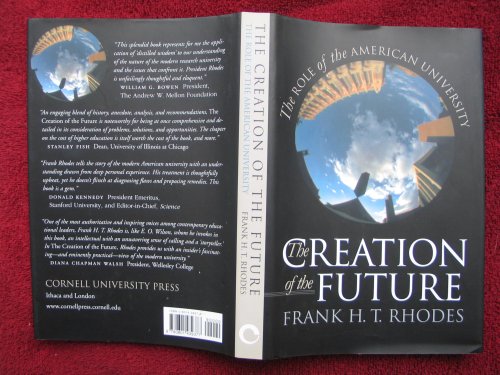
Is the university a dinosaur: huge, lumbering, endearing in its own way, yet unsuited to today's world? Is it a thing of the past, unnecessary in an age of the Internet and online learning? In a book likely to provoke people who are loyal to the ideal of the university as well as those who foresee its demise, Frank H. T. Rhodes acknowledges that the university is an imperfect institution, but argues that it plays an essential role in modern society. In the process, he articulates strong opinions on a range of difficult issues.
The Creation of the Future is no defense or promotion of the status quo. Focusing on American research universities, Rhodes makes the case that they are an irreplaceable resource, quite literally a national and international treasure, whose value must be preserved through judicious renewal and reform, beginning with a rededication to teaching as a moral vocation.
Rhodes discusses where the research university is today and how it got here, as well as where it must go in the future. In the process, he addresses a wide range of contemporary challenges facing the institution, including
*why universities can no longer be "ivory towers"
*why post-tenure review of professors is desirable
*whether grading standards have become too lax
*why unionization of graduate students is inappropriate
*why affirmative action is necessary
*how governance and leadership can be improved
*how to maintain a sense of commitment to the university in the face of increasing disciplinary specialization
*why faculty must affirm that university membership has not only its privileges, but also its price.
*what should and should not be done to control the rapid rise in tuition.
*whether curricula of professional schools should be more heavily weighted toward the liberal arts.
*why service is a social obligation of all universities, not just land-grant institutions.
*why research is vital to effective teaching.
His eighteen-year tenure as president of Cornell University gives Rhodes a unique perspective on a system he finds both invaluable and in need of change. Although he is an enthusiastic advocate, he pulls no punches in recommending sweeping changes. The greatest catastrophe facing universities today, he writes, is loss of community: "Without community, knowledge becomes idiosyncratic. The lone learner, studying in isolation, is vulnerable to narrowness, dogmatism, and untested assumption; pursued in community, learning will be expansive and informed, contested by opposing interpretations, leavened by differing experience, and refined by alternative viewpoints."
In championing a new relevance for the American research university, Rhodes argues for renewal through the application of old virtues to new realities. Campus culture, he says, must embrace the human experience in all its richness, breadth, and ambiguity if it is to survive and thrive.
Is the university a dinosaur: huge, lumbering, endearing in its own way, yet unsuited to today's world? Is it a thing of the past, unnecessary in an age of the Internet and online learning? In a book likely to provoke people who are loyal to the ideal of the university as well as those who foresee its demise, Frank H. T. Rhodes acknowledges that the university is an imperfect institution, but argues that it plays an essential role in modern society. In the process, he articulates strong opinions on a range of difficult issues. The Creation of the Future is no defense or promotion of the status quo. Focusing on American research universities, Rhodes makes the case that they are an irreplaceable resource, quite literally a national and international treasure, whose value must be preserved through judicious renewal and reform, beginning with a rededication to teaching as a moral vocation. Rhodes discusses where the research university is today and how it got here, as well as where it must go in the future. In the process, he addresses a wide range of contemporary challenges facing the institution, including*why universities can no longer be "ivory towers"*why post-tenure review of professors is desirable*whether grading standards have become too lax*why unionization of graduate students is inappropriate*why affirmative action is necessary*how governance and leadership can be improved*how to maintain a sense of commitment to the university in the face of increasing disciplinary specialization*why faculty must affirm that university membership has not only its privileges, but also its price.*what should and should not be done to control the rapid rise in tuition.*whether curricula of professional schools should be more heavily weighted toward the liberal arts.*why service is a social obligation of all universities, not just land-grant institutions.*why research is vital to effective teaching.His eighteen-year tenure as president of Cornell University gives Rhodes a unique perspective on a system he finds both invaluable and in need of change. Although he is an enthusiastic advocate, he pulls no punches in recommending sweeping changes. The greatest catastrophe facing universities today, he writes, is loss of community: "Without community, knowledge becomes idiosyncratic. The lone learner, studying in isolation, is vulnerable to narrowness, dogmatism, and untested assumption; pursued in community, learning will be expansive and informed, contested by opposing interpretations, leavened by differing experience, and refined by alternative viewpoints."In championing a new relevance for the American research university, Rhodes argues for renewal through the application of old virtues to new realities. Campus culture, he says, must embrace the human experience in all its richness, breadth, and ambiguity if it is to survive and thrive.
Die Inhaltsangabe kann sich auf eine andere Ausgabe dieses Titels beziehen.
Über die Autorin bzw. den Autor
Frank H. T. Rhodes is President Emeritus of Cornell University. A geologist by training, his numerous published works on geology and education include the books The Evolution of Life and Language of the Earth. He holds the Bigsby Medal of the Geological Society and the Clark-Kerr Medal of the University of California-Berkeley. He currently serves as President of the American Philosophical Society and as Chairman of the Board of the Atlantic Foundation. He is the past chairman of the National Science Board and the boards of the American Council on Education, the Association of American Universities, and the Carnegie Foundation for the Advancement of Teaching. He holds more than thirty honorary degrees from universities both in this country and abroad.
„Über diesen Titel“ kann sich auf eine andere Ausgabe dieses Titels beziehen.
Suchergebnisse für The Creation of the Future: The Role of the American...

Foto des Verkäufers
The Creation of the Future: The Role of the American University
Verlag:
Cornell University Press, 2001
ISBN 10: 080143937X
ISBN 13: 9780801439377
Gebraucht
Hardcover
Anbieter: Dream Books Co., Denver, CO, USA
Verkäuferbewertung 5 von 5 Sternen

Zustand: very_good. Pages are clean with no markings. May show minor signs of wear or cosmetic defects marks, cuts, bends, or scuffs on the cover, spine, pages, or dust jacket. May have remainder marks on edges. Artikel-Nr. DBV.080143937X.VG
Gebraucht kaufen
EUR 3,88
Versand gratis
Versand innerhalb von USA
Versand innerhalb von USA
Anzahl: 1 verfügbar
Beispielbild für diese ISBN
The Creation of the Future: Th
Verlag:
Cornell University Press, 2001
ISBN 10: 080143937X
ISBN 13: 9780801439377
Gebraucht
Hardcover
Anbieter: World of Books (was SecondSale), Montgomery, IL, USA
Verkäuferbewertung 5 von 5 Sternen
Zustand: Good. Item in good condition. Textbooks may not include supplemental items i.e. CDs, access codes etc. Artikel-Nr. 00108731466
Gebraucht kaufen
EUR 5,50
Versand gratis
Versand innerhalb von USA
Versand innerhalb von USA
Anzahl: 1 verfügbar
Beispielbild für diese ISBN
The Creation of the Future: Puzzles of American Democracy
Verlag:
Cornell University Press, 2001
ISBN 10: 080143937X
ISBN 13: 9780801439377
Gebraucht
Hardcover
Anbieter: ThriftBooks-Dallas, Dallas, TX, USA
Verkäuferbewertung 5 von 5 Sternen
Hardcover. Zustand: Very Good. No Jacket. May have limited writing in cover pages. Pages are unmarked. ~ ThriftBooks: Read More, Spend Less. Artikel-Nr. G080143937XI4N00
Gebraucht kaufen
EUR 6,12
Versand gratis
Versand innerhalb von USA
Versand innerhalb von USA
Anzahl: 1 verfügbar
Beispielbild für diese ISBN
The Creation of the Future: Puzzles of American Democracy
Verlag:
Cornell University Press, 2001
ISBN 10: 080143937X
ISBN 13: 9780801439377
Gebraucht
Hardcover
Anbieter: ThriftBooks-Atlanta, AUSTELL, GA, USA
Verkäuferbewertung 5 von 5 Sternen
Hardcover. Zustand: Very Good. No Jacket. May have limited writing in cover pages. Pages are unmarked. ~ ThriftBooks: Read More, Spend Less. Artikel-Nr. G080143937XI4N00
Gebraucht kaufen
EUR 6,12
Versand gratis
Versand innerhalb von USA
Versand innerhalb von USA
Anzahl: 1 verfügbar
Beispielbild für diese ISBN
The Creation of the Future: The Role of the American University
Verlag:
Cornell University Press (edition First Edition), 2001
ISBN 10: 080143937X
ISBN 13: 9780801439377
Gebraucht
Hardcover
Erstausgabe
Anbieter: BooksRun, Philadelphia, PA, USA
Verkäuferbewertung 5 von 5 Sternen
Hardcover. Zustand: Very Good. First Edition. With dust jacket. It's a well-cared-for item that has seen limited use. The item may show minor signs of wear. All the text is legible, with all pages included. It may have slight markings and/or highlighting. Artikel-Nr. 080143937X-11-1-29
Gebraucht kaufen
EUR 6,35
Versand gratis
Versand innerhalb von USA
Versand innerhalb von USA
Anzahl: 1 verfügbar
Beispielbild für diese ISBN
The Creation of the Future: The Role of the American University
Verlag:
Cornell University Press, 2001
ISBN 10: 080143937X
ISBN 13: 9780801439377
Gebraucht
Hardcover
Anbieter: Wonder Book, Frederick, MD, USA
Verkäuferbewertung 5 von 5 Sternen
Zustand: Very Good. Very Good condition. Like New dust jacket. A copy that may have a few cosmetic defects. May also contain light spine creasing or a few markings such as an owner's name, short gifter's inscription or light stamp. Artikel-Nr. L17L-01495
Gebraucht kaufen
EUR 6,41
Versand gratis
Versand innerhalb von USA
Versand innerhalb von USA
Anzahl: 1 verfügbar
Beispielbild für diese ISBN
The Creation of the Future : The Role of the American University
Verlag:
Cornell University Press, 2001
ISBN 10: 080143937X
ISBN 13: 9780801439377
Gebraucht
Hardcover
Anbieter: Better World Books: West, Reno, NV, USA
Verkäuferbewertung 5 von 5 Sternen
Zustand: Good. Former library copy. Pages intact with minimal writing/highlighting. The binding may be loose and creased. Dust jackets/supplements are not included. Includes library markings. Stock photo provided. Product includes identifying sticker. Better World Books: Buy Books. Do Good. Artikel-Nr. GRP36938857
Gebraucht kaufen
EUR 8,77
Versand gratis
Versand innerhalb von USA
Versand innerhalb von USA
Anzahl: 1 verfügbar
Beispielbild für diese ISBN
The Creation of the Future : The Role of the American University
Verlag:
Cornell University Press, 2001
ISBN 10: 080143937X
ISBN 13: 9780801439377
Gebraucht
Hardcover
Anbieter: Better World Books, Mishawaka, IN, USA
Verkäuferbewertung 5 von 5 Sternen
Zustand: Good. Pages intact with minimal writing/highlighting. The binding may be loose and creased. Dust jackets/supplements are not included. Stock photo provided. Product includes identifying sticker. Better World Books: Buy Books. Do Good. Artikel-Nr. 14871468-6
Gebraucht kaufen
EUR 8,77
Versand gratis
Versand innerhalb von USA
Versand innerhalb von USA
Anzahl: 1 verfügbar
Beispielbild für diese ISBN
The Creation of the Future: The Role of the American University
Verlag:
Cornell University Press, 2001
ISBN 10: 080143937X
ISBN 13: 9780801439377
Gebraucht
Hardcover
Anbieter: WorldofBooks, Goring-By-Sea, WS, Vereinigtes Königreich
Verkäuferbewertung 5 von 5 Sternen
Hardback. Zustand: Very Good. The book has been read, but is in excellent condition. Pages are intact and not marred by notes or highlighting. The spine remains undamaged. Artikel-Nr. GOR005694478
Gebraucht kaufen
EUR 3,55
EUR 6,65 Versand
Versand von Vereinigtes Königreich nach USA
Versand von Vereinigtes Königreich nach USA
Anzahl: 1 verfügbar
Beispielbild für diese ISBN
Creation of the Future: Puzzles of American Democracy
Verlag:
Cornell University Press, 2001
ISBN 10: 080143937X
ISBN 13: 9780801439377
Gebraucht
Hardcover
Erstausgabe
Anbieter: Books End Bookshop, Syracuse, NY, USA
Verkäuferbewertung 4 von 5 Sternen

Hardcover. Zustand: Very Good. Zustand des Schutzumschlags: Very Good. First Edition. Bumped corners. Age toned pages with light foxing fmc2%262D. Artikel-Nr. 1050892
Gebraucht kaufen
EUR 5,97
EUR 5,34 Versand
Versand innerhalb von USA
Versand innerhalb von USA
Anzahl: 1 verfügbar