
Verwandte Artikel zu Triangular Norms (Trends in Logic, 8, Band 8)
Inhaltsangabe
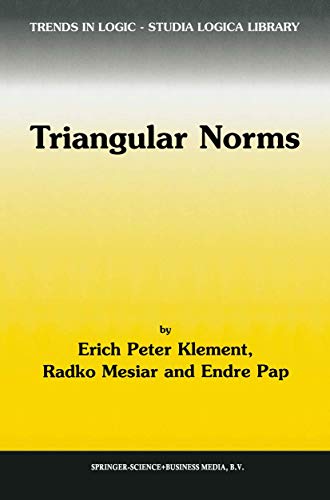
The history of triangular norms started with the paper "Statistical metrics" [Menger 1942]. The main idea of Karl Menger was to construct metric spaces where probability distributions rather than numbers are used in order to de scribe the distance between two elements of the space in question. Triangular norms (t-norms for short) naturally came into the picture in the course of the generalization of the classical triangle inequality to this more general set ting. The original set of axioms for t-norms was considerably weaker, including among others also the functions which are known today as triangular conorms. Consequently, the first field where t-norms played a major role was the theory of probabilistic metric spaces ( as statistical metric spaces were called after 1964). Berthold Schweizer and Abe Sklar in [Schweizer & Sklar 1958, 1960, 1961] provided the axioms oft-norms, as they are used today, and a redefinition of statistical metric spaces given in [Serstnev 1962]led to a rapid development of the field. Many results concerning t-norms were obtained in the course of this development, most of which are summarized in the monograph [Schweizer & Sklar 1983]. Mathematically speaking, the theory of (continuous) t-norms has two rather independent roots, namely, the field of (specific) functional equations and the theory of (special topological) semigroups.
Die Inhaltsangabe kann sich auf eine andere Ausgabe dieses Titels beziehen.
Suchergebnisse für Triangular Norms (Trends in Logic, 8, Band 8)

Beispielbild für diese ISBN
Triangular Norms (Trends in Logic, 8)
Anbieter: Ria Christie Collections, Uxbridge, Vereinigtes Königreich
Verkäuferbewertung 5 von 5 Sternen

Zustand: New. In English. Artikel-Nr. ria9780792364160_new
Neu kaufen
EUR 249,39
EUR 13,13 Versand
Versand von Vereinigtes Königreich nach USA
Versand von Vereinigtes Königreich nach USA
Anzahl: Mehr als 20 verfügbar
Foto des Verkäufers
Triangular Norms
Anbieter: AHA-BUCH GmbH, Einbeck, Deutschland
Verkäuferbewertung 5 von 5 Sternen
Buch. Zustand: Neu. Druck auf Anfrage Neuware - Printed after ordering - The history of triangular norms started with the paper 'Statistical metrics' [Menger 1942]. The main idea of Karl Menger was to construct metric spaces where probability distributions rather than numbers are used in order to de scribe the distance between two elements of the space in question. Triangular norms (t-norms for short) naturally came into the picture in the course of the generalization of the classical triangle inequality to this more general set ting. The original set of axioms for t-norms was considerably weaker, including among others also the functions which are known today as triangular conorms. Consequently, the first field where t-norms played a major role was the theory of probabilistic metric spaces ( as statistical metric spaces were called after 1964). Berthold Schweizer and Abe Sklar in [Schweizer & Sklar 1958, 1960, 1961] provided the axioms oft-norms, as they are used today, and a redefinition of statistical metric spaces given in [Serstnev 1962]led to a rapid development of the field. Many results concerning t-norms were obtained in the course of this development, most of which are summarized in the monograph [Schweizer & Sklar 1983]. Mathematically speaking, the theory of (continuous) t-norms has two rather independent roots, namely, the field of (specific) functional equations and the theory of (special topological) semigroups. Artikel-Nr. 9780792364160
Neu kaufen
EUR 230,55
EUR 35,00 Versand
Versand von Deutschland nach USA
Versand von Deutschland nach USA
Anzahl: 1 verfügbar
Beispielbild für diese ISBN
Triangular Norms
Anbieter: Revaluation Books, Exeter, Vereinigtes Königreich
Verkäuferbewertung 5 von 5 Sternen
Hardcover. Zustand: Brand New. 1st edition. 385 pages. 9.50x6.50x1.00 inches. In Stock. Artikel-Nr. x-0792364163
Neu kaufen
EUR 310,29
EUR 14,53 Versand
Versand von Vereinigtes Königreich nach USA
Versand von Vereinigtes Königreich nach USA
Anzahl: 2 verfügbar
Beispielbild für diese ISBN
Triangular Norms
Anbieter: Kennys Bookstore, Olney, MD, USA
Verkäuferbewertung 5 von 5 Sternen
Zustand: New. Surveys several applied fields in which triangular norms play a significant part: probabilistic metric spaces, aggregation operators, many-valued logics, fuzzy logics, sets and control, and non-additive measures together with their corresponding integrals. This work is self contained, including proofs, and gives many graphical illustrations. Series: Trends in Logic. Num Pages: 387 pages, biography. BIC Classification: PBCD. Category: (P) Professional & Vocational; (UP) Postgraduate, Research & Scholarly; (UU) Undergraduate. Dimension: 234 x 156 x 23. Weight in Grams: 752. . 2000. Hardback. . . . . Books ship from the US and Ireland. Artikel-Nr. V9780792364160
Neu kaufen
EUR 329,46
EUR 9,22 Versand
Versand innerhalb von USA
Versand innerhalb von USA
Anzahl: 15 verfügbar