
Verwandte Artikel zu Ethics after Anscombe: Post “Modern Moral Philosophy&...
Ethics after Anscombe: Post “Modern Moral Philosophy” (Library of Ethics and Applied Philosophy, 5, Band 5) - Hardcover
Buch 22 von 36: Library of Ethics and Applied Philosophy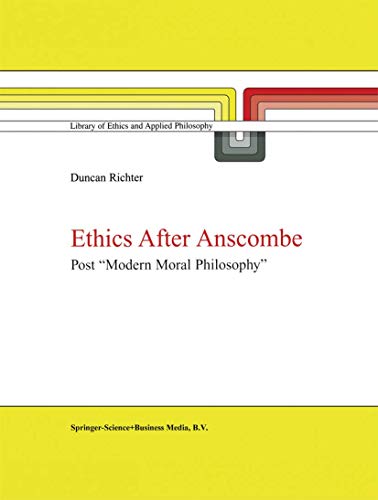
Inhaltsangabe
How, if at all, can we do moral philosophy in the light of the radical critique made by Elizabeth Anscombe in "Modem Moral Philosophy"? Among the principal theses of this essay is that ethical thinking (that of philosophers and others) suffers from a widespread appeal to incoherent uses of terms such as 'obligation,' 'ought,' 'right' and 'wrong. ' In this book I first explain and evaluate her thesis and the argument for it, and I then confront the challenge it poses: what ways are there of doing moral philosophy that avoid the kind of incoherence to which she has drawn our attention? The best way to show how it is possible for us to think about ethics is to demonstrate how to do so, using actual cases. This book therefore combines the critical study of central theoretical issues about ethics, in the first half, with concrete examination of serious practical issues, in the second. Following Dostoyevsky's Ivan Karamazov, it is often said that if God does not exist then everything is permitted. This is not literally the case, since God cannot permit anything if He does not exist, and those of us who do exist do not permit everything, or at least our parents, employers, and governments do not. It is true, though, that if God does not exist then nothing is forbidden in the traditional sense of 'forbidden'.
Die Inhaltsangabe kann sich auf eine andere Ausgabe dieses Titels beziehen.
Suchergebnisse für Ethics after Anscombe: Post “Modern Moral Philosophy&...

Beispielbild für diese ISBN
Ethics after Anscombe : post "modern moral philosophy"
Anbieter: Kloof Booksellers & Scientia Verlag, Amsterdam, Niederlande
Verkäuferbewertung 4 von 5 Sternen

Zustand: as new. Dordrecht : Kluwer Academic, c2000. Hardcover. xi,173 pp. 25 cm. (Library of ethics and applied philosophy (LOET), 5). - How, if at all, can we do moral philosophy in the light of the radical critique made by Elizabeth Anscombe in "Modem Moral Philosophy"? Among the principal theses of this essay is that ethical thinking (that of philosophers and others) suffers from a widespread appeal to incoherent uses of terms such as 'obligation,' 'ought,' 'right' and 'wrong. ' In this book I first explain and evaluate her thesis and the argument for it, and I then confront the challenge it poses: what ways are there of doing moral philosophy that avoid the kind of incoherence to which she has drawn our attention? The best way to show how it is possible for us to think about ethics is to demonstrate how to do so, using actual cases. This book therefore combines the critical study of central theoretical issues about ethics, in the first half, with concrete examination of serious practical issues, in the second. Following Dostoyevsky's Ivan Karamazov, it is often said that if God does not exist then everything is permitted. This is not literally the case, since God cannot permit anything if He does not exist, and those of us who do exist do not permit everything, or at least our parents, employers, and governments do not. It is true, though, that if God does not exist then nothing is forbidden in the traditional sense of 'forbidden'. Condition : as new copy. ISBN 9780792360933. Keywords : PHILOSOPHY, Artikel-Nr. 294219
Gebraucht kaufen
EUR 66,95
EUR 30,00 Versand
Versand von Niederlande nach USA
Versand von Niederlande nach USA
Anzahl: 1 verfügbar
Foto des Verkäufers
ETHICS AFTER ANSCOMBE: POST "MODERN MORAL PHILOSOPHY"
Verlag:
Kluwer Academic Publishers, Dordrecht, The Netherlands, 2000
ISBN 10: 0792360931
ISBN 13: 9780792360933
Gebraucht
Hardcover
Erstausgabe
Anbieter: Second Story Books, ABAA, Rockville, MD, USA
Verkäuferbewertung 4 von 5 Sternen
Hardcover. First Edition. Octavo; xi, 173 pages. In Very Good condition. Spine yellow and white with black and red lettering. Minor shelfwear. Light rubbing to front cover. Textblock clean. Shelved in Philosophy. Volume V in the "Library of Ethics and Applied Philosophy" series. 1368339. Shelved Dupont Bookstore. Artikel-Nr. 1368339
Gebraucht kaufen
EUR 97,75
EUR 6,04 Versand
Versand innerhalb von USA
Versand innerhalb von USA
Anzahl: 1 verfügbar
Beispielbild für diese ISBN
Ethics after Anscombe: Post "Modern Moral Philosophy" (Library of Ethics and Applied Philosophy, 5)
Anbieter: Ria Christie Collections, Uxbridge, Vereinigtes Königreich
Verkäuferbewertung 5 von 5 Sternen

Zustand: New. In. Artikel-Nr. ria9780792360933_new
Neu kaufen
EUR 116,34
EUR 13,97 Versand
Versand von Vereinigtes Königreich nach USA
Versand von Vereinigtes Königreich nach USA
Anzahl: Mehr als 20 verfügbar
Beispielbild für diese ISBN
Ethics after Anscombe : Post "Modern Moral Philosophy"
Anbieter: Better World Books, Mishawaka, IN, USA
Verkäuferbewertung 5 von 5 Sternen
Zustand: Good. Former library copy. Pages intact with minimal writing/highlighting. The binding may be loose and creased. Dust jackets/supplements are not included. Includes library markings. Stock photo provided. Product includes identifying sticker. Better World Books: Buy Books. Do Good. Artikel-Nr. 67678208-6
Gebraucht kaufen
EUR 133,83
Versand gratis
Versand innerhalb von USA
Versand innerhalb von USA
Anzahl: 1 verfügbar
Beispielbild für diese ISBN
Ethics After Anscombe
Anbieter: Kennys Bookstore, Olney, MD, USA
Verkäuferbewertung 5 von 5 Sternen
Zustand: New. This work is a challenge to G.E.M. Anscombe in "Modern Moral Philosophy". It makes a contribution to the debate on virtue theory and anti-theory, and shows the relevance of such theoretical discussion to moral issues such as abortion, suicide, and the moral status of animals. Series: Library of Ethics and Applied Philosophy. Num Pages: 188 pages, biography. BIC Classification: HPQ. Category: (P) Professional & Vocational; (UP) Postgraduate, Research & Scholarly; (UU) Undergraduate. Dimension: 235 x 155 x 12. Weight in Grams: 990. . 1999. Hardback. . . . . Books ship from the US and Ireland. Artikel-Nr. V9780792360933
Neu kaufen
EUR 165,59
EUR 9,06 Versand
Versand innerhalb von USA
Versand innerhalb von USA
Anzahl: 15 verfügbar
Foto des Verkäufers
Ethics after Anscombe : Post "Modern Moral Philosophy"
Anbieter: AHA-BUCH GmbH, Einbeck, Deutschland
Verkäuferbewertung 5 von 5 Sternen
Buch. Zustand: Neu. Druck auf Anfrage Neuware - Printed after ordering - How, if at all, can we do moral philosophy in the light of the radical critique made by Elizabeth Anscombe in 'Modem Moral Philosophy' Among the principal theses of this essay is that ethical thinking (that of philosophers and others) suffers from a widespread appeal to incoherent uses of terms such as 'obligation,' 'ought,' 'right' and 'wrong. ' In this book I first explain and evaluate her thesis and the argument for it, and I then confront the challenge it poses: what ways are there of doing moral philosophy that avoid the kind of incoherence to which she has drawn our attention The best way to show how it is possible for us to think about ethics is to demonstrate how to do so, using actual cases. This book therefore combines the critical study of central theoretical issues about ethics, in the first half, with concrete examination of serious practical issues, in the second. Following Dostoyevsky's Ivan Karamazov, it is often said that if God does not exist then everything is permitted. This is not literally the case, since God cannot permit anything if He does not exist, and those of us who do exist do not permit everything, or at least our parents, employers, and governments do not. It is true, though, that if God does not exist then nothing is forbidden in the traditional sense of 'forbidden'. Artikel-Nr. 9780792360933
Neu kaufen
EUR 114,36
EUR 62,29 Versand
Versand von Deutschland nach USA
Versand von Deutschland nach USA
Anzahl: 1 verfügbar