
Verwandte Artikel zu The Liberalization of Capital Movements in Europe:...
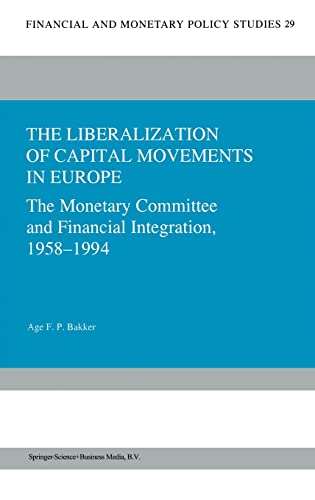
The Liberalization of Capital Movements in Europe: The Monetary Committee and Financial Integration 1958-1994: v. 29 (Financial and Monetary Policy Studies) - Hardcover
Inhaltsangabe
1. Introduction. 2. Capital restrictions: classification and general observations. 3. The Treaty of Rome and capital movements. 4. The role of the Monetary Committee. 5. The 1960s: lost momentum. 6. The 1970s: lost control. 7. The 1980s: liberalization and deregulation. 8. Towards the full liberalization of capital movements. 9. Towards Economic and Monetary Union. 10. Conclusion. Chronology of major measures with respect to the regime of capital movements in the member states of the European Community. Chronology of general events in Europe. Annexes. Literature. Index A: subjects. Index B: persons.
Die Inhaltsangabe kann sich auf eine andere Ausgabe dieses Titels beziehen.
Reseña del editor
This book provides a comprehensive overview of the process of capital liberalization in Europe from the time of the writing of the Treaty of Rome in the 1950s to the complete abolition of restrictions in the latter half of the 1980s and early 1990s in the run up to Economic and Monetary Union. The process is described mainly from an institutional angle, with special reference to the far-reaching discussions in the Monetary Committee and the role of the European Commission. Related topics such as monetary cooperation, the working of the European Monetary System, taxation and supervision issues are also dealt with. The book highlights the motives which countries held with respect to maintaining or abolishing restrictions. Their eventual abolition had important consequences for the financial structure in member states and for the transition to the use of indirect instruments of monetary policy by the national central banks. The book will be of outstanding interest for anyone who is professionally involved in European integration issues and in monetary and financial policy.
Reseña del editor
This work offers a review of liberalization of capital movements in Europe, from the time that the Treaty of Rome was written in the 1950s to the complete abolition of restrictions in the latter half of the 1980s and early 1990s in the run up to Economic and Monetary Union. The process is described mainly from an institutional angle, with special reference to the far-reaching discussions in the Monetary Committee and the role of the European Commission. Related topics are also dealt with, such as monetary co-operation, the working of the European Monetary System, taxation and supervision issues. The book highlights the motives which drove countries in their desire to maintain or abolish restrictions. The eventual abolition of restrictions had important consequences for the financial structure in member states and for the transition to the use of indirect instruments of monetary policy by the national central banks. The work should be of interest to anyone who is professionally involved in European integration issues, and in monetary and financial policy.
„Über diesen Titel“ kann sich auf eine andere Ausgabe dieses Titels beziehen.
Suchergebnisse für The Liberalization of Capital Movements in Europe:...

Beispielbild für diese ISBN
The Liberalization of Capital Movements in Europe: The Monetary Committee and Financial Integration, 1958-1994 (Financial and Monetary Policy Studies)
Anbieter: Ria Christie Collections, Uxbridge, Vereinigtes Königreich
Verkäuferbewertung 5 von 5 Sternen

Zustand: New. In English. Artikel-Nr. ria9780792335917_new
Neu kaufen
EUR 103,75
EUR 13,16 Versand
Versand von Vereinigtes Königreich nach USA
Versand von Vereinigtes Königreich nach USA
Anzahl: Mehr als 20 verfügbar
Foto des Verkäufers
The Liberalization of Capital Movements in Europe : The Monetary Committee and Financial Integration, 1958-1994
Anbieter: AHA-BUCH GmbH, Einbeck, Deutschland
Verkäuferbewertung 5 von 5 Sternen
Buch. Zustand: Neu. Druck auf Anfrage Neuware - Printed after ordering - This book provides a comprehensive overview of the process of capital liberalization in Europe from the time of the writing of the Treaty of Rome in the 1950s to the complete abolition of restrictions in the latter half of the 1980s and early 1990s in the run up to Economic and Monetary Union. The process is described mainly from an institutional angle, with special reference to the far-reaching discussions in the Monetary Committee and the role of the European Commission. Related topics such as monetary cooperation, the working of the European Monetary System, taxation and supervision issues are also dealt with. The book highlights the motives which countries held with respect to maintaining or abolishing restrictions. Their eventual abolition had important consequences for the financial structure in member states and for the transition to the use of indirect instruments of monetary policy by the national central banks. The book will be of outstanding interest for anyone who is professionally involved in European integration issues and in monetary and financial policy. Artikel-Nr. 9780792335917
Neu kaufen
EUR 95,65
EUR 35,00 Versand
Versand von Deutschland nach USA
Versand von Deutschland nach USA
Anzahl: 2 verfügbar
Foto des Verkäufers
The Liberalization of Capital Movements in Europe
Verlag:
Springer Netherlands|Springer, Berlin, 1995
ISBN 10: 0792335910
ISBN 13: 9780792335917
Neu
Hardcover
Anbieter: moluna, Greven, Deutschland
Verkäuferbewertung 5 von 5 Sternen
Gebunden. Zustand: New. This book provides a comprehensive overview of the process of capital liberalization in Europe from the time of the writing of the Treaty of Rome in the 1950s to the complete abolition of restrictions in the latter half of the 1980s and early 1990s in the r. Artikel-Nr. 898696772
Neu kaufen
EUR 104,46
EUR 48,99 Versand
Versand von Deutschland nach USA
Versand von Deutschland nach USA
Anzahl: Mehr als 20 verfügbar
Beispielbild für diese ISBN
The Liberalization of Capital Movements in Europe: The Monetary Committee and Financial Integration 1958-1994
Anbieter: Revaluation Books, Exeter, Vereinigtes Königreich
Verkäuferbewertung 5 von 5 Sternen
Hardcover. Zustand: Brand New. 333 pages. 10.00x6.75x1.25 inches. In Stock. Artikel-Nr. x-0792335910
Neu kaufen
EUR 143,63
EUR 14,57 Versand
Versand von Vereinigtes Königreich nach USA
Versand von Vereinigtes Königreich nach USA
Anzahl: 2 verfügbar