
Verwandte Artikel zu Maimonides on the "Decline of the Generations"...
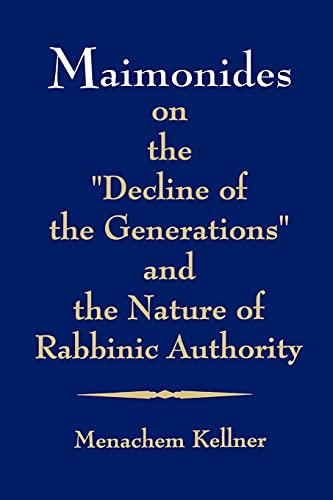
Maimonides on the "Decline of the Generations" and the Nature of Rabbinic Authority (SUNY Series in Jewish Philosophy) (Suny Series, Jewish Philosophy) - Softcover
Inhaltsangabe
Shows to what extent and in what fashion Jews are bound to accept the opinions and the pronouncements of religious authorities. Moses Maimonides, medieval Judaism's leading legist and philosopher, and a figure of central importance for contemporary Jewish self-understanding, held a view of Judaism which maintained the authority of the Talmudic rabbis in matters of Jewish law while allowing for free and open inquiry in matters of science and philosophy. Maimonides affirmed, not the superiority of the "moderns" (the scholars of his and subsequent generations) over the "ancients" (the Tannaim and Amoraim, the Rabbis of the Mishnah and Talmud) but the inherent equality of the two. The equality presented here is not equality of halakhic authority, but equality of ability, of essential human characteristics. In order to substantiate these claims, Kellner explores the related idea that Maimonides does not adopt the notion of "the decline of the generations", according to which each succeeding generation, or each succeeding epoch, is in some significant and religiously relevant sense inferior to preceding generations or epochs.
Die Inhaltsangabe kann sich auf eine andere Ausgabe dieses Titels beziehen.
Über die Autorin bzw. den Autor
Menachem Kellner teaches medieval Jewish Philosophy in the Department of Jewish History and Thought and is Wolfson Professor of Jewish Thought and is Dean of Students at the University of Haifa. He is the author of Dogma in Medieval Jewish Thought; Torat he-Ikkarim ba-Philosophiah ha-Yehudit Bimei ha-Benayim; Maimonides on Human Perfection; and Maimonides on Judaism and the Jewish People, also published by SUNY Press. He is translator of Isaac Abravanel's Principles of Faith and Levi ben Gershom's Commentary on Song of Songs; and editor of Contemporary Jewish Ethics; Rosh Amanah; and The Pursuit of the Ideal: Jewish Writings of Steven Schwarzschild, also published by SUNY Press.
Von der hinteren Coverseite
Moses Maimonides, medieval Judaism's leading legist and philosopher, and a figure of central importance for contemporary Jewish self-understanding, held a view of Judaism which maintained the authority of the Talmudic rabbis in matters of Jewish law while allowing for free and open inquiry in matters of science and philosophy. Maimonides affirmed, not the superiority of the "moderns" (the scholars of his and subsequent generations) over the "ancients" (the Tannaim and Amoraim, the Rabbis of the Mishnah and Talmud) but the inherent equality of the two. The equality presented here is not equality of halakhic authority, but equality of ability, of essential human characteristics. In order to substantiate these claims, Kellner explores the related idea that Maimonides does not adopt the notion of "the decline of the generations", according to which each succeeding generation, or each succeeding epoch, is in some significant and religiously relevant sense inferior to preceding generations or epochs.
„Über diesen Titel“ kann sich auf eine andere Ausgabe dieses Titels beziehen.
Suchergebnisse für Maimonides on the "Decline of the Generations"...

Beispielbild für diese ISBN
Maimonides on the "Decline of the Generations" and the Nature of Rabbinic Authority
Anbieter: PBShop.store US, Wood Dale, IL, USA
Verkäuferbewertung 5 von 5 Sternen

PAP. Zustand: New. New Book. Shipped from UK. Established seller since 2000. Artikel-Nr. CX-9780791429228
Beispielbild für diese ISBN
Maimonides on the "Decline of the Generations" and the Nature of Rabbinic Authority (SUNY series in Jewish Philosophy)
Verlag:
State University of New York Press, 1996
ISBN 10: 0791429229
ISBN 13: 9780791429228
Neu
Softcover
Anbieter: Ria Christie Collections, Uxbridge, Vereinigtes Königreich
Verkäuferbewertung 5 von 5 Sternen
Zustand: New. In English. Artikel-Nr. ria9780791429228_new
Neu kaufen
EUR 40,81
EUR 10,93 Versand
Versand von Vereinigtes Königreich nach USA
Versand von Vereinigtes Königreich nach USA
Anzahl: Mehr als 20 verfügbar