
Verwandte Artikel zu Discussing the Undiscussable: A Guide to Overcoming...
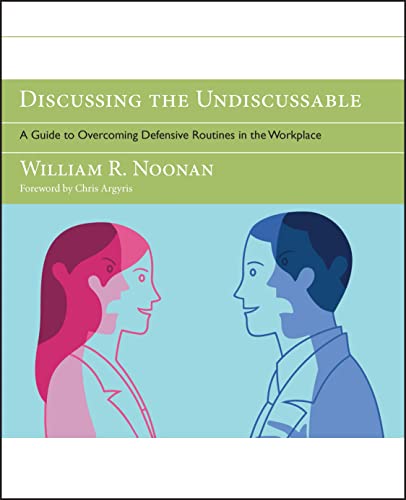
Discussing the Undiscussable: A Guide to Overcoming Defensive Routines in the Workplace (Jossey-Bass Business & Management) - Softcover
Inhaltsangabe
Since his 1990 landmark book Overcoming Organizational Defenses, Chris Argyris has extensively researched and written about how well-meaning, smart people create vicious cycles of defensive behavior to protect themselves from embarrassment and threat. In Discussing the Undiscussable, Bill Noonan enlivens the scholarly work of Chris Argyris through the use of reflective exercises and easy-to-read chapters that illuminate the basic human experience endemic to the creation of defensive routines. This book offers hope for altering organizational defensive routines by leveraging the greatest opportunity for change―the way we think and act.
Discussing the Undiscussable provides a set of practical “how to do” exercises for detecting, surfacing, and discussing organizational defensive routines in a safe and productive way. The combination of text, business fable, and interactive and reflective exercises is versatile in its application to both individuals and groups. The companion DVD contains video vignettes of the book’s business fable where the actors model both defensive routines and virtuous cycles of behavior. Readers will instantly recognize what has long been going on in the workplace, and will be able to develop the skills to talk about it productively.
Die Inhaltsangabe kann sich auf eine andere Ausgabe dieses Titels beziehen.
Über die Autorin bzw. den Autor
The Author
BILL NOONAN is an educator and consultant with an international practice that includes facilitation, conducting workshops, and designing web-based learning programs. He has consulted to leading learning organizations such as Federal Express, Hewlett-Packard, Shell Oil Company, and Herman Miller.
Von der hinteren Coverseite
DISCUSSING THE UNDISCUSSABLE
Since his 1990 landmark book Overcoming Organizational Defenses, Chris Argyris has extensively researched and written about how well-meaning, smart people create vicious cycles of defensive behavior to protect themselves from embarrassment and threat. In Discussing the Undiscussable, Bill Noonan enlivens the scholarly work of Chris Argyris through the use of reflective exercises and easy-to-read chapters that illuminate the basic human experience endemic to the creation of defensive routines. This book offers hope for altering organizational defensive routines by leveraging the greatest opportunity for change―the way we think and act.
Discussing the Undiscussable provides a set of practical “how to do” exercises for detecting, surfacing, and discussing organizational defensive routines in a safe and productive way. The combination of text, business fable, and interactive and reflective exercises is versatile in its application to both individuals and groups. The companion website contains video vignettes of the book’s business fable where the actors model both defensive routines and virtuous cycles of behavior. Readers will instantly recognize what has long been going on in the workplace, and will be able to develop the skills to talk about it productively.
Praise for Discussing the Undiscussable
“I highly recommend this book to leaders, consultants, and anyone else who wants to help teams and organizations learn to address their most challenging issues. Bill Noonan’s insights, stories, and practical methods make this an important book to read.”
―Roger Schwarz, author, The Skilled Facilitator, and coauthor, The Skilled Facilitator Fieldbook
“Noonan makes Chris Argyris’s pathbreaking work on organizational defensive routines accessible, and even entertaining.”
―Bruce Patton, coauthor, Getting to YES and Difficult Conversations
“Whether at work or home we can use Bill Noonan’s work to improve our lives and those of the people we interact with.”
―Robb E. Van Cleave, treasurer, International Board of Directors, Society for Human Resources Management (SHRM)
“In a world of increasing complexity where multiple perspectives are required for addressing work issues, the ability to guide groups in having honest discussions where both intuition and data are given full and fair consideration is more and more important.”
―Ralph Biggadike, professor, management division, Columbia Business School
Aus dem Klappentext
Since his 1990 landmark book "Overcoming Organizational Defenses," Chris Argyris has extensively researched and written about how well-meaning, smart people create vicious cycles of defensive behavior to protect themselves from embarrassment and threat. In "Discussing the Undiscussable," Bill Noonan enlivens the scholarly work of Chris Argyris through the use of reflective exercises and easy-to-read chapters that illuminate the basic human experience endemic to the creation of defensive routines. This book offers hope for altering organizational defensive routines by leveraging the greatest opportunity for change-- the way we think and act.
"Discussing the Undiscussable" provides a set of practical " how to do" exercises for detecting, surfacing, and discussing organizational defensive routines in a safe and productive way. The combination of text, business fable, and interactive and reflective exercises is versatile in its application to both individuals and groups. The companion DVD contains video vignettes of the book' s business fable where the actors model both defensive routines and virtuous cycles of behavior. Readers will instantly recognize what has long been going on in the workplace, and will be able to develop the skills to talk about it productively.
Auszug. © Genehmigter Nachdruck. Alle Rechte vorbehalten.
Discussing the Undiscussable
A Guide to Overcoming Defensive Routines in the WorkplaceBy William R. NoonanJossey-Bass
Copyright © 2007 William R. NoonanAll right reserved.
ISBN: 978-0-7879-8632-2
Chapter One
Framing the IssueThe Work of Chris Argyris
Innovation, ingenuity, and thinking outside the box are often cited as hallmarks of successful organizations, but in practice, their occurrence is rare. More likely, the "way things work around here" is a litany of missed deadlines, low morale, strained relationships, and inept problem solving. In fact, many organizations manage to operate far below the standards of excellence they strive for. Why is that the case?
No one sits down and says, "Okay, here's our plan for lowering morale in the company." No one asks, "What can we do to run this project into the ground?" We are human beings who desire to succeed, to foster creativity, to be competent, and to value the dignity of work. Yet we find ourselves being ineffective, settling for less, and caught in escalating cycles of unproductive behavior toward each other. We also tend to cover up inefficiency to protect ourselves, and come to see those actions as necessary, realistic, and even caring. How does this happen?
I have written this book to help people and their companies sort out these puzzles of human behavior. My inspiration and the foundation for this book is the work of Chris Argyris. Professor Argyris has dedicated his life's work to the topic of human behavior in organizations. His research has shown that our reactions to conditions of threat and embarrassment create patterns of behavior that he refers to as organizational defensive routines. These routines are predictable and ubiquitous in the world of work, and ultimately they do not serve the best interests of an organization. Understanding how each one of us participates in these dynamics is an important step toward creating a productive workplace. Learning how to mitigate or even avoid the resulting discord and loss of productivity is another. My goal is to help you accomplish both. This book, along with its accompanying interactive materials, attempts to make Chris Argyris's work more accessible and practical.
WHAT IS AN ORGANIZATIONAL DEFENSIVE ROUTINE?
Organizational defensive routines arise when we find ourselves under the conditions of threat or embarrassment. In reaction to these conditions, we engage in a characteristic mode of defensive reasoning and behavior. We think, "The problem is not me, but you." If both parties are thinking in the same defensive mode about each other, then the stage is set for some nasty behavior.
Although we would not think of ourselves as being unreasonable or ill intended, we readily concoct private explanations about why others do what they do. We make attributions about each other's motives and intentions and hold other parties accountable for the difficulty when we find ourselves at odds with one another. In the privacy of our own minds, we hold our positions with a high degree of certainty. It is hard to listen when you think the other person is dead wrong. Yet we will be the first to call "Unfair!" if we don't think the other person is listening to us.
None of what we are thinking is spoken directly to the person involved. In fact, when and if we share our emotionally charged assessments, theories, and explanations, we generally do so only with those individuals who we feel will be sympathetic to our views. These private conversations are held behind closed doors, in the hallways and break rooms. Nothing is discussed in public meetings, and rarely, if ever, do the targets of those third-party conversations ever find out what we really think. The result is "open secrets," "undiscussables," or the "elephant in the room." Most everyone can think of some example of this, often accompanied by a juicy story. What is often left out of the story is the teller's complicit participation in it. There is no awareness of how he or she might be involved in creating the open secret, the undiscussable, or the elephant in the room.
These dynamics become a routine part of the workplace culture. Whole departments become encased in assumptions and expectations that feed predictable, vicious cycles of human behavior. As organizational defensive routines take hold of a company's culture, the consequences are increasingly troubling. I have observed companies in which defensive routines proliferate to the point where the organizational culture becomes so toxic to working relationships that the organization's productivity suffers dramatically.
Defensive routines become so ingrained in our social behavior that they become an accepted part of the "way things work around here." What becomes apparent is that the organization, project, or team isn't all that it's cracked up to be. No one is walking the talk, and everyone knows it. When this realization dawns on us, our first reaction is usually sadness, disappointment, or a physical sensation of being let down. People talk of being deflated and dispirited. There is a loss of animation. Animation, by the way, derives from the Latin word animus (m.) or anima (f.), "soul." That definition holds true here. There is a loss of soul.
But even that isn't the whole story. Along with that loss comes a sense of helplessness. Organizational defensive routines are experienced and reported as being external to anyone's control or influence. We distance ourselves from any sense of personal responsibility. We don't realize that we might be as much a part of the problem as the next person. No one knows how to break the cycle and start afresh. This self-fueling, counterproductive process exists in all organizations and plays out in one-to-one interactions, in groups, and across organizational divisions, time and again, to the detriment of all.
These situations are depressing, to put it mildly. They are also much more common than we'd like to think, in organizations of all sizes, shapes, and geographies. But there is a way to break the cycle. And although the process is difficult, it is doable and very much worth the effort.
HOW I CAME TO WRITE THIS BOOK
I came to know Chris Argyris's work and to write this book through an untraditional route. My academic background is steeped in the liberal arts fields of philosophy, psychology, religious studies, and folklore. Prior to my career as an educator and consultant, I made the rounds in a variety of health care professions, mainly in care of the sick and dying.
I never thought I would be writing a business book. Fortunately, my background, particularly in the study of philosophy, has served me well in this line of work. In the study of philosophy, reflection is a requirement, and critical thinking is an essential tool, just as it is in the field of organizational learning. I have never been attracted to a philosophy that is disconnected from living, nor do I desire to ponder thoughts without understanding their practical implications. I follow the precepts of the philosopher Epicurus, who said, "Empty is the argument of the philosopher which does not relieve any human suffering." Translated into the language of action science, knowledge must be actionable if it is to be at all useful.
I recognized in Chris Argyris's work a program of attraction for those with an appetite for reflection. He prescribes a different way of thinking and acting that holds the promise of greater learning, reduction of error, and a fair exchange between conflicting views. Simply said, he...
„Über diesen Titel“ kann sich auf eine andere Ausgabe dieses Titels beziehen.
Suchergebnisse für Discussing the Undiscussable: A Guide to Overcoming...

Beispielbild für diese ISBN
Discussing the Undiscussable
Anbieter: ThriftBooks-Atlanta, AUSTELL, GA, USA
Verkäuferbewertung 5 von 5 Sternen

Paperback. Zustand: Very Good. No Jacket. May have limited writing in cover pages. Pages are unmarked. ~ ThriftBooks: Read More, Spend Less. Artikel-Nr. G0787986321I4N00
Gebraucht kaufen
EUR 5,87
Versand gratis
Versand innerhalb von USA
Versand innerhalb von USA
Anzahl: 1 verfügbar
Beispielbild für diese ISBN
Discussing the Undiscussable : A Guide to Overcoming Defensive Routines in the Workplace
Verlag:
Wiley & Sons, Incorporated, John, 2007
ISBN 10: 0787986321
ISBN 13: 9780787986322
Gebraucht
Softcover
Anbieter: Better World Books, Mishawaka, IN, USA
Verkäuferbewertung 5 von 5 Sternen
Zustand: Good. Former library copy. Pages intact with minimal writing/highlighting. The binding may be loose and creased. Dust jackets/supplements are not included. Includes library markings. Stock photo provided. Product includes identifying sticker. Better World Books: Buy Books. Do Good. Artikel-Nr. 11917333-6
Gebraucht kaufen
EUR 8,22
Versand gratis
Versand innerhalb von USA
Versand innerhalb von USA
Anzahl: 1 verfügbar
Beispielbild für diese ISBN
Discussing the Undiscussable
Anbieter: PBShop.store UK, Fairford, GLOS, Vereinigtes Königreich
Verkäuferbewertung 5 von 5 Sternen
PAP. Zustand: New. New Book. Shipped from UK. Established seller since 2000. Artikel-Nr. FW-9780787986322
Neu kaufen
EUR 68,77
EUR 5,84 Versand
Versand von Vereinigtes Königreich nach USA
Versand von Vereinigtes Königreich nach USA
Anzahl: 15 verfügbar
Beispielbild für diese ISBN
Discussing the Undiscussable: A Guide to Overcoming Defensive Routines in the Workplace (Jossey-Bass Business & Management)
Anbieter: Ria Christie Collections, Uxbridge, Vereinigtes Königreich
Verkäuferbewertung 5 von 5 Sternen
Zustand: New. In English. Artikel-Nr. ria9780787986322_new
Neu kaufen
EUR 80,69
EUR 13,13 Versand
Versand von Vereinigtes Königreich nach USA
Versand von Vereinigtes Königreich nach USA
Anzahl: Mehr als 20 verfügbar
Beispielbild für diese ISBN
Discussing the Undiscussable
Anbieter: Majestic Books, Hounslow, Vereinigtes Königreich
Verkäuferbewertung 4 von 5 Sternen

Zustand: New. pp. xiii + 268 Illus. Artikel-Nr. 7472799
Neu kaufen
EUR 88,68
EUR 7,56 Versand
Versand von Vereinigtes Königreich nach USA
Versand von Vereinigtes Königreich nach USA
Anzahl: 3 verfügbar
Beispielbild für diese ISBN
Discussing the Undiscussable A Guide to g Defensive Routines in the Workplace (w/ website)
Anbieter: Revaluation Books, Exeter, Vereinigtes Königreich
Verkäuferbewertung 5 von 5 Sternen
Paperback. Zustand: Brand New. paperback/dvdr edition. 268 pages. 9.25x7.00x1.00 inches. In Stock. Artikel-Nr. x-0787986321
Neu kaufen
EUR 103,28
EUR 14,53 Versand
Versand von Vereinigtes Königreich nach USA
Versand von Vereinigtes Königreich nach USA
Anzahl: 2 verfügbar
Beispielbild für diese ISBN
Discussing the Undiscussable: A Guide to Overcoming Defensive Routines in the Workplace
Anbieter: Kennys Bookstore, Olney, MD, USA
Verkäuferbewertung 5 von 5 Sternen
Zustand: New. Discussing the Undiscussable Since his 1990 landmark book Overcoming Organizational Defenses, Chris Argyris has extensively researched and written about how well-meaning, smart people create vicious cycles of defensive behavior to protect themselves from embarrassment and threat. Num Pages: 288 pages, Illustrations. BIC Classification: KJW. Category: (P) Professional & Vocational. Dimension: 234 x 180 x 20. Weight in Grams: 514. . 2007. 1st Edition. Paperback. . . . . Books ship from the US and Ireland. Artikel-Nr. V9780787986322
Neu kaufen
EUR 115,68
EUR 9,23 Versand
Versand innerhalb von USA
Versand innerhalb von USA
Anzahl: Mehr als 20 verfügbar
Foto des Verkäufers
Discussing the Undiscussable
Anbieter: moluna, Greven, Deutschland
Verkäuferbewertung 5 von 5 Sternen
Zustand: New. Bill Noonan is an educator and consultant with an international practice that includes facilitation, conducting workshops, and designing web-based learning programs. He has consulted to leading learning organizations such as Federal Express, Hewlett-Packard. Artikel-Nr. 447063992
Neu kaufen
EUR 82,21
EUR 48,99 Versand
Versand von Deutschland nach USA
Versand von Deutschland nach USA
Anzahl: Mehr als 20 verfügbar
Foto des Verkäufers
Discussing the Undiscussable
Anbieter: AHA-BUCH GmbH, Einbeck, Deutschland
Verkäuferbewertung 5 von 5 Sternen
Taschenbuch. Zustand: Neu. Neuware - Discussing the UndiscussableSince his 1990 landmark book Overcoming Organizational Defenses, Chris Argyris has extensively researched and written about how well-meaning, smart people create vicious cycles of defensive behavior to protect themselves from embarrassment and threat. In Discussing the Undiscussable, Bill Noonan enlivens the scholarly work of Chris Argyris through the use of reflective exercises and easy-to-read chapters that illuminate the basic human experience endemic to the creation of defensive routines. This book offers hope for altering organizational defensive routines by leveraging the greatest opportunity for change-the way we think and act.Discussing the Undiscussable provides a set of practical 'how to do' exercises for detecting, surfacing, and discussing organizational defensive routines in a safe and productive way. The combination of text, business fable, and interactive and reflective exercises is versatile in its application to both individuals and groups. The companion DVD contains video vignettes of the book's business fable where the actors model both defensive routines and virtuous cycles of behavior. Readers will instantly recognize what has long been going on in the workplace, and will be able to develop the skills to talk about it productively.Praise for Discussing the Undiscussable'I highly recommend this book to leaders, consultants, and anyone else who wants to help teams and organizations learn to address their most challenging issues. Bill Noonan's insights, stories, and practical methods make this an important book to read.'-Roger Schwarz, author, The Skilled Facilitator, and coauthor, The Skilled Facilitator Fieldbook'Noonan makes Chris Argyris's pathbreaking work on organizational defensive routines accessible, and even entertaining.'-Bruce Patton, coauthor, Getting to YES and Difficult Conversations'Whether at work or home we can use Bill Noonan's work to improve our lives and those of the people we interact with.'-Robb E. Van Cleave, treasurer, International Board of Directors, Society for Human Resources Management (SHRM)'In a world of increasing complexity where multiple perspectives are required for addressing work issues, the ability to guide groups in having honest discussions where both intuition and data are given full and fair consideration is more and more important.'-Ralph Biggadike, professor, management division, Columbia Business School. Artikel-Nr. 9780787986322
Neu kaufen
EUR 100,88
EUR 35,00 Versand
Versand von Deutschland nach USA
Versand von Deutschland nach USA
Anzahl: 2 verfügbar