
Verwandte Artikel zu The Emotionally Intelligent Manager: How to Develop...
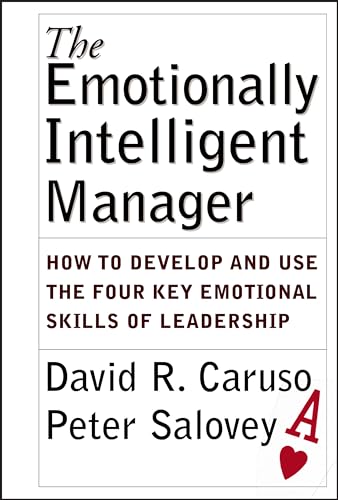
The Emotionally Intelligent Manager: How to Develop and Use the Four Key Emotional Skills of Leadership - Hardcover
Inhaltsangabe
We have long been taught that emotions should be felt and expressed in carefully controlled ways, and then only in certain environments and at certain times. This is especially true when at work, particularly when managing others. It is considered terribly unprofessional to express emotion while on the job, and many of us believe that our biggest mistakes and regrets are due to our reactions at those times when our emotions get the better of us. David R. Caruso and Peter Salovey believe that this view of emotion is not correct. The emotion centers of the brain, they argue, are not relegated to a secondary place in our thinking and reasoning, but instead are an integral part of what it means to think, reason, and to be intelligent. In The Emotionally Intelligent Manager, they show that emotion is not just important, but absolutely necessary for us to make good decisions, take action to solve problems, cope with change, and succeed. The authors detail a practical four-part hierarchy of emotional skills: identifying emotions, using emotions to facilitate thinking, understanding emotions, and managing emotions―and show how we can measure, learn, and develop each skill and employ them in an integrated way to solve our most difficult work-related problems.
Die Inhaltsangabe kann sich auf eine andere Ausgabe dieses Titels beziehen.
Über die Autorin bzw. den Autor
DAVID R. CARUSO is a research affiliate in the Department of Psychology at Yale University. He is also a management psychologist. His practice focuses on executive coaching, leadership development, and career assessment. Caruso conducts highly acclaimed training and development seminars on emotional intelligence, and he has published more than two dozen scientific articles and chapters. Prior to starting his own firm, he held a number of staff and line positions in consulting, small business, and Fortune 500 organizations in the areas of strategic planning, market research, and product management.
The Chris Argyris Professor of Psychology at Yale University,
PETER SALOVEY published the first scientific articles on emotional intelligence (with John D. Mayer), introducing the concept to the field of psychology. Salovey also serves as dean of Yale’s Graduate School of Arts and Sciences and has additional faculty appointments in the School of Management and the Department of Epidemiology and Public Health. He is currently president of the Society for General Psychology. A leading authority on the psychological consequences of mood and emotion as well as on health communication, he is widely quoted in print and broadcast media. Salovey was founding editor of the Review of General Psychology and served as an associate editor of the APA journals Emotion and Psychological Bulletin.
Von der hinteren Coverseite
The Emotionally Intelligent Manager
We have long been taught that emotions should be felt and expressed in carefully controlled ways, and then only in certain environments and at certain times. This is especially true when at work, particularly when managing others. It is considered terribly unprofessional to express emotion while on the job, and many of us believe that our biggest mistakes and regrets are due to our reactions at those times when our emotions get the better of us.
David R. Caruso and Peter Salovey believe that this view of emotion is not correct. The emotion centers of the brain, they argue, are not relegated to a secondary place in our thinking and reasoning, but instead are an integral part of what it means to think, reason, and to be intelligent. In The Emotionally Intelligent Manager, they show that emotion is not just important, but absolutely necessary for us to make good decisions, take action to solve problems, cope with change, and succeed. The authors detail a practical four-part hierarchy of emotional skills: identifying emotions, using emotions to facilitate thinking, understanding emotions, and managing emotions―and show how we can measure, learn, and develop each skill and employ them in an integrated way to solve our most difficult work-related problems.
Aus dem Klappentext
We have long been taught that emotions should be felt and expressed in carefully controlled ways, and then only in certain environments and at certain times. This is especially true when at work, particularly when managing others. It is considered terribly unprofessional to express emotion while on the job, and many of us believe that our biggest mistakes and regrets are due to our reactions at those times when our emotions get the better of us.
David R. Caruso and Peter Salovey believe that this view of emotion is not correct. The emotion centers of the brain, they argue, are not relegated to a secondary place in our thinking and reasoning, but instead are an integral part of what it means to think, reason, and to be intelligent. In The Emotionally Intelligent Manager, they show that emotion is not just important, but absolutely necessary for us to make good decisions, take action to solve problems, cope with change, and succeed. The authors detail a practical four-part hierarchy of emotional skills: identifying emotions, using emotions to facilitate thinking, understanding emotions, and managing emotions--and show how we can measure, learn, and develop each skill and employ them in an integrated way to solve our most difficult work-related problems.
Auszug. © Genehmigter Nachdruck. Alle Rechte vorbehalten.
The Emotionally Intelligent Manager
How to Develop and Use the Four Key Emotional Skills of LeadershipBy David R. Caruso Peter SaloveyJossey-Bass
Copyright © 2004 David R. CarusoAll right reserved.
ISBN: 978-0-7879-7071-0
Introduction
Have any of these statements been made to you?
Let's not get too excited.
You are being way too emotional about this.
We need to look at this rationally.
We are taught that emotions should be felt and expressed in carefully controlled ways, and then only in certain environments and at certain times. This is especially true when at work. It is considered terribly unprofessional to express emotion while on the job. We all believe that our biggest mistakes and regrets are due to being overly emotional-the times when our emotions get the better of us. After all, emotions are remnants from 300 million years ago, when they were necessary for the survival of our species.
We believe that this view of emotion is incorrect. After 300 million years-give or take a few million-human brains have gotten bigger and more complex but still have the wiring for emotion. The emotion centers of the brain are not relegated to a secondary place in our thinking and reasoning but instead are an integral part of what it means to think, reason, and be intelligent. This is the essence of the work conducted by University of Iowa neuroscientist Antonio Damasio.
The fundamental premise of The Emotionally Intelligent Manager is that emotion is not just important but absolutely necessary for us to make good decisions, take optimal action to solve problems, cope with change, and succeed. This does not mean that you jump with joy every time you make a sale or that you sob your heart out when you aren't promoted. Instead, the premise of The Emotionally Intelligent Manager replaces the conventional view of emotion with an intelligent view-one that might sound like this:
Let's get excited.
You are not being emotional enough about this.
We need to look at this emotionally-and logically.
The Emotionally Intelligent Manager is organized around an ability-based approach to emotional competencies that was developed in the late 1980s by two psychologists, John ( Jack) Mayer and Peter Salovey, and called emotional intelligence. This intelligent approach to emotions includes four different skills arranged in a hierarchical fashion. We explain the importance of each of the four emotional skills and provide you with concrete techniques to improve and use these skills in the workplace.
These are the four emotional skills around which we build The Emotionally Intelligent Manager:
1. Read People: Identifying Emotions. Emotions contain data. They are signals to us about important events going on in our world, whether it's our internal world, social world, or the natural environment. We must accurately identify emotions in others and be able to convey and express emotions accurately to others in order to communicate effectively.
2. Get in the Mood: Using Emotions. How we feel influences how we think and what we think about. Emotions direct our attention to important events; they ready us for a certain action, and they help guide our thought processes as we solve problems.
3. Predict the Emotional Future: Understanding Emotions. Emotions are not random events. They have underlying causes; they change according to a set of rules, and they can be understood. Knowledge of emotions is reflected by our emotion vocabulary and our ability to conduct emotional what-if analyses.
4. Do It with Feeling: Managing Emotions. Because emotions contain information and influence thinking, we need to incorporate emotions intelligently into our reasoning, problem solving, judging, and behaving. This requires us to stay open to emotions, whether they are welcome or not, and to choose strategies that include the wisdom of our feelings.
Each ability can be isolated from the others, but at the same time, each builds on the others. Although we can measure, learn, and develop each skill on its own, the interrelationships among the skills, as depicted in Figure I.1, allow us to employ them in an integrated way to solve important problems.
A Diagnostic Example
Here is a simple example to show how this process model of thinking and feeling works.
You are conducting a product development team meeting with a number of items on the agenda. There is some discussion regarding the items, and once everyone has had a chance to provide input, you ask for consensus agreement before you move on to the next item. Most of the items are discussed efficiently, and you have a good deal of agreement by team members. You find that you are moving quickly through the list.
The next item has to do with the latest changes to the product specs requested by your internal customer-the marketing VP. Such changes are not unusual; they have been requested before in this project, and you consider these particular changes to be fairly minor. There is general agreement by the group for the need to alter the plan, and you are about to move to one of the last items on the agenda. But something holds you back, keeps you from moving on, and you pause to reflect briefly before closing down the discussion. It's nothing that anyone has said that gave you pause, but it certainly was something. Almost without thinking, you mentally review the requested changes and feel less sure about them. Something does not seem quite right-does not feel right to you.
You consider letting this fleeting feeling pass. But even though you have paused for just a few seconds, you see that the pause has had an effect on the group. They seem a bit more attentive and have drawn themselves forward in their chairs. The mood is a bit more serious. One of your senior engineers speaks up and wonders whether the changes, albeit minor, will have an impact on any of the underlying architecture. It's an annoying question, as you have covered this ground a number of times. Again though, you reflect that the vague uneasiness you just felt may have something to do with this very issue. You ask for others' input, and with the now-more-serious focus, a number of team members point out that the product changes are much less trivial than they first appeared to be. You encourage this focused attention and analysis to continue, and in doing so, the team realizes that the system was simply not being designed with such changes in mind. Rather than looking for buy-in, you are now seeking information with which to go back to the marketing VP to demonstrate that the requested changes are not feasible.
What just happened? And why did it happen? Our model of emotional intelligence begins with the awareness, recognition, and identification of emotion. Something held you back from moving on. What was it? First, there was the look on the faces of a few of your more senior developers that indicated some subtle signs of uneasiness and caution. Second, you felt some inner discomfort, recognized it, and did not let it go. Third, you expressed your uneasiness and sense of trouble by looking down at the floor, slightly frowning, and rubbing your hand over your chin.
The second part of our model explains how these feelings influence thinking. The fleeting feelings of worry and concern focused your attention-and the team's attention-on a problem. Your brain, or something inside of you, is saying, "Houston, we have a problem."...
„Über diesen Titel“ kann sich auf eine andere Ausgabe dieses Titels beziehen.
Suchergebnisse für The Emotionally Intelligent Manager: How to Develop...

Beispielbild für diese ISBN
The Emotionally Intelligent Manager : How to Develop and Use the Four Key Emotional Skills of Leadership
Verlag:
Wiley & Sons, Incorporated, John, 2004
ISBN 10: 0787970719
ISBN 13: 9780787970710
Gebraucht
Hardcover
Erstausgabe
Anbieter: Better World Books: West, Reno, NV, USA
Verkäuferbewertung 5 von 5 Sternen

Zustand: Good. 1st Edition. Former library copy. Pages intact with minimal writing/highlighting. The binding may be loose and creased. Dust jackets/supplements are not included. Includes library markings. Stock photo provided. Product includes identifying sticker. Better World Books: Buy Books. Do Good. Artikel-Nr. 5833297-6
Gebraucht kaufen
EUR 6,60
Versand gratis
Versand innerhalb von USA
Versand innerhalb von USA
Anzahl: 1 verfügbar
Beispielbild für diese ISBN
The Emotionally Intelligent Manager : How to Develop and Use the Four Key Emotional Skills of Leadership
Verlag:
Wiley & Sons, Incorporated, John, 2004
ISBN 10: 0787970719
ISBN 13: 9780787970710
Gebraucht
Hardcover
Erstausgabe
Anbieter: Better World Books, Mishawaka, IN, USA
Verkäuferbewertung 5 von 5 Sternen
Zustand: Good. 1st Edition. Pages intact with minimal writing/highlighting. The binding may be loose and creased. Dust jackets/supplements are not included. Stock photo provided. Product includes identifying sticker. Better World Books: Buy Books. Do Good. Artikel-Nr. 4478480-6
Gebraucht kaufen
EUR 6,60
Versand gratis
Versand innerhalb von USA
Versand innerhalb von USA
Anzahl: 1 verfügbar
Beispielbild für diese ISBN
The Emotionally Intelligent Manager : How to Develop and Use the Four Key Emotional Skills of Leadership
Verlag:
Wiley & Sons, Incorporated, John, 2004
ISBN 10: 0787970719
ISBN 13: 9780787970710
Gebraucht
Hardcover
Erstausgabe
Anbieter: Better World Books: West, Reno, NV, USA
Verkäuferbewertung 5 von 5 Sternen
Zustand: Very Good. 1st Edition. Former library copy. Pages intact with possible writing/highlighting. Binding strong with minor wear. Dust jackets/supplements may not be included. Includes library markings. Stock photo provided. Product includes identifying sticker. Better World Books: Buy Books. Do Good. Artikel-Nr. 4667652-6
Gebraucht kaufen
EUR 6,60
Versand gratis
Versand innerhalb von USA
Versand innerhalb von USA
Anzahl: 1 verfügbar
Beispielbild für diese ISBN
The Emotionally Intelligent Manager : How to Develop and Use the Four Key Emotional Skills of Leadership
Verlag:
Wiley & Sons, Incorporated, John, 2004
ISBN 10: 0787970719
ISBN 13: 9780787970710
Gebraucht
Hardcover
Erstausgabe
Anbieter: Better World Books: West, Reno, NV, USA
Verkäuferbewertung 5 von 5 Sternen
Zustand: Very Good. 1st Edition. Pages intact with possible writing/highlighting. Binding strong with minor wear. Dust jackets/supplements may not be included. Stock photo provided. Product includes identifying sticker. Better World Books: Buy Books. Do Good. Artikel-Nr. 4335694-6
Gebraucht kaufen
EUR 6,60
Versand gratis
Versand innerhalb von USA
Versand innerhalb von USA
Anzahl: 2 verfügbar
Beispielbild für diese ISBN
The Emotionally Intelligent Manager: How to Develop and Use the Four Key Emotional Skills of Leadership
Anbieter: Wonder Book, Frederick, MD, USA
Verkäuferbewertung 5 von 5 Sternen
Zustand: Good. Good condition. A copy that has been read but remains intact. May contain markings such as bookplates, stamps, limited notes and highlighting, or a few light stains. Artikel-Nr. Y10M-01167
Gebraucht kaufen
EUR 7,00
Versand gratis
Versand innerhalb von USA
Versand innerhalb von USA
Anzahl: 1 verfügbar
Beispielbild für diese ISBN
The Emotionally Intelligent Manager: How to Develop and Use the Four Key Emotional Skills of Leadership
Anbieter: ThriftBooks-Dallas, Dallas, TX, USA
Verkäuferbewertung 5 von 5 Sternen
Hardcover. Zustand: Very Good. No Jacket. May have limited writing in cover pages. Pages are unmarked. ~ ThriftBooks: Read More, Spend Less. Artikel-Nr. G0787970719I4N00
Gebraucht kaufen
EUR 7,06
Versand gratis
Versand innerhalb von USA
Versand innerhalb von USA
Anzahl: 1 verfügbar
Beispielbild für diese ISBN
The Emotionally Intelligent Manager: How to Develop and Use the Four Key Emotional Skills of Leadership
Verlag:
John Wiley & Sons 20/04/2004, 2004
ISBN 10: 0787970719
ISBN 13: 9780787970710
Gebraucht
Hardcover
Anbieter: AwesomeBooks, Wallingford, Vereinigtes Königreich
Verkäuferbewertung 5 von 5 Sternen
Zustand: Very Good. This book is in very good condition and will be shipped within 24 hours of ordering. The cover may have some limited signs of wear but the pages are clean, intact and the spine remains undamaged. This book has clearly been well maintained and looked after thus far. Money back guarantee if you are not satisfied. See all our books here, order more than 1 book and get discounted shipping. . Artikel-Nr. 7719-9780787970710
Gebraucht kaufen
EUR 3,38
EUR 4,80 Versand
Versand von Vereinigtes Königreich nach USA
Versand von Vereinigtes Königreich nach USA
Anzahl: 1 verfügbar
Beispielbild für diese ISBN
The Emotionally Intelligent Manager: How to Develop and Use the Four Key Emotional Skills of Leadership
Anbieter: WorldofBooks, Goring-By-Sea, WS, Vereinigtes Königreich
Verkäuferbewertung 5 von 5 Sternen
Hardback. Zustand: Very Good. The book has been read, but is in excellent condition. Pages are intact and not marred by notes or highlighting. The spine remains undamaged. Artikel-Nr. GOR003113120
Gebraucht kaufen
EUR 4,49
EUR 6,53 Versand
Versand von Vereinigtes Königreich nach USA
Versand von Vereinigtes Königreich nach USA
Anzahl: 5 verfügbar
Beispielbild für diese ISBN
The Emotionally Intelligent Manager: How to Develop and Use the Four Key Emotional Skills of Leadership
Anbieter: WorldofBooks, Goring-By-Sea, WS, Vereinigtes Königreich
Verkäuferbewertung 5 von 5 Sternen
Hardback. Zustand: Fair. A readable copy of the book which may include some defects such as highlighting and notes. Cover and pages may be creased and show discolouration. Artikel-Nr. GOR004008040
Gebraucht kaufen
EUR 4,49
EUR 6,53 Versand
Versand von Vereinigtes Königreich nach USA
Versand von Vereinigtes Königreich nach USA
Anzahl: 1 verfügbar
Beispielbild für diese ISBN
The Emotionally Intelligent Manager : How to Develop and Use the Four Key Emotional Skills of Leadership
Verlag:
Wiley & Sons, Incorporated, John, 2004
ISBN 10: 0787970719
ISBN 13: 9780787970710
Gebraucht
Hardcover
Erstausgabe
Anbieter: Better World Books Ltd, Dunfermline, Vereinigtes Königreich
Verkäuferbewertung 5 von 5 Sternen
Zustand: Good. 1st Edition. Former library copy. Pages intact with minimal writing/highlighting. The binding may be loose and creased. Dust jackets/supplements are not included. Includes library markings. Stock photo provided. Product includes identifying sticker. Better World Books: Buy Books. Do Good. Artikel-Nr. 5833297-6
Gebraucht kaufen
EUR 5,64
EUR 5,83 Versand
Versand von Vereinigtes Königreich nach USA
Versand von Vereinigtes Königreich nach USA
Anzahl: 3 verfügbar