
Verwandte Artikel zu The Anger Workbook for Christian Parents
Inhaltsangabe
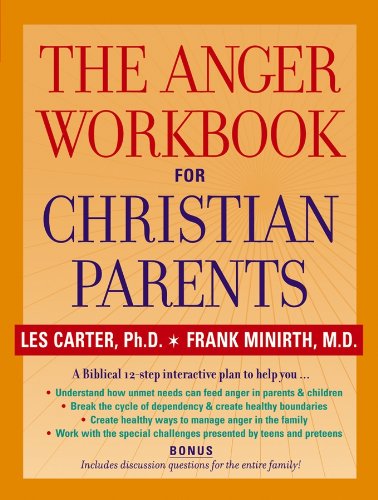
In this practical book, anger experts Drs. Les Carter and Frank Minirth–coauthors of the bestselling The Anger Workbook–show families how the "blame game" (parents blame the kids and kids blame the parents) doesn’t work. Instead they provide insight for dealing with the root causes of anger. In a perfect blend of biblical wisdom and psychological research, they show readers how to understand what can be right about anger, distinguish between healthy and unhealthy anger, recognize how anger can be managed more successfully by controlling desires and insecurities and addressing other underlying issues, and much more. Filled with real-life examples, checklists, evaluation tools, and study questions, this valuable resource for any parent with a preteen or teenager will help parents understand and manage their children’s anger–as well as their own–and show how to create harmony at home.
Die Inhaltsangabe kann sich auf eine andere Ausgabe dieses Titels beziehen.
Über die Autorin bzw. den Autor
Dr. Les Carter is a nationally known psychotherapist at the Minirth Clinic in Richardson, Texas, where he has practiced since 1980. He has authored or coauthored seventeen books including The Anger Trap from Jossey-Bass.
Dr. Frank Minirth is president of the Minirth Clinic, which he founded in 1975. The author or coauthor of more than fifty books, he is featured on "Life Perspectives" with Don Hawkins, a national program currently on fifty-five stations, and on "American Family Radio," currently on two hundred radio stations in America.
Von der hinteren Coverseite
In this practical book, anger experts Drs. Les Carter and Frank Minirth coauthors of the bestselling The Anger Workbook show families how the "blame game" (parents blame the kids and kids blame the parents) doesn t work. Instead they provide insight for dealing with the root causes of anger. In a perfect blend of biblical wisdom and psychological research, they show readers how to understand what can be right about anger, distinguish between healthy and unhealthy anger, recognize how anger can be managed more successfully by controlling desires and insecurities and addressing other underlying issues, and much more. Filled with real-life examples, checklists, evaluation tools, and study questions, this valuable resource for any parent with a preteen or teenager will help parents understand and manage their children s anger as well as their own and show how to create harmony at home.
Praise for The Anger Workbook for Christian Parents
"Parents will recognize themselves in this book. That s me, been there, and said that. In easily implemented steps, the authors provide insightful, practical suggestions for changing the anger factor in family interactions."
Dr. Garry L. Landreth, Regents professor and director, Center for Play Therapy, University of North Texas
"Les Carter and Frank Minirth give you all you need to know about how to use this dicey emotion to your advantage so that you become the parent you want to be. As a parent of two boys, I found this resource invaluable, and I know you will too."
Les Parrott, Ph.D., author, High-Maintenance Relationships
Aus dem Klappentext
In this practical book, anger experts Drs. Les Carter and Frank Minirth–coauthors of the bestselling The Anger Workbook–show families how the "blame game" (parents blame the kids and kids blame the parents) doesn’t work. Instead they provide insight for dealing with the root causes of anger. In a perfect blend of biblical wisdom and psychological research, they show readers how to understand what can be right about anger, distinguish between healthy and unhealthy anger, recognize how anger can be managed more successfully by controlling desires and insecurities and addressing other underlying issues, and much more. Filled with real-life examples, checklists, evaluation tools, and study questions, this valuable resource for any parent with a preteen or teenager will help parents understand and manage their children’s anger–as well as their own–and show how to create harmony at home.
Praise for The Anger Workbook for Christian Parents
"Parents will recognize themselves in this book. ‘That’s me, been there, and said that.’ In easily implemented steps, the authors provide insightful, practical suggestions for changing the anger factor in family interactions."
–Dr. Garry L. Landreth, Regents professor and director, Center for Play Therapy, University of North Texas
"Les Carter and Frank Minirth give you all you need to know about how to use this dicey emotion to your advantage so that you become the parent you want to be. As a parent of two boys, I found this resource invaluable, and I know you will too."
–Les Parrott, Ph.D., author, High-Maintenance Relationships
Auszug. © Genehmigter Nachdruck. Alle Rechte vorbehalten.
The Anger Workbook for Christian Parents
By Les Carter Frank MinirthJossey-Bass
Copyright © 2004 Les CarterAll right reserved.
ISBN: 978-0-7879-6903-5
Chapter One
THE PURPOSE OF ANGERSTEP 1: Learn to identify what is behind the expression of anger, and make that a primary focus.
It was the best of times. It was the worst of times." These are the opening words of Charles Dickens's A Tale of Two Cities. Certainly Mr. Dickens did not intend to apply them to the life of teenagers and preteens. His focus was quite separate. Hardly any parent, however, would refute these words as an apt description of life in a home with maturing youths.
As children begin to take on the looks and thoughts of adults-in-waiting, they can be a delight, given their ability to relate with a keener mind and increased wit and higher reasoning. Parents can actually enjoy a young person's enhanced abilities to contribute to the overall good of the household more fully than in previous years. It can be a blessing that the child has greater capacity for maintaining responsibilities and communicating with deeper awareness. The youth's increased desire for independence, when channeled appropriately, is the beginning of interactions with parents that are less authoritarian and more typical of the mutual respect that exists in a healthy adult relationship.
That same desire for independence, however, can be the impetus for great friction in the home. In most parent-teen relationships, a built-in friction exists because young people's overconfidence in themselves invariably clashes with their parents' desire for caution. Eager to spread their wings for flight, our youths may deem the wisdom of their elders unnecessary, only to discover that the elders are none too eager to be so summarily dismissed. The net result is ongoing conflict played out in the form of arguing, bargaining, and manipulation. The emotion beneath this conflict is anger.
Do you have a well-conceived plan for handling that anger? Do you know how to respond wisely when your young refute you? Have you taken the time to discern your own reasons for feeling angry? Do you recognize how patterns of control, insecurity, or fear can sabotage the emotional well-being of the home?
As you take the time to pore over the information in the pages to follow, you will be challenged to understand the anger that is sure to exist between yourself and the youths in your home. We are writing with the belief that the best way to teach your youngsters to handle anger appropriately is first to be aware of your own use of anger. Only as you understand your own emotional responses and how best to proceed with them can you guide your young in their emotions.
Most Christians are familiar with the traits listed in Galatians 5:22-23 as the fruit of the Spirit: love, joy, peace, patience, kindness, goodness, faithfulness, gentleness, and self-control. These certainly represent the qualities most desired by the majority of parents as they address conflict with their young. How often, though, do these traits go flying out the window as sons and daughters act defiantly or disobediently? Anger has a way of running roughshod over parents' best-laid plans; before they know what hit them it takes priority over the fruit of the Spirit, and the home atmosphere is ruined.
Our goal, as we work with parents, is to help them understand the nature of anger and learn how to tame it so anger allows them to teach their young the ways of God. If anger remains a constant in parent-and-child interaction, the young person's emotional and spiritual development is hindered greatly. On the other hand, if anger is managed in a balanced manner, the groundwork is laid for deeper teaching about the paths of the righteous.
Let's begin with a fundamental realization. Some parents will say, "I don't feel angry very often, but I do have regular experiences with frustration and irritability." In saying this, they show a misunderstanding of anger. Implied in such a comment is the notion that anger is displayed only through loud, raucous behavior such as shouting or slamming doors. If you do not engage in such behavior, so the reasoning goes, you are not experiencing anger.
Indeed, anger is often accompanied by noisy and forceful communication, but it is not that narrow in scope. Frustration is anger. Irritability is anger. Likewise, anger is in play when you feel impatient, when you cling to critical thoughts, when you are annoyed, and when you punish through withdrawal. Anger is a broad emotion; it can be experienced whether you are loud or silent.
No doubt, you have heard that you should never discipline your children in anger. This represents a noble thought, but it does not run parallel with reality. Being a parent, you are going to have many moments of agitation, disgust, or annoyance. In other words, you will feel angry toward your children just as they will feel angry toward you. Not only are these reactions not strange, but they commonly become the motivation that spurs you to address problems. Rather than trying to have (or pretending you have) no feelings of anger, it is best to admit its presence so you can then make informed decisions about the wisest way to proceed.
Ephesians 6:4 instructs fathers not to provoke their children to wrath. This is not meant to be a biblical injunction against having anger in the home, but to handle anger-producing conflicts in a manner that is healing rather than harmful. Instead of determining never to have anger, it is more realistic to first learn to identify the many ways in which anger can be expressed, for the purpose of then choosing to address the anger in the most constructive way. Trying to be anger-free as a parent is not a realistic goal. Trying to recognize the reasons for the anger so as to be most effective in family communication is a realistic goal.
Ephesians 4:26 tells us to "be angry, and yet do not sin," meaning that it can be normal to have angry emotions. Just a few verses prior to that, in Ephesians 4:15, we find the phrase "speaking the truth in love," which implies that directness and confrontation can still be managed within a respectful framework. Whenever anger exists in your home (which it inevitably does), you have the option to manage it cleanly or to handle it in a less-than-constructive way. Our goal is to teach clean uses of anger that diminish the probability of ongoing dispute.
An Illustration
Rita spoke with Dr. Carter about her struggles with her two sons, Ryan and Ashton. They were twelve and fifteen, respectively. "Those boys are the two most competitive people on the planet," she explained. "Their communication with each other is an ongoing battle for an edge over the other. Naturally, since Ashton is older he usually has the upper hand in their arguments, but Ryan is pretty feisty, and he thinks he can outwit his brother on just about anything."
Their family life had many of the same tensions as any other. The boys argued over which television shows they wanted to watch. Among the four family members there was one computer, and of course the boys would argue about who was spending more time using it. Sometimes the computer was needed for homework assignments, other times it was desired for pleasure. Arguments that began over a minor subject, perhaps using the computer, would often gain an irrational momentum and turn into a nasty fight that included shouting and insulting words, and worse. Ryan and Ashton frequently appealed to their mother to pronounce...
„Über diesen Titel“ kann sich auf eine andere Ausgabe dieses Titels beziehen.
Suchergebnisse für The Anger Workbook for Christian Parents

Beispielbild für diese ISBN
The Anger Workbook for Christian Parents
Verlag:
Jossey-Bass (edition 1), 2004
ISBN 10: 0787969036
ISBN 13: 9780787969035
Gebraucht
Paperback
Anbieter: BooksRun, Philadelphia, PA, USA
Verkäuferbewertung 5 von 5 Sternen

Paperback. Zustand: Very Good. 1. It's a well-cared-for item that has seen limited use. The item may show minor signs of wear. All the text is legible, with all pages included. It may have slight markings and/or highlighting. Artikel-Nr. 0787969036-8-1
Gebraucht kaufen
EUR 5,60
Versand gratis
Versand innerhalb von USA
Versand innerhalb von USA
Anzahl: 1 verfügbar
Beispielbild für diese ISBN
The Anger Workbook for Christian Parents
Anbieter: World of Books (was SecondSale), Montgomery, IL, USA
Verkäuferbewertung 5 von 5 Sternen
Paperback. Zustand: Good. Shows families how the 'blame game' (parents blame the kids and kids blame the parents) doesn't work. This book provides insight for dealing with the root causes of anger. Artikel-Nr. CIN0787969036G
Gebraucht kaufen
EUR 7,59
Versand gratis
Versand innerhalb von USA
Versand innerhalb von USA
Anzahl: 1 verfügbar
Beispielbild für diese ISBN
The Anger Workbook for Christian Parents
Anbieter: Books From California, Simi Valley, CA, USA
Verkäuferbewertung 4 von 5 Sternen

paperback. Zustand: Very Good. Artikel-Nr. mon0003930384
Gebraucht kaufen
EUR 4,61
EUR 4,47 Versand
Versand innerhalb von USA
Versand innerhalb von USA
Anzahl: 1 verfügbar
Beispielbild für diese ISBN
The Anger Workbook for Christian Parents
Anbieter: WorldofBooks, Goring-By-Sea, WS, Vereinigtes Königreich
Verkäuferbewertung 5 von 5 Sternen
Paperback. Zustand: Very Good. The book has been read, but is in excellent condition. Pages are intact and not marred by notes or highlighting. The spine remains undamaged. Artikel-Nr. GOR002571828
Gebraucht kaufen
EUR 6,06
EUR 6,69 Versand
Versand von Vereinigtes Königreich nach USA
Versand von Vereinigtes Königreich nach USA
Anzahl: 1 verfügbar
Beispielbild für diese ISBN
The Anger Workbook for Christian Parents
Anbieter: AwesomeBooks, Wallingford, Vereinigtes Königreich
Verkäuferbewertung 5 von 5 Sternen
Paperback. Zustand: Very Good. The Anger Workbook for Christian Parents This book is in very good condition and will be shipped within 24 hours of ordering. The cover may have some limited signs of wear but the pages are clean, intact and the spine remains undamaged. This book has clearly been well maintained and looked after thus far. Money back guarantee if you are not satisfied. See all our books here, order more than 1 book and get discounted shipping. Artikel-Nr. 7719-9780787969035
Gebraucht kaufen
EUR 8,01
EUR 4,92 Versand
Versand von Vereinigtes Königreich nach USA
Versand von Vereinigtes Königreich nach USA
Anzahl: 2 verfügbar
Beispielbild für diese ISBN
The Anger Workbook for Christian Parents
Anbieter: Bahamut Media, Reading, Vereinigtes Königreich
Verkäuferbewertung 4 von 5 Sternen
Paperback. Zustand: Very Good. This book is in very good condition and will be shipped within 24 hours of ordering. The cover may have some limited signs of wear but the pages are clean, intact and the spine remains undamaged. This book has clearly been well maintained and looked after thus far. Money back guarantee if you are not satisfied. See all our books here, order more than 1 book and get discounted shipping. Artikel-Nr. 6545-9780787969035
Gebraucht kaufen
EUR 7,91
EUR 8,34 Versand
Versand von Vereinigtes Königreich nach USA
Versand von Vereinigtes Königreich nach USA
Anzahl: 2 verfügbar
Beispielbild für diese ISBN
The Anger Workbook for Christian Parents
Anbieter: PBShop.store UK, Fairford, GLOS, Vereinigtes Königreich
Verkäuferbewertung 5 von 5 Sternen
PAP. Zustand: New. New Book. Shipped from UK. Established seller since 2000. Artikel-Nr. FW-9780787969035
Neu kaufen
EUR 15,42
EUR 6,00 Versand
Versand von Vereinigtes Königreich nach USA
Versand von Vereinigtes Königreich nach USA
Anzahl: 15 verfügbar
Beispielbild für diese ISBN
The Anger Workbook for Christian Parents
Anbieter: Majestic Books, Hounslow, Vereinigtes Königreich
Verkäuferbewertung 4 von 5 Sternen
Zustand: New. pp. xv + 247. Artikel-Nr. 7472358
Neu kaufen
EUR 18,11
EUR 7,76 Versand
Versand von Vereinigtes Königreich nach USA
Versand von Vereinigtes Königreich nach USA
Anzahl: 3 verfügbar
Beispielbild für diese ISBN
The Anger Workbook for Christian Parents
Anbieter: Kennys Bookstore, Olney, MD, USA
Verkäuferbewertung 5 von 5 Sternen
Zustand: New. Shows families how the 'blame game' (parents blame the kids and kids blame the parents) doesn't work. This book provides insight for dealing with the root causes of anger. Num Pages: 272 pages, black & white illustrations. BIC Classification: HR; VS. Category: (P) Professional & Vocational; (U) Tertiary Education (US: College). Dimension: 236 x 179 x 16. Weight in Grams: 520. . 2004. 1st Edition. Paperback. . . . . Books ship from the US and Ireland. Artikel-Nr. V9780787969035
Neu kaufen
EUR 24,01
EUR 9,40 Versand
Versand innerhalb von USA
Versand innerhalb von USA
Anzahl: Mehr als 20 verfügbar
Beispielbild für diese ISBN
The Anger Workbook for Christian Parents
Anbieter: Ria Christie Collections, Uxbridge, Vereinigtes Königreich
Verkäuferbewertung 5 von 5 Sternen
Zustand: New. In English. Artikel-Nr. ria9780787969035_new
Neu kaufen
EUR 20,16
EUR 13,48 Versand
Versand von Vereinigtes Königreich nach USA
Versand von Vereinigtes Königreich nach USA
Anzahl: Mehr als 20 verfügbar