
Verwandte Artikel zu SoulTypes: Decode Your Spiritual DNA to Create a Life...
Inhaltsangabe
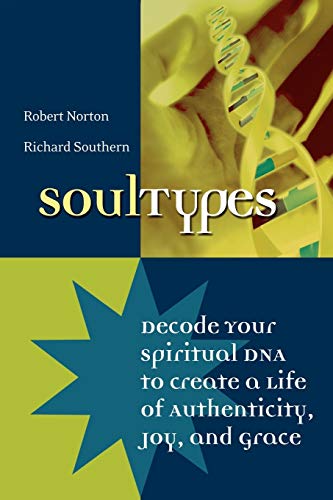
We are all wired for God, but our needs, inclinations, and personalities are all different. Using the metaphor of "spiritual DNA," SoulTypes will help you assess your own inborn qualities and find a spiritual path that will support your quest for a richer, fuller, more integrated life.
If you consider yourself spiritual but not religious, SoulTypes will help you discover just what works for you. With its inventory and assessment to guide you to discover and interpret your spiritual type, SoulTypes helps you in answering the most profound questions:
* Who am I What is my authentic identity?
* What’s important to me What are my values, my gifts, my passions?
* Why am I here What is my purpose or mission in life?
* Where am I going What is my vision of my future?
Die Inhaltsangabe kann sich auf eine andere Ausgabe dieses Titels beziehen.
Über die Autorin bzw. den Autor
Robert Norton and Richard Southern have taught the principles of SoulTypes to thousands of seekers. They are also principals in Church Development Systems, a nonprofit organization and national consulting practice.
Von der hinteren Coverseite
Find the Spiritual Path and Style That s Right for You
We are all wired for God, but our needs, inclinations, and personalities are all different. Using the metaphor of "spiritual DNA," SoulTypes will help you assess your own inborn qualities and find a spiritual path that will support your quest for a richer, fuller, more integrated life.
If you consider yourself spiritual but not religious, SoulTypes will help you discover just what works for you. With its unique inventory and assessment tools to guide you, you ll discover your spiritual type and find the answers to the most profound questions:
- Who am I? What is my authentic identity?
- What s important to me? What are my values, my gifts, my passions?
- Why am I here? What is my purpose or mission in life?
- Where am I going? What is my vision of my future?
The SoulType processes will help you find your unique answer for these questions, and then turn to the most crucial question: how do I get from where I am to where I want to be?
"If you have been bewildered by the glut of writings about spirituality, Norton and Southern s book offers a voice of clarity. SoulTypes helps us to sort out who we are, what we value, and where to look for spiritual nourishment. This book is a must-read for every seeker who longs to deepen their journey."
Lauren Artress, Canon for Special Ministries, Grace Cathedral, San Francisco; author, Walking a Sacred Path; Rediscovering the Labyrinth as a Spiritual Tool
Aus dem Klappentext
Find the Spiritual Path and Style That’s Right for You
We are all wired for God, but our needs, inclinations, and personalities are all different. Using the metaphor of "spiritual DNA," SoulTypes will help you assess your own inborn qualities and find a spiritual path that will support your quest for a richer, fuller, more integrated life.
If you consider yourself spiritual but not religious, SoulTypes will help you discover just what works for you. With its unique inventory and assessment tools to guide you, you’ll discover your spiritual type and find the answers to the most profound questions:
- Who am I? What is my authentic identity?
- What’s important to me? What are my values, my gifts, my passions?
- Why am I here? What is my purpose or mission in life?
- Where am I going? What is my vision of my future?
The SoulType processes will help you find your unique answer for these questions, and then turn to the most crucial question: how do I get from where I am to where I want to be?
"If you have been bewildered by the glut of writings about spirituality, Norton and Southern’s book offers a voice of clarity. SoulTypes helps us to sort out who we are, what we value, and where to look for spiritual nourishment. This book is a must-read for every seeker who longs to deepen their journey."
–Lauren Artress, Canon for Special Ministries, Grace Cathedral, San Francisco; author, Walking a Sacred Path; Rediscovering the Labyrinth as a Spiritual Tool
Auszug. © Genehmigter Nachdruck. Alle Rechte vorbehalten.
SoulTypes
Decode Your Spiritual DNA to Create a Life of Authenticity, Joy, and GraceBy Robert Norton Richard SouthernJossey-Bass
Copyright © 2004 Robert NortonAll right reserved.
ISBN: 978-0-7879-6872-4
Chapter One
Who Are You?Discovering Your Spiritual Identity
Look for it and you will find it-what is unsought will go undetected. SOPHOCLES
Two friends, Mike and Frankie, were walking near a lake on a quiet afternoon. Mike says, "You know, no one's around, so why don't we do some skinny dipping?"
"Sounds good," Frankie replies, "but I have a problem. I'll have to take off all my clothes to skinny dip, so how will I know who I am when I get out of the water?"
"Hmmm," says Mike, mulling over the problem. "I've got it. Here, I have a piece of blue twine in my pocket, we'll tie it around your big toe, so when you come out of the water, you'll know who you are."
They agreed and the twine was tied. But while they were swimming, the twine slipped off Frankie's toe and wrapped itself around Mike's toe. When they came out of the water, Frankie looked down at his toe, and the blue twine was missing. Then he saw that the blue twine was tied around Mike's big toe. Flabbergasted, Frankie said to Mike: "I know who you are, but who am I?"
Versions of this story are found in many traditions and cultures. They all make the point that "Who am I?" is an important question that can only be answered by each individual. Yet most people live in a fog about their spiritual identity; they put energy and time into other things that distract them from answering this simple but fundamental question.
ARE YOU YOUR SOUL?
The Titanic disaster, on April 14, 1912, was heralded by a headline that read, "Titanic Sinks: 1,620 Souls Lost at Sea." This headline presupposed a common acceptance of what a soul is. Actually, there was not then, nor is there now, a universally accepted definition of soul.
Many believe that you're born with your soul, and when you die it dies with you. Others say your soul lives on beyond your physical death. Still others feel that your soul is preexistent and enters your body at conception, or at birth, and when you die it travels on to another body, before reaching total union with God. Some argue that your soul is the real essence of your being, and that your body is nothing more than a vehicle for your soul. Some say your body is simply an outer expression of your soul within, while others insist that your soul and body are fused together to form you as a complete being.
All living religious traditions have something to say about the concept of the soul. Hindus refer to an individual soul as the atman, or the highest self, a part of God, an expression of God-which, in reality, is God. Sri Aurobindo said the soul is an alive, evolving, psychic being; that once it understands its connection to cosmic consciousness, the soul displays not only its unique individuality but also its relationship to the totality of being.
Buddhists, on the other hand, have no teaching about a deity or creator god, so there is no affirmation of a separate soul and no individual expression of the divine. They see the concept of a separate soul as an expression of clinging to the self. For Buddhists, the purpose of discovering your spiritual DNA would be to assist you in realizing your true nature, an effort that typically requires a focused and disciplined mind.
In the Hebrew scriptures, the Book of Genesis relates that God formed the human race from the dust of the earth; when God breathed life into humankind, we became living souls. The essential dichotomy of seeing humanity as both soul and body gave Judaism a holistic understanding of individual existence.
According to Sufi teachings, your soul, or ruh, is connected to God-even if you are not conscious of the connection-at seven soul levels: mineral, vegetable, animal, personal, human, secret, and inner secret, with unique gifts and skills for each level. By conscious development you can express these gifts for your personal benefit and for society. Your soul, Sufis say, goes through an evolutionary process as it grows through these levels, until finally it reaches a holistic state in which it encompasses all aspects of your individuality: mind, body, and spirit.
Christianity uses the Greek word psyche for soul more than one hundred times in the New Testament, indicating a number of understandings of the concept. Rather than a separate, immortal soul, the central theme here is that your soul is one aspect of your individual identity, which will be restored at the resurrection. In the formative days of Christian teaching, St. Augustine's concept that the soul is the image of God was widely accepted. By the medieval period, the soul was referred to as "the echo of the body," in which soul had some connection with God and yet maintained its own separateness. The Protestant Reformation brought a strongly rational view of humans as having a dichotomy of body and soul as two separate spheres of being. Today we see a decided shift back to a unitary concept of mind, body, and spirit.
Clearly, there are many definitions for soul!
In this book, when we speak of the soul we mean the organizing principle for an individual life, which can be perceived and expressed in a variety of ways: through the mind, through the affect, through silence, and through activity. Whatever the origin of the soul-or the origin of the concept of the soul-the fact is that from a spiritual perspective you're created in love, sustained in love, and called to love. In this sense, soul is, as Huston Smith has said, "the final locus of our individuality."
WHAT'S IN A NAME?
Names are intended to distinguish individuals from one another. Imagine how difficult it would be if we did not use names. Instead of saying "Marie," for example, one would have to say something like "the beautiful blond woman who lives in the green house down the street"!
Names are convenient. Some names carry information about roots, such as inherited family, clan, or tribal names. If you look in the phone directory, you'll see many listings for a common last name such as Jones or Lopez or Wong.
Names can serve other purposes as well. The Chinese use names to identify the generation of the bearer. African cultures use names to describe the order in which siblings are born. Given names (first names) are generally bestowed at some point after the birth of a child, or they are decided upon before birth.
Life Map Notes: What's in Your Name?
1. Print your first name (or middle name, if you go by that) here (or, preferably, in your journal): __________________________
2. If you're known by a nickname, print it here: _______________
3. Have you ever been identified by a negative name? Did you buy into it at the time? ____________________________________
If you find the process of naming particularly intriguing, explore these optional questions.
4. What is the etymology (derivation) of your given name?
To research the meaning of your name, search the Internet using the keywords "names," "meaning of names," "etymology." You'll be able to research names from most cultures. If your name was specially created for you, you probably won't find it; however, you might find a name that sounds like yours and probably has a similar...
„Über diesen Titel“ kann sich auf eine andere Ausgabe dieses Titels beziehen.
Suchergebnisse für SoulTypes: Decode Your Spiritual DNA to Create a Life...

Beispielbild für diese ISBN
SoulTypes: Decode Your Spiritual DNA to Create a Life of Authenticity, Joy, and Grace
Anbieter: Wonder Book, Frederick, MD, USA
Verkäuferbewertung 5 von 5 Sternen

Zustand: Very Good. Very Good condition. A copy that may have a few cosmetic defects. May also contain light spine creasing or a few markings such as an owner's name, short gifter's inscription or light stamp. Bundled media such as CDs, DVDs, floppy disks or access codes may not be included. Artikel-Nr. Z07H-01263
Gebraucht kaufen
EUR 6,32
Versand gratis
Versand innerhalb von USA
Versand innerhalb von USA
Anzahl: 1 verfügbar
Beispielbild für diese ISBN
Soultypes: Decode Your Spiritual DNA to Create a Life of Authenticity, Joy, and Grace
Anbieter: ThriftBooks-Atlanta, AUSTELL, GA, USA
Verkäuferbewertung 5 von 5 Sternen
Paperback. Zustand: Very Good. No Jacket. May have limited writing in cover pages. Pages are unmarked. ~ ThriftBooks: Read More, Spend Less. Artikel-Nr. G0787968722I4N00
Gebraucht kaufen
EUR 7,22
Versand gratis
Versand innerhalb von USA
Versand innerhalb von USA
Anzahl: 1 verfügbar
Beispielbild für diese ISBN
SoulTypes : Decode Your Spiritual DNA to Create a Life of Authenticity, Joy, and Grace
Verlag:
Wiley & Sons, Incorporated, John, 2004
ISBN 10: 0787968722
ISBN 13: 9780787968724
Gebraucht
Softcover
Erstausgabe
Anbieter: Better World Books: West, Reno, NV, USA
Verkäuferbewertung 5 von 5 Sternen
Zustand: Very Good. 1st Edition. Pages intact with possible writing/highlighting. Binding strong with minor wear. Dust jackets/supplements may not be included. Stock photo provided. Product includes identifying sticker. Better World Books: Buy Books. Do Good. Artikel-Nr. 57451047-75
Gebraucht kaufen
EUR 8,21
Versand gratis
Versand innerhalb von USA
Versand innerhalb von USA
Anzahl: 1 verfügbar
Beispielbild für diese ISBN
SoulTypes : Decode Your Spiritual DNA to Create a Life of Authenticity, Joy, and Grace
Verlag:
Wiley & Sons, Incorporated, John, 2004
ISBN 10: 0787968722
ISBN 13: 9780787968724
Gebraucht
Softcover
Erstausgabe
Anbieter: Better World Books, Mishawaka, IN, USA
Verkäuferbewertung 5 von 5 Sternen
Zustand: Good. 1st Edition. Former library copy. Pages intact with minimal writing/highlighting. The binding may be loose and creased. Dust jackets/supplements are not included. Includes library markings. Stock photo provided. Product includes identifying sticker. Better World Books: Buy Books. Do Good. Artikel-Nr. GRP102037289
Gebraucht kaufen
EUR 8,21
Versand gratis
Versand innerhalb von USA
Versand innerhalb von USA
Anzahl: 2 verfügbar
Beispielbild für diese ISBN
SoulTypes
Anbieter: PBShop.store UK, Fairford, GLOS, Vereinigtes Königreich
Verkäuferbewertung 5 von 5 Sternen
PAP. Zustand: New. New Book. Shipped from UK. Established seller since 2000. Artikel-Nr. FW-9780787968724
Neu kaufen
EUR 13,16
EUR 4,84 Versand
Versand von Vereinigtes Königreich nach USA
Versand von Vereinigtes Königreich nach USA
Anzahl: 15 verfügbar
Beispielbild für diese ISBN
Soultypes
Anbieter: Majestic Books, Hounslow, Vereinigtes Königreich
Verkäuferbewertung 4 von 5 Sternen

Zustand: New. pp. 170. Artikel-Nr. 7472383
Neu kaufen
EUR 14,79
EUR 7,56 Versand
Versand von Vereinigtes Königreich nach USA
Versand von Vereinigtes Königreich nach USA
Anzahl: 3 verfügbar
Beispielbild für diese ISBN
SoulTypes: Decode Your Spiritual DNA to Create a Life of Authenticity, Joy, and Grace
Anbieter: Ria Christie Collections, Uxbridge, Vereinigtes Königreich
Verkäuferbewertung 5 von 5 Sternen
Zustand: New. In English. Artikel-Nr. ria9780787968724_new
Neu kaufen
EUR 17,30
EUR 10,90 Versand
Versand von Vereinigtes Königreich nach USA
Versand von Vereinigtes Königreich nach USA
Anzahl: Mehr als 20 verfügbar
Beispielbild für diese ISBN
SoulTypes: Decode Your Spiritual DNA to Create a Life of Authenticity, Joy, and Grace
Anbieter: Kennys Bookstore, Olney, MD, USA
Verkäuferbewertung 5 von 5 Sternen
Zustand: New. We are all wired for God, but our needs, inclinations, and personalities are all different. Using the metaphor of 'spiritual DNA,' this book helps you assess your own inborn qualities and find a spiritual path that can support your quest for a richer, fuller, more integrated life. Num Pages: 192 pages, black & white illustrations. BIC Classification: HR. Category: (P) Professional & Vocational; (U) Tertiary Education (US: College). Dimension: 229 x 153 x 13. Weight in Grams: 233. . 2004. 1st Edition. Paperback. . . . . Books ship from the US and Ireland. Artikel-Nr. V9780787968724
Neu kaufen
EUR 20,27
EUR 9,22 Versand
Versand innerhalb von USA
Versand innerhalb von USA
Anzahl: Mehr als 20 verfügbar
Beispielbild für diese ISBN
Soul Types: Decode Your Spiritual DNA to Create a Life of Authenticity, Joy, and Grace
Anbieter: Revaluation Books, Exeter, Vereinigtes Königreich
Verkäuferbewertung 5 von 5 Sternen
Paperback. Zustand: Brand New. 1st edition. 192 pages. 8.75x6.00x0.50 inches. In Stock. Artikel-Nr. x-0787968722
Neu kaufen
EUR 18,31
EUR 11,63 Versand
Versand von Vereinigtes Königreich nach USA
Versand von Vereinigtes Königreich nach USA
Anzahl: 2 verfügbar
Foto des Verkäufers
Soultypes
Anbieter: moluna, Greven, Deutschland
Verkäuferbewertung 5 von 5 Sternen
Zustand: New. We are all wired for God, but our needs, inclinations, and personalities are all different. Using the metaphor of spiritual DNA, this book helps you assess your own inborn qualities and find a spiritual path that can support your quest for a richer, fulle. Artikel-Nr. 447063823
Neu kaufen
EUR 20,32
EUR 48,99 Versand
Versand von Deutschland nach USA
Versand von Deutschland nach USA
Anzahl: Mehr als 20 verfügbar