
Verwandte Artikel zu The Project Manager's MBA: How to Translate Project...
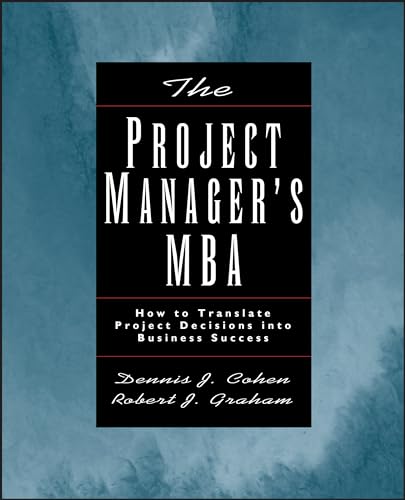
The Project Manager's MBA: How to Translate Project Decisions into Business Success (Jossey Bass Business & Management Series) - Hardcover
Inhaltsangabe
Project managers are no longer judged by the technical success of their projects alone. They're also held accountable for their contributions to the company's financial goals. Yet most project managers don't have the business knowledge necessary to make project-based decisions that lead to bottom-line success. In this book, Dennis Cohen and Robert Graham, both former university professors and experienced project management consultants, provide the skills that, until now, could only be gained through a graduate degree and years of hands-on experience.
Cohen and Graham walk project managers through basic business concepts such as value creation, accounting and finance, strategy, and marketing. They connect these concepts to the decisions project managers face every day. And they make it easy to apply the resulting solutions on the job through a unique business systems calculator. Readers can use the online calculator in conjunction with the book to understand how different project variables affect business outcomes, to determine the overall impact of proposed project changes, and to evaluate the economic results of many decisions they make.
Cohen and Graham's principles apply equally to projects in business, non-profit, and government organizations. And each one is illustrated through case studies drawn from a range of industries, including pharmaceuticals, the technology sector, even the winemaking business. Whether the mandate is to get new products to market, improve the infrastructure, or better serve customers and clients, this book teaches project managers how to make day-to-day decisions from an upper-management perspective. And it provides a blueprint for planning and pitching potential projects that demonstrates a higher level of business savvy.
Die Inhaltsangabe kann sich auf eine andere Ausgabe dieses Titels beziehen.
Über die Autorin bzw. den Autor
The Authors
Dennis J. Cohen is senior vice president and managing director of the Project Management Practice at Strategic Management Group.
Robert J. Graham has developed a consulting practice in project management and is the author of Project Management as if People Mattered and Creating an Environment for Successful Projects.
Both Cohen and Graham have presented papers on this and other project management subjects at conferences of the Project Management Institute and Project World.
Von der hinteren Coverseite
The PROJECT MANAGER'S MBA
Project managers are no longer judged by the technical success of their projects alone. They're also held accountable for their contributions to the company's financial goals. Yet most project managers don't have the business knowledge necessary to make project-based decisions that lead to bottom-line success. In this book, Dennis Cohen and Robert Graham, both former university professors and experienced project management consultants, provide the skills that, until now, could only be gained through a graduate degree and years of hands-on experience.
Cohen and Graham walk project managers through basic business concepts such as value creation, accounting and finance, strategy, and marketing. They connect these concepts to the decisions project managers face every day. And they make it easy to apply the resulting solutions on the job through a unique business systems calculator. Readers can use the online calculator in conjunction with the book to understand how different project variables affect business outcomes, to determine the overall impact of proposed project changes, and to evaluate the economic results of many decisions they make.
Cohen and Graham's principles apply equally to projects in business, nonprofit, and government organizations. And each one is illustrated through case studies drawn from a range of industries, including pharmaceuticals, the technology sector, even the wine-making business.Whether the mandate is to get new products to market, improve the infrastructure, or better serve customers and clients, this book teaches project managers how to make day-to-day decisions from an upper-management perspective. And it provides a blueprint for planning and pitching potential projects that demonstrates a higher level of business savvy.
Aus dem Klappentext
Project managers are no longer judged by the technical success of their projects alone. They're also held accountable for their contributions to the company's financial goals. Yet most project managers don't have the business knowledge necessary to make project-based decisions that lead to bottom-line success. In this book, Dennis Cohen and Robert Graham, both former university professors and experienced project management consultants, provide the skills that, until now, could only be gained through a graduate degree and years of hands-on experience.Cohen and Graham walk project managers through basic business concepts such as value creation, accounting and finance, strategy, and marketing. They connect these concepts to the decisions project managers face every day. And they make it easy to apply the resulting solutions on the job through a unique business systems calculator. Readers can use the online calculator in conjunction with the book to understand how different project variables affect business outcomes, to determine the overall impact of proposed project changes, and to evaluate the economic results of many decisions they make.Cohen and Graham's principles apply equally to projects in business, non-profit, and government organizations. And each one is illustrated through case studies drawn from a range of industries, including pharmaceuticals, the technology sector, even the winemaking business. Whether the mandate is to get new products to market, improve the infrastructure, or better serve customers and clients, this book teaches project managers how to make day-to-day decisions from an upper-management perspective. And it provides a blueprint for planning and pitching potential projects that demonstrates a higher level of business savvy.
Auszug. © Genehmigter Nachdruck. Alle Rechte vorbehalten.
From Chapter 1: An Entrepreneurial Approach to Managing Projects
Make it fast. Make it good. Make it cheap." So goes the project management folklore about what senior management always asks for. "Pick two," is the traditional project manager reply. Almost always, "make it cheap" is one of the two project goals upper management chooses. However, only when upper managers and project managers understand the wider business implications of their decisions do they realize that "make it cheap" may not contribute to successful business results as often as they think. This is because the cost of the project, or the cost of producing the product, is only one factor in determining the economic success of the project. In this book we develop a framework for thinking about projects based on business concepts such as increasing economic value, or Economic Value Added (EVA); this framework can contribute to better decision making throughout the project lifecycle and ultimately result in more successful projects. In addition we show that the old success criteria of meeting outcome, cost, and schedule constraints are no longer adequate and that increasing economic value will become an important, if not the most important, criterion for success in the future of project management.
The use of economic value as a decision criterion indicates a change in the way project success is determined. In the past, project managers were assessed primarily on project performance up to the point of project completion. This resulted in evaluations based on outcomes that met the project specifications, a fixed budget, and a given deadline. The ensuing economic success of the product produced was normally someone else's concern. However, in the future project managers must think more broadly about what a successful outcome really means. To for-profit businesses it means a level of customer satisfaction high enough to produce sales that result in enough cash flow to cover project and operating expenses, make a profit, and pay back the cost of the capital used to produce the product. At this point the project begins to produce the economic value known as shareholder value.
Shareholder value is a term that has become familiar in the world of business. Those who work for publicly owned corporations are likely to have some idea of its increasing influence on upper-management behavior in those companies. Those who work for not-for-profit or governmental organizations may have to do a little translation to relate the idea of shareholder value to their projects. We suggest mentally substituting the term stakeholder, taxpayer, or voter value for the terms shareholder value and economic value (which we use interchangeably throughout). At first glance, shareholder value, or economic value, seems to be a purely financial term. Besides its financial element, however, it contains a dynamic balancing of competing values. In order for a business to maximize shareholder value, it must balance customer satisfaction and competitive market forces with internal cost and outcome considerations. Shareholders of a for-profit company want a return on their investment. Stakeholders of a not-for-profit organization want its desired outcomes achieved within the economic constraints necessary to ensure the survival of the organization so that it can continue to do good in the world. Stakeholder value may not involve a profit, but it must necessarily involve an outcome that somehow recoups any actual or implied cost of the capital used by the project. In addition, many not-for-profit organizations are finding themselves in competition with for-profit businesses and thus subject to similar competitive and economic forces (Ryan, 1999). Taxpayers, for example, want the highest quality outcome from a governmental project for the lowest relative cost. This outcome must also include considerations of cost of capital, which is lower for governments than for businesses but still not inconsequential. We believe that the dynamic new approach to projects we are describing here will serve you well whether your project is in a business, a not-for-profit organization, or a governmental agency.
In any of these organizations, the criteria for economic value are now or soon will be your responsibility, because management will measure your performance by them. This, then, is the future of project management. As a project manager, you must recognize it as your future as well.
Welcome to the world of business systems. The only way that you will attain success given the new project management paradigm will be as a business systems thinker. In more direct terms this means of thinking of your project as if it were a business and you were the chief executive officer, the CEO. This chapter out lines the change in thinking managers must undertake to work within the new project management paradigm. In any sociotechnical system the people in the system work better when they understand how they fit into the system as a whole. This understanding is developed when people share the perspective of the CEO, the person who is responsible for the whole business and whose results are measured by an increase in value for the stakeholders of the organization. The board of directors represents the stakeholders, and the CEO works for the board. He or she must manage the whole company from the top. Therefore, the entrepreneurial approach to project management requires the project manager to manage the project as if it were an independent business venture. But like the CEO, the project manager must also manage with the larger organizational system in mind, even though the project manager will be influencing the system from the project standpoint rather than from the top. He or she will need to understand how the elements of the project affect the business as a whole and how elements of the business influence the project. By thinking in business terms project managers will better understand the interaction between the project and the overall organization. In addition, they will be better able to explain the business implications of upper-management decisions about a project. That is, they will be able to speak to upper managers in a language that those managers understand...
„Über diesen Titel“ kann sich auf eine andere Ausgabe dieses Titels beziehen.
Suchergebnisse für The Project Manager's MBA: How to Translate Project...

Beispielbild für diese ISBN
The Project Manager's MBA: How to Translate Project Decisions into Business Success
Anbieter: World of Books (was SecondSale), Montgomery, IL, USA
Verkäuferbewertung 5 von 5 Sternen

Hardback. Zustand: Good. Covers basic business concepts such as value creation, accounting and finance, strategy, and marketing. This book aims to connect these concepts to the decisions project managers face every day. Readers can use the online calculator in conjunction with the book to understand how different project variables affect business outcomes. Artikel-Nr. 00102816471
Gebraucht kaufen
EUR 4,70
Versand gratis
Versand innerhalb von USA
Versand innerhalb von USA
Anzahl: 2 verfügbar
Beispielbild für diese ISBN
The Project Manager's MBA: How to Translate Project Decisions into Business Success
Anbieter: Wonder Book, Frederick, MD, USA
Verkäuferbewertung 5 von 5 Sternen
Zustand: As New. Like New condition. Very Good dust jacket. Artikel-Nr. D09I-00186
Gebraucht kaufen
EUR 4,88
Versand gratis
Versand innerhalb von USA
Versand innerhalb von USA
Anzahl: 1 verfügbar
Beispielbild für diese ISBN
The Project Manager's MBA: How to Translate Project Decisions into Business Success
Verlag:
Jossey-Bass (edition 1), 2000
ISBN 10: 0787952567
ISBN 13: 9780787952563
Gebraucht
Hardcover
Anbieter: BooksRun, Philadelphia, PA, USA
Verkäuferbewertung 5 von 5 Sternen
Hardcover. Zustand: Very Good. 1. With dust jacket. It's a well-cared-for item that has seen limited use. The item may show minor signs of wear. All the text is legible, with all pages included. It may have slight markings and/or highlighting. Artikel-Nr. 0787952567-11-1-29
Gebraucht kaufen
EUR 5,92
Versand gratis
Versand innerhalb von USA
Versand innerhalb von USA
Anzahl: 2 verfügbar
Beispielbild für diese ISBN
The Project Manager's MBA : How to Translate Project Decisions into Business Success
Verlag:
Wiley & Sons, Incorporated, John, 2000
ISBN 10: 0787952567
ISBN 13: 9780787952563
Gebraucht
Hardcover
Erstausgabe
Anbieter: Better World Books, Mishawaka, IN, USA
Verkäuferbewertung 5 von 5 Sternen
Zustand: Good. 1st ed. Pages intact with minimal writing/highlighting. The binding may be loose and creased. Dust jackets/supplements are not included. Stock photo provided. Product includes identifying sticker. Better World Books: Buy Books. Do Good. Artikel-Nr. 4273209-75
Gebraucht kaufen
EUR 6,37
Versand gratis
Versand innerhalb von USA
Versand innerhalb von USA
Anzahl: 2 verfügbar
Beispielbild für diese ISBN
The Project Manager's MBA: How to Translate Project Decisions into Business Success
Anbieter: Wonder Book, Frederick, MD, USA
Verkäuferbewertung 5 von 5 Sternen
Zustand: Very Good. Very Good condition. Good dust jacket. A copy that may have a few cosmetic defects. May also contain light spine creasing or a few markings such as an owner's name, short gifter's inscription or light stamp. Bundled media such as CDs, DVDs, floppy disks or access codes may not be included. Artikel-Nr. M11M-01226
Gebraucht kaufen
EUR 6,44
Versand gratis
Versand innerhalb von USA
Versand innerhalb von USA
Anzahl: 1 verfügbar
Beispielbild für diese ISBN
The Project Manager's MBA: How to Translate Project Decisions into Business Success
Anbieter: Wonder Book, Frederick, MD, USA
Verkäuferbewertung 5 von 5 Sternen
Zustand: Very Good. Very Good condition. Very Good dust jacket. A copy that may have a few cosmetic defects. May also contain light spine creasing or a few markings such as an owner's name, short gifter's inscription or light stamp. Artikel-Nr. A09A-06925
Gebraucht kaufen
EUR 6,44
Versand gratis
Versand innerhalb von USA
Versand innerhalb von USA
Anzahl: 2 verfügbar
Beispielbild für diese ISBN
Project Manager MBA
Anbieter: ThriftBooks-Dallas, Dallas, TX, USA
Verkäuferbewertung 5 von 5 Sternen
Hardcover. Zustand: Very Good. No Jacket. Former library book; May have limited writing in cover pages. Pages are unmarked. ~ ThriftBooks: Read More, Spend Less. Artikel-Nr. G0787952567I4N10
Gebraucht kaufen
EUR 6,52
Versand gratis
Versand innerhalb von USA
Versand innerhalb von USA
Anzahl: 1 verfügbar
Beispielbild für diese ISBN
Project Manager MBA
Anbieter: ThriftBooks-Dallas, Dallas, TX, USA
Verkäuferbewertung 5 von 5 Sternen
Hardcover. Zustand: Very Good. No Jacket. May have limited writing in cover pages. Pages are unmarked. ~ ThriftBooks: Read More, Spend Less. Artikel-Nr. G0787952567I4N00
Gebraucht kaufen
EUR 6,52
Versand gratis
Versand innerhalb von USA
Versand innerhalb von USA
Anzahl: 1 verfügbar
Beispielbild für diese ISBN
The Project Manager's MBA: How to Translate Project Decisions into Business Success (Jossey-Bass Business & Management)
Anbieter: AwesomeBooks, Wallingford, Vereinigtes Königreich
Verkäuferbewertung 5 von 5 Sternen
Hardcover. Zustand: Very Good. The Project Manager's MBA: How to Translate Project Decisions into Business Success (Jossey-Bass Business & Management) This book is in very good condition and will be shipped within 24 hours of ordering. The cover may have some limited signs of wear but the pages are clean, intact and the spine remains undamaged. This book has clearly been well maintained and looked after thus far. Money back guarantee if you are not satisfied. See all our books here, order more than 1 book and get discounted shipping. Artikel-Nr. 7719-9780787952563
Gebraucht kaufen
EUR 4,90
EUR 4,92 Versand
Versand von Vereinigtes Königreich nach USA
Versand von Vereinigtes Königreich nach USA
Anzahl: 2 verfügbar
Beispielbild für diese ISBN
The Project Manager's MBA : How to Translate Project Decisions into Business Success
Verlag:
Wiley & Sons, Incorporated, John, 2000
ISBN 10: 0787952567
ISBN 13: 9780787952563
Gebraucht
Hardcover
Erstausgabe
Anbieter: Better World Books Ltd, Dunfermline, Vereinigtes Königreich
Verkäuferbewertung 5 von 5 Sternen
Zustand: Very Good. 1st ed. Former library copy. Pages intact with possible writing/highlighting. Binding strong with minor wear. Dust jackets/supplements may not be included. Includes library markings. Stock photo provided. Product includes identifying sticker. Better World Books: Buy Books. Do Good. Artikel-Nr. 10292429-20
Gebraucht kaufen
EUR 5,77
EUR 5,97 Versand
Versand von Vereinigtes Königreich nach USA
Versand von Vereinigtes Königreich nach USA
Anzahl: 2 verfügbar