
Verwandte Artikel zu Don't Sweat the Small Stuff with Your Family: Simple...
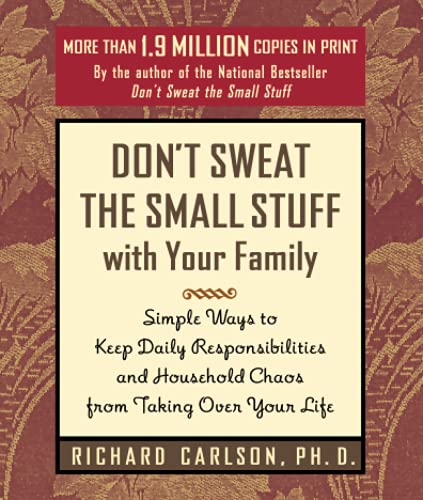
Don't Sweat the Small Stuff with Your Family: Simple Ways to Keep Daily Responsibilities from Taking Over Your Life (Don't Sweat the Small Stuff Series) - Softcover
Inhaltsangabe
Featured in Don't Sweat the Small Stuff: The Kristine Carlson Story starring Heather Locklear, premiering on Lifetime
This indispensable guide to family in the #1 bestselling series reveals how to avoid letting the minor setbacks in your home life get you down. With his characteristic candor and piercing insight, author Richard Carlson demonstrates how to resolve such common domestic tensions as:
- Children who are whining or fighting
- Issues with your spouse
- Hassles over household chores
- Difficult teenagers
Die Inhaltsangabe kann sich auf eine andere Ausgabe dieses Titels beziehen.
Über die Autorin bzw. den Autor
During his life, Richard Carlson, Ph.D, was considered one of the foremost experts in happiness and stress reduction in the United States and around the world and was a frequent featured guest on many national television and radio programs. Don't Sweat the Small Stuff continued to be a publishing phenomenon with over twenty titles in the brand franchise, two of which were co-authored and authored with his beloved wife, Kris. He died of a pulmonary embolism in December 2006, at the age of forty-five.
Auszug. © Genehmigter Nachdruck. Alle Rechte vorbehalten.
Don't Sweat the Small Stuff with Your Family
Simple Ways to Keep Daily Responsibilities and Household Chaos from Taking Over Your Life
By Richard CarlsonHyperion
Copyright © 1998 Richard Carlson
All rights reserved.
ISBN: 978-0-7868-8337-0All rights reserved.
CHAPTER 1
SET A POSITIVE EMOTIONAL CLIMATE
Just like a garden that flourishes best under certain conditions, your homeoperates more smoothly when the emotional climate is well thought out. Ratherthan simply reacting to each crisis and circumstance as it arises, setting anemotional climate gives you a head start in fending off potential sources ofstress and conflict. It helps you respond to life rather than react to it.
When trying to determine the ideal emotional environment for yourself and/oryour family, there are several important questions to ask yourself: What type ofperson are you? What type of environment do you enjoy and thrive in? Do you wishyour home were more peaceful? These types of questions are critical in order toset the optimal emotional climate.
The creation of an emotional climate has more to do with your inner preferencesthan your external environment. For example, the placement of your furniture orthe colors of your walls or carpet can contribute to the emotional environmentbut are not the most critical ingredients. Your emotional environment isprimarily made up of things like noise levels, the speed of activity (iseveryone rushing around like a chicken with its head cut off?), the respect ofone another, and the willingness (or lack of willingness) to sit still andlisten.
In our home, for example, we have determined that our goal is to create andmaintain an environment of relative calm. Although we often fall short of ourgoal, we do take steps to put the odds in our favor. For example, although weall love spending time together, and we very often do, each of us also enjoysspending time alone in our home. The simple recognition that being alone isthought of as positive, rather than as negative, makes it easier for all of usto be sensitive to the noise, activity, and chaos levels that are occurring atany given moment. We have learned to sense when one of us needs a quieterenvironment or the space to be alone.
Another thing we try to do is to keep unnecessary rushing around to a minimum.Even though our children are only eight and five years old, we have discussedthis issue many times. As a family, we have agreed to work on this tendency asindividuals as well as in our interactions together. For example, if I fall intomy habit of rushing around, trying to do too many things at once, I've given mychildren permission to gently remind me to slow down. They know that keeping asane pace is important to the quality of our life at home and they feelcomfortable reminding me when I'm interfering with this goal.
Obviously, the ideal emotional environment is going to be different from home tohome. However, I think you'll find that if you spend a little time reflecting onwhat type of environment you would most prefer, you'll see relatively simplechanges that you can begin to implement. Be patient with this one. It may havetaken many years to create your current emotional environment, so it may take alittle time to create a new one. Over time, I'm fairly certain you'll find thisstrategy extremely rewarding.
CHAPTER 2
GIVE YOURSELF AN EXTRA TEN MINUTES
When you ask a typical person or family about what stresses them out the most,it's rare that someone doesn't include the fact that they are almost alwaysrunning "a few minutes behind." Whether you're off to a soccer match, work, theairport, a neighborhood picnic, a typical day at school, or church, it seemsthat most of us almost always find a way to wait until the last possible minuteto leave, thus running a little late. This tendency creates a great deal ofunnecessary stress as we're constantly thinking about who is waiting for us, howfar we are behind schedule, and how often this occurs. Invariably, we end upclutching the steering wheel, tightening our neck, and worrying about theconsequences of being late. Running late makes us feel stressed out andencourages us to sweat the small stuff!
This ever-so-common problem is easily solved by simply giving yourself an extraten minutes to get yourself and your family to your appointments. Irrespectiveof where you're headed, tell yourself that, no matter what, you're going to beten minutes early instead of waiting until the last possible moment torush out the door.
The key, of course, is to start getting ready a little earlier than usual and tobe sure you're all-the-way ready before you start doing something else. I can'ttell you how much this simple strategy has helped me in my own life. Rather thanconstantly scrambling to find my daughters' shoes or my wallet at the lastpossible moment, I'm now usually ready with plenty of time to spare. Don't kidyourself that these extra ten minutes aren't significant—they are. Theextra few minutes before and between activities can be the difference between astressful day and a joyful day. In addition, you'll discover that when you'renot running late you'll be able to enjoy rather than rush through the differentthings you do each day. Even simple, ordinary events can be great fun whenyou're not in such a hurry.
When you're done with one activity, leave a little earlier for the next one.When possible, try to schedule your activities, work, play, and everything elsea little further apart. Finally, don't overschedule. Allow for some downtime,time where absolutely nothing is scheduled.
If you implement this strategy, you'll be amazed at how much more relaxed yourlife will seem. The constant sense of pressure, of rushing around, scrambling,will be replaced with a quiet sense of peace.
CHAPTER 3
KEEP IN MIND THAT A HAPPY SPOUSE IS A HELPING SPOUSE
This is such an obvious concept that I'm almost embarrassed to write about it.Yet, I've found that very few marriages take advantage of the truly remarkableramifications of this strategy. The idea, of course, is that when your spouse ishappy and feels appreciated, he or she will want to be of help to you! On theother hand, when your spouse feels unhappy and/or taken for granted, the lastthing in the world he or she will feel like doing is making your lifeeasier!
Let me make it perfectly clear that I'm not suggesting that it's yourresponsibility to make your spouse happy. It's ultimately up to each person tomake that happen for himself or herself. We do, however, play a significant rolein whether or not our spouses feel appreciated. Think about your own situationfor a moment. How often do you genuinely thank your spouse for all thehard work he or she does on your behalf? I've met hundreds of people who admitto virtually never thanking their spouses in this way, and almost no one whodoes so on a regular basis.
Your spouse is your partner. Ideally, you'd treat your partner as you would yourbest friend. If your best friend, for example, said to you, "I would love to getaway by myself for a few days," what would you say? In most cases, you'dprobably come back with something like, "That sounds great. You deserve it. Youshould do it." But if your spouse said exactly the same thing, wouldyour reaction be the same? Or would you think about how his or her request wouldaffect you? Would you feel put out, defensive, or resentful? Is a good friendmore concerned with himself or herself, or with the happiness of the otherperson? Do you think it's a coincidence that your good friends love to help youwhenever...
„Über diesen Titel“ kann sich auf eine andere Ausgabe dieses Titels beziehen.
Suchergebnisse für Don't Sweat the Small Stuff with Your Family: Simple...

Beispielbild für diese ISBN
Don't Sweat the Small Stuff with Your Family
Anbieter: World of Books (was SecondSale), Montgomery, IL, USA
Verkäuferbewertung 5 von 5 Sternen

Paperback. Zustand: Fair. In Don't Sweat the Small Stuff, Richard Carlson showed readers how to prevent the little things in life from causing big aggravation. Now, in Don't Sweat the Small Stuff with Your Family, he offers 100 simple yet revolutionary strategies for cultivating the empathetic, kind, gentle part of ourselves at home, for greater peace with and enjoyment of our families. Artikel-Nr. 00109857160
Gebraucht kaufen
EUR 3,76
Versand gratis
Versand innerhalb von USA
Versand innerhalb von USA
Anzahl: 2 verfügbar
Beispielbild für diese ISBN
Don't Sweat the Small Stuff with Your Family
Anbieter: World of Books (was SecondSale), Montgomery, IL, USA
Verkäuferbewertung 5 von 5 Sternen
Paperback. Zustand: Good. In Don't Sweat the Small Stuff, Richard Carlson showed readers how to prevent the little things in life from causing big aggravation. Now, in Don't Sweat the Small Stuff with Your Family, he offers 100 simple yet revolutionary strategies for cultivating the empathetic, kind, gentle part of ourselves at home, for greater peace with and enjoyment of our families. Artikel-Nr. 00030488745
Gebraucht kaufen
EUR 3,76
Versand gratis
Versand innerhalb von USA
Versand innerhalb von USA
Anzahl: Mehr als 20 verfügbar
Beispielbild für diese ISBN
Don't Sweat the Small Stuff with Your Family: Simple Ways to Keep Daily Responsibilities from Taking Over Your Life
Verlag:
Balance (edition First Edition), 1998
ISBN 10: 0786883375
ISBN 13: 9780786883370
Gebraucht
Paperback
Erstausgabe
Anbieter: BooksRun, Philadelphia, PA, USA
Verkäuferbewertung 5 von 5 Sternen
Paperback. Zustand: Very Good. First Edition. It's a well-cared-for item that has seen limited use. The item may show minor signs of wear. All the text is legible, with all pages included. It may have slight markings and/or highlighting. Artikel-Nr. 0786883375-11-1
Gebraucht kaufen
EUR 4,38
Versand gratis
Versand innerhalb von USA
Versand innerhalb von USA
Anzahl: 2 verfügbar
Beispielbild für diese ISBN
Don't Sweat the Small Stuff with Your Family: Simple Ways to Keep Daily Responsibilities from Taking Over Your Life
Verlag:
Balance (edition First Edition), 1998
ISBN 10: 0786883375
ISBN 13: 9780786883370
Gebraucht
Paperback
Erstausgabe
Anbieter: BooksRun, Philadelphia, PA, USA
Verkäuferbewertung 5 von 5 Sternen
Paperback. Zustand: Fair. First Edition. The item might be beaten up but readable. May contain markings or highlighting, as well as stains, bent corners, or any other major defect, but the text is not obscured in any way. Artikel-Nr. 0786883375-7-18-13
Gebraucht kaufen
EUR 4,84
Versand gratis
Versand innerhalb von USA
Versand innerhalb von USA
Anzahl: 1 verfügbar
Beispielbild für diese ISBN
Don't Sweat the Small Stuff with Your Family
Verlag:
Little Brown and Company, 1998
ISBN 10: 0786883375
ISBN 13: 9780786883370
Gebraucht
Paperback
Anbieter: ThriftBooks-Reno, Reno, NV, USA
Verkäuferbewertung 5 von 5 Sternen
Paperback. Zustand: As New. No Jacket. Pages are clean and are not marred by notes or folds of any kind. ~ ThriftBooks: Read More, Spend Less. Artikel-Nr. G0786883375I2N00
Gebraucht kaufen
EUR 5,96
Versand gratis
Versand innerhalb von USA
Versand innerhalb von USA
Anzahl: 1 verfügbar
Beispielbild für diese ISBN
Don't Sweat the Small Stuff with Your Family
Verlag:
Little Brown and Company, 1998
ISBN 10: 0786883375
ISBN 13: 9780786883370
Gebraucht
Paperback
Anbieter: ThriftBooks-Dallas, Dallas, TX, USA
Verkäuferbewertung 5 von 5 Sternen
Paperback. Zustand: As New. No Jacket. Pages are clean and are not marred by notes or folds of any kind. ~ ThriftBooks: Read More, Spend Less. Artikel-Nr. G0786883375I2N00
Gebraucht kaufen
EUR 5,96
Versand gratis
Versand innerhalb von USA
Versand innerhalb von USA
Anzahl: 1 verfügbar
Beispielbild für diese ISBN
Don't Sweat the Small Stuff with Your Family
Verlag:
Little Brown and Company, 1998
ISBN 10: 0786883375
ISBN 13: 9780786883370
Gebraucht
Paperback
Anbieter: ThriftBooks-Atlanta, AUSTELL, GA, USA
Verkäuferbewertung 5 von 5 Sternen
Paperback. Zustand: As New. No Jacket. Pages are clean and are not marred by notes or folds of any kind. ~ ThriftBooks: Read More, Spend Less. Artikel-Nr. G0786883375I2N00
Gebraucht kaufen
EUR 5,96
Versand gratis
Versand innerhalb von USA
Versand innerhalb von USA
Anzahl: 1 verfügbar
Beispielbild für diese ISBN
Don't Sweat the Small Stuff with Your Family : Simple Ways to Keep Daily Responsibilities from Taking over Your Life
Verlag:
Grand Central Publishing, 1998
ISBN 10: 0786883375
ISBN 13: 9780786883370
Gebraucht
Softcover
Erstausgabe
Anbieter: Better World Books: West, Reno, NV, USA
Verkäuferbewertung 5 von 5 Sternen
Zustand: Good. 1st. Former library copy. Pages intact with minimal writing/highlighting. The binding may be loose and creased. Dust jackets/supplements are not included. Includes library markings. Stock photo provided. Product includes identifying sticker. Better World Books: Buy Books. Do Good. Artikel-Nr. GRP61949565
Gebraucht kaufen
EUR 6,18
Versand gratis
Versand innerhalb von USA
Versand innerhalb von USA
Anzahl: 1 verfügbar
Beispielbild für diese ISBN
Don't Sweat the Small Stuff with Your Family : Simple Ways to Keep Daily Responsibilities from Taking over Your Life
Verlag:
Grand Central Publishing, 1998
ISBN 10: 0786883375
ISBN 13: 9780786883370
Gebraucht
Softcover
Erstausgabe
Anbieter: Better World Books: West, Reno, NV, USA
Verkäuferbewertung 5 von 5 Sternen
Zustand: Good. 1st. Pages intact with minimal writing/highlighting. The binding may be loose and creased. Dust jackets/supplements are not included. Stock photo provided. Product includes identifying sticker. Better World Books: Buy Books. Do Good. Artikel-Nr. GRP73180333
Gebraucht kaufen
EUR 6,18
Versand gratis
Versand innerhalb von USA
Versand innerhalb von USA
Anzahl: 1 verfügbar
Beispielbild für diese ISBN
Don't Sweat the Small Stuff with Your Family: Simple Ways to Keep Daily Responsibilities from Taking Over Your Life (Don't Sweat the Small Stuff Series)
Anbieter: Wonder Book, Frederick, MD, USA
Verkäuferbewertung 5 von 5 Sternen
Zustand: Very Good. Very Good condition. A copy that may have a few cosmetic defects. May also contain light spine creasing or a few markings such as an owner's name, short gifter's inscription or light stamp. Artikel-Nr. X05H-02193
Gebraucht kaufen
EUR 6,42
Versand gratis
Versand innerhalb von USA
Versand innerhalb von USA
Anzahl: 4 verfügbar