
Verwandte Artikel zu Don't Sweat the Small Stuff at Work: Simple Ways...
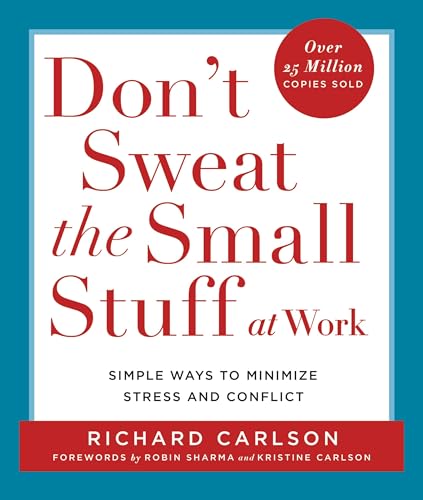
Don't Sweat the Small Stuff at Work: Simple Ways to Minimize Stress and Conflict (Don't Sweat the Small Stuff Series) - Softcover
Inhaltsangabe
Featured in Don't Sweat the Small Stuff: The Kristine Carlson Story starring Heather Locklear, premiering on Lifetime
In this classic roadmap to managing your high-tension job, Richard Carlson shows how to stop worrying about the aspects of your work beyond your control and interact more fruitfully and joyfully with colleagues, clients, and bosses. His key insights reveal how to:
- How to manage rush deadlines with rushing
- How to transform your outlook and prepare for the day ahead
- How to enjoy corporate travel
- How to have a really bad day . . . and get over it
Die Inhaltsangabe kann sich auf eine andere Ausgabe dieses Titels beziehen.
Über die Autorin bzw. den Autor
During his life, Richard Carlson, Ph.D, was considered one of the foremost experts in happiness and stress reduction in the United States and around the world and was a frequent featured guest on many national television and radio programs. Don't Sweat the Small Stuff continued to be a publishing phenomenon with over twenty titles in the brand franchise, two of which were co-authored and authored with his beloved wife, Kris. He died of a pulmonary embolism in December 2006, at the age of forty-five.
Auszug. © Genehmigter Nachdruck. Alle Rechte vorbehalten.
Don't Sweat the Small Stuff at Work
Simple Ways to Minimize Stress and Conflict While Bringing Out the Best in Yourself and Others
By Richard CarlsonHyperion
Copyright © 1999 Richard Carlson
All rights reserved.
ISBN: 978-0-7868-8336-3All rights reserved.
CHAPTER 1
DARE TO BE HAPPY
Many people don't allow themselves the luxury of being enthusiastic, light-hearted,inspired, relaxed, or happy—especially at work. To me, this is avery unfortunate form of self-denial. It seems that a great number of people arefrightened at what a happy demeanor would look like to other people, includingcoworkers, clients, and employers. After all, they assume, "Someone who isrelaxed (or happy) must not be a hard worker." The logic goes something likethis: If they looked happy, others might assume they were satisfied with thestatus quo and therefore lacking the necessary motivation to excel in their workor go the extra mile. They certainly couldn't survive in a competitiveenvironment.
I'm often hired to speak to corporations around the country on stress reductionand happier living. On a number of occasions, the person who invited me to speakhas asked me, in a nervous tone, whether I would help the employees become sohappy that they would "lose their edge." I'm not kidding!
In reality, it's the other way around. It's nonsense to believe that a relaxed,happy person necessarily lacks motivation. On the contrary, happy people arealmost always the ones who love what they do. It's been shown again and againthat people who love what they do are highly motivated by their own enthusiasmto continually better themselves and their performance. They are good listenersand have a sharp learning curve. In addition, happy workers are highly creative,charismatic, easy to be around, and good team players.
Unhappy people, on the other hand, are often held back by their own misery orstress, which distracts them from success. Rigid, stressed-out people are a dragto be around and difficult to work with. They are the ones who lack motivationbecause they are so consumed with their own problems, lack of time, and stress.Unhappy people often feel victimized by others and their working conditions.It's difficult for them to be solution-oriented because everything is seen assomeone else's fault. In addition, they are usually poor team players becausethey are often self-centered and preoccupied with their own issues. They aredefensive and, almost always, poor listeners. If they are successful, it'sdespite their unhappiness, not because of it. In fact, if an unhappy, stressed-out person can learn to become happier, he or she will become even moresuccessful.
I felt this strategy would be an excellent way to introduce this book becauseone of my goals is to convince you that it's okay to be happy, kind,patient, more relaxed and forgiving. It's to your advantage, personally andprofessionally. You won't lose your edge, nor will you be "walked on." I canassure you that you won't become apathetic, uncaring or unmotivated. To thecontrary, you'll feel more inspired, creative, and driven to make an evengreater contribution than you do right now. You'll see solutions andopportunities where others see problems. Likewise, rather than being discouragedby setbacks or failures, you'll bounce back quickly and resiliently. You willhave increased energy, you'll be able to work "in the eye of the storm," and,because you'll be so level-headed, you'll be the one who is looked to when toughdecisions need to be made. You will rise to the top.
If you dare to be happy, your life will begin to change immediately. Your lifeand your work will take on greater significance and will be experienced as anextraordinary adventure. You'll be loved by others and, without a doubt, you'llbe sweating the small stuff far less often at work.
CHAPTER 2
BECOME LESS CONTROLLING
When I talk about being "controlling," I'm referring to unhealthy attempts tomanipulate the behavior of others, having the need to control your environment,insisting on having things be "just so" in order to feel secure, and becomingimmobilized, defensive or anxious when other people don't behave to yourspecifications—the way you think they should be. To be controlling meansyou are preoccupied with the actions of others and how those actions affect you.To put it in the context of this book, people who are controlling "sweat thebehavior" of others when it doesn't match their own expectations.
I've made several observations about people who are controlling; two inparticular. First, there are too many of them. For whatever reason, there seemsto be a national trend toward controlling behavior. Secondly, the trait of beingcontrolling is highly stressful—both to the controller and to those whoare being controlled. If you want a more peaceful life, it's essential youbecome less controlling.
One of the most extreme examples of controlling behavior I've heard of involved,of all things, paper clips! A lawyer at a top-flight law firm had a penchant forcertain things to be done in certain ways—not only "big picture" things,but very minuscule things as well. This fellow liked to use copper-colored paperclips instead of the silver ones his firm provided (what could be more importantthan that?). So he had his secretary buy his own private supply for him eachweek (and didn't even reimburse her). If something came to his desk with thewrong kind of clip, he'd fly into a rage. He became known in the office as "thepaper clip king."
It probably won't come as a big surprise that this guy was almost always behindon his paperwork, and his work for his clients suffered. All the time he spentgetting angry over petty things slowed him down. The paper clips were only oneaspect of his controlling behavior—he had rules and regulations abouteverything from how his coffee was served (in a special china cup and saucer) tothe order in which he was introduced in meetings. Ultimately, his controllingbehavior turned off one too many of his clients, and he was let go from thefirm.
This is a very unusual and extreme example, yet if you examine your ownbehavior, you may find areas that you are trying to control that are futile orjust plain silly. I encourage you to take a look.
A person who is controlling carries with him a great deal of stress because, notonly does he (or she) have to be concerned with his own choices and behavior,but in addition, he insists that others think and behave in certain ways aswell. While occasionally we can influence another person, we certainly can'tforce him to be a certain way. To someone who is controlling, this is highlyfrustrating.
Obviously, in business, there are many times you want to have a meeting of theminds, or you need others to see things as you do. You have to sell yourself andyour ideas to those you work with. In certain instances, you must exert youropinions, influence, even power to get something done. There are times you mustinsist on getting your way or think of clever and creative ways to get others tothink differently. That's all part of business. And that's absolutely not whatI'm referring to here. We're not talking about healthy, normal attempts to cometo a meeting of the minds or balancing points of view. We're also not talkingabout not caring about the behavior of others—of course you care. Rather,we're discussing the ways that insistence, singular thinking, rigidity, and theneed to control translates into pain and stress.
What hurts the controlling person is what goes on inside—his feelings andemotions. The key element seems to be a lack of...
„Über diesen Titel“ kann sich auf eine andere Ausgabe dieses Titels beziehen.
Suchergebnisse für Don't Sweat the Small Stuff at Work: Simple Ways...

Beispielbild für diese ISBN
Don't Sweat the Small Stuff: S
Anbieter: World of Books (was SecondSale), Montgomery, IL, USA
Verkäuferbewertung 5 von 5 Sternen

Zustand: Good. Item in good condition. Textbooks may not include supplemental items i.e. CDs, access codes etc. Artikel-Nr. 00063424438
Gebraucht kaufen
EUR 3,67
Versand gratis
Versand innerhalb von USA
Versand innerhalb von USA
Anzahl: Mehr als 20 verfügbar
Beispielbild für diese ISBN
Don't Sweat the Small Stuff
Anbieter: World of Books (was SecondSale), Montgomery, IL, USA
Verkäuferbewertung 5 von 5 Sternen
Paperback. Zustand: Very Good. Featured in Don't Sweat the Small Stuff: The Kristine Carlson Story starring Heather Locklear, premiering on Lifetime In this classic roadmap to managing your high-tension job, Richard Carlson shows how to stop worrying about the aspects of your work beyond your control and interact more fruitfully and joyfully with colleagues, clients, and bosses. His key insights reveal how to: How to manage rush deadlines with rushing How to transform your outlook and prepare for the day ahead How to enjoy corporate travel How to have a really bad day . . . and get over it. Artikel-Nr. 00106397248
Gebraucht kaufen
EUR 3,67
Versand gratis
Versand innerhalb von USA
Versand innerhalb von USA
Anzahl: Mehr als 20 verfügbar
Beispielbild für diese ISBN
Don't Sweat the Small Stuff: S
Anbieter: World of Books (was SecondSale), Montgomery, IL, USA
Verkäuferbewertung 5 von 5 Sternen
Zustand: Acceptable. Item in acceptable condition! Textbooks may not include supplemental items i.e. CDs, access codes etc. Artikel-Nr. 00106517580
Gebraucht kaufen
EUR 3,67
Versand gratis
Versand innerhalb von USA
Versand innerhalb von USA
Anzahl: 13 verfügbar
Beispielbild für diese ISBN
Don't Sweat the Small Stuff at Work
Verlag:
Balance (edition First Edition), 1998
ISBN 10: 0786883367
ISBN 13: 9780786883363
Gebraucht
Paperback
Erstausgabe
Anbieter: BooksRun, Philadelphia, PA, USA
Verkäuferbewertung 5 von 5 Sternen
Paperback. Zustand: Fair. First Edition. The item might be beaten up but readable. May contain markings or highlighting, as well as stains, bent corners, or any other major defect, but the text is not obscured in any way. Artikel-Nr. 0786883367-7-1
Gebraucht kaufen
EUR 4,29
Versand gratis
Versand innerhalb von USA
Versand innerhalb von USA
Anzahl: 1 verfügbar
Beispielbild für diese ISBN
Don't Sweat the Small Stuff at Work
Verlag:
Balance (edition First Edition), 1998
ISBN 10: 0786883367
ISBN 13: 9780786883363
Gebraucht
Paperback
Erstausgabe
Anbieter: BooksRun, Philadelphia, PA, USA
Verkäuferbewertung 5 von 5 Sternen
Paperback. Zustand: Very Good. First Edition. It's a well-cared-for item that has seen limited use. The item may show minor signs of wear. All the text is legible, with all pages included. It may have slight markings and/or highlighting. Artikel-Nr. 0786883367-11-1
Gebraucht kaufen
EUR 4,51
Versand gratis
Versand innerhalb von USA
Versand innerhalb von USA
Anzahl: 2 verfügbar
Beispielbild für diese ISBN
Don't Sweat the Small Stuff at Work
Verlag:
Balance (edition First Edition), 1998
ISBN 10: 0786883367
ISBN 13: 9780786883363
Gebraucht
Paperback
Erstausgabe
Anbieter: BooksRun, Philadelphia, PA, USA
Verkäuferbewertung 5 von 5 Sternen
Paperback. Zustand: Very Good. First Edition. It's a well-cared-for item that has seen limited use. The item may show minor signs of wear. All the text is legible, with all pages included. It may have slight markings and/or highlighting. Artikel-Nr. 0786883367-8-18
Gebraucht kaufen
EUR 4,56
Versand gratis
Versand innerhalb von USA
Versand innerhalb von USA
Anzahl: 1 verfügbar
Beispielbild für diese ISBN
Don't Sweat the Small Stuff at Work
Verlag:
Balance (edition First Edition), 1998
ISBN 10: 0786883367
ISBN 13: 9780786883363
Gebraucht
Paperback
Erstausgabe
Anbieter: BooksRun, Philadelphia, PA, USA
Verkäuferbewertung 5 von 5 Sternen
Paperback. Zustand: Very Good. First Edition. It's a well-cared-for item that has seen limited use. The item may show minor signs of wear. All the text is legible, with all pages included. It may have slight markings and/or highlighting. Artikel-Nr. 0786883367-11-18
Gebraucht kaufen
EUR 4,79
Versand gratis
Versand innerhalb von USA
Versand innerhalb von USA
Anzahl: 2 verfügbar
Beispielbild für diese ISBN
Don't Sweat The Small Stuff At Work, First Edition ISBN 10: 0786883367 ISBN 13: 9780786883363 (1998 Copyright)
Anbieter: Bookworksonline, Crossville, TN, USA
Verkäuferbewertung 5 von 5 Sternen
Soft cover. Zustand: Very Good. Jennifer Ann Daddio, Book Design (illustrator). Self-Help Edition. Very Good, Clean, Unmarked, Unused 1998 Copyright In Soft Cover Format, Don't Sweat The Small Stuff At Work, Simple Ways To Minimize Stress And Conflict While Bringing Out The Best In Yourself And Others With Introduction, Chapters 1-100, About The Author, 284 Pages, Pictorial Blue White Cover, Shelf Wear Limited To Upper Left Binding Edge; Dimensions 5.5" Wide X 6.5" High X .75" Deep, Access Code And Software Not Issued; ISBN 10: 0786883367 ISBN 13: 9780786883363 (1998 Copyright) L8G. Artikel-Nr. 511870
Gebraucht kaufen
EUR 2,71
EUR 2,43 Versand
Versand innerhalb von USA
Versand innerhalb von USA
Anzahl: 1 verfügbar
Beispielbild für diese ISBN
Don't Sweat the Small Stuff at Work: Simple Ways to Minimize Stress and Conflict
Anbieter: ThriftBooks-Phoenix, Phoenix, AZ, USA
Verkäuferbewertung 5 von 5 Sternen
Paperback. Zustand: As New. No Jacket. Pages are clean and are not marred by notes or folds of any kind. ~ ThriftBooks: Read More, Spend Less. Artikel-Nr. G0786883367I2N00
Gebraucht kaufen
EUR 5,87
Versand gratis
Versand innerhalb von USA
Versand innerhalb von USA
Anzahl: 2 verfügbar
Beispielbild für diese ISBN
Don't Sweat the Small Stuff at Work: Simple Ways to Minimize Stress and Conflict
Anbieter: ThriftBooks-Dallas, Dallas, TX, USA
Verkäuferbewertung 5 von 5 Sternen
Paperback. Zustand: As New. No Jacket. Pages are clean and are not marred by notes or folds of any kind. ~ ThriftBooks: Read More, Spend Less. Artikel-Nr. G0786883367I2N00
Gebraucht kaufen
EUR 5,87
Versand gratis
Versand innerhalb von USA
Versand innerhalb von USA
Anzahl: 3 verfügbar