
Verwandte Artikel zu Breaking the Da Vinci Code: Answers to the Questions...
Inhaltsangabe
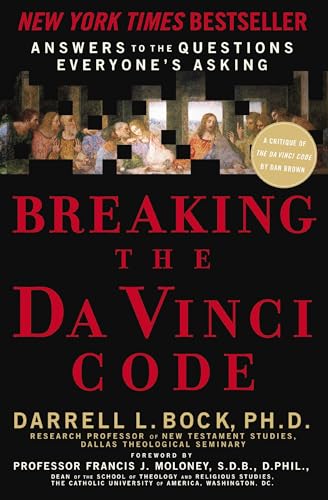
Many who have read the New York Times bestseller The Da Vinci Code have questions that arise from seven codes-expressed or implied-in Dan Brown's book. In Breaking the Da Vinci Code: Answers to the Questions Everyone's Asking, Darrell Bock, Ph.D., responds to the novelist's claims using central ancient texts and answers the following questions:
- Who was Mary Magdalene?
- Was Jesus Married?
- Would Jesus Being Single be Un-Jewish?
- Do the So-Called Secret Gnostic Gospels Help Us Understand Jesus?
- What Is the Remaining Relevance of The Da Vinci Code?
Darrell Bock's research uncovers the origins of these codes by focusing on the 325 years immediately following the birth of Christ, for the claims of The Da Vinci Code rise or fall on the basis of things emerging from this period. Breaking the Da Vinci Code, now available in trade paper, distinguishes fictitious entertainment from historical elements of the Christian faith. For by seeing these differences, one can break the Da Vinci code.
Die Inhaltsangabe kann sich auf eine andere Ausgabe dieses Titels beziehen.
Über die Autorin bzw. den Autor
Darrell L. Bock (PhD, University of Aberdeen) is senior research professor of New Testament studies and Executive Director for Cultural Engagement at Dallas Theological Seminary. Known for his work in Luke-Acts, Dr. Bock is a Humboldt Scholar (Tubingen University in Germany), is on the editorial board for Christianity Today, and a past president of the Evangelical Theological Society (2000-2001). A New York Times bestselling author, Bock has written over forty books, including Luke in the NIV Application Commentary series.
Auszug. © Genehmigter Nachdruck. Alle Rechte vorbehalten.
BREAKING THE DA VINCI CODE
ANSWERS TO THE QUESTIONS EVERYONE'S ASKINGBy DARRELL L. BOCKNelson Books
Copyright © 2007 Darrell L. BockAll right reserved.
ISBN: 978-0-7852-8014-9
Contents
Foreword............................................................................................xiIntroduction........................................................................................1Code 1: Who Was Mary Magdalene?.....................................................................13Code 2: Was Jesus Married?..........................................................................31Code 3: Would Being Single Make Jesus Un-Jewish?....................................................47Code 4: Do the So-Called Secret, Gnostic Gospels Help Us Understand Jesus?..........................61Code 5: How Were the New Testament Gospels Assembled?...............................................99Code 6: Does Mary's Honored Role As Apostle Match the Claims of the New School?.....................125Code 7: What Is the Remaining Relevance of The Da Vinci Code?.......................................151Code 8: The Real Jesus Code.........................................................................159Appendix: Leonardo's Last Supper....................................................................168Selected Bibliography...............................................................................171Glossary............................................................................................175About the Author....................................................................................189
Chapter One
Code 1WHO WAS MARY MAGDALENE?
We start with the key woman in our study, Mary of Magdala. In The Da Vinci Code, she is the wife of Jesus and the mother of His children, and that is a secret the church wanted to cover up to protect the divinity of Jesus. In the novel, she also is directly associated with the Holy Grail. The association with the Grail comes through the idea of Holy Blood and its bloodline (p. 250), the Sangreal. A word play on the term Sang Real gets us to a connection to the Holy Grail. The hypothesis is that the story of the Holy Grail really points to the holy bloodline of Jesus and Mary Magdalene coming into France. This idea is expressed explicitly in Holy Blood, Holy Grail as a hypothesis (pp. 313-15). In fact, the direct connection of Mary to the Holy Grail is a late, fresh twentieth-century addition to the legend of the Holy Grail. In addition, the word play it is based upon comes from the medieval period and is not a part of the original meaning of the term.
In The Da Vinci Code, Mary is said to be in Leonardo da Vinci's painting The Last Supper. The evidence is the V shape to the left side of Jesus as one looks at the painting (p. 244). It is the symbol of the feminine, and a feminine-looking figure on the left side of the V is Mary of Magdala (p. 238 of the novel discusses this V; see the painting on our cover). Leonardo knew of the genealogical secret and put a clue of it in this painting. It is from this detail that the novel gets its title, The Da Vinci Code. All of these ideas surface in the middle portion of the book (pp. 242-45). So Mary is a logical person with whom to begin our study. Who was she? What was her relationship to Jesus?
Mary Magdalene has always possessed a certain mystique. In the 1960s she was often a key figure in musicals about Jesus. Interest in her has not waned and reflects a curiosity that has belonged to her almost from the beginning. Part of the reason for such interest is that there are actually so little data about her. One element of a story like Mary's is that when there is very little information, there is a desire to round out the picture. Proving or disproving what is speculated about her is hard to do. We will proceed one step at a time. We consider now only Mary Magdalene's familial relationship to Jesus, the key element in the novel's claims. In a later chapter we will return to Mary and explore the symbol that Mary has become for our culture.
Mary in the New Testament
Mary is one of seven people with this name in the New Testament, and most of them are distinguished by additional descriptions: (1) Mary, the mother of Jesus (Luke 1:30-31); (2) Mary of Bethany (John 11:1); (3) Mary, the mother of James who was not the Lord's brother (Matt. 27:56); (4) Mary, the wife of Clopas (John 19:25); (5) Mary, the mother of John Mark (Acts 12:12); (6) one otherwise unidentified Mary (Rom. 16:6); and (7) Mary Magdalene, distinguished by a reference to her home, Magdala (Luke 8:2). These descriptions help us to sort out the individuals on the list. There is no hesitation to mention one's familial status as a way of doing this. Often a connection to a male is the distinguishing feature, as with Jesus' mother, the mother of James, John Mark's mother, and especially the wife of Clopas. Such a connection reflected the patriarchal first-century culture; that is, it was culturally centered on the male. This frequent naming of females with a male connection will be a significant point when we consider whether Jesus was married.
The name Mary is actually a modern form of the Jewish name Miriam. It was an extremely popular ancient name for women, which may add to the confusion among individuals. Mary Magdalene was not connected to any male, though she could have been if there had been such a connection to highlight. Rather, Magdala, where she lived, identified her. So Mary Magdalene was Mary from Magdala. Magdala is probably modern-day Migdal, located near the Sea of Galilee in Israel. Jesus' main ministry took place in the Sea of Galilee area.
Mary Magdalene in the New Testament
The biblical passages that discuss Mary from Magdala come in four groups.
First, she was a disciple who was the beneficiary of an exorcism by Jesus and was part of an entourage of women who supported and traveled with Jesus and His disciples (Luke 8:1-3). Having several women travelers was not as unusual as having Mary Magdalene travel with the group of disciples on her own would have been.
Second, she was present at the cross, a witness who no doubt was sad about Jesus' fate (Matt. 27:55-56 with the mother of James and Joseph and the mother of the sons of Zebedee; Mark 15:40-41; John 19:25). In each note about her presence at the cross she was not alone, but was part of a larger group of women. Matthew described the women as those who had followed Jesus from Galilee, ministering to Him. Mark identified the women as people who followed Jesus in Galilee and ministered to Him. John's description was similar. Mary was not singled out, but was part of a group of women, and many of the women at the cross were connected to known males. Had there been such a connection between Mary and Jesus, there was plenty of opportunity to make the point about Mary Magdalene in these earliest texts.
Third, some texts placed her at the cross either as or after Jesus was laid to rest (Matt. 27:61 with the "other" Mary; Mark 15:40 with Mary, the mother of James the younger and of Joses, and Salome, along with many other women). In other words, the named women were prominent among the women noted. Once again, Mary was not singled out on her own.
Fourth, all of the remaining biblical texts about Mary Magdalene depict her as a witness to Jesus' resurrection. According to Matthew 28:1, she returned with the "other" Mary to anoint the body, which they...
„Über diesen Titel“ kann sich auf eine andere Ausgabe dieses Titels beziehen.
Suchergebnisse für Breaking the Da Vinci Code: Answers to the Questions...

Beispielbild für diese ISBN
Breaking the Da Vinci Code: Answers to the Questions Everyone's Asking
Anbieter: World of Books (was SecondSale), Montgomery, IL, USA
Verkäuferbewertung 5 von 5 Sternen

Zustand: Good. Item in good condition. Textbooks may not include supplemental items i.e. CDs, access codes etc. Artikel-Nr. 00097080578
Gebraucht kaufen
EUR 3,66
Versand gratis
Versand innerhalb von USA
Versand innerhalb von USA
Anzahl: 4 verfügbar
Beispielbild für diese ISBN
Breaking the Da Vinci Code: Answers to the Questions Everyone's Asking
Anbieter: World of Books (was SecondSale), Montgomery, IL, USA
Verkäuferbewertung 5 von 5 Sternen
Zustand: Acceptable. Item in acceptable condition! Textbooks may not include supplemental items i.e. CDs, access codes etc. Artikel-Nr. 00098427563
Gebraucht kaufen
EUR 3,66
Versand gratis
Versand innerhalb von USA
Versand innerhalb von USA
Anzahl: 1 verfügbar
Beispielbild für diese ISBN
Breaking the Da Vinci Code: Answers to the Questions Everyone's Asking
Verlag:
Thomas Nelson (edition ), 2006
ISBN 10: 0785280146
ISBN 13: 9780785280149
Gebraucht
Paperback
Anbieter: BooksRun, Philadelphia, PA, USA
Verkäuferbewertung 5 von 5 Sternen
Paperback. Zustand: Very Good. It's a well-cared-for item that has seen limited use. The item may show minor signs of wear. All the text is legible, with all pages included. It may have slight markings and/or highlighting. Artikel-Nr. 0785280146-11-1
Gebraucht kaufen
EUR 5,01
Versand gratis
Versand innerhalb von USA
Versand innerhalb von USA
Anzahl: 1 verfügbar
Beispielbild für diese ISBN
Breaking the Da Vinci Code
Verlag:
Nelson Incorporated, Thomas, 2006
ISBN 10: 0785280146
ISBN 13: 9780785280149
Gebraucht
Softcover
Anbieter: Better World Books, Mishawaka, IN, USA
Verkäuferbewertung 5 von 5 Sternen
Zustand: Very Good. Pages intact with possible writing/highlighting. Binding strong with minor wear. Dust jackets/supplements may not be included. Stock photo provided. Product includes identifying sticker. Better World Books: Buy Books. Do Good. Artikel-Nr. 38476796-6
Gebraucht kaufen
EUR 6,09
Versand gratis
Versand innerhalb von USA
Versand innerhalb von USA
Anzahl: 2 verfügbar
Beispielbild für diese ISBN
Breaking the Da Vinci Code: Answers to the Questions Everyone's Asking
Anbieter: Wonder Book, Frederick, MD, USA
Verkäuferbewertung 5 von 5 Sternen
Zustand: Very Good. Very Good condition. A copy that may have a few cosmetic defects. May also contain light spine creasing or a few markings such as an owner's name, short gifter's inscription or light stamp. Artikel-Nr. D12N-00387
Gebraucht kaufen
EUR 6,33
Versand gratis
Versand innerhalb von USA
Versand innerhalb von USA
Anzahl: 2 verfügbar
Beispielbild für diese ISBN
Breaking the Da Vinci Code: Answers to the Questions Everyone's Asking
Anbieter: Wonder Book, Frederick, MD, USA
Verkäuferbewertung 5 von 5 Sternen
Zustand: Good. Good condition. A copy that has been read but remains intact. May contain markings such as bookplates, stamps, limited notes and highlighting, or a few light stains. Artikel-Nr. V09B-04835
Gebraucht kaufen
EUR 6,33
Versand gratis
Versand innerhalb von USA
Versand innerhalb von USA
Anzahl: 3 verfügbar
Beispielbild für diese ISBN
Breaking the Da Vinci Code: Answers to the Questions Everyone's Asking
Anbieter: ThriftBooks-Atlanta, AUSTELL, GA, USA
Verkäuferbewertung 5 von 5 Sternen
Paperback. Zustand: As New. No Jacket. Pages are clean and are not marred by notes or folds of any kind. ~ ThriftBooks: Read More, Spend Less. Artikel-Nr. G0785280146I2N00
Gebraucht kaufen
EUR 6,46
Versand gratis
Versand innerhalb von USA
Versand innerhalb von USA
Anzahl: 1 verfügbar
Beispielbild für diese ISBN
Breaking the Da Vinci Code: Answers to the Questions Everyone's Asking
Anbieter: Hitchcock Railway Books & Things, Saint Anthony, ID, USA
Verkäuferbewertung 5 von 5 Sternen
Soft cover. Zustand: Fine. minor shelf wear. Artikel-Nr. 2560
Gebraucht kaufen
EUR 2,72
EUR 4,39 Versand
Versand innerhalb von USA
Versand innerhalb von USA
Anzahl: 1 verfügbar
Beispielbild für diese ISBN
Breaking the Da Vinci Code
Anbieter: Books Do Furnish A Room, Durham, NC, USA
Verkäuferbewertung 4 von 5 Sternen

Trade Paperback. Zustand: Fine. Pages unmarked. Covers glossy. Binding square & firm. Artikel-Nr. 65832
Gebraucht kaufen
EUR 4,53
EUR 4,75 Versand
Versand innerhalb von USA
Versand innerhalb von USA
Anzahl: 1 verfügbar
Beispielbild für diese ISBN
Breaking the Da Vinci Code: Answers to the Questions Everyone's Asking
Anbieter: WorldofBooks, Goring-By-Sea, WS, Vereinigtes Königreich
Verkäuferbewertung 5 von 5 Sternen
Paperback. Zustand: Very Good. The book has been read, but is in excellent condition. Pages are intact and not marred by notes or highlighting. The spine remains undamaged. Artikel-Nr. GOR008310456
Gebraucht kaufen
EUR 7,18
EUR 6,51 Versand
Versand von Vereinigtes Königreich nach USA
Versand von Vereinigtes Königreich nach USA
Anzahl: 3 verfügbar