
Verwandte Artikel zu Nasty, Brutish, and Short: The Quirks and Quarks Guide...
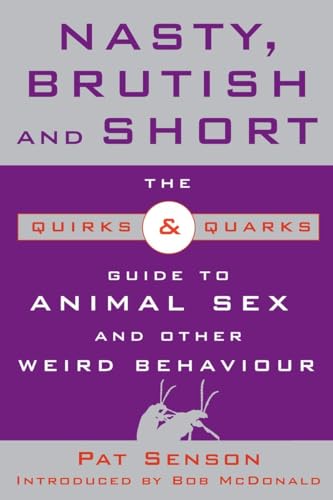
Nasty, Brutish, and Short: The Quirks and Quarks Guide to Animal Sex and Other Weird Behaviour - Softcover
Inhaltsangabe
Birds do it, and bees do it, so do all animals, some of them in weird and wonderful ways. Quirks & Quarks' latest book explores the more bizarre behaviours of more than 100 creatures, from barnacles to Panda bears.
The tiny spider that has to tear off one of its two huge sex organs just to be able to get around; the sea slug that produces a powerful love drug and mates with both males and females; the bedbug that stabs its penis into the female's abdomen — the range of animal sexual practices is mind-boggling. And it's not only reproduction that has them doing very strange things. There's a beetle that shoots a stream of boiling hot, toxic liquid when it's threatened; a lizard that can run on water; a shrimp that explodes its prey.
Quirks & Quarks' latest guide is much more than a catalogue of peculiar practices, it's an engrossing look at the astonishing behaviours different animals have evolved in order to survive and reproduce.
With an introduction by Bob McDonald, host of Quirks & Quarks.
Die Inhaltsangabe kann sich auf eine andere Ausgabe dieses Titels beziehen.
Über die Autorin bzw. den Autor
For nine seasons biologist PAT SENSON was a producer with CBC Radio's national science program, Quirks & Quarks, where his documentary work received numerous awards and accolades. He can still be heard every week on CBC Radio across the country as he supplies science stories to the local afternoon shows through CBC's syndication service. Pat currently lives in Toronto with his partner and their two slightly addled cats.
Auszug. © Genehmigter Nachdruck. Alle Rechte vorbehalten.
1
The Battle of the Sexes
The Insects
For examples of extreme sexual conflict in the animal world, insects are the place to look. From arms races to fatal copulation, they do it all.
Insect Arms Race
It would hardly be novel to say that males and females frequently want different things. But when it comes to insects, we’re not talking about hanging out with buddies at a football game versus staying home watching romantic movies. No, this is a story about sex, and so it’s ultimately about evolution, with males wanting one evolutionary outcome and females another. Nature has set up some species for sexual conflict that goes far beyond the battle over who takes out the garbage. Take, for example, the water strider. This group of insects is locked in a sexual struggle that has all the features of an evolutionary arms race, complete with occasional detente and the threat of mutually assured destruction.
You would probably recognize water striders if you saw them. They’re found all over the world, and according to Dr. Locke Rowe, an evolutionary biologist at the University of Toronto, just about anywhere there’s a pool of water there will be water striders. As their name suggests, they’re able to walk across the surface of the water, standing on the ends of their long legs.
Their sexual conflict arises out of the different desires of the males and females. The males want as many matings as possible. The more they mate, the more babies are their kin, and the more genes they’ll pass on. For the females, though, mating is much more costly, since it takes a lot of energy to produce eggs. As soon as a female’s eggs are fertilized, she doesn’t need to mate again, but the males are still going to show interest. Also, as Dr. Rowe says, “The females actually carry the males during mating, and that’s an energetic cost. So they fight. If you see water striders on the surface and look closely, you’ll see, after some time, males jumping on females and females struggling and somersaulting to get rid of them.”
So, the females have come up with ways to try and keep the males off their backs once they have already mated. In some species they have developed long spines that make it difficult for the males to climb on them. The males have fought back by evolving their entire body into one big grappling device. Each of their three pairs of legs has grappling hooks and spines that allow them to hang on, for dear life, to the females. In one species, the males have evolved antennae that are, Dr. Rowe says, “big, muscularized, swollen-up armaments that they use for grasping those females.” These antennae are not much use for sensing the environment any more (their original purpose) – but very helpful when the female doesn’t want to co-operate.
This back-and-forth retaliation has been going on throughout the water striders’ evolution. The females develop a way of repelling males, and the males come up with a way of countering the new apparatus. Then the female comes up with a new defence, and the male responds. And so on. Except, not always. Dr. Rowe has observed that sometimes there’s a de-escalation in the arms race, and there are fewer and fewer armaments on successive generations of the insects. Depending on the particular species, the arms race seems to be raging, quieting down, or staying steady. Curiously, as long as there’s a balance between the two sexes’ armaments, all these different species are about equally successful at reproducing. That’s a lot like a human arms race. As long as everyone’s in the same boat, then how well armed you are isn’t the point; it’s the balance that counts.
Sometimes the balance is off, and whenever the male has the advantage, mating rates shoot up to as much as ten times what they are in other strider species. But that puts females under a great deal of pressure to evolve defences, so it isn’t long before they do and balance is restored. This explains how escalation can happen, but why there’s de-escalation is more complicated.
No one knows for sure, but Dr. Rowe thinks it’s because of the heavy costs of the arms race to the individual insects. Their armaments take a lot of energy to grow and maintain and can get in the way of normal activity. So, if they are not needed, might as well get rid of them. De-escalation happens when females are so far behind the males in the arms race that they just give up. Then the males don’t need to be so heavily armoured, and the ones who waste less energy building grappling hooks have the advantage, and so gradually both sexes scale back. Same thing when males are scarce; then the females’ desire to breed leads them over a few generations to abandon their weapons and be nice to the guys.
But whether it’s a full-scale war or just a skirmish, as long as the armaments on both sides are balanced, then this arms race helps the species keep striding along.
Weevil Penises
It’s pretty safe to say that men and women generally have different priorities when it comes to sex. But that isn’t just a human trait. Throughout the animal kingdom, what females want is not always matched by male desire. A good example is the humble bean weevil (Callosobruchus maculatus), an animal that seems to have taken the battle of the sexes to a new extreme. Their copulatory conflict was first described by Dr. Helen Crudgington, a researcher at the University of Sheffield in England.
Looking for sexual activity among bean weevils is no simple task. The beetles are a common pest species found throughout the world, but they’re really small, only about three and a half millimetres long (about an eighth of an inch). And they’re fairly nondescript brown bugs, or they appear to be until you look at the males really closely. Examine the penis of a bean weevil and you’ll discover it’s covered in hard, sharp spines. The purpose of these spines? Well, when a male bean weevil mates, these spines puncture the lining of the female’s genital tract.
This is not, to say the least, what a female is looking for in a sexual encounter. So, she’s faced with a problem. She does need to get fertilized. After all, as Dr. Crudgington explains it, “It may not be in the interests of females to go along with those matings, but they obviously need at least one to get sperm to fertilize their eggs. And in evolutionary terms, it’s no good if you remain a virgin.” But the damage caused by the males, says Dr. Crudgington, “can produce costs for the female in terms of dehydration – that is, losing moisture from these wounds. And they can also be costly in the sense that they can be a route for the entrance of harmful pathogenic organisms. So, obviously, this is not ideal for the females.” Now there’s an understatement.
From the male perspective, however, there are two possible advantages to damaging the female like this. First of all, if she is injured, she’s unlikely to try to mate again until she’s healed. In the meantime, her eggs will mature, and the male who has fertilized her gets to be the father of all the offspring. Second, these wounds are so traumatic that they can leave the female close to death, and the biological response to that is to produce a lot of eggs quickly. It could be her last chance to have offspring, so, from an evolutionary perspective, she wants to have as many as possible, as soon as possible. And the male who got to her first is the one whose sperm she’s going to use when she lays those eggs. But it’s not in the male’s best...
„Über diesen Titel“ kann sich auf eine andere Ausgabe dieses Titels beziehen.
Suchergebnisse für Nasty, Brutish, and Short: The Quirks and Quarks Guide...

Beispielbild für diese ISBN
Nasty, Brutish, and Short: The Quirks & Quarks Guide to Animal Sex and Other Weird Behaviour
Anbieter: ThriftBooks-Atlanta, AUSTELL, GA, USA
Verkäuferbewertung 5 von 5 Sternen

Paperback. Zustand: Very Good. No Jacket. May have limited writing in cover pages. Pages are unmarked. ~ ThriftBooks: Read More, Spend Less. Artikel-Nr. G0771079680I4N00
Gebraucht kaufen
EUR 8,21
Versand gratis
Versand innerhalb von USA
Versand innerhalb von USA
Anzahl: 1 verfügbar
Beispielbild für diese ISBN
Nasty, Brutish, and Short : The Quirks and Quarks Guide to Animal Sex and Other Weird Behaviour
Anbieter: Better World Books: West, Reno, NV, USA
Verkäuferbewertung 5 von 5 Sternen
Zustand: Very Good. Former library copy. Pages intact with possible writing/highlighting. Binding strong with minor wear. Dust jackets/supplements may not be included. Includes library markings. Stock photo provided. Product includes identifying sticker. Better World Books: Buy Books. Do Good. Artikel-Nr. 9631792-75
Gebraucht kaufen
EUR 8,33
Versand gratis
Versand innerhalb von USA
Versand innerhalb von USA
Anzahl: 1 verfügbar
Foto des Verkäufers
Nasty, Brutish, and Short : The Quirks & Quarks Guide to Animal Sex and Other Weird Behaviour
Verlag:
Mcclelland & Stewart Apr 2010, 2010
ISBN 10: 0771079680
ISBN 13: 9780771079689
Neu
Taschenbuch
Anbieter: AHA-BUCH GmbH, Einbeck, Deutschland
Verkäuferbewertung 5 von 5 Sternen
Taschenbuch. Zustand: Neu. Neuware - Birds do it, and bees do it, so do all animals, some of them in weird and wonderful ways. Quirks & Quarks' latest book explores the more bizarre behaviours of more than 100 creatures, from barnacles to Panda bears.The tiny spider that has to tear off one of its two huge sex organs just to be able to get around; the sea slug that produces a powerful love drug and mates with both males and females; the bedbug that stabs its penis into the female's abdomen the range of animal sexual practices is mind-boggling. And it's not only reproduction that has them doing very strange things. There's a beetle that shoots a stream of boiling hot, toxic liquid when it's threatened; a lizard that can run on water; a shrimp that explodes its prey.Quirks & Quarks' latest guide is much more than a catalogue of peculiar practices, it's an engrossing look at the astonishing behaviours different animals have evolved in order to survive and reproduce.With an introduction by Bob McDonald, host of Quirks & Quarks. Artikel-Nr. 9780771079689
Neu kaufen
EUR 28,57
EUR 35,00 Versand
Versand von Deutschland nach USA
Versand von Deutschland nach USA
Anzahl: 2 verfügbar
Foto des Verkäufers
Nasty, Brutish, and Short
Anbieter: moluna, Greven, Deutschland
Verkäuferbewertung 5 von 5 Sternen
Zustand: New. For nine seasons biologist PAT SENSON was a producer with CBC Radio s national science program, Quirks & Quarks, where his documentary work received numerous awards and accolades. He can still be heard every week on CBC Radio across the country as he su. Artikel-Nr. 898646826
Neu kaufen
EUR 21,26
EUR 48,99 Versand
Versand von Deutschland nach USA
Versand von Deutschland nach USA
Anzahl: Mehr als 20 verfügbar