
Verwandte Artikel zu Why Catholics Are Right
Inhaltsangabe
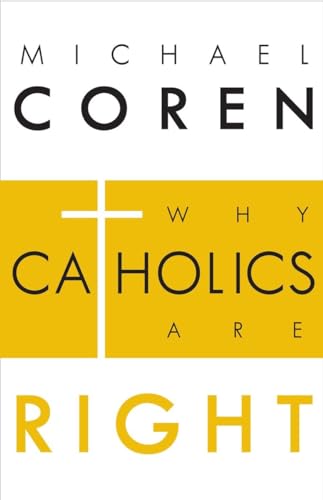
A practicing Catholic defends the faith and offers a passionate response to current anti-Catholic opinion.
In Why Catholics Are Right, author, columnist, and practicing Catholic Michael Coren examines four main aspects of Catholicism as they are encountered, understood, and more importantly, misunderstood today. Beginning with a frank examination of the tragedy of the Catholic clergy abuse scandal, Coren addresses some of them most common attacks on Catholics and Catholicism. Tracing Catholic history, he deconstructs popular and frequent anti-Catholic arguments regarding the Church and the Crusades, the Inquisition, Galileo, and the Holocaust. He examines Catholic theology and central pillars of Catholic belief, explaining why Catholics believe what they do: papal infallibility, immaculate conception, the Church rather than Bible alone. Finally, he explores the dignity of life argument and why it is so important to Catholicism.
In this challenging and thought-provoking book, Michael Coren demolishes often propagated myths about the Church's beliefs and teachings, and in doing so, opens a window onto Catholicism, which, he writes, "is as important now as it ever was and perhaps even more necessary."
Die Inhaltsangabe kann sich auf eine andere Ausgabe dieses Titels beziehen.
Über die Autorin bzw. den Autor
MICHAEL COREN is the bestselling author of twelve books, including biographies of G.K. Chesterton, H.G. Wells, Arthur Conan Doyle, J.R.R. Tolkein, and C.S. Lewis. He is the host of The Michael Coren Show, a nightly television talk show with an audience of 250,000 viewers. He also hosts a daily radio show and writes a syndicated column for ten daily newspapers.
Auszug. © Genehmigter Nachdruck. Alle Rechte vorbehalten.
When I first told friends and colleagues about this book, they were intrigued by its proposed content but disturbed by its title. “Sounds a little proud,” “Is that sufficiently conciliatory for these progressive and pluralistic days?” and “You ought to be careful because it might offend people.” Which is odd in that when I suggested to them titles for other books such as Why Liberals Are Right, Why Conservatives Are Right, even Why Muslims Are Right, and especially Why Atheists Are Right, they thought the suggestions to describe the various subjects entirely reasonable and unlikely to cause any problems at all. To believe something is, self-evidently, not to believe something that is its contrary. So obvious is this that it is not questioned and seems a self-evident truth in most areas and about most subjects. It is, after all, just common sense. But to claim that being an authentic Roman Catholic necessitates believing that Roman Catholicism is correct positively terrifies many modern men and women, as though a Catholic claiming to be right was some terrible sin – not that many of these people believe in sin, of course.
If this audacious insistence that being Catholic meant, well, being Catholic and led to the persecution or killing of others who were not Catholic, it would naturally be intimidating and insulting but that is certainly not the case – even though, as we will see in the first chapter, it usually takes only a few moments during a disagreement for someone to bring up the days when Catholics did indeed give their opponents a hard time, as though in all of history only Catholics have ever got it wrong or even just acted like most people were acting at the time. So the title stands, and for a specific reason: to oblige and demand a certain clarity on the part of the book’s readers. I’m a Catholic and believe in Catholicism, and thus I believe that people who disagree with my beliefs are wrong. I do not dislike them – or at least don’t dislike all of them – nor do I wish to hurt them, even those who wish to hurt me and will probably wish to hurt me even more after they read this book, pretend to read it, or read nasty reviews of it.
I do, however, want these readers to consider what I have to say and to not abuse my beliefs in a manner and with a harshness that they would not dream of using against almost any other creed or religion. It might be a romantic hope but hope is one of those Catholic qualities we like to think of as important and helpful.
Having said this, I admit there are degrees of wrongness. Some people are only slightly wrong, others wrong most of the time and to a shocking degree. Non-Catholic Christians and in particular serious evangelicals and Eastern Orthodox believers are examples of the former. Many of them could teach many Catholics a great deal about love, charity, and devotion to God. Alleged Christians who want to edit rather than follow Christ, professional atheists who flood the Internet with their obsessions, and part-time Catholic-bashers are the latter. This brings me to the anti-Catholicism that has become the last acceptable prejudice in what passes for polite society and has become so obvious and so pronounced that to even repeat the fact seems almost banal. We have all heard comments about Catholics that if applied to almost any other group would simply not be tolerated. It’s bad enough when this is street conversation and pointless gossip, far worse when it passes for informed comment in allegedly serious newspapers. British historian and biographer Christopher Hibbert put it well when he said that historically the Pope had been thought of as “an unseen, ghost-like enemy, lurking behind clouds of wicked incense in a Satanic southern city called Rome.” In much of contemporary Anglo-Saxon culture as well as the greater modern world, this perverse caricature has found a second wind.
Philip Jenkins is a professor of history and religion at Pennsylvania State University and has written extensively about the Roman Catholic Church and some of the attacks on it. His book The New Anti-Catholicism: The Last Acceptable Prejudice1 outlined the history and modern experience of the phenomenon. Jenkins himself left the Church in the 1980s. When his book was published, he was asked to define its thesis. He replied, “It depends on how you define anti-Catholicism. I suggest it is a very widespread phenomenon in different degrees. For example, people would say things about the Catholic Church and condemn a religion with much more ease than they would condemn other religions, other religious traditions. I think that’s always been true to some extent, but I think that’s really shifted its basis in the last twenty-five years. It’s become much more of a left-liberal, as opposed to a right-wing prerogative.” He continued, “It makes anti-Catholicism different from other kinds of prejudice. It survives as what I call ‘the last acceptable prejudice.’ In other words, if you say something that is insensitive or hostile about most religious or ethnic groups, then those words will come back to haunt you and in many cases destroy you. . . . If you say something about Catholicism, or even something which is very hostile, really quite extreme, and in many people’s idea, constitutes outrageous bigotry, it doesn’t. Nobody really notices. You’re expected to lighten up and not take this too seriously.”
Jenkins is right. And this is all far more profound than merely responding to an achingly nasty and smothering bigotry. The importance of Catholicism is that in a culture where various forms of religious and atheistic fundamentalism, crass materialism, and clawing decadence eat away at civility and civilization the only permanent, consistent, and logically complete alternative is the Roman Catholic Church. Which is probably why it seems to so antagonize people who would usually be fair and tolerant toward a faith or ideology they did not completely understand.
I was not born a Catholic and came into the Church only in my mid-twenties. I’d grown up in a secular home in Britain with a Jewish father whose family had fled Poland in the 1890s. He wasn’t anti-Catholic but he saw the Church as something foreign and alien, from both a Jewish and a British perspective. While London in the 1960s and 1970s was hardly anti-Semitic to any meaningful degree, it’s impossible to have Jewish blood and not experience at least some prejudice and hatred. Even if it isn’t direct and personal, it’s a ghost that haunts the world, and, with the growth of both the Internet and the nuances of Middle Eastern politics and an increasing distance from the Holocaust, it has been given new life in recent years. So I know what being despised simply for being is all about. Anti-Catholicism is fundamentally different from anti-Semitism. It’s not racial or ethnic and, outside of fundamentalist Protestant circles and Islamic extremists, not even especially religious. Very few people dislike Catholicism because of its theology but many oppose it because of the moral and ethical consequences of its teachings. In spite of that, in 2008 the Internet video-sharing website YouTube hosted forty videos showing the graphic desecration of the consecrated host. They had been posted by an anti-Catholic activist who was seen burning, nailing, and stapling the Eucharist and flushing it down a toilet.
This is obviously incredibly offensive to Catholics who, as we shall see, believe the consecrated host to be the body and blood of Jesus Christ. Perhaps so, runs the standard response, but while Catholics are entitled to their opinion, those who disagree with them are allowed theirs and may be as...
„Über diesen Titel“ kann sich auf eine andere Ausgabe dieses Titels beziehen.
Suchergebnisse für Why Catholics Are Right

Beispielbild für diese ISBN
Why Catholics Are Right
Anbieter: World of Books (was SecondSale), Montgomery, IL, USA
Verkäuferbewertung 5 von 5 Sternen

Hardback. Zustand: Good. A practicing Catholic defends the faith and offers a passionate response to current anti-Catholic opinion. In>Why Catholics Are Right, author, columnist, and practicing Catholic Michael Coren examines four main aspects of Catholicism as they are encountered, understood, and more importantly, misunderstood today. Beginning with a frank examination of the tragedy of the Catholic clergy abuse scandal, Coren addresses some of them most common attacks on Catholics and Catholicism. Tracing Catholic history, he deconstructs popular and frequent anti-Catholic arguments regarding the Church and the Crusades, the Inquisition, Galileo, and the Holocaust. He examines Catholic theology and central pillars of Catholic belief, explaining why Catholics believe what they do: papal infallibility, immaculate conception, the Church rather than Bible alone. Finally, he explores the dignity of life argument and why it is so important to Catholicism. In this challenging and thought-provoking book, Michael Coren demolishes often propagated myths about the Church's beliefs and teachings, and in doing so, opens a window onto Catholicism, which, he writes, is as important now as it ever was and perhaps even more necessary. Artikel-Nr. 00074487863
Gebraucht kaufen
EUR 4,96
Versand gratis
Versand innerhalb von USA
Versand innerhalb von USA
Anzahl: 2 verfügbar
Beispielbild für diese ISBN
Why Catholics Are Right
Anbieter: Better World Books, Mishawaka, IN, USA
Verkäuferbewertung 5 von 5 Sternen
Zustand: Very Good. Pages intact with possible writing/highlighting. Binding strong with minor wear. Dust jackets/supplements may not be included. Stock photo provided. Product includes identifying sticker. Better World Books: Buy Books. Do Good. Artikel-Nr. 867262-6
Gebraucht kaufen
EUR 6,19
Versand gratis
Versand innerhalb von USA
Versand innerhalb von USA
Anzahl: 1 verfügbar
Beispielbild für diese ISBN
Why Catholics Are Right
Anbieter: Better World Books: West, Reno, NV, USA
Verkäuferbewertung 5 von 5 Sternen
Zustand: Good. Former library copy. Pages intact with minimal writing/highlighting. The binding may be loose and creased. Dust jackets/supplements are not included. Includes library markings. Stock photo provided. Product includes identifying sticker. Better World Books: Buy Books. Do Good. Artikel-Nr. 4403281-75
Gebraucht kaufen
EUR 6,19
Versand gratis
Versand innerhalb von USA
Versand innerhalb von USA
Anzahl: 1 verfügbar
Beispielbild für diese ISBN
Why Catholics Are Right
Anbieter: Wonder Book, Frederick, MD, USA
Verkäuferbewertung 5 von 5 Sternen
Zustand: Very Good. Very Good condition. Very Good dust jacket. A copy that may have a few cosmetic defects. May also contain light spine creasing or a few markings such as an owner's name, short gifter's inscription or light stamp. Artikel-Nr. B07B-03518
Gebraucht kaufen
EUR 6,43
Versand gratis
Versand innerhalb von USA
Versand innerhalb von USA
Anzahl: 1 verfügbar
Beispielbild für diese ISBN
Why Catholics Are Right
Anbieter: ThriftBooks-Dallas, Dallas, TX, USA
Verkäuferbewertung 5 von 5 Sternen
Hardcover. Zustand: Very Good. No Jacket. May have limited writing in cover pages. Pages are unmarked. ~ ThriftBooks: Read More, Spend Less. Artikel-Nr. G0771023219I4N00
Gebraucht kaufen
EUR 7,30
Versand gratis
Versand innerhalb von USA
Versand innerhalb von USA
Anzahl: 1 verfügbar
Beispielbild für diese ISBN
Why Catholics Are Right
Anbieter: AwesomeBooks, Wallingford, Vereinigtes Königreich
Verkäuferbewertung 5 von 5 Sternen
Hardcover. Zustand: Very Good. Why Catholics Are Right This book is in very good condition and will be shipped within 24 hours of ordering. The cover may have some limited signs of wear but the pages are clean, intact and the spine remains undamaged. This book has clearly been well maintained and looked after thus far. Money back guarantee if you are not satisfied. See all our books here, order more than 1 book and get discounted shipping. Artikel-Nr. 7719-9780771023217
Gebraucht kaufen
EUR 3,75
EUR 4,86 Versand
Versand von Vereinigtes Königreich nach USA
Versand von Vereinigtes Königreich nach USA
Anzahl: 2 verfügbar
Foto des Verkäufers
Why Catholics Are Right
Verlag:
McClelland & Stewart Ltd, 2011
ISBN 10: 0771023219
ISBN 13: 9780771023217
Gebraucht
Hardcover
Anbieter: WeBuyBooks, Rossendale, LANCS, Vereinigtes Königreich
Verkäuferbewertung 5 von 5 Sternen
hardcover. Zustand: Very Good. Most items will be dispatched the same or the next working day. A copy that has been read, but is in excellent condition. Pages are intact and not marred by notes or highlighting. The spine remains undamaged. Artikel-Nr. rev6542705867
Gebraucht kaufen
EUR 1,62
EUR 7,61 Versand
Versand von Vereinigtes Königreich nach USA
Versand von Vereinigtes Königreich nach USA
Anzahl: 1 verfügbar
Beispielbild für diese ISBN
Why Catholics Are Right
Anbieter: WorldofBooks, Goring-By-Sea, WS, Vereinigtes Königreich
Verkäuferbewertung 5 von 5 Sternen
Paperback. Zustand: Very Good. The book has been read, but is in excellent condition. Pages are intact and not marred by notes or highlighting. The spine remains undamaged. Artikel-Nr. GOR003460891
Gebraucht kaufen
EUR 3,92
EUR 6,61 Versand
Versand von Vereinigtes Königreich nach USA
Versand von Vereinigtes Königreich nach USA
Anzahl: 8 verfügbar
Beispielbild für diese ISBN
Why Catholics Are Right
Anbieter: Bahamut Media, Reading, Vereinigtes Königreich
Verkäuferbewertung 4 von 5 Sternen

Hardcover. Zustand: Very Good. This book is in very good condition and will be shipped within 24 hours of ordering. The cover may have some limited signs of wear but the pages are clean, intact and the spine remains undamaged. This book has clearly been well maintained and looked after thus far. Money back guarantee if you are not satisfied. See all our books here, order more than 1 book and get discounted shipping. Artikel-Nr. 6545-9780771023217
Gebraucht kaufen
EUR 4,13
EUR 8,23 Versand
Versand von Vereinigtes Königreich nach USA
Versand von Vereinigtes Königreich nach USA
Anzahl: 2 verfügbar
Foto des Verkäufers
Why Catholics Are Right
Verlag:
McClelland & Stewart, 2011
ISBN 10: 0771023219
ISBN 13: 9780771023217
Gebraucht
Hardcover
Signiert
Anbieter: ThriftBooksVintage, Tukwila, WA, USA
Verkäuferbewertung 5 von 5 Sternen
Hardcover. Zustand: Very Good. No Jacket. SIGNED and inscribed by the author. Minor shelf and handling wear, overall a clean solid copy with minimal signs of use. Secure packaging for safe delivery. signed and inscribed by author. Artikel-Nr. 3572704390
Gebraucht kaufen
EUR 21,15
Versand gratis
Versand innerhalb von USA
Versand innerhalb von USA
Anzahl: 1 verfügbar