
Verwandte Artikel zu Setting Limits with Your Strong-Willed Child, Revised...
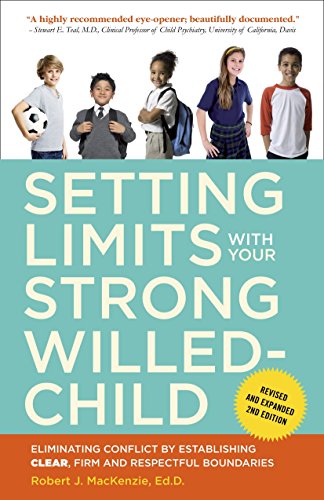
Setting Limits with Your Strong-Willed Child, Revised and Expanded 2nd Edition: Eliminating Conflict by Establishing CLEAR, Firm, and Respectful Boundaries - Softcover
Inhaltsangabe
In this fully revised and expanded second edition, Setting Limits author Robert MacKenzie is back with even more time-proven methods for dealing with misbehavior and creating positive, respectful, and rewarding relationships with children prone to acting out and disobedience.
Disruptive misbehavior, constant power struggles, manipulative or aggressive behavior--the challenges facing parents and teachers of strong-willed children can seem overwhelming at times. That's why thousands of parents and educators have turned to the solutions in Setting Limits With Your Strong-Willed Child. This revised and expanded second edition offers the most up-to-date alternatives to punishment and permissiveness--moving beyond traditional methods that wear you down and get you nowhere, and zeroing in on what really works so parents can use their energy in more efficient and productive ways. With fully updated guidelines on parenting tools like "logical consequences," and examples drawn directly from the modern world that children deal with each day, this is an invaluable resource for anyone wondering how to effectively motivate strong-willed children and instill proper conduct.
Die Inhaltsangabe kann sich auf eine andere Ausgabe dieses Titels beziehen.
Über die Autorin bzw. den Autor
ROBERT J. MACKENZIE, EdD, is an educational psychologist and family therapist who founded the Setting Limits program. He is the author of Setting Limits and Setting Limits with Your Strong-Willed Child.
Auszug. © Genehmigter Nachdruck. Alle Rechte vorbehalten.
1
Understanding Your Strong-Willed Child
Four-year-old Corey is a challenge. He begins his typical day by refusing to wear the clothes his mother picks out, then dawdles for the next twenty minutes while she prods and pleads with him to put them on. When he arrives at the breakfast table, he turns up his nose and complains that he doesn’t like what’s offered. This is not a battle I want to fight, his mother says to herself as she prepares Corey his own special meal. She tells her husband that she worries about Corey’s nutrition, but what she really worries about is the tantrum Corey will throw if he doesn’t get what he wants. Her husband thinks she’s too soft on Corey and so do her two daughters. “It’s not fair!” they complain. “He always gets his own way.” By the time Corey makes it out the door in the morning, his mother is ready for a nap. But this is only the beginning. Round two begins in the afternoon when Corey returns from preschool. Sometimes Corey’s mother wonders how long she can take it.
Six-year-old Kristal is sweet and cooperative one moment, angry and defiant the next. Little things set her off—unexpected changes, departures from routine, or simply things not working out her way. Tantrums are not uncommon. “Living with Kristal is like riding on a roller coaster,” says her mother. “It’s exhausting!” Kristal’s parents alternate between punishing and giving in, depending upon how worn down they feel; but nothing seems to make any difference. They wonder if Kristal’s behavior is normal and question whether they did something to cause her to behave this way.
Nine-year-old Alex has a short fuse and often acts before he thinks. When things don’t go his way at school or in the neighborhood, Alex gets loud, calls names, threatens, and sometimes hits other kids. Alex has been suspended from school three times this year for being disrespectful to teachers and fighting on the playground. It’s only December. “It’s too bad they don’t spank kids at school anymore,” Alex’s father laments. “When Alex acts like a brat at home, we give him an earful, then we paddle him. He has to learn. We’ve threatened to take away his TV privileges for the rest of the year if he gets suspended again.”
Lynn, age twelve, is destined to be a great trial lawyer. She’s bright, intense, and very persistent. Lynn will argue with anyone if she thinks there’s a chance of getting things to work out her way, and she’s willing to use drama, rudeness, and disrespect when she believes it will help her win her case. “I never would have imagined talking to adults the way she talks to us,” Lynn’s father complains. “We reason with her every way we know, but everything turns into an argument.”
Do any of these children sound familiar? If your child resembles one of these, you’re not alone. I see more than a hundred children each year whom parents and teachers describe as challenging, difficult, spirited, stubborn, hell-raising, a pistol, or just plain impossible. Although no single term adequately describes all, or even most, of the children I see, the one that comes closest is “strong-willed.” These are normal children with extreme behavior who are hard to raise and difficult to discipline.
Strong-willed children are not part of some conspiracy to make life difficult for others. They just do what strong-willed children do. They test harder and more often, resist longer, protest louder, use more drama, and carry things further than most of us would ever imagine. They’re movers and shakers, powerful kids who bring out strong reactions in others.
Teachers and principals know them as the 10 to 15 percent who cause 90 percent of school discipline problems. Parents know them as their big challenge. I know them affectionately as “my kids” because I spend a lot of my time with them, both at work and at home. Yes, I’m the proud parent of a strong-willed son. My youngest son is a delight, but he’s also a workout, and he’s not the least bit impressed by the fact that I write books on this subject or that I’m supposed to know what to do. At home, I get no breaks or professional immunity. He pushes hard against my rules and authority. At times, I’ve wondered whether his behavior is normal.
Strong-willed children are not part of some conspiracy to make life difficult for others. They just do what strong-willed children do. They test.
Do you sometimes question whether your child’s behavior is normal? Perhaps you worry that you’ve done something to cause your child to behave this way. If so, you’ll be relieved to know that the problem, in most cases, is not parents. Most are doing the best they can with the discipline tools they have. The problem is not the child, either. Most strong-willed children are just being themselves. The real problem is a bad match between the child’s temperament and the parents’ discipline methods. The parents’ tools are not well suited for the job. The predictable result—conflict and power struggles.
When parents arrive at my office looking for help in dealing with their strong-willed child, one of my first tasks is to assist them in understanding their child’s temperament. Then we examine how their discipline tools match up with their child’s temperament and discuss the predictable conflicts and friction points that develop around a bad match. That’s what we’re going to do in this chapter. A new perspective awaits you. You’re not the problem, but you are a big part of the solution. Improving the match is well within your control.
Who Is This Strong-Willed Child?
My youngest son, Ian, is a great force in our family and a great source of pride and joy. He’s bright, creative, sensitive, and very determined. Sometimes, I think he’s more determined to train his parents than we are to train him. He keeps us on our toes. If we are unclear, inconsistent, or indecisive when we ask him to do something, Ian lets us know. He holds out for a clearer signal.
Like most strong-willed children, Ian understands the “bottom line,” and he knows how to get there. He just pushes hard until he finds it, and when he does, he pushes a little more to see whether it holds up. If it does, he stops pushing, at least for a while, and accepts the boundary. But Ian pushes a lot before he gets there. It’s wearing! My older son, Scott, usually cooperates for the asking without all the pushing.
How would you react if you asked two children to cooperate in the same respectful manner and got two consistently different responses? Would you become upset? Would you question whether something is wrong?
The persistent testing that is so characteristic of strong-willed children is also what drives most parents crazy. Why would anyone do this? I’d ask myself. Is this normal? I would never push anyone as hard as Ian pushes me.
Does your child push hard against your rules and authority? Has he or she done so from an early age? Do you react in extreme ways and question whether your child is normal? Join the club. Now it’s time to get better acquainted with your child. Following are some basic facts about strong-willed children that will help you better understand your child and your reactions to his or her behavior.
The persistent testing that is so characteristic of strong-willed children is also what drives most parents crazy.
• Strong-willed children are normal. You’ve probably worried about whether your child is normal when his teacher or a well-intended relative pointed out...
„Über diesen Titel“ kann sich auf eine andere Ausgabe dieses Titels beziehen.
Suchergebnisse für Setting Limits with Your Strong-Willed Child, Revised...

Beispielbild für diese ISBN
Setting Limits with Your Stron
Anbieter: World of Books (was SecondSale), Montgomery, IL, USA
Verkäuferbewertung 5 von 5 Sternen

Zustand: Good. Item in good condition. Textbooks may not include supplemental items i.e. CDs, access codes etc. Artikel-Nr. 00100265404
Gebraucht kaufen
EUR 3,81
Versand gratis
Versand innerhalb von USA
Versand innerhalb von USA
Anzahl: Mehr als 20 verfügbar
Beispielbild für diese ISBN
Setting Limits with Your Stron
Anbieter: World of Books (was SecondSale), Montgomery, IL, USA
Verkäuferbewertung 5 von 5 Sternen
Zustand: Acceptable. Item in good condition. Textbooks may not include supplemental items i.e. CDs, access codes etc. Artikel-Nr. 00070981320
Gebraucht kaufen
EUR 3,81
Versand gratis
Versand innerhalb von USA
Versand innerhalb von USA
Anzahl: 2 verfügbar
Beispielbild für diese ISBN
Setting Limits with Your Stron
Anbieter: World of Books (was SecondSale), Montgomery, IL, USA
Verkäuferbewertung 5 von 5 Sternen
Zustand: Acceptable. Item in acceptable condition! Textbooks may not include supplemental items i.e. CDs, access codes etc. Artikel-Nr. 00096830846
Gebraucht kaufen
EUR 3,81
Versand gratis
Versand innerhalb von USA
Versand innerhalb von USA
Anzahl: 5 verfügbar
Beispielbild für diese ISBN
Setting Limits with Your Strong-Willed Child, Revised and Expanded 2nd Edition: Eliminating Conflict by Establishing CLEAR, Firm, and Respectful Boundaries
Anbieter: BooksRun, Philadelphia, PA, USA
Verkäuferbewertung 5 von 5 Sternen
Paperback. Zustand: Very Good. 2. It's a well-cared-for item that has seen limited use. The item may show minor signs of wear. All the text is legible, with all pages included. It may have slight markings and/or highlighting. Artikel-Nr. 0770436595-11-1
Gebraucht kaufen
EUR 4,78
Versand gratis
Versand innerhalb von USA
Versand innerhalb von USA
Anzahl: 2 verfügbar
Beispielbild für diese ISBN
Setting Limits with Your Strong-Willed Child, Revised and Expanded 2nd Edition: Eliminating Conflict by Establishing CLEAR, Firm, and Respectful Bound
Verlag:
Harmony/Rodale/Convergent, 2013
ISBN 10: 0770436595
ISBN 13: 9780770436599
Gebraucht
Paperback
Anbieter: ThriftBooks-Atlanta, AUSTELL, GA, USA
Verkäuferbewertung 5 von 5 Sternen
Paperback. Zustand: Good. No Jacket. Pages can have notes/highlighting. Spine may show signs of wear. ~ ThriftBooks: Read More, Spend Less. Artikel-Nr. G0770436595I3N00
Gebraucht kaufen
EUR 5,74
Versand gratis
Versand innerhalb von USA
Versand innerhalb von USA
Anzahl: 1 verfügbar
Beispielbild für diese ISBN
Setting Limits with Your Strong-Willed Child, Revised and Expanded 2nd Edition: Eliminating Conflict by Establishing CLEAR, Firm, and Respectful Bound
Verlag:
Harmony/Rodale/Convergent, 2013
ISBN 10: 0770436595
ISBN 13: 9780770436599
Gebraucht
Paperback
Anbieter: ThriftBooks-Reno, Reno, NV, USA
Verkäuferbewertung 5 von 5 Sternen
Paperback. Zustand: Good. No Jacket. Pages can have notes/highlighting. Spine may show signs of wear. ~ ThriftBooks: Read More, Spend Less. Artikel-Nr. G0770436595I3N00
Gebraucht kaufen
EUR 5,74
Versand gratis
Versand innerhalb von USA
Versand innerhalb von USA
Anzahl: 1 verfügbar
Beispielbild für diese ISBN
Setting Limits with Your Strong-Willed Child, Revised and Expanded 2nd Edition: Eliminating Conflict by Establishing CLEAR, Firm, and Respectful Bound
Verlag:
Harmony/Rodale/Convergent, 2013
ISBN 10: 0770436595
ISBN 13: 9780770436599
Gebraucht
Paperback
Anbieter: ThriftBooks-Phoenix, Phoenix, AZ, USA
Verkäuferbewertung 5 von 5 Sternen
Paperback. Zustand: Good. No Jacket. Pages can have notes/highlighting. Spine may show signs of wear. ~ ThriftBooks: Read More, Spend Less. Artikel-Nr. G0770436595I3N00
Gebraucht kaufen
EUR 5,74
Versand gratis
Versand innerhalb von USA
Versand innerhalb von USA
Anzahl: 1 verfügbar
Beispielbild für diese ISBN
Setting Limits with Your Strong-Willed Child, Revised and Expanded 2nd Edition: Eliminating Conflict by Establishing CLEAR, Firm, and Respectful Bound
Verlag:
Harmony/Rodale/Convergent, 2013
ISBN 10: 0770436595
ISBN 13: 9780770436599
Gebraucht
Paperback
Anbieter: ThriftBooks-Phoenix, Phoenix, AZ, USA
Verkäuferbewertung 5 von 5 Sternen
Paperback. Zustand: Good. No Jacket. Former library book; Pages can have notes/highlighting. Spine may show signs of wear. ~ ThriftBooks: Read More, Spend Less. Artikel-Nr. G0770436595I3N10
Gebraucht kaufen
EUR 5,74
Versand gratis
Versand innerhalb von USA
Versand innerhalb von USA
Anzahl: 1 verfügbar
Beispielbild für diese ISBN
Setting Limits with Your Strong-Willed Child, Revised and Expanded 2nd Edition: Eliminating Conflict by Establishing CLEAR, Firm, and Respectful Bound
Verlag:
Harmony/Rodale/Convergent, 2013
ISBN 10: 0770436595
ISBN 13: 9780770436599
Gebraucht
Paperback
Anbieter: ThriftBooks-Dallas, Dallas, TX, USA
Verkäuferbewertung 5 von 5 Sternen
Paperback. Zustand: Good. No Jacket. Pages can have notes/highlighting. Spine may show signs of wear. ~ ThriftBooks: Read More, Spend Less. Artikel-Nr. G0770436595I3N00
Gebraucht kaufen
EUR 5,74
Versand gratis
Versand innerhalb von USA
Versand innerhalb von USA
Anzahl: 1 verfügbar
Beispielbild für diese ISBN
Setting Limits with Your Strong-Willed Child, Revised and Expanded 2nd Edition: Eliminating Conflict by Establishing CLEAR, Firm, and Respectful Bound
Verlag:
Harmony/Rodale/Convergent, 2013
ISBN 10: 0770436595
ISBN 13: 9780770436599
Gebraucht
Paperback
Anbieter: ThriftBooks-Reno, Reno, NV, USA
Verkäuferbewertung 5 von 5 Sternen
Paperback. Zustand: Good. No Jacket. Former library book; Pages can have notes/highlighting. Spine may show signs of wear. ~ ThriftBooks: Read More, Spend Less. Artikel-Nr. G0770436595I3N10
Gebraucht kaufen
EUR 5,74
Versand gratis
Versand innerhalb von USA
Versand innerhalb von USA
Anzahl: 1 verfügbar