
Verwandte Artikel zu The Church: Unlocking the Secrets to the Places Catholics...
Inhaltsangabe
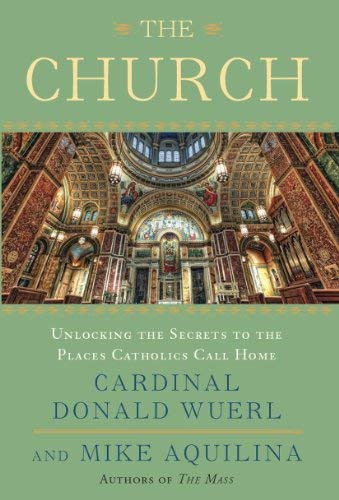
From the bestselling authors of The Mass, an insightful and practical guide that explores the architectural and spiritual components of the Catholic Church.
Your local church is not only a physical place, but a spiritual home. In this thought-provoking book, Wuerl and Aquilina illuminate the importance of the Church in its many guises and examine the theological ideas behind the physical structure of churches, cathedrals, and basilicas. How is a church designed? What is the function of the altar? What does the nave represent? What is the significance of the choir loft? With eloquent prose and elegant black-and-white photography, these questions and many more will lead to answers that illuminate the history and practicality of Catholic life.
Die Inhaltsangabe kann sich auf eine andere Ausgabe dieses Titels beziehen.
Über die Autorin bzw. den Autor
DONALD WUERL is the archbishop of Washington, D.C., and the bestselling author ofThe Catholic Way.
MIKE AQUILINA is the author of more than 20 books, including Angels of God, and appears regularly on EWTN with Scott Hahn.
Auszug. © Genehmigter Nachdruck. Alle Rechte vorbehalten.
Love Is the Builder
Catholics love their churches. We build them with love. We make them lovable.
If you visit a remote village in Latin America, the people will be pleased to show you their church—the church that they or their ancestors have raised to the glory of God. Step inside and you’ll find a sanctuary adorned with precious items: skillfully wrought woodwork, stonework, and metalwork, and paintings and statues in the local style. If you linger for Mass, you’ll see a chalice and plate of gold or silver, enhanced perhaps by gems.
The inside of the church may be lavish and rich, while the homes outside are simple and unadorned. And that contrast sometimes shocks people who are visiting from more prosperous lands. It has become a cliché of anti-Catholic prejudice to say that such precious objects would serve a better purpose if they were sold to raise money for food.
The people in the village know better. They know that the money earned from such a sale would feed them for no more than a few days, while the loss would leave them impoverished forever. Without their church—their church—they would be spiritually and culturally destitute. For they’ve built and furnished their church with love, as Catholics everywhere do and always have done.
Such love finds expression in the smallest details of construction and decoration, and in a seemingly infinite variety of styles. You’ll see it in Ethiopia’s ancient churches—carved out of a single massive block of black stone, the size of a small mountain. You’ll see it in Cappadocia’s cave churches—occupied during a time when Christianity was illegal and the faith was forced underground (literally). You’ll see it in the play of dark and light in the Gothic cathedrals of the Middle Ages. You’ll find it in the most ordinary suburban churches in the United States.
These churches, in all their diversity, are built according to a common plan, furnished with similar items, and decorated with remarkably standard symbols, scenes, and images. The elements bespeak a love shared by Catholics from all over the world, regardless of language, culture, wealth, or historical period.
Catholics build their churches with love; and our love has a language all its own. Like romance, Christian devotion follows certain customs and conventions—a tradition poetic and courtly—hallowed by millennia of experience.
This book is about that silent language of love. In these pages we’ll examine the structure of a church and its furnishings. We’ll consider the historical and biblical roots of each element in a church, providing basic definitions, and we’ll explain each element’s meaning in the Christian tradition. Why, for example, do churches have spires and bells? Where did we get the custom of using holy water? How does an altar differ from an ordinary table? What are votive candles for?
Every part of a church is rich in meaning and mystery, theology and history. Every furnishing or ornament reveals some important detail of the story of our salvation. Through two millennia, Christians have preserved and developed a tradition of building and decoration. The tradition is supple enough that it could be adapted by local cultures as the Gospel spread to new lands, yet solid enough to protect and preserve the essential heritage received from the Apostles and revealed by God.
If you were making a movie and you wanted your audience to identify an interior immediately as a Catholic church, what would you do? You’d show sunlight streaming through stained glass. You’d angle your camera heavenward, looking upward past monumental statues of the saints. You’d pan across a bank of red votive candles with flickering flames, and then focus on an array of seemingly surreal images: a human heart surrounded by thorns; an eye; a disembodied hand raised in blessing; a painting of a woman standing on a crescent moon; a carving of a dove descending; a lion, an eagle, and an ox, all crowned by similar halos; and a throng of angels.
In the popular imagination, these elements add up to a Catholic identity. But what exactly does each of them mean? And how do all the elements work together? What’s the sense of the symbols? What are we trying to say through the medium of human body parts and exotic animals? Late in the fourth century Saint Augustine, who would go on to become a builder of churches, wrote: “I know that a truth which the mind understands in just one way can be materially expressed by many different means, and I also know that there are many different ways in which the mind can understand an idea that is outwardly expressed in one way.”1
The African saint gives us an important insight for “reading” our churches: One image can convey many layers of meaning, and the same idea can be expressed in manifold ways.
Everything we see in a Catholic church is there for a single purpose: to tell a love story. It is a story as old as the world, and it involves the whole of creation, the vast expanse of history, and every human being who ever lived. It involves Almighty God, and it involves you.
Art and architecture are means of communication. Our churches speak of something remote, beyond the reach of human sciences—what Dante called “the Love that moves the sun and the other stars.”2 But our churches speak also to something deep inside us—in our souls and in our senses—because, as Dante added, the same Love that moves the cosmos also moves “my desire and my will.”
To understand our churches is to begin to understand a love at once unmistakably divine and profoundly human, faraway and yet intimate. When we begin to understand that love, it begins to light up our view of our churches and their symbols.
The love story appears in compressed, poetic form in the Gospel according to Saint John.
In the beginning was the Word, and the Word was with God, and the Word was God. He was in the beginning with God; all things were made through him, and without him was not anything made that was made. In him was life, and the life was the light of men. The light shines in the darkness, and the darkness has not overcome it. . . .
The true light that enlightens every man was coming into the world. He was in the world, and the world was made through him, yet the world knew him not. He came to his own home, and his own people received him not. But to all who received him, who believed in his name, he gave power to become children of God; who were born, not of blood nor of the will of the flesh nor of the will of man, but of God.
And the Word became flesh and dwelt among us, full of grace and truth; we have beheld his glory, glory as of the only-begotten Son from the Father. . . .
For God so loved the world that he gave his only-begotten Son, that whoever believes in him should not perish but have eternal life. (John 1:1–5, 9–14; 3:16)
John begins his Gospel by describing a God of awesome power, remote in space and transcending time: a Spirit, a Word. This is the God whom even the pagan philosophers knew: the Prime Mover, the One. Yet, precisely where the pagan philosophers stalled, John’s drama proceeds to a remarkable climax: “And the Word became flesh and dwelt among us.”
From beyond the distant heavens, existing before the beginning of time, God himself broke into history, took on flesh, and made his dwelling—literally, “pitched his tent”—among his people. Yes, God is eternally the Word, but a word is elusive, and not everyone may grasp it.
God, who reigns in heaven, and who transcends all creation and all time, assumed...
„Über diesen Titel“ kann sich auf eine andere Ausgabe dieses Titels beziehen.
Suchergebnisse für The Church: Unlocking the Secrets to the Places Catholics...

Beispielbild für diese ISBN
The Church: Unlocking the Secrets to the Places Catholics Call Home
Anbieter: World of Books (was SecondSale), Montgomery, IL, USA
Verkäuferbewertung 5 von 5 Sternen

Zustand: Good. Item in good condition. Textbooks may not include supplemental items i.e. CDs, access codes etc. Artikel-Nr. 00072094827
Gebraucht kaufen
EUR 4,58
Versand gratis
Versand innerhalb von USA
Versand innerhalb von USA
Anzahl: 1 verfügbar
Beispielbild für diese ISBN
The Church: Unlocking the Secrets to the Places Catholics Call Home
Anbieter: BooksRun, Philadelphia, PA, USA
Verkäuferbewertung 5 von 5 Sternen
Hardcover. Zustand: Very Good. With dust jacket. It's a well-cared-for item that has seen limited use. The item may show minor signs of wear. All the text is legible, with all pages included. It may have slight markings and/or highlighting. Artikel-Nr. 0770435513-11-1-29
Gebraucht kaufen
EUR 4,87
Versand gratis
Versand innerhalb von USA
Versand innerhalb von USA
Anzahl: 1 verfügbar
Beispielbild für diese ISBN
The Church: Unlocking the Secrets to the Places Catholics Call Home
Anbieter: Wonder Book, Frederick, MD, USA
Verkäuferbewertung 5 von 5 Sternen
Zustand: Very Good. Very Good condition. Very Good dust jacket. In protective mylar cover. A copy that may have a few cosmetic defects. May also contain light spine creasing or a few markings such as an owner's name, short gifter's inscription or light stamp. Artikel-Nr. X07C-01873
Gebraucht kaufen
EUR 6,41
Versand gratis
Versand innerhalb von USA
Versand innerhalb von USA
Anzahl: 1 verfügbar
Beispielbild für diese ISBN
The Church: Unlocking the Secrets to the Places Catholics Call Home
Anbieter: Wonder Book, Frederick, MD, USA
Verkäuferbewertung 5 von 5 Sternen
Zustand: Very Good. Very Good condition. Very Good dust jacket. A copy that may have a few cosmetic defects. May also contain light spine creasing or a few markings such as an owner's name, short gifter's inscription or light stamp. Artikel-Nr. E12P-01427
Gebraucht kaufen
EUR 6,41
Versand gratis
Versand innerhalb von USA
Versand innerhalb von USA
Anzahl: 1 verfügbar
Beispielbild für diese ISBN
The Church: Unlocking the Secrets to the Places Catholics Call Home
Anbieter: ThriftBooks-Atlanta, AUSTELL, GA, USA
Verkäuferbewertung 5 von 5 Sternen
Hardcover. Zustand: As New. No Jacket. Pages are clean and are not marred by notes or folds of any kind. ~ ThriftBooks: Read More, Spend Less. Artikel-Nr. G0770435513I2N00
Gebraucht kaufen
EUR 6,49
Versand gratis
Versand innerhalb von USA
Versand innerhalb von USA
Anzahl: 1 verfügbar
Beispielbild für diese ISBN
The Church: Unlocking the Secrets to the Places Catholics Call Home
Anbieter: ThriftBooks-Dallas, Dallas, TX, USA
Verkäuferbewertung 5 von 5 Sternen
Hardcover. Zustand: Very Good. No Jacket. Former library book; May have limited writing in cover pages. Pages are unmarked. ~ ThriftBooks: Read More, Spend Less. Artikel-Nr. G0770435513I4N10
Gebraucht kaufen
EUR 6,49
Versand gratis
Versand innerhalb von USA
Versand innerhalb von USA
Anzahl: 1 verfügbar
Beispielbild für diese ISBN
The Church: Unlocking the Secrets to the Places Catholics Call Home
Anbieter: ThriftBooks-Atlanta, AUSTELL, GA, USA
Verkäuferbewertung 5 von 5 Sternen
Hardcover. Zustand: Very Good. No Jacket. May have limited writing in cover pages. Pages are unmarked. ~ ThriftBooks: Read More, Spend Less. Artikel-Nr. G0770435513I4N00
Gebraucht kaufen
EUR 6,49
Versand gratis
Versand innerhalb von USA
Versand innerhalb von USA
Anzahl: 1 verfügbar
Beispielbild für diese ISBN
The Church: Unlocking the Secrets to the Places Catholics Call Home
Anbieter: ThriftBooks-Dallas, Dallas, TX, USA
Verkäuferbewertung 5 von 5 Sternen
Hardcover. Zustand: As New. No Jacket. Pages are clean and are not marred by notes or folds of any kind. ~ ThriftBooks: Read More, Spend Less. Artikel-Nr. G0770435513I2N00
Gebraucht kaufen
EUR 6,49
Versand gratis
Versand innerhalb von USA
Versand innerhalb von USA
Anzahl: 1 verfügbar
Beispielbild für diese ISBN
The Church : Unlocking the Secrets to the Places Catholics Call Home
Verlag:
Crown Publishing Group, The, 2013
ISBN 10: 0770435513
ISBN 13: 9780770435516
Gebraucht
Hardcover
Anbieter: Better World Books, Mishawaka, IN, USA
Verkäuferbewertung 5 von 5 Sternen
Zustand: Good. Pages intact with minimal writing/highlighting. The binding may be loose and creased. Dust jackets/supplements are not included. Stock photo provided. Product includes identifying sticker. Better World Books: Buy Books. Do Good. Artikel-Nr. 10782634-6
Gebraucht kaufen
EUR 7,19
Versand gratis
Versand innerhalb von USA
Versand innerhalb von USA
Anzahl: 1 verfügbar
Beispielbild für diese ISBN
The Church : Unlocking the Secrets to the Places Catholics Call Home
Verlag:
Crown Publishing Group, The, 2013
ISBN 10: 0770435513
ISBN 13: 9780770435516
Gebraucht
Hardcover
Anbieter: Better World Books: West, Reno, NV, USA
Verkäuferbewertung 5 von 5 Sternen
Zustand: Very Good. Pages intact with possible writing/highlighting. Binding strong with minor wear. Dust jackets/supplements may not be included. Stock photo provided. Product includes identifying sticker. Better World Books: Buy Books. Do Good. Artikel-Nr. 9006141-6
Gebraucht kaufen
EUR 7,19
Versand gratis
Versand innerhalb von USA
Versand innerhalb von USA
Anzahl: 1 verfügbar