
Verwandte Artikel zu The Case for Jesus: The Biblical and Historical Evidence...
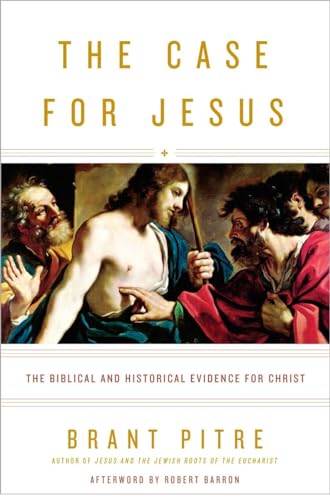
Inhaltsangabe
“This book will prove to be a most effective weapon… against the debunking and skeptical attitudes toward the Gospels that are so prevalent, not only in academe, but also on the street, among young people who, sadly, are leaving the Churches in droves.” – Robert Barron, author of Catholicism
For well over a hundred years now, many scholars have questioned the historical truth of the Gospels, claiming that they were originally anonymous. Others have even argued that Jesus of Nazareth did not think he was God and never claimed to be divine.
In The Case for Jesus, Dr. Brant Pitre, the bestselling author of Jesus and the Jewish Roots of the Eucharist, goes back to the sources—the biblical and historical evidence for Christ—in order to answer several key questions, including:
• Were the four Gospels really anonymous?
• Are the Gospels folklore? Or are they biographies?
• Were the four Gospels written too late to be reliable?
• What about the so-called “Lost Gospels,” such as “Q” and the Gospel of Thomas?
• Did Jesus claim to be God?
• Is Jesus divine in all four Gospels? Or only in John?
• Did Jesus fulfill the Jewish prophecies of the Messiah?
• Why was Jesus crucified?
• What is the evidence for the Resurrection?
As The Case for Jesus will show, recent discoveries in New Testament scholarship, as well as neglected evidence from ancient manuscripts and the early church fathers, together have the potential to pull the rug out from under a century of skepticism toward the traditional Gospels. Above all, Pitre shows how the divine claims of Jesus of Nazareth can only be understood by putting them in their ancient Jewish context.
Die Inhaltsangabe kann sich auf eine andere Ausgabe dieses Titels beziehen.
Über die Autorin bzw. den Autor
BRANT PITRE (Ph.D., University of Notre Dame) is Professor of Sacred Scripture at Notre Dame Seminary in New Orleans. He is the author of the bestselling book Jesus and the Jewish Roots of the Eucharist: Unlocking the Secrets of the Last Supper and Jesus the Bridegroom: The Greatest Love Story Ever Told. Dr. Pitre is a highly sought after speaker and has produced dozens of Bible studies on CD, DVD, and MP3 in which he explores the biblical and historical roots of Christianity. He currently lives in Louisiana with his wife Elizabeth and their five children. More information about his work can be found at www.BrantPitre.com.
Auszug. © Genehmigter Nachdruck. Alle Rechte vorbehalten.
1
The Quest for Jesus
This book is about one big question: Did Jesus of Nazareth claim to be God?
The seeds of my interest in who Jesus really claimed to be were first planted back in the early 1990s, when I was an undergraduate at Louisiana State University. I still remember vividly the day I walked into one of my introductory level classes, very excited to begin learning about the Bible. Although I had grown up Catholic and had even spent a fairly good deal of time reading the Scriptures, I had never before had the opportunity to study the Bible in an in-depth way.
At the time, I was especially excited to begin studying the Gospels. For me, the Gospels were the most familiar part of the Bible, and my personal favorite. In particular, I was hoping that I would be able to learn more about Jesus. As a Christian, I had always believed that Jesus was the divine Son of God, fully God and fully man. I worshiped him and tried to the best of my ability (which was often quite lacking) to live according to his teachings. So when it came time in the classroom to turn to Jesus and the Gospels, I was all ears.
Needless to say, I was somewhat taken aback when the professor began by saying:
“Forget everything you thought you knew about who wrote the Gospels.”
What was that? At the time, I was vigorously trying to take notes, so I couldn’t quite digest what the professor had said.
He continued:
“Although your English Bibles say ‘The Gospel according to “Matthew,” “Mark,” “Luke,” and “John,” ’ these titles were actually added much later. In fact, we don’t really know who wrote the Gospels. Nowadays, modern scholars agree that the Gospels were originally anonymous.”
Got it. Titles added later. Gospels originally anonymous.
Wait a minute! I thought. We don’t know who wrote the Gospels? What about Matthew, Mark, Luke, and John? Weren’t they disciples of Jesus? (As we will see in chapter 2, I was wrong to think Mark and Luke were disciples.)
At the time, these questions flashed through my mind in a matter of moments. Being a zealous undergraduate intent on getting straight As, I was more focused on writing down the professor’s words than on processing them. All the same, I do remember being struck by a thought. If what he was saying was true—which, of course, I never doubted, since I was an ignoramus and he was the professor—then how do we know what Jesus actually did and said? And, in fact, that is exactly what he proceeded to talk about: the so-called “quest for the historical Jesus,” in which modern scholars search for the truth about what Jesus really did and said, using contemporary tools of historical research.
Despite my initial surprise at the idea that we don’t know who wrote the Gospels, the whole notion of the quest for Jesus still fascinated me. After all, Christianity is a historical religion, which claims that the God who made the universe actually became a man—a real human being who lived in a particular time and in a particular place. As a result, the idea of searching for the historical truth about Jesus made sense to me. So, somewhat blindly, that’s what I set out to do.
The Telephone Game
On the one hand, as I began to devour a steady stream of books about Jesus, I felt as if my whole understanding of him and his world was being opened up in new and exciting ways. For one thing, I began taking courses in ancient Greek so that I could learn to read the New Testament in its original language. It was thrilling. I also began studying the Old Testament, which helped me get a better understanding of the history behind the Bible. The end result was that I added a Religious Studies major to my program in English Literature. I also decided to become a professor and spend my life teaching and writing about the Bible. Eventually, I was admitted to a master’s program in biblical studies at Vanderbilt University, which kicked off with a rigorous regimen of learning ancient Hebrew. I even had the privilege of studying under Amy-Jill Levine, a Jewish professor of New Testament. From Dr. Levine, I began to learn how important it was to interpret the words and deeds of Jesus in their first-century Jewish context. She helped me to see Jesus through ancient Jewish eyes. This was a great gift and, in many ways, a great time in my life.
On the other hand, at the very same time, something else began to happen. I also began to encounter ideas about Jesus and the Gospels that were difficult to reconcile with what I had grown up believing. For example, in addition to the theory that the Gospels were originally anonymous, I learned that many modern scholars believe that the Gospels are not biographies of Jesus, that they were not authored by disciples of Jesus, and that they were written too late in the first century AD to be based on reliable eyewitness testimony. One of the textbooks I learned from—written by the now famous atheist New Testament scholar Bart Ehrman—even compares the way we got the accounts of Jesus in the Gospels to the children’s game of “Telephone”! These are the words I read all those years ago:
[N]early all of these storytellers had no independent knowledge of what really happened [to Jesus]. It takes little imagination to realize what happened to the stories. You are probably familiar with the old birthday party game “telephone.” A group of kids sits in a circle, the first tells a brief story to the one sitting next to her, who tells it to the next, and to the next, and so on, until it comes back full circle to the one who started it. Invariably, the story has changed so much in the process of retelling that everyone gets a good laugh. Imagine this same activity taking place, not in a solitary living room with ten kids on one afternoon, but over the expanse of the Roman Empire (some 2,500 miles across), with thousands of participants.
We’ll revisit the idea of the Telephone game later on in this book. As we will see, this so-called “analogy” is completely anachronistic and has no place in any serious historical study of Jesus and the Gospels. But I didn’t know that seventeen years ago. At the time, let’s just say that it didn’t exactly inspire confidence in me that the four Gospels were historically reliable. To make matters even more complicated, I also discovered that there were lots of other ancient gospels outside the New Testament that I had never heard about before. In fact, some scholars argued that these “lost gospels,” especially the Gospel of Thomas, should get equal treatment as historical sources in the quest for Jesus. After all, if the four Gospels weren’t based on eyewitness testimony, why should we trust them instead of the lost gospels? Finally, and most significant of all, I began to realize that many contemporary New Testament scholars do not believe that Jesus of Nazareth ever actually claimed to be God. Of all the ideas that I encountered, this last one shook me to my core.
Liar, Lunatic, Lord, or Legend?
Don’t get me wrong. It wasn’t as if I had never before come across the idea of someone not believing in the divinity of Jesus. To the contrary, when I was an undergraduate, I had read very closely C. S. Lewis’s famous book Mere Christianity, in which he explains some of the reasons he converted from atheism to Christianity. In that book, Lewis gives a classic argument against the common idea that Jesus was just a great moral teacher or a prophet. In Lewis’s own words:
I am trying here to prevent anyone saying the really foolish thing that people often say about Him: “I’m ready to accept...
„Über diesen Titel“ kann sich auf eine andere Ausgabe dieses Titels beziehen.
Suchergebnisse für The Case for Jesus: The Biblical and Historical Evidence...

Beispielbild für diese ISBN
The Case for Jesus : The Biblical and Historical Evidence for Christ
Verlag:
Doubleday Religious Publishing Group, The, 2016
ISBN 10: 0770435483
ISBN 13: 9780770435486
Gebraucht
Hardcover
Anbieter: Better World Books, Mishawaka, IN, USA
Verkäuferbewertung 5 von 5 Sternen

Zustand: Very Good. Former library copy. Pages intact with possible writing/highlighting. Binding strong with minor wear. Dust jackets/supplements may not be included. Includes library markings. Stock photo provided. Product includes identifying sticker. Better World Books: Buy Books. Do Good. Artikel-Nr. 10290399-6
Gebraucht kaufen
EUR 12,12
Versand gratis
Versand innerhalb von USA
Versand innerhalb von USA
Anzahl: 1 verfügbar
Beispielbild für diese ISBN
The Case for Jesus : The Biblical and Historical Evidence for Christ
Verlag:
Doubleday Religious Publishing Group, The, 2016
ISBN 10: 0770435483
ISBN 13: 9780770435486
Gebraucht
Hardcover
Anbieter: Better World Books, Mishawaka, IN, USA
Verkäuferbewertung 5 von 5 Sternen
Zustand: Good. Pages intact with minimal writing/highlighting. The binding may be loose and creased. Dust jackets/supplements are not included. Stock photo provided. Product includes identifying sticker. Better World Books: Buy Books. Do Good. Artikel-Nr. 10583349-6
Gebraucht kaufen
EUR 12,12
Versand gratis
Versand innerhalb von USA
Versand innerhalb von USA
Anzahl: 2 verfügbar
Beispielbild für diese ISBN
The Case for Jesus The Biblica
Anbieter: World of Books (was SecondSale), Montgomery, IL, USA
Verkäuferbewertung 5 von 5 Sternen
Zustand: Good. Item in good condition. Textbooks may not include supplemental items i.e. CDs, access codes etc. Artikel-Nr. 00107686689
Gebraucht kaufen
EUR 14,53
Versand gratis
Versand innerhalb von USA
Versand innerhalb von USA
Anzahl: 3 verfügbar
Beispielbild für diese ISBN
The Case for Jesus The Biblica
Anbieter: World of Books (was SecondSale), Montgomery, IL, USA
Verkäuferbewertung 5 von 5 Sternen
Zustand: Very Good. Item in very good condition! Textbooks may not include supplemental items i.e. CDs, access codes etc. Artikel-Nr. 00107785475
Gebraucht kaufen
EUR 14,53
Versand gratis
Versand innerhalb von USA
Versand innerhalb von USA
Anzahl: 1 verfügbar
Beispielbild für diese ISBN
The Case for Jesus
Anbieter: PBShop.store US, Wood Dale, IL, USA
Verkäuferbewertung 5 von 5 Sternen
HRD. Zustand: New. New Book. Shipped from UK. Established seller since 2000. Artikel-Nr. WB-9780770435486
Beispielbild für diese ISBN
The Case for Jesus: The Biblical and Historical Evidence for Christ
Anbieter: Majestic Books, Hounslow, Vereinigtes Königreich
Verkäuferbewertung 4 von 5 Sternen

Zustand: New. pp. 224. Artikel-Nr. 373584235
Neu kaufen
EUR 21,07
EUR 7,59 Versand
Versand von Vereinigtes Königreich nach USA
Versand von Vereinigtes Königreich nach USA
Anzahl: 1 verfügbar
Beispielbild für diese ISBN
The Case for Jesus: The Biblical and Historical Evidence for Christ
Anbieter: WorldofBooks, Goring-By-Sea, WS, Vereinigtes Königreich
Verkäuferbewertung 5 von 5 Sternen
Paperback. Zustand: Very Good. The book has been read, but is in excellent condition. Pages are intact and not marred by notes or highlighting. The spine remains undamaged. Artikel-Nr. GOR008020641
Gebraucht kaufen
EUR 27,71
EUR 6,54 Versand
Versand von Vereinigtes Königreich nach USA
Versand von Vereinigtes Königreich nach USA
Anzahl: 1 verfügbar
Beispielbild für diese ISBN
The Case for Jesus: The Biblical and Historical Evidence for Christ
Anbieter: Revaluation Books, Exeter, Vereinigtes Königreich
Verkäuferbewertung 5 von 5 Sternen
Hardcover. Zustand: Brand New. 224 pages. 8.50x5.75x0.75 inches. In Stock. Artikel-Nr. __0770435483
Neu kaufen
EUR 29,02
EUR 11,68 Versand
Versand von Vereinigtes Königreich nach USA
Versand von Vereinigtes Königreich nach USA
Anzahl: 1 verfügbar
Beispielbild für diese ISBN
The Case for Jesus: The Biblical and Historical Evidence for Christ
Anbieter: Revaluation Books, Exeter, Vereinigtes Königreich
Verkäuferbewertung 5 von 5 Sternen
Hardcover. Zustand: Brand New. 224 pages. 8.50x5.75x0.75 inches. In Stock. Artikel-Nr. xr0770435483
Neu kaufen
EUR 29,28
EUR 11,68 Versand
Versand von Vereinigtes Königreich nach USA
Versand von Vereinigtes Königreich nach USA
Anzahl: 2 verfügbar
Beispielbild für diese ISBN
The Case for Jesus: The Biblical and Historical Evidence for Christ
Anbieter: Revaluation Books, Exeter, Vereinigtes Königreich
Verkäuferbewertung 5 von 5 Sternen
Hardcover. Zustand: Brand New. 224 pages. 8.50x5.75x0.75 inches. In Stock. Artikel-Nr. xi0770435483
Neu kaufen
EUR 29,28
EUR 11,68 Versand
Versand von Vereinigtes Königreich nach USA
Versand von Vereinigtes Königreich nach USA
Anzahl: 2 verfügbar