
Verwandte Artikel zu The Informant! (Film Tie-In): A True Story... Based...
The Informant! (Film Tie-In): A True Story... Based On a Tattle Tale (The Informant: A True Story) - Softcover
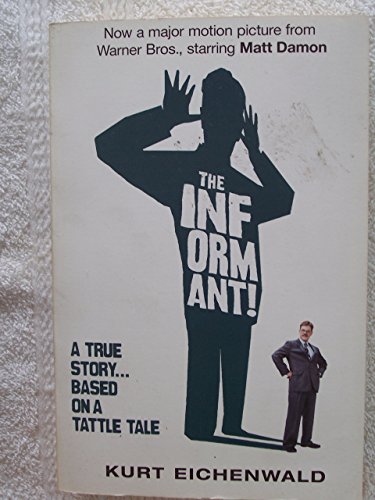
Inhaltsangabe
Akribisch recherchiert erzählt Eichenwald die Geschichte eines der bestgehüteten Geheimnisse des FBI. Eine der politisch einflussreichsten Firmen Amerikas, Archer Daniels Midland, wurde infiltriert und überwacht, ein Informant, eine hochrangige Führungskraft bei ADM gewonnen. Man wollte ein Kontinente übergreifendes Verbrechen aufdecken, den Plan ADMs, Millionen von Dollar von den eigenen Kunden zu stehlen. Der Informant setzte alles aufs Spiel: seine Karriere, seine Sicherheit, die Sicherheit seiner Familie, nur um das FBI zu unterstützen. Doch in Wahrheit war nichts wie es schien - das FBI hatte dem einen Mann vertraut, der einen ganz eigenen Plan hatte, einen Plan, den außer ihm niemand kannte...
Die Inhaltsangabe kann sich auf eine andere Ausgabe dieses Titels beziehen.
Über die Autorin bzw. den Autor
Kurt Eichenwald has written about white-collar crime and corporate cor-ruption for the New York Times for more than a decade. A two-time winner of the prestigious George Polk award for excellence in journalism and a finalist for the 2000 Pulitzer Prize, he has been repeatedly selected by TJFR Business News Reporter as one of the nation's most influential financial journalists. For the Times, he has covered some of the highest-profile news stories emanating from the business world, including the Archer Daniels Midland story, and he is the author of Serpent on the Rock. Eichenwald lives in Westchester County, outside New York City, with his wife and three children.
From the Hardcover edition.
Auszug. © Genehmigter Nachdruck. Alle Rechte vorbehalten.
Chapter 1
The large gray van, its windows tinted to block the glances of the curious, pulled away from the Decatur Airport, heading toward Route 105. Inside, four foreign visitors watched as images of the modest town came into view. Working-class houses. An Assembly of God church. A man-made lake. The vast fields of corn that could be seen from the air were no longer visible, replaced instead by an entanglement of industrial plants and office buildings.
These were the sights of a thousand other blue-collar neighborhoods in a thousand other Midwestern towns. Still, on this day, September 10, 1992, it was hard not to feel a slight sense of awe. For years, world leaders had seen these images, perhaps from this very van, in a virtual pilgrimage of power. In the last few months alone, this road had been traveled by Mikhail Gorbachev, the former Soviet leader, and by Dan Quayle, the American vice president. Those men, like leaders before them, had been drawn to this out-of-the-way place in the center of America largely by one company and often by one man: Archer Daniels Midland and its influential chairman, Dwayne Andreas.
Few Americans were familiar with who Andreas was or what he did. But among the world’s moneyed and powerful, he and his grain processing company were known well. In Washington, anyone who mattered was acquainted with Andreas—or more likely, with his money. For decades, he had been one of the country’s foremost political contributors, heaping cash almost indiscriminately on Democrats and Republicans—this year alone, Andreas money would be used by both George Bush and Bill Clinton in their battle for the presidency. The largesse helped transform Andreas into one of Washington’s most important men, even as he remained comfortably ensconced in its shadows. But it also thrust him into controversy. It was the $25,000 from Andreas that operatives of President Nixon laundered into the bank account of a Watergate burglar. Following the wide-ranging investigations that stemmed from the Watergate scandal, Andreas was tried and acquitted on charges of violating campaign-finance laws—but that was for the $100,000 he gave to Nixon’s 1968 rival, Hubert Humphrey.
The foreign visitors traveling to ADM on this day hoped for an opportunity to meet Andreas but were uncertain if they would. At this point, they were scheduled only to speak with others in ADM management, the people who ran its day-to-day business.
If all went well, the visitors expected the meeting to last some time. After all, before the day’s end, there were several important things that they needed to learn. But there was also one important thing that they needed to steal.
The van turned onto Faries Parkway, heading directly toward ADM’s homely, sprawling complex. Yellow flowers planted along the side of the road did little to soften the effect of the property’s jagged barbed-wire fence. At the main gate, the driver gave a nod to the guard before turning right toward the squat, nondescript building that housed ADM’s top brass. The van came to a stop beside the seven-foot bronze statue of Ronald Reagan, mounted on a two-ton granite base, that Dwayne Andreas had erected to commemorate a 1984 visit by the then-president.
Hirokazu Ikeda stepped down from the enormous vehicle, trailed closely by Kanji Mimoto, both senior executives from Ajinomoto Inc., a giant Japanese competitor of ADM. Two other Ajinomoto executives followed—one Japanese, one European. Shading their eyes from the morning sun, the men headed into the building’s lobby and introduced themselves to a receptionist. She placed a call, and within seconds a young, energetic man came bounding down a hallway toward them. It was Mark Whitacre, the thirty-four-year-old president of ADM’s newest unit, the Bioproducts Division. He was a man whom in recent months they had come to know, if not yet to trust.
Whitacre smiled as he stepped into the lobby. “Welcome to Decatur,’’ he said, shaking Ikeda’s hand. “And welcome to ADM.
“Thank you, Mr. Whitacre,’’ Ikeda said in halting English. “Happy to be here.
Whitacre turned and greeted Mimoto, a man closer to his own age who spoke English fairly well. The other two men were strangers; they were introduced to Whitacre as Kotaro Fujiwara, an engineer at the company’s Tokyo headquarters, and J. L. Brehant, who held a similar job at its European subsidiary.
With introductions complete, Whitacre escorted the executives down the hallway toward ADM’s huge trading room, the corporate nerve center where it purchased tons of corn, wheat, soybeans, and other farm products for processing each day. On the front wall of the vast room, a screen flashed up-to-the-minute commodity prices. At row after row of desks, an army of traders barked buy and sell orders into telephones.
Around the edges of the room were various executive offices, most with the doors open. Whitacre stopped at one office and tapped on the door frame.
“Terry?’’ he said. “They’re here.
Terry Wilson, head of the company’s corn-processing division, looked up from his desk and smiled. The expression was more a re- flection of strategy than delight; he was hoping to finish with the Ajinomoto executives quickly, in time for an early afternoon round of golf. Like many American businessmen, Wilson often felt frustrated with the Japanese. In negotiations, they seemed loath to horse-trade; they would listen but often retreated into ambiguity, making no specific commitments. Such tactics were considered a sign of virtue in Japan, the vague responses praised as tamamushi-iro no hy¯ogen o tsukau, or “using iridescent expressions.’’ Whatever its elegant description in Japanese, for Westerners like Wilson, a hard-drinking ex-marine, the approach was tiresome. He was not looking forward to it today.
Wilson stepped from behind his desk, past a television that was broadcasting the day’s news.
“Mr. Ikeda, Mr. Mimoto, it’s been a long time,’’ he said. “You’ve come on a day with such nice weather, it’s a shame you’re not here to play golf.
The men chatted about their golf games as Whitacre led them to the executive meeting room, where they found their places around a conference table. A kitchen staffer appeared, serving iced tea, water, and orange juice. As everyone settled in, Whitacre walked to a wall phone and dialed 5505—the extension for Jim Randall, the president of ADM.
“Jim, our guests are here,’’ Whitacre said simply. He hung up and returned to his seat.
Everyone knew this could be a tense moment. Randall had been at the company since 1968. His skills as an engineer were indisputable; his hands-on role kept the huge processing plants running. Still, the sixty-eight-year-old Randall was no Dwayne Andreas. As much as Dwayne’s smooth and polished style made him the perfect Mr. Outside for ADM, Randall’s gruff, plainspoken approach ensured that he would remain Mr. Inside. He often rubbed people the wrong way, whether he was boasting about his sports cars or ADM’s market dominance. The visitors today expected to hear about the company’s might; they knew that ADM’s invitation to visit was partly for the purpose of scaring them.
Randall walked into the room a few minutes later, introduced himself, and took his place alongside Wilson and Whitacre. Instantly he took control of the meeting and the conversation, describing how ADM was transforming itself into a new company.
Over slightly less than a century, ADM had grown into a global giant, processing grains and other farm staples into oils, flours, and...
„Über diesen Titel“ kann sich auf eine andere Ausgabe dieses Titels beziehen.
Suchergebnisse für The Informant! (Film Tie-In): A True Story... Based...

Beispielbild für diese ISBN
The Informant: A True Story
Anbieter: World of Books (was SecondSale), Montgomery, IL, USA
Verkäuferbewertung 5 von 5 Sternen

Zustand: Good. Item in good condition. Textbooks may not include supplemental items i.e. CDs, access codes etc. Artikel-Nr. 00092356740
Gebraucht kaufen
EUR 4,57
Versand gratis
Versand innerhalb von USA
Versand innerhalb von USA
Anzahl: 1 verfügbar
Beispielbild für diese ISBN
The Informant: A True Story
Verlag:
Broadway (edition Reprint), 2009
ISBN 10: 0767931254
ISBN 13: 9780767931250
Gebraucht
Paperback
Anbieter: BooksRun, Philadelphia, PA, USA
Verkäuferbewertung 5 von 5 Sternen
Paperback. Zustand: Very Good. Reprint. It's a well-cared-for item that has seen limited use. The item may show minor signs of wear. All the text is legible, with all pages included. It may have slight markings and/or highlighting. Artikel-Nr. 0767931254-11-1
Gebraucht kaufen
EUR 5,16
Versand gratis
Versand innerhalb von USA
Versand innerhalb von USA
Anzahl: 1 verfügbar
Beispielbild für diese ISBN
The Informant: A True Story
Verlag:
Broadway (edition Reprint), 2009
ISBN 10: 0767931254
ISBN 13: 9780767931250
Gebraucht
Paperback
Anbieter: BooksRun, Philadelphia, PA, USA
Verkäuferbewertung 5 von 5 Sternen
Paperback. Zustand: Fair. Reprint. The item might be beaten up but readable. May contain markings or highlighting, as well as stains, bent corners, or any other major defect, but the text is not obscured in any way. Artikel-Nr. 0767931254-7-1
Gebraucht kaufen
EUR 5,22
Versand gratis
Versand innerhalb von USA
Versand innerhalb von USA
Anzahl: 1 verfügbar
Beispielbild für diese ISBN
The Informant: A True Story
Verlag:
Broadway (edition Reprint), 2009
ISBN 10: 0767931254
ISBN 13: 9780767931250
Gebraucht
Paperback
Anbieter: BooksRun, Philadelphia, PA, USA
Verkäuferbewertung 5 von 5 Sternen
Paperback. Zustand: Very Good. Reprint. It's a well-cared-for item that has seen limited use. The item may show minor signs of wear. All the text is legible, with all pages included. It may have slight markings and/or highlighting. Artikel-Nr. 0767931254-11-18
Gebraucht kaufen
EUR 5,51
Versand gratis
Versand innerhalb von USA
Versand innerhalb von USA
Anzahl: 1 verfügbar
Beispielbild für diese ISBN
The Informant: A True Story (Random House Movie Tie-In Books)
Anbieter: Wonder Book, Frederick, MD, USA
Verkäuferbewertung 5 von 5 Sternen
Zustand: Good. Good condition. A copy that has been read but remains intact. May contain markings such as bookplates, stamps, limited notes and highlighting, or a few light stains. Artikel-Nr. J07B-02233
Gebraucht kaufen
EUR 6,27
Versand gratis
Versand innerhalb von USA
Versand innerhalb von USA
Anzahl: 3 verfügbar
Beispielbild für diese ISBN
The Informant: A True Story (Random House Movie Tie-In Books)
Anbieter: Wonder Book, Frederick, MD, USA
Verkäuferbewertung 5 von 5 Sternen
Zustand: Very Good. Very Good condition. A copy that may have a few cosmetic defects. May also contain light spine creasing or a few markings such as an owner's name, short gifter's inscription or light stamp. Artikel-Nr. L10C-02217
Gebraucht kaufen
EUR 6,27
Versand gratis
Versand innerhalb von USA
Versand innerhalb von USA
Anzahl: 1 verfügbar
Beispielbild für diese ISBN
The Informant : A True Story
Anbieter: Better World Books: West, Reno, NV, USA
Verkäuferbewertung 5 von 5 Sternen
Zustand: Good. Reprint. Pages intact with minimal writing/highlighting. The binding may be loose and creased. Dust jackets/supplements are not included. Stock photo provided. Product includes identifying sticker. Better World Books: Buy Books. Do Good. Artikel-Nr. 864365-6
Gebraucht kaufen
EUR 6,58
Versand gratis
Versand innerhalb von USA
Versand innerhalb von USA
Anzahl: 1 verfügbar
Beispielbild für diese ISBN
The Informant : A True Story
Anbieter: Better World Books, Mishawaka, IN, USA
Verkäuferbewertung 5 von 5 Sternen
Zustand: Very Good. Reprint. Pages intact with possible writing/highlighting. Binding strong with minor wear. Dust jackets/supplements may not be included. Stock photo provided. Product includes identifying sticker. Better World Books: Buy Books. Do Good. Artikel-Nr. 16205365-6
Gebraucht kaufen
EUR 6,58
Versand gratis
Versand innerhalb von USA
Versand innerhalb von USA
Anzahl: 1 verfügbar
Beispielbild für diese ISBN
The Informant: Movie Tie-In: A True Story (Random House Movie Tie-In Books)
Anbieter: AwesomeBooks, Wallingford, Vereinigtes Königreich
Verkäuferbewertung 5 von 5 Sternen
Paperback. Zustand: Very Good. The Informant: Movie Tie-In: A True Story (Random House Movie Tie-In Books) This book is in very good condition and will be shipped within 24 hours of ordering. The cover may have some limited signs of wear but the pages are clean, intact and the spine remains undamaged. This book has clearly been well maintained and looked after thus far. Money back guarantee if you are not satisfied. See all our books here, order more than 1 book and get discounted shipping. Artikel-Nr. 7719-9780767931250
Gebraucht kaufen
EUR 4,92
EUR 4,80 Versand
Versand von Vereinigtes Königreich nach USA
Versand von Vereinigtes Königreich nach USA
Anzahl: 2 verfügbar
Beispielbild für diese ISBN
Movie Tie-In (The Informant: A True Story)
ISBN 10: 0767931254
ISBN 13: 9780767931250
Gebraucht
Paperback
Anbieter: WorldofBooks, Goring-By-Sea, WS, Vereinigtes Königreich
Verkäuferbewertung 5 von 5 Sternen
Paperback. Zustand: Very Good. The book has been read, but is in excellent condition. Pages are intact and not marred by notes or highlighting. The spine remains undamaged. Artikel-Nr. GOR003376068
Gebraucht kaufen
EUR 3,60
EUR 6,53 Versand
Versand von Vereinigtes Königreich nach USA
Versand von Vereinigtes Königreich nach USA
Anzahl: 1 verfügbar