
Verwandte Artikel zu Money and Power: How Goldman Sachs Came to Rule the...
Inhaltsangabe
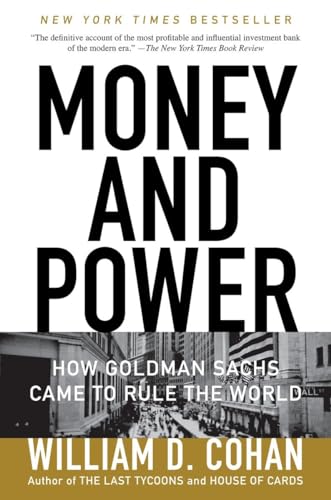
The bestselling author of the acclaimed House of Cards and The Last Tycoons turns his spotlight on to Goldman Sachs and the controversy behind its success.
From the outside, Goldman Sachs is a perfect company. The Goldman PR machine loudly declares it to be smarter, more ethical, and more profitable than all of its competitors. Behind closed doors, however, the firm constantly straddles the line between conflict of interest and legitimate deal making, wields significant influence over all levels of government, and upholds a culture of power struggles and toxic paranoia. And its clever bet against the mortgage market in 2007—unknown to its clients—may have made the financial ruin of the Great Recession worse. Money and Power reveals the internal schemes that have guided the bank from its founding through its remarkable windfall during the 2008 financial crisis. Through extensive research and interviews with the inside players, including current CEO Lloyd Blankfein, William Cohan constructs a nuanced, timely portrait of Goldman Sachs, the company that was too big—and too ruthless—to fail.
Die Inhaltsangabe kann sich auf eine andere Ausgabe dieses Titels beziehen.
Über die Autorin bzw. den Autor
William D. Cohan is the author of the New York Times bestsellers House of Cards and The Last Tycoons, which won the 2007 FT/Goldman Sachs Business Book of the Year Award. He is a contributing editor at Vanity Fair, has a weekly opinion column in Bloomberg View, and writes frequently for Fortune, The Atlantic, Art News, BloombergBusinessWeek, The New York Times, The Financial Times, The Irish Times and The Washington Post, among other publications. He also is a contributing editor on Bloomberg Television and a frequent on-air contributor to MSNBC, CNN and CNBC. A former investment banker, Cohan is a graduate of Duke University, Columbia University School of Journalism and the Columbia University Graduate School of Business.
Auszug. © Genehmigter Nachdruck. Alle Rechte vorbehalten.
Wall Street has always been a dangerous place. Firms have been going in and out of business ever since speculators first gathered under a buttonwood tree near the southern tip of Manhattan in the late eighteenth century. Despite the ongoing risks, during great swaths of its mostly charmed 142 years, Goldman Sachs has been both envied and feared for having the best talent, the best clients, and the best political connections, and for its ability to alchemize them into extreme profitability and market prowess.
Indeed, of the many ongoing mysteries about Goldman Sachs, one of the most overarching is just how it makes so much money, year in and year out, in good times and in bad, all the while revealing as little as possible to the outside world about how it does it. Another— equally confounding— mystery is the firm’s steadfast, zealous belief in its ability to manage its multitude of internal and external conflicts better than any other beings on the planet. The combination of these two genetic strains— the ability to make boatloads of money at will and to appear to manage conflicts that have humbled, then humiliated lesser firms— has made Goldman Sachs the envy of its financial- services brethren.
But it is also something else altogether: a symbol of immutable global power and unparalleled connections, which Goldman is shameless in exploiting for its own benefit, with little concern for how its success affects the rest of us. The firm has been described as everything from “a cunning cat that always lands on its feet” to, now famously, “a great vampire squid wrapped around the face of humanity, relentlessly jamming its blood funnel into anything that smells like money,” by Rolling Stone writer Matt Taibbi. The firm’s inexorable success leaves people wondering: Is Goldman Sachs better than everyone else, or have they found ways to win time and time again by cheating?
But in the early twenty- first century, thanks to the fallout from Goldman’s very success, the firm is looking increasingly vulnerable. To be sure, the firm has survived plenty of previous crises, starting with the Depression, when much of the firm’s capital was lost in a scam of its own creation, and again in the late 1940s, when Goldman was one of seventeen Wall Street firms put on trial and accused of collusion by the federal government. In the past forty years, as a consequence of numerous scandals involving rogue traders, suicidal clients, and charges of insider trading, the firm has come far closer— repeatedly— to financial collapse than its reputation would attest.
Each of these previous threats changed Goldman in some meaningful way and forced the firm to adapt to the new laws that either the market or regulators imposed. This time will be no different. What is different for Goldman now, though, is that for the first time since 1932— when Sidney Weinberg, then Goldman’s senior partner, knew that he could quickly reach his friend, President- elect Franklin Delano Roosevelt— the firm no longer appears to have sympathetic high- level relationships in Washington. Goldman’s friends in high places, so crucial to the firm’s extraordinary success, are abandoning it. Indeed, in today’s charged political climate, which is polarized along socioeconomic lines, Goldman seems particularly isolated and demonized.
Certainly Lloyd Blankfein, Goldman’s fifty-six- year- old chairman and CEO, has no friend in President Barack Obama, despite being invited to a recent state dinner for the president of China. According to Newsweek columnist Jonathan Alter’s book The Promise, the “angriest” Obama got during his first year in office was when he heard Blankfein justify the firm’s $16.2 billion of bonuses in 2009 by claiming “Goldman was never in danger of collapse” during the financial crisis that began in 2007. According to Alter, President Obama told a friend that Blankfein’s statement was “flatly untrue” and added for good measure, “These guys want to be paid like rock stars when all they’re doing is lip- synching capitalism.”
Complicating the firm’s efforts to be better understood by the American public— a group Goldman has never cared to serve— is a long-standing reticence among many of the firm’s current and former executives, bankers, and traders to engage with the media in a constructive way. Even retired Goldman partners feel compelled to check with the firm’s disciplined administrative bureaucracy, run by John F. W. Rogers— a former chief of staff to James Baker, both at the White House and at the State Department— before agreeing to be interviewed. Most have likely signed confidentiality or nondisparagement agreements as a condition of their departures from the firm. Should they make themselves available, unlike bankers and traders at other firms— where self-aggrandizement in the press at the expense of colleagues is typical— Goldman types stay firmly on the message that what matters most is the Goldman team, not any one individual on it.
“They’re extremely disciplined,” explained one private- equity executive who both competes and invests with Goldman. “They understand probably better than anybody how to never take the game face off. You’ll never get a Goldman banker after three beers saying, ‘You know, listen, my colleagues are a bunch of fucking dickheads.’ They just don’t do that the way other guys will, whether it’s because they tend to keep the uniform on for a longer stretch of time so they’re not prepared to damage their squad, or whether or not it’s because they’re afraid of crossing the powers that be, once they’ve taken the blood oath... they maintain that discipline in a kind of eerily successful way.”
Anyone who might have forgotten how dangerous Wall Street can be was reminded of it again, in spades, beginning in early 2007, as the market for home mortgages in the United States began to crack, and then implode, leading to the demise or near demise a year or so later of several large Wall Street firms that had been around for generations— including Bear Stearns, Lehman Brothers, and Merrill Lynch— as well as other large financial institutions such as Citigroup, AIG, Washington Mutual, and Wachovia.
Although it underwrote billions of dollars of mortgage securities, Goldman Sachs avoided the worst of the crisis, thanks largely to a fully authorized, well- timed proprietary bet by a small group of Goldman traders— led by Dan Sparks, Josh Birnbaum, and Michael Swenson— beginning in December 2006, that the housing bubble would collapse and that the securities tied to home mortgages would rapidly lose value. They were right.
In July 2007, David Viniar, Goldman’s longtime chief financial officer, referred to this proprietary bet as “the big short” in an e-mail he wrote to Blankfein and others. During 2007, as other firms lost billions of dollars writing down the value of mortgage- related securities on their balance sheets, Goldman was able to offset its own mortgage- related losses with huge gains— of some $4 billion— from its bet the housing market would fall.
Goldman earned a net profit in 2007 of $11.4 billion— then a record...
„Über diesen Titel“ kann sich auf eine andere Ausgabe dieses Titels beziehen.
Suchergebnisse für Money and Power: How Goldman Sachs Came to Rule the...

Beispielbild für diese ISBN
Money and Power: How Goldman S
Anbieter: World of Books (was SecondSale), Montgomery, IL, USA
Verkäuferbewertung 5 von 5 Sternen

Zustand: Acceptable. Item in acceptable condition! Textbooks may not include supplemental items i.e. CDs, access codes etc. Artikel-Nr. 00106052010
Gebraucht kaufen
EUR 4,50
Versand gratis
Versand innerhalb von USA
Versand innerhalb von USA
Anzahl: 1 verfügbar
Beispielbild für diese ISBN
Money and Power: How Goldman S
Anbieter: World of Books (was SecondSale), Montgomery, IL, USA
Verkäuferbewertung 5 von 5 Sternen
Zustand: Like New. Item is in like new condition. Artikel-Nr. 00103130045
Gebraucht kaufen
EUR 4,50
Versand gratis
Versand innerhalb von USA
Versand innerhalb von USA
Anzahl: 1 verfügbar
Beispielbild für diese ISBN
Money and Power: How Goldman S
Anbieter: World of Books (was SecondSale), Montgomery, IL, USA
Verkäuferbewertung 5 von 5 Sternen
Zustand: Good. Item in good condition. Textbooks may not include supplemental items i.e. CDs, access codes etc. Artikel-Nr. 00102888074
Gebraucht kaufen
EUR 4,50
Versand gratis
Versand innerhalb von USA
Versand innerhalb von USA
Anzahl: 5 verfügbar
Beispielbild für diese ISBN
Money and Power : How Goldman Sachs Came to Rule the World
Verlag:
Knopf Doubleday Publishing Group, 2012
ISBN 10: 0767928261
ISBN 13: 9780767928267
Gebraucht
Softcover
Anbieter: Better World Books, Mishawaka, IN, USA
Verkäuferbewertung 5 von 5 Sternen
Zustand: Good. Pages intact with minimal writing/highlighting. The binding may be loose and creased. Dust jackets/supplements are not included. Stock photo provided. Product includes identifying sticker. Better World Books: Buy Books. Do Good. Artikel-Nr. 4230872-6
Gebraucht kaufen
EUR 6,26
Versand gratis
Versand innerhalb von USA
Versand innerhalb von USA
Anzahl: 4 verfügbar
Beispielbild für diese ISBN
Money and Power : How Goldman Sachs Came to Rule the World
Verlag:
Knopf Doubleday Publishing Group, 2012
ISBN 10: 0767928261
ISBN 13: 9780767928267
Gebraucht
Softcover
Anbieter: Better World Books: West, Reno, NV, USA
Verkäuferbewertung 5 von 5 Sternen
Zustand: Good. Pages intact with minimal writing/highlighting. The binding may be loose and creased. Dust jackets/supplements are not included. Stock photo provided. Product includes identifying sticker. Better World Books: Buy Books. Do Good. Artikel-Nr. 4230872-6
Gebraucht kaufen
EUR 6,26
Versand gratis
Versand innerhalb von USA
Versand innerhalb von USA
Anzahl: 1 verfügbar
Beispielbild für diese ISBN
Money and Power: How Goldman Sachs Came to Rule the World
Anbieter: Wonder Book, Frederick, MD, USA
Verkäuferbewertung 5 von 5 Sternen
Zustand: Good. Good condition. A copy that has been read but remains intact. May contain markings such as bookplates, stamps, limited notes and highlighting, or a few light stains. Artikel-Nr. U12Q-00093
Gebraucht kaufen
EUR 6,33
Versand gratis
Versand innerhalb von USA
Versand innerhalb von USA
Anzahl: 1 verfügbar
Beispielbild für diese ISBN
Money and Power: How Goldman Sachs Came to Rule the World
Anbieter: ThriftBooks-Phoenix, Phoenix, AZ, USA
Verkäuferbewertung 5 von 5 Sternen
Paperback. Zustand: Good. No Jacket. Pages can have notes/highlighting. Spine may show signs of wear. ~ ThriftBooks: Read More, Spend Less. Artikel-Nr. G0767928261I3N00
Gebraucht kaufen
EUR 7,05
Versand gratis
Versand innerhalb von USA
Versand innerhalb von USA
Anzahl: 1 verfügbar
Beispielbild für diese ISBN
Money and Power: How Goldman Sachs Came to Rule the World
Anbieter: ThriftBooks-Dallas, Dallas, TX, USA
Verkäuferbewertung 5 von 5 Sternen
Paperback. Zustand: Fair. No Jacket. Readable copy. Pages may have considerable notes/highlighting. ~ ThriftBooks: Read More, Spend Less. Artikel-Nr. G0767928261I5N00
Gebraucht kaufen
EUR 7,05
Versand gratis
Versand innerhalb von USA
Versand innerhalb von USA
Anzahl: 1 verfügbar
Beispielbild für diese ISBN
Money and Power: How Goldman Sachs Came to Rule the World
Anbieter: ThriftBooks-Dallas, Dallas, TX, USA
Verkäuferbewertung 5 von 5 Sternen
Paperback. Zustand: Good. No Jacket. Pages can have notes/highlighting. Spine may show signs of wear. ~ ThriftBooks: Read More, Spend Less. Artikel-Nr. G0767928261I3N00
Gebraucht kaufen
EUR 7,05
Versand gratis
Versand innerhalb von USA
Versand innerhalb von USA
Anzahl: 2 verfügbar
Beispielbild für diese ISBN
Money and Power: How Goldman Sachs Came to Rule the World
Anbieter: ThriftBooks-Reno, Reno, NV, USA
Verkäuferbewertung 5 von 5 Sternen
Paperback. Zustand: Good. No Jacket. Pages can have notes/highlighting. Spine may show signs of wear. ~ ThriftBooks: Read More, Spend Less. Artikel-Nr. G0767928261I3N00
Gebraucht kaufen
EUR 7,05
Versand gratis
Versand innerhalb von USA
Versand innerhalb von USA
Anzahl: 1 verfügbar