
Verwandte Artikel zu The Exhaustion Cure: Up Your Energy from Low to Go...
Inhaltsangabe
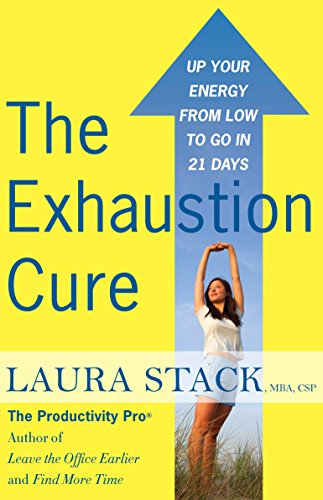
LAURA STACK, MBA, CSP, is a personal productivity expert and the author of Leave the Office Earlier and Find More Time. As a professional speaker, she helps workers Leave the Office Earlier® with Maximum Results in Minimum Time™. Laura is the president of The Productivity Pro®, Inc., an international time management company whose clients include Microsoft, GM, Time Warner, Lockheed Martin, and Bank of America.
Feeling fatigued? Wish you could have more get-up-and-go?
If you’re like millions of Americans, you get home from a long day with barely enough energy to lift the remote control. But with Laura Stack’s comprehensive plan, you can regain your vitality in just three weeks. Let The Productivity Pro® help you eliminate the “energy bandits” from all aspects of your life--from your diet and your work schedule to your environment and your relationships--so you can start living in a way that will boost your energy.
Focusing on simple changes that make a huge difference, The Exhaustion Cure presents manageable ways to:
Cut down on “energy bandits” and fill up on “energy boosters.”
Stop relying on caffeine, cigarettes and other substances to keep you going.
Avoid letting negative situations or people control your thoughts and actions.
Sneak in time for fitness during the busiest days.
Accomplish your goals and find more time to devote to your family.
Die Inhaltsangabe kann sich auf eine andere Ausgabe dieses Titels beziehen.
Über die Autorin bzw. den Autor
LAURA STACK, MBA, CSP, is the author of Leave the Office Earlier and Find More Time. The President of The Productivity Pro®, she lectures at companies that include IBM, Time Warner, Lockheed Martin, and Bank of America. She lives in Highlands Ranch, Colorado.
Auszug. © Genehmigter Nachdruck. Alle Rechte vorbehalten.
One
Sleep
Physiology quiz item #1:
I love the last letter of the alphabet
You might be surprised to learn that researchers have discovered a single treatment that boosts energy levels, improves memory, increases your ability to concentrate, strengthens the immune system, and decreases your risk of being killed in accidents. Sound too good to be true? It gets even better. If you knew the treatment was completely free, had no side effects, and that you would consider it highly enjoyable, would you try it? Sure, you would. The answer is an extra sixty to ninety minutes of sleep each night. (1) Perhaps you've been able to keep up with your modern, supercharged life by working all day, completing personal work and home chores late into the night, and sleeping an hour less than is optimal. Warning: without the proper sleep, you'll experience fatigue, lack of energy, difficulty concentrating, and irritability the next day. While the body can dig into its reserves for a few days, prolonged time of inadequate sleep is virtually guaranteed to reduce your effectiveness at anything you attempt to do.
In this chapter, you'll learn how to achieve quality, restful, undisturbed sleep. You'll find out when and if you should nap. You'll discover how your circadian rhythms are impacted by too much or not enough sleep. I'll show you how much sleep you need, how to achieve undisturbed sleep, and how to adopt proper sleep behaviors, so you feel refreshed and recharged in the morning, without becoming fatigued in the afternoon.
***
ENERGY BANDIT #1 | Too little sleep
As any parent of young children knows, sleep can be a fleeting thing the first few years. Sleep deprivation starts before the baby even arrives. But lack of sleep due to having children is a temporary inconvenience. However, lack of sleep over a long period of time is downright dangerous. In the short term, lack of sleep can have the following results:
• Decreased performance and alertness: Sleep deprivation induces significant reductions in performance and alertness. Reducing your nighttime sleep by as little as one and a half hours for just one night could result in a reduction of daytime alertness by as much as 32 percent.
• Memory and cognitive impairment: Decreased alertness and excessive daytime sleepiness impair your memory and your cognitive ability--your ability to think and process information.
• Stress on relationships: Disruption of a bed partner's sleep due to a sleep disorder may cause significant problems for the relationship (for example, separate bedrooms, conflicts, moodiness, and so forth).
• Poor quality of life: You might, for example, be unable to participate in certain activities that require sustained attention, like going to the movies, seeing your child in a school play, or watching a favorite TV show.
• Lowered immune system: Your body makes the most immune-strengthening repairs to your cells during the last, longest period of REM sleep, which begins only after seven hours of slumber, says Philip Tierno, Ph.D., director of clinical microbiology and immunology at New York University Medical Center. A solid night of shut-eye will stave off illness. (2) A Harvard study reported in the journal Neuron (July 3, 2002) concurs: the final two hours of a full night's sleep are critical for the stage of sleep (stage 2 non-rapid eye movement, or NREM) that allows the maximum benefit for learning motor skills.
• Occupational injury: Excessive sleepiness also contributes to a greater than twofold higher risk of sustaining an occupational injury.
• Automobile injury: The National Highway Traffic Safety Administration (NHTSA) estimates conservatively that each year drowsy driving is responsible for at least 100,000 automobile crashes, 71,000 injuries, and 1,550 fatalities. (3)
• Appetite: According to the Journal of the American Medical Association and Lancet, sleep deprivation can negatively influence the stress hormone cortisol. If you aren't getting adequate sleep, you may be hungry even after eating a sufficient amount of food. In addition to affecting appetite control, sleep loss can also interfere with carbohydrate metabolism (the process of breaking down carbs), which leads to an increase in blood glucose levels, causing insulin to be released, which can lead to weight gain and increased fat storage. (4) Try this online test to see if you're sleep-deprived: http://www.smmc.com/Epworth-Sleepiness-Scale.105.0.html.
ENERGY BOOSTER | Get the right amount of sleep
Tonight, you are going to get the proper amount of sleep—for you. Every individual is different. It's not too late to raise your personal energy level by getting the proper amount of sleep. Most people aged sixteen to sixty-five require six to nine hours per night, but you may need somewhere between five and ten. Don't be afraid to experiment until you get it right. To learn more about sleep deprivation and how to fight it, visit http://www.sleep-deprivation.com.
The common sleep wisdom has been to work eight hours, sleep eight hours, and rest eight hours. But some people need more sleep and some need less. Your exact sleep requirements depend on many factors:
• your age (infants, 16 hours; babies, 10-14 hours; young children, 10-12 hours; teenagers, 9 hours; adults, 7-8 hours),
• how much your parents slept (genetics),
• the type of work you do during waking hours,
• the amount of exercise you get,
• whether you're still growing,
• your sleep behaviors before bedtime,
• your stress level,
• how much caffeine, nicotine, and alcohol you consumed during the day,
• the quality of your sleep, and
• your body clock.
Try not to vary the hours when you go to bed and when you wake up, even on weekends. A consistent sleep schedule trains your body to go to sleep and wake up at set times. If you are getting enough sleep, meaning you're going to bed and waking up at about the same time each day without daytime sleepiness, you won't be able to sleep in on the weekend. If you sleep longer on weekends than you do during the week, you have a sleep debt. When you work, you drain your energy account. When you sleep, you replenish it. If your body needs eight hours of sleep, and you get only six each night during the week, you are a night of sleep behind come the weekend. Starting today, commit to going to bed on time to get the amount of sleep your body requires. How will you know? With the right amount of sleep, you will wake up feeling refreshed, full of energy, and will generally not get sleepy during the day. Not enough sleep will leave you sluggish, fuzzy-headed, and moody. Too much sleep will result in fragmented and shallow sleep. Sleep as much as needed to feel healthy the following day, but not more. Use this helpful sleep diary to track your progress: http://www.helpguide.org/life/sleep_diary.pdf.
***
ENERGY BANDIT #2 | Too many cat naps
According to the American Academy of Sleep Medicine, you should try to avoid napping at all during the day if you have trouble sleeping at night (e.g., insomnia, disturbed sleep, or wakeful sleep), because short naps during the day can partially satisfy your body's need to sleep at night. (5) If you doze off while reading a book or watching television early in the evening, it may be harder for you to fall asleep at night. Without napping, when you're ready for sleep, you'll be truly exhausted, so you'll fall asleep more quickly and sleep more soundly.
ENERGY BOOSTER | Nap wisely
If...
„Über diesen Titel“ kann sich auf eine andere Ausgabe dieses Titels beziehen.
Suchergebnisse für The Exhaustion Cure: Up Your Energy from Low to Go...

Beispielbild für diese ISBN
The Exhaustion Cure: Up Your E
Anbieter: World of Books (was SecondSale), Montgomery, IL, USA
Verkäuferbewertung 5 von 5 Sternen

Zustand: Very Good. Item in very good condition! Textbooks may not include supplemental items i.e. CDs, access codes etc. Artikel-Nr. 00104552319
Gebraucht kaufen
EUR 4,47
Versand gratis
Versand innerhalb von USA
Versand innerhalb von USA
Anzahl: 1 verfügbar
Beispielbild für diese ISBN
The Exhaustion Cure: Up Your E
Anbieter: World of Books (was SecondSale), Montgomery, IL, USA
Verkäuferbewertung 5 von 5 Sternen
Zustand: Good. Item in good condition. Textbooks may not include supplemental items i.e. CDs, access codes etc. Artikel-Nr. 00103285778
Gebraucht kaufen
EUR 4,47
Versand gratis
Versand innerhalb von USA
Versand innerhalb von USA
Anzahl: 2 verfügbar
Beispielbild für diese ISBN
The Exhaustion Cure: Up Your Energy from Low to Go in 21 Days
Verlag:
Harmony (edition First Edition), 2008
ISBN 10: 0767927516
ISBN 13: 9780767927512
Gebraucht
Paperback
Erstausgabe
Anbieter: BooksRun, Philadelphia, PA, USA
Verkäuferbewertung 5 von 5 Sternen
Paperback. Zustand: Fair. First Edition. The item might be beaten up but readable. May contain markings or highlighting, as well as stains, bent corners, or any other major defect, but the text is not obscured in any way. Artikel-Nr. 0767927516-7-1
Gebraucht kaufen
EUR 5,01
Versand gratis
Versand innerhalb von USA
Versand innerhalb von USA
Anzahl: 1 verfügbar
Beispielbild für diese ISBN
The Exhaustion Cure : Up Your Energy from Low to Go in 21 Days
Verlag:
Potter/Ten Speed/Harmony/Rodale, 2008
ISBN 10: 0767927516
ISBN 13: 9780767927512
Gebraucht
Softcover
Anbieter: Better World Books: West, Reno, NV, USA
Verkäuferbewertung 5 von 5 Sternen
Zustand: Good. Former library copy. Pages intact with minimal writing/highlighting. The binding may be loose and creased. Dust jackets/supplements are not included. Includes library markings. Stock photo provided. Product includes identifying sticker. Better World Books: Buy Books. Do Good. Artikel-Nr. GRP102373295
Gebraucht kaufen
EUR 6,41
Versand gratis
Versand innerhalb von USA
Versand innerhalb von USA
Anzahl: 2 verfügbar
Beispielbild für diese ISBN
The Exhaustion Cure: Up Your Energy from Low to Go in 21 Days
Anbieter: ThriftBooks-Atlanta, AUSTELL, GA, USA
Verkäuferbewertung 5 von 5 Sternen
Paperback. Zustand: As New. No Jacket. Pages are clean and are not marred by notes or folds of any kind. ~ ThriftBooks: Read More, Spend Less. Artikel-Nr. G0767927516I2N00
Gebraucht kaufen
EUR 6,77
Versand gratis
Versand innerhalb von USA
Versand innerhalb von USA
Anzahl: 1 verfügbar
Beispielbild für diese ISBN
The Exhaustion Cure: Up Your Energy from Low to Go in 21 Days
Anbieter: ThriftBooks-Dallas, Dallas, TX, USA
Verkäuferbewertung 5 von 5 Sternen
Paperback. Zustand: As New. No Jacket. Pages are clean and are not marred by notes or folds of any kind. ~ ThriftBooks: Read More, Spend Less. Artikel-Nr. G0767927516I2N00
Gebraucht kaufen
EUR 6,77
Versand gratis
Versand innerhalb von USA
Versand innerhalb von USA
Anzahl: 1 verfügbar