
Verwandte Artikel zu The Ultimate Cheapskate's Road Map to True Riches:...
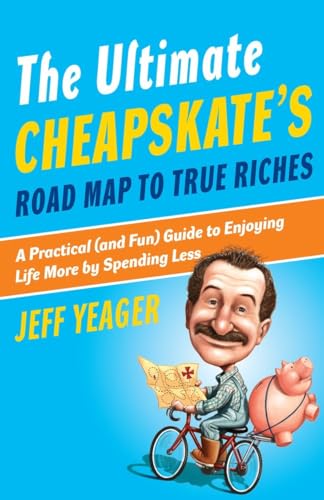
The Ultimate Cheapskate's Road Map to True Riches: A Practical (and Fun) Guide to Enjoying Life More by Spending Less - Softcover
Inhaltsangabe
It used to be that “stuff” made you cool. That is so twentieth century. Jeff Yeager, the man dubbed The Ultimate Cheapskate by Matt Lauer on Today, offers a completely fresh take on personal finance, teaching us how to enjoy life more by spending less. He will show you how to buy less stuff, retire young, and live financially free, while you make a positive difference in people’s lives and save the planet along the way. The Ultimate Cheapskate’s Road Map to True Riches lays out the practices and principles that have made cheap the new cool.
Live within your means at thirty and stay there. The Ultimate Cheapskate was living well on what he earned at thirty, so when he made more money, he saved every penny. Now he is “selfishly” employed, doing work he loves and helping others.
Do for yourself what you could have others do for you. Cheapskates are die-hard do-it-yourselfers. It’s all about having the right tools, and The Ultimate Cheapskate will get you started.
Pinch the dollars and the pennies will pinch themselves. It’s not the $3 cup of coffee; it’s the big-ticket decisions that determine whether you’ll be financially free. So buy a house, not a castle.
The Ultimate Cheapskate’s Road Map to True Riches promises a quality of life you cannot buy, a sense of satisfaction you cannot fake, and an appreciation for others and for the planet that gives life value. Open your road map and prepare to discover the true joys of financial freedom.
Die Inhaltsangabe kann sich auf eine andere Ausgabe dieses Titels beziehen.
Über die Autorin bzw. den Autor
JEFF YEAGER has run nonprofit agencies, and is now a writer and the creator of the Web site ultimatecheapskate.com. He lives happily and frugally with his wife, Denise, in Accokeek, Maryland.
Auszug. © Genehmigter Nachdruck. Alle Rechte vorbehalten.
1
Introduction: The Money Step
I always stay at the cheapest hotel, so I was surprised to find a mint on my pillow in the evening. Turns out it fell out of the mouth of the guy who slept there the night before.
—Jeff Yeager, the Ultimate Cheapskate
Rule No. 1: Groceries do not count as Christmas gifts, even if you gift wrap them.
—Denise Yeager, pooooor wife of the Ultimate Cheapskate, giving Jeff the annual holiday gift buying lecture.
Man, money may not be the root of all evil, but it’s a seed that can sprout some pretty nasty shit.
—anonymous barroom philosopher I met in The Bar, Williston, North Dakota, summer 1977, while I was on a cross–country bicycle trip. He was bemoaning the recent breakup with his “old lady,” a rift that grew out of the couple’s winning one thousand dollars in the lottery.
What’s your earliest childhood memory of money?
Close your eyes and think about it hard for a minute, because it's really important. The memory you eventually dredge up may have a shockingly familiar feeling. In fact you may conjure up feelings and emotions that crossed the radar screen of your mind this very day, as you paid for your groceries, wrote a check to the electric company, or shelled out the kid's weekly allowance.
Keep that memory at the very top of your mind as we travel in the pages ahead down some of life’s major byways, byways filled with intersections, with choices. Not just choices about money and how to spend it, but decisions about what you want out of life, what’s important in life, and what money does—or doesn’t—have to do with any of it.
I’ll bet that your earliest thoughts and memories of money are still influencing some of the financial decisions you make today. As you keep barreling down the Road to Riches, convinced, as most of us are, that the intersection with the Highway to Happiness is just around the next bend, it’s worth spending a moment to think about how you got to this point. Like consulting a road map when you're already hopelessly lost, you might be surprised to find out where you really are and that the course you are on is leading you away from your intended destination.
In my case, my earliest memory of money is, ironically, of found money, of a shiny silver dime, probably dated around 1963, when I was five. I found it while playing in our front yard on Summerfield Road in Sylvania, Ohio.
In my case, my first taste of money truly was a taste. By the time my mom sprinted across the yard to see what I was playing with, it was too late. I had already swallowed it. In addition to the spellbinding shine of the coin, I remember the metallic flavor as it traveled awkwardly down my tiny throat. Somehow, through the marvels of the human body and mind, I still get a slight, almost undetectable taste of metal in my mouth at the end of every day when I empty out my pocket change.
Money on the Brain
Like it or not, money is part of our very being. We worry more about money than anything else. We fight with our spouses and families more about money than anything else. We spend more of our waking hours earning and spending money than doing anything else.
In fact I read about a research study a few years ago that showed that people think about money an average of fifty–five times a day. That immediately caught my attention, as I also remembered reading about another study that showed that people (or, rather, men) think about sex an average of every fifteen minutes throughout the day.
When you combine the results of these two studies and subtract out of a twenty–four–hour period the number of hours spent sleeping and the hours spent thinking about nothing at all, if I’ve done the math correctly, you discover something startling. Not only do most people think only about money and sex, but a good deal of the time men are thinking about money and sex simultaneously. On second thought, I guess I don’t find it that surprising.
So with thoughts of money dominating your every waking hour and encroaching on every aspect of your life, you pick up a book about—what else?—money.
But unlike most personal finance books, this book is not about how to make more money. This book is about how to make less money, but how to be happier than if you made more. It’s about how to make money less a part of your life by spending less, so that you can enjoy life more. And it’s not so much about finding the best values in things—although it provides some good advice in that regard—as about valuing the best things, which usually come without price tags.
Most of all, this book is about choices, not about sacrifices, as my moniker, the Ultimate Cheapskate, might make you think. It’s about the choices we make every day about earning and spending money and the priorities we set for ourselves on the basis of those choices.
The Money Step
Ultimately each of the choices we’re going to look at in this book—whether it’s what kind of house you should buy or whether you have enough roughage in your diet—is a choice involving the Money Step.
The Money Step is the little dance of earning and spending we do pretty much every day of our life. It has three beats, like a waltz:
Earning money
To spend money
To get what you want
[…or at least what you think you want]
The Money Step has become the default setting for the world we live in today. It’s now the rule, not the exception. We unconsciously, or consciously, take the Money Step when doing almost everything we do. The idea of getting what we really want by reducing or even entirely skipping the Money Step—a comfortable house without an uncomfortable mortgage, strong health without ever buying a gym membership, the ability to sleep nights knowing that we’re debt free—is a concept so out of vogue in our society it’s nearly extinct.
As we’ll see, questioning the Money Step is as much about deciding what you truly want and need as about deciding how best to get it. By the end of this book I hope you’ll start to question whether the Money Step should continue to be the default setting in your life. And throughout this book, as we look at different big–ticket items in the typical family budget, I encourage you to keep one key question in mind: Can you and your family skip, or at least limit, the Money Step and go straight to the real prize?
The Allegory of the Ax and the Basketball
I first came to appreciate—indeed fixate on—the Money Step during my twenty–five–year career as a CEO and fundraiser in the nonprofit sector. Operating in an environment where money is always scarce and goals are rarely measured just in dollars, I spent my days finding creative ways to avoid, or at least mitigate as much possible, the Money Steps that stood between my organization and the mission it was created to serve.
You might say that my vocation as a nonprofit manager was achieving success without the use of money, or at least without a lot of it. “The nonprofit sector is fortunate to be immune from economic downturns,” I used to tell my staff, “because in the nonprofit world, the economy always sucks.” Much of what I learned during those years rubbed off on my personal life and finances, or maybe the other way around, making my transition to the Ultimate Cheapskate a natural one.
But looking back on it now, I guess I should have grasped the concept of the Money Step years before, as a result of a horrifically...
„Über diesen Titel“ kann sich auf eine andere Ausgabe dieses Titels beziehen.
Suchergebnisse für The Ultimate Cheapskate's Road Map to True Riches:...

Beispielbild für diese ISBN
The Ultimate Cheapskate's Road Map to True Riches: A Practical (and Fun) Guide to Enjoying Life More by Spending Less
Anbieter: World of Books (was SecondSale), Montgomery, IL, USA
Verkäuferbewertung 5 von 5 Sternen

Paperback. Zustand: Fair. It used to be that "stuff" made you cool. That is so twentieth century. Jeff Yeager, the man dubbed The Ultimate Cheapskate by Matt Lauer on Today, offers a completely fresh take on personal finance, teaching us how to enjoy life more by spending less. He will show you how to buy less stuff, retire young, and live financially free, while you make a positive difference in people's lives and save the planet along the way. The Ultimate Cheapskate's Road Map to True Riches lays out the practices and principles that have made cheap the new cool. Live within your means at thirty and stay there. The Ultimate Cheapskate was living well on what he earned at thirty, so when he made more money, he saved every penny. Now he is "selfishly" employed, doing work he loves and helping others. Do for yourself what you could have others do for you. Cheapskates are die-hard do-it-yourselfers. It's all about having the right tools, and The Ultimate Cheapskate will get you started. Pinch the dollars and the pennies will pinch themselves. It's not the $3 cup of coffee; it's the big-ticket decisions that determine whether you'll be financially free. So buy a house, not a castle. The Ultimate Cheapskate's Road Map to True Riches promises a quality of life you cannot buy, a sense of satisfaction you cannot fake, and an appreciation for others and for the planet that gives life value. Open your road map and prepare to discover the true joys of financial freedom. Artikel-Nr. 00099137440
Gebraucht kaufen
EUR 3,99
Versand gratis
Versand innerhalb von USA
Versand innerhalb von USA
Anzahl: 4 verfügbar
Beispielbild für diese ISBN
The Ultimate Cheapskate's Road Map to True Riches: A Practical (and Fun) Guide to Enjoying Life More by Spending Less
Anbieter: World of Books (was SecondSale), Montgomery, IL, USA
Verkäuferbewertung 5 von 5 Sternen
Paperback. Zustand: Good. It used to be that "stuff" made you cool. That is so twentieth century. Jeff Yeager, the man dubbed The Ultimate Cheapskate by Matt Lauer on Today, offers a completely fresh take on personal finance, teaching us how to enjoy life more by spending less. He will show you how to buy less stuff, retire young, and live financially free, while you make a positive difference in people's lives and save the planet along the way. The Ultimate Cheapskate's Road Map to True Riches lays out the practices and principles that have made cheap the new cool. Live within your means at thirty and stay there. The Ultimate Cheapskate was living well on what he earned at thirty, so when he made more money, he saved every penny. Now he is "selfishly" employed, doing work he loves and helping others. Do for yourself what you could have others do for you. Cheapskates are die-hard do-it-yourselfers. It's all about having the right tools, and The Ultimate Cheapskate will get you started. Pinch the dollars and the pennies will pinch themselves. It's not the $3 cup of coffee; it's the big-ticket decisions that determine whether you'll be financially free. So buy a house, not a castle. The Ultimate Cheapskate's Road Map to True Riches promises a quality of life you cannot buy, a sense of satisfaction you cannot fake, and an appreciation for others and for the planet that gives life value. Open your road map and prepare to discover the true joys of financial freedom. Artikel-Nr. 00087628951
Gebraucht kaufen
EUR 3,99
Versand gratis
Versand innerhalb von USA
Versand innerhalb von USA
Anzahl: 16 verfügbar
Beispielbild für diese ISBN
The Ultimate Cheapskate's Road Map to True Riches: A Practical (and Fun) Guide to Enjoying Life More by Spending Less
Anbieter: BooksRun, Philadelphia, PA, USA
Verkäuferbewertung 5 von 5 Sternen
Paperback. Zustand: Fair. The item might be beaten up but readable. May contain markings or highlighting, as well as stains, bent corners, or any other major defect, but the text is not obscured in any way. Artikel-Nr. 0767926951-7-1
Gebraucht kaufen
EUR 4,50
Versand gratis
Versand innerhalb von USA
Versand innerhalb von USA
Anzahl: 1 verfügbar
Beispielbild für diese ISBN
The Ultimate Cheapskate's Road Map to True Riches : A Practical (and Fun) Guide to Enjoying Life More by Spending Less
Verlag:
Crown Publishing Group, The, 2007
ISBN 10: 0767926951
ISBN 13: 9780767926959
Gebraucht
Softcover
Anbieter: Better World Books, Mishawaka, IN, USA
Verkäuferbewertung 5 von 5 Sternen
Zustand: Good. Former library copy. Pages intact with minimal writing/highlighting. The binding may be loose and creased. Dust jackets/supplements are not included. Includes library markings. Stock photo provided. Product includes identifying sticker. Better World Books: Buy Books. Do Good. Artikel-Nr. GRP102763099
Gebraucht kaufen
EUR 6,09
Versand gratis
Versand innerhalb von USA
Versand innerhalb von USA
Anzahl: 2 verfügbar
Beispielbild für diese ISBN
The Ultimate Cheapskate's Road Map to True Riches : A Practical (and Fun) Guide to Enjoying Life More by Spending Less
Verlag:
Crown Publishing Group, The, 2007
ISBN 10: 0767926951
ISBN 13: 9780767926959
Gebraucht
Softcover
Anbieter: Better World Books, Mishawaka, IN, USA
Verkäuferbewertung 5 von 5 Sternen
Zustand: Good. Pages intact with minimal writing/highlighting. The binding may be loose and creased. Dust jackets/supplements are not included. Stock photo provided. Product includes identifying sticker. Better World Books: Buy Books. Do Good. Artikel-Nr. 2471282-75
Gebraucht kaufen
EUR 6,09
Versand gratis
Versand innerhalb von USA
Versand innerhalb von USA
Anzahl: 1 verfügbar
Beispielbild für diese ISBN
The Ultimate Cheapskate's Road Map to True Riches: A Practical (and Fun) Guide to Enjoying Life More by Spending Less
Anbieter: Wonder Book, Frederick, MD, USA
Verkäuferbewertung 5 von 5 Sternen
Zustand: Good. Signed Copy . Signed/Inscribed by author on half title page. Artikel-Nr. SB00Z-00724
Gebraucht kaufen
EUR 6,33
Versand gratis
Versand innerhalb von USA
Versand innerhalb von USA
Anzahl: 1 verfügbar
Beispielbild für diese ISBN
The Ultimate Cheapskate's Road Map to True Riches: A Practical (and Fun) Guide to Enjoying Life More by Spending Less
Anbieter: ThriftBooks-Dallas, Dallas, TX, USA
Verkäuferbewertung 5 von 5 Sternen
Paperback. Zustand: Very Good. No Jacket. May have limited writing in cover pages. Pages are unmarked. ~ ThriftBooks: Read More, Spend Less. Artikel-Nr. G0767926951I4N00
Gebraucht kaufen
EUR 6,46
Versand gratis
Versand innerhalb von USA
Versand innerhalb von USA
Anzahl: 1 verfügbar
Beispielbild für diese ISBN
The Ultimate Cheapskate's Road Map to True Riches: A Practical (and Fun) Guide to Enjoying Life More by Spending Less
Anbieter: ThriftBooks-Atlanta, AUSTELL, GA, USA
Verkäuferbewertung 5 von 5 Sternen
Paperback. Zustand: Very Good. No Jacket. May have limited writing in cover pages. Pages are unmarked. ~ ThriftBooks: Read More, Spend Less. Artikel-Nr. G0767926951I4N00
Gebraucht kaufen
EUR 6,46
Versand gratis
Versand innerhalb von USA
Versand innerhalb von USA
Anzahl: 1 verfügbar
Beispielbild für diese ISBN
The Ultimate Cheapskate's Road Map to True Riches: A Practical (and Fun) Guide to Enjoying Life More by Spending Less
Anbieter: Wonder Book, Frederick, MD, USA
Verkäuferbewertung 5 von 5 Sternen
Zustand: Very Good. Signed Copy . Inscribed by author on half title page. Artikel-Nr. SB12E-01234
Gebraucht kaufen
EUR 10,15
Versand gratis
Versand innerhalb von USA
Versand innerhalb von USA
Anzahl: 1 verfügbar
Beispielbild für diese ISBN
The Ultimate Cheapskate's Road Map to True Riches: A Practical (And Fun) Guide to Enjoying Life More by Spending Less
Anbieter: Revaluation Books, Exeter, Vereinigtes Königreich
Verkäuferbewertung 5 von 5 Sternen
Paperback. Zustand: Brand New. 241 pages. 8.00x4.75x0.75 inches. In Stock. Artikel-Nr. x-0767926951
Neu kaufen
EUR 21,05
EUR 11,66 Versand
Versand von Vereinigtes Königreich nach USA
Versand von Vereinigtes Königreich nach USA
Anzahl: 2 verfügbar