
Verwandte Artikel zu Killing Rommel: A Novel
Inhaltsangabe
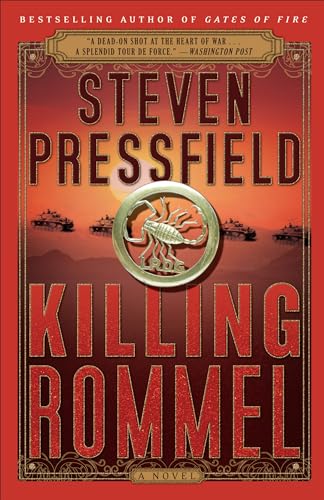
A thrilling WWII tale based on the real-life exploits of the Long Range Desert Group, an elite British special forces unit that took on the German Afrika Korps and its legendary commander, Field Marshal Erwin Rommel, "the Desert Fox."
Autumn 1942. Hitler’s legions have swept across Europe; France has fallen; Churchill and the English are isolated on their island. In North Africa, Rommel and his Panzers have routed the British Eighth Army and stand poised to overrun Egypt, Suez, and the oilfields of the Middle East. With the outcome of the war hanging in the balance, the British hatch a desperate plan—send a small, highly mobile, and heavily armed force behind German lines to strike the blow that will stop the Afrika Korps in its tracks.
Narrated from the point of view of a young lieutenant, Killing Rommel brings to life the flair, agility, and daring of this extraordinary secret unit, the Long Range Desert Group. Stealthy and lethal as the scorpion that serves as their insignia, they live by their motto: Non Vi Sed Arte—Not by Strength, by Guile as they gather intelligence, set up ambushes, and execute raids. Killing Rommel chronicles the tactics, weaponry, and specialized skills needed for combat, under extreme desert conditions. And it captures the camaraderie of this “band of brothers” as they perform the acts of courage and cunning crucial to the Allies’ victory in North Africa.
Combining scrupulous historical detail and accuracy with remarkable narrative momentum, Pressfield powerfully renders the drama and intensity of warfare, the bonds of men in close combat, and the surprising human emotions and frailties that come into play on the battlefield to create a vivid and authoritative depiction of the desert war.
Die Inhaltsangabe kann sich auf eine andere Ausgabe dieses Titels beziehen.
Über die Autorin bzw. den Autor
STEVEN PRESSFIELD is the author of Gates of Fire, The Virtues of War, Tides of War, Last of the Amazons, and The Afghan Campaign. He lives in Los Angeles, California.
Auszug. © Genehmigter Nachdruck. Alle Rechte vorbehalten.
1
DURING THE FINAL months of 1942 and the early weeks of 1943, it was my extraordinary fortune to take part in an operation behind enemy lines whose aim was to locate and kill Field Marshal Erwin Rommel, commander-in-chief of German and Italian forces in North Africa.
The operation—the term "raid" was never employed—was authorised by Lieutenant-General Bernard Law Montgomery, commanding Eighth Army; planned by the office of Lieutenant-Colonel John "Shan" Hackett, of G Raiding Force; and carried out by elements of Lieutenant-Colonel David Stirling's SAS, the Special Air Service, reinforced by irregular troopers of Major Vladimir Peniakoff's No. 1 Demolition Squadron, more familiarly known as Popski's Private Army, as well as officers and other ranks of the Long Range Desert Group. The operation placed its hopes of success not in firepower, since its heaviest vehicles were unarmoured one-and-a-half-ton Chevrolet trucks packing no armament bigger than .50-calibre aircraft Brownings and 20mm Breda guns, but on cunning, audacity and surprise. Attempts on Rommel's life had been made before. These, however, had struck at lightly defended rear areas, to which their target had withdrawn temporarily for rest or recuperation. The operation in which I took part aimed to strike at the heart of the German Afrika Korps in the field.
If this scheme sounds driven by desperation, it was. At the moment of the operation's initial planning—summer '42—Rommel and Panzerarmee Afrika had just finished routing the British Eighth Army in a series of battles in the Western Desert. German armour had driven our tanks and men across all Libya, over the Egyptian frontier, to the very gates of Alexandria. Churchill had just sacked the army's commanders. In Cairo, the code books were being burned. Rommel stood one push from Suez and the Middle East oilfields. Russia was then reeling under attack from 166 Nazi divisions. With Arab oil, Hitler's war machine could break the Red Army's back. Nor would rescue quickly come from America. The U.S. had barely entered the war; full mobilisation lay months away. The Allies were staring global defeat in the face.
Could a commando raid in North Africa make a difference? It could, the planners in Cairo believed, if it could eliminate Rommel. Rommel was the heart and soul of Axis forces in the desert. "The Jerries have no general who can replace him." This was Major Jake Easonsmith, our commander, speaking at the initial briefing. "Kill him and the beast dies."
But could such a strike succeed? It might, paradoxically, because of Rommel's own personal bravery and his audacious style of command. The Desert Fox led from the front. His mode of leadership was to place himself physically wherever the action was hottest, heedless of his own safety. "Rommel isn't reckless," declared Easonsmith. "He has simply found that in mobile warfare the commander's presence at the point of action is essential."
Rommel was notorious among his own junior officers, we were told, for materialising unannounced at forward positions, stepping down from his Fieseler Storch scout plane or his "Mammoth" Armoured Command Vehicle, occasionally from a tank or a staff car or even a motorcycle upon which he had hitched a ride. It was not exceptional for Rommel to issue orders directly to his regimental commanders or even, in the heat of the moment, to take personal command of units as small as infantry companies.
Such boldness had nearly got Rommel killed more than once. He set his plane down by accident one time amongst an Allied formation and winged away, barely, with bullets whizzing round his head. Another time he escaped capture when he ran out of fuel on the frontier wire, again amidst Commonwealth troops. Rommel was rescued a third time by the staff car carrying one of his own generals who happened, emulating his mentor, to be as far forward as Rommel was.
Rommel's trademark aggressiveness, it was hoped, could render him vulnerable to a surprise thrust. If Allied raiders could use the deep desert routes to move undetected into the German rear; if they could manoeuvre forward undiscovered; if they could fix Rommel's position . . . if a skilled and daring party could do all this, they might be able to land a blow that would change the course of the war.
***
My name is Chapman, Richmond Lawrence. In September 1942 I was a lieutenant in the 22nd Armoured Brigade, 7th Armoured Division. I was a tank officer. I commanded theoretically a "recce" (reconnaissance) troop of four A-15 Crusaders. I say theoretically because in action the turnover was so swift and violent, both from enemy fire and from mechanical breakdowns, that a troop could be down to two tanks or even one of its original kind, then reconstituted overnight with different types fresh from the repair depots—American Grants, British Crusaders, and the U.S.-built aircraft-engined Stuarts that their crews called Honeys. Likewise the men turned over. That is another story. The point for this tale is that, at that time, circumstances conspired to export me from the Armoured Division and translate me into the Long Range Desert Group.
My presence amongst this company was in a technical capacity only; I had been PTDed ("personnel temporarily detached") to the formation with an eye to assessing "the going" over which the patrols would travel—meaning the terrain's suitability on future occasion to bear tanks and heavy transport. I was by no means the first tank officer so assigned. Advisers from the Royal Armoured Corps regularly hitch-hiked on LRDG patrols for similar purposes; Royal Air Force officers did the same, scouting out potential landing grounds in the inner desert.
The mission of the Long Range Desert Group was raiding and reconnaissance in the enemy's rear. At the time I joined it, the unit operated in patrols of five or six trucks, with one officer and fifteen to twenty men. Patrols were entirely self-contained, carrying all their own petrol, water, rations, ammunition and spare parts. In addition to its own combat operations, the Long Range Desert Group conveyed spies and agents on covert assignments and provided transport and navigation for assault parties of the SAS and other commando outfits. The group's greatest joy, however, was to work "beat-ups," their slang term for attacks on enemy airfields, motor assembly areas and convoy routes.
At the time of the British retreat to Alamein in summer '42, the LRDG had been in business for almost two years. Its raids had destroyed and damaged hundreds of Axis aircraft and caused thousands of German and Italian troops to be pulled out of the front lines and redeployed to provide rear-area security. The formation had acquired a certain swashbuckling glamour. Volunteers queued by the hundreds. Getting in was no cinch, however. From one batch of seven hundred applicants, the LRDG took only twelve. Criteria for selection were less wild and woolly than one might imagine. The group was not seeking buccaneers or assassins; what its officers wanted was the solid, mature sort—the type of chap who could think for himself under pressure, work in close quarters with others, and handle extremes not only of danger but of tedium, hardship and privation. The virtues of resourcefulness, self-composure, patience, hardiness, not to mention a sense of humour, were prized as highly as those of bravery, aggressiveness, and raw martial rigour.
In this I believe the LRDG was spot on. One of the factors that has kept me until now from writing of my own combat experiences is the uneasiness I have felt about the genre of war literature. Tales of heroes, the nobility of sacrifice and so forth have always made me uneasy. They run counter...
„Über diesen Titel“ kann sich auf eine andere Ausgabe dieses Titels beziehen.
Suchergebnisse für Killing Rommel: A Novel

Beispielbild für diese ISBN
Killing Rommel: A Novel
Verlag:
Crown Publishing Group (NY), 2009
ISBN 10: 0767926161
ISBN 13: 9780767926164
Gebraucht
Paperback
Anbieter: World of Books (was SecondSale), Montgomery, IL, USA
Verkäuferbewertung 5 von 5 Sternen

Paperback. Zustand: Fair. A thrilling WWII tale based on the real-life exploits of the Long Range Desert Group, an elite British special forces unit that took on the German Afrika Korps and its legendary commander, Field Marshal Erwin Rommel, "the Desert Fox." Autumn 1942. Hitler's legions have swept across Europe; France has fallen; Churchill and the English are isolated on their island. In North Africa, Rommel and his Panzers have routed the British Eighth Army and stand poised to overrun Egypt, Suez, and the oilfields of the Middle East. With the outcome of the war hanging in the balance, the British hatch a desperate plan--send a small, highly mobile, and heavily armed force behind German lines to strike the blow that will stop the Afrika Korps in its tracks. Narrated from the point of view of a young lieutenant, Killing Rommel brings to life the flair, agility, and daring of this extraordinary secret unit, the Long Range Desert Group. Stealthy and lethal as the scorpion that serves as their insignia, they live by their motto: Non Vi Sed Arte--Not by Strength, by Guile as they gather intelligence, set up ambushes, and execute raids. Killing Rommel chronicles the tactics, weaponry, and specialized skills needed for combat, under extreme desert conditions. And it captures the camaraderie of this "band of brothers" as they perform the acts of courage and cunning crucial to the Allies' victory in North Africa. Combining scrupulous historical detail and accuracy with remarkable narrative momentum, Pressfield powerfully renders the drama and intensity of warfare, the bonds of men in close combat, and the surprising human emotions and frailties that come into play on the battlefield to create a vivid and authoritative depiction of the desert war. Artikel-Nr. 00106064562
Gebraucht kaufen
EUR 3,71
Versand gratis
Versand innerhalb von USA
Versand innerhalb von USA
Anzahl: 1 verfügbar
Beispielbild für diese ISBN
Killing Rommel: A Novel
Verlag:
Crown Publishing Group (NY), 2009
ISBN 10: 0767926161
ISBN 13: 9780767926164
Gebraucht
Paperback
Anbieter: World of Books (was SecondSale), Montgomery, IL, USA
Verkäuferbewertung 5 von 5 Sternen
Paperback. Zustand: Good. A thrilling WWII tale based on the real-life exploits of the Long Range Desert Group, an elite British special forces unit that took on the German Afrika Korps and its legendary commander, Field Marshal Erwin Rommel, "the Desert Fox." Autumn 1942. Hitler's legions have swept across Europe; France has fallen; Churchill and the English are isolated on their island. In North Africa, Rommel and his Panzers have routed the British Eighth Army and stand poised to overrun Egypt, Suez, and the oilfields of the Middle East. With the outcome of the war hanging in the balance, the British hatch a desperate plan--send a small, highly mobile, and heavily armed force behind German lines to strike the blow that will stop the Afrika Korps in its tracks. Narrated from the point of view of a young lieutenant, Killing Rommel brings to life the flair, agility, and daring of this extraordinary secret unit, the Long Range Desert Group. Stealthy and lethal as the scorpion that serves as their insignia, they live by their motto: Non Vi Sed Arte--Not by Strength, by Guile as they gather intelligence, set up ambushes, and execute raids. Killing Rommel chronicles the tactics, weaponry, and specialized skills needed for combat, under extreme desert conditions. And it captures the camaraderie of this "band of brothers" as they perform the acts of courage and cunning crucial to the Allies' victory in North Africa. Combining scrupulous historical detail and accuracy with remarkable narrative momentum, Pressfield powerfully renders the drama and intensity of warfare, the bonds of men in close combat, and the surprising human emotions and frailties that come into play on the battlefield to create a vivid and authoritative depiction of the desert war. Artikel-Nr. 00104142660
Gebraucht kaufen
EUR 3,71
Versand gratis
Versand innerhalb von USA
Versand innerhalb von USA
Anzahl: 12 verfügbar
Beispielbild für diese ISBN
Killing Rommel: A Novel
Verlag:
Crown Publishing Group (NY), 2009
ISBN 10: 0767926161
ISBN 13: 9780767926164
Gebraucht
Paperback
Anbieter: World of Books (was SecondSale), Montgomery, IL, USA
Verkäuferbewertung 5 von 5 Sternen
Paperback. Zustand: Very Good. A thrilling WWII tale based on the real-life exploits of the Long Range Desert Group, an elite British special forces unit that took on the German Afrika Korps and its legendary commander, Field Marshal Erwin Rommel, "the Desert Fox." Autumn 1942. Hitler's legions have swept across Europe; France has fallen; Churchill and the English are isolated on their island. In North Africa, Rommel and his Panzers have routed the British Eighth Army and stand poised to overrun Egypt, Suez, and the oilfields of the Middle East. With the outcome of the war hanging in the balance, the British hatch a desperate plan--send a small, highly mobile, and heavily armed force behind German lines to strike the blow that will stop the Afrika Korps in its tracks. Narrated from the point of view of a young lieutenant, Killing Rommel brings to life the flair, agility, and daring of this extraordinary secret unit, the Long Range Desert Group. Stealthy and lethal as the scorpion that serves as their insignia, they live by their motto: Non Vi Sed Arte--Not by Strength, by Guile as they gather intelligence, set up ambushes, and execute raids. Killing Rommel chronicles the tactics, weaponry, and specialized skills needed for combat, under extreme desert conditions. And it captures the camaraderie of this "band of brothers" as they perform the acts of courage and cunning crucial to the Allies' victory in North Africa. Combining scrupulous historical detail and accuracy with remarkable narrative momentum, Pressfield powerfully renders the drama and intensity of warfare, the bonds of men in close combat, and the surprising human emotions and frailties that come into play on the battlefield to create a vivid and authoritative depiction of the desert war. Artikel-Nr. 00104050364
Gebraucht kaufen
EUR 3,71
Versand gratis
Versand innerhalb von USA
Versand innerhalb von USA
Anzahl: 2 verfügbar
Beispielbild für diese ISBN
Killing Rommel: A Novel
Verlag:
Crown (edition Reprint), 2009
ISBN 10: 0767926161
ISBN 13: 9780767926164
Gebraucht
Paperback
Anbieter: BooksRun, Philadelphia, PA, USA
Verkäuferbewertung 5 von 5 Sternen
Paperback. Zustand: Very Good. Reprint. It's a well-cared-for item that has seen limited use. The item may show minor signs of wear. All the text is legible, with all pages included. It may have slight markings and/or highlighting. Artikel-Nr. 0767926161-11-1
Gebraucht kaufen
EUR 4,55
Versand gratis
Versand innerhalb von USA
Versand innerhalb von USA
Anzahl: 1 verfügbar
Beispielbild für diese ISBN
Killing Rommel : A Novel
Verlag:
Crown Publishing Group, The, 2009
ISBN 10: 0767926161
ISBN 13: 9780767926164
Gebraucht
Softcover
Anbieter: Better World Books, Mishawaka, IN, USA
Verkäuferbewertung 5 von 5 Sternen
Zustand: Good. Reprint. Pages intact with minimal writing/highlighting. The binding may be loose and creased. Dust jackets/supplements are not included. Stock photo provided. Product includes identifying sticker. Better World Books: Buy Books. Do Good. Artikel-Nr. 863561-6
Gebraucht kaufen
EUR 6,16
Versand gratis
Versand innerhalb von USA
Versand innerhalb von USA
Anzahl: 6 verfügbar
Beispielbild für diese ISBN
Killing Rommel
Verlag:
Crown Publishing Group (NY), 2009
ISBN 10: 0767926161
ISBN 13: 9780767926164
Gebraucht
Paperback
Anbieter: ThriftBooks-Dallas, Dallas, TX, USA
Verkäuferbewertung 5 von 5 Sternen
Paperback. Zustand: Good. No Jacket. Pages can have notes/highlighting. Spine may show signs of wear. ~ ThriftBooks: Read More, Spend Less. Artikel-Nr. G0767926161I3N00
Gebraucht kaufen
EUR 6,33
Versand gratis
Versand innerhalb von USA
Versand innerhalb von USA
Anzahl: 1 verfügbar
Beispielbild für diese ISBN
Killing Rommel
Verlag:
Crown Publishing Group (NY), 2009
ISBN 10: 0767926161
ISBN 13: 9780767926164
Gebraucht
Paperback
Anbieter: ThriftBooks-Dallas, Dallas, TX, USA
Verkäuferbewertung 5 von 5 Sternen
Paperback. Zustand: Fair. No Jacket. Readable copy. Pages may have considerable notes/highlighting. ~ ThriftBooks: Read More, Spend Less. Artikel-Nr. G0767926161I5N00
Gebraucht kaufen
EUR 6,33
Versand gratis
Versand innerhalb von USA
Versand innerhalb von USA
Anzahl: 1 verfügbar
Beispielbild für diese ISBN
Killing Rommel
Verlag:
Crown Publishing Group (NY), 2009
ISBN 10: 0767926161
ISBN 13: 9780767926164
Gebraucht
Paperback
Anbieter: ThriftBooks-Atlanta, AUSTELL, GA, USA
Verkäuferbewertung 5 von 5 Sternen
Paperback. Zustand: Very Good. No Jacket. May have limited writing in cover pages. Pages are unmarked. ~ ThriftBooks: Read More, Spend Less. Artikel-Nr. G0767926161I4N00
Gebraucht kaufen
EUR 6,33
Versand gratis
Versand innerhalb von USA
Versand innerhalb von USA
Anzahl: 1 verfügbar
Beispielbild für diese ISBN
Killing Rommel
Verlag:
Crown Publishing Group (NY), 2009
ISBN 10: 0767926161
ISBN 13: 9780767926164
Gebraucht
Paperback
Anbieter: ThriftBooks-Atlanta, AUSTELL, GA, USA
Verkäuferbewertung 5 von 5 Sternen
Paperback. Zustand: Good. No Jacket. Pages can have notes/highlighting. Spine may show signs of wear. ~ ThriftBooks: Read More, Spend Less. Artikel-Nr. G0767926161I3N00
Gebraucht kaufen
EUR 6,33
Versand gratis
Versand innerhalb von USA
Versand innerhalb von USA
Anzahl: 1 verfügbar
Beispielbild für diese ISBN
Killing Rommel
Verlag:
Crown Publishing Group (NY), 2009
ISBN 10: 0767926161
ISBN 13: 9780767926164
Gebraucht
Paperback
Anbieter: ThriftBooks-Phoenix, Phoenix, AZ, USA
Verkäuferbewertung 5 von 5 Sternen
Paperback. Zustand: Very Good. No Jacket. May have limited writing in cover pages. Pages are unmarked. ~ ThriftBooks: Read More, Spend Less. Artikel-Nr. G0767926161I4N00
Gebraucht kaufen
EUR 6,33
Versand gratis
Versand innerhalb von USA
Versand innerhalb von USA
Anzahl: 1 verfügbar