
Verwandte Artikel zu The Murray's Cheese Handbook: A Guide to More Than...
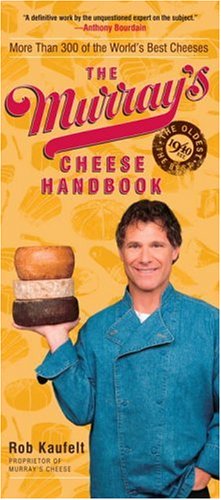
Inhaltsangabe
Rob Kaufelt, cheese purveyor to American’s top restaurants and owner of Murray’s Cheese—named the world’s best cheese store byForbes magazine—guides us through the bewildering variety of cheeses available today in this entertaining and indispensable guide featuring:
*Descriptions of more than 300 cheeses from across America and around the world, including what to drink with each
*Suggested accompaniments for all the different styles and types of cheeses
*How to arrange cheese plates for dressed-up dinners or casual cheese tastings
*The best cheeses to serve before a meal, with a salad, or for a gooey grilled cheese sandwich
*Must-have lists: The Ten Most Intimidating Cheeses, Sexiest Cheeses, Cheeses to Eat Before You Die
*Answers to the most frequently asked questions about cheese
Die Inhaltsangabe kann sich auf eine andere Ausgabe dieses Titels beziehen.
Über die Autorin bzw. den Autor
In 1991, ROB KAUFELT bought the original Murray’s Cheese Shop. He has since moved the store (just across the street) and ambitiously expanded it. A nationally recognized cheese expert, Rob has appeared on the Food Network and has been profiled inThe New Yorker. He lives in New York City.
Auszug. © Genehmigter Nachdruck. Alle Rechte vorbehalten.
INTRODUCTION
I've always loved cheese, but I didn’t become passionate about it until I became a customer at Murray’s myself back in 1989. If I think back to my earliest cheese memories, they are not about eating the perfect Piave in Italy. They are about growing up eating cheeseburgers and grilled cheese sandwiches in Highland Park, New Jersey, and about Mom cooking Dad those big, puffy, brown cheese omelets on a Sunday with Swiss or Cheddar.
Almost everybody loves cheese and has some favorites. The magic is that you can go on discovering cheese almost forever; there are thousands of different cheeses from all over the world. The most amazing thing about them all is that the three main ingredients remain the same—milk, rennet, and salt—and yet the tastes, textures, and appearance are infinite in their variety. It's amazing, too, that cheese has been made the same way continuously for thousands of years.
I don’t think my love of cheese is distinguishable from the idea of buying something uniquely delicious and perfectly ripened from an old shop in an old neighborhood, and that’s the experience I want all my customers to have in the new Murray’s.
When I first became a customer at the old Murray’s, one of the things I liked best about it, and still do, is that it is the oldest cheese shop in New York. As I write this, in October 2005, Murray’s is celebrating its sixty–fifth anniversary. It may have moved three times, but it's traveled only twenty-five feet from the original shop in all that time.
I never met the original owner, Murray Greenberg; he died before I got here. He was an Eastern European Spanish Civil War veteran, and when he came to America in 1940 he opened a wholesale butter and egg shop a few doors up Cornelia Street. Despite his communist leanings, I've been told he was a street–smart capitalist who used to buy cheese cheap, trim it up, and sell it.
In the 1970s, he finally sold the shop to his clerk, Louis Tudda, an Italian immigrant from Calabria, who filled the shop not just with cheese but also with cheap olive oil and tomatoes, which he sold mostly to his local Italian neighbors. That’s the way it was when I bought the shop fifteen years ago in 1991. So what made me buy it and give up everything for cheese? I had left the family supermarket business in 1985 to work in full-service specialty shops in New Jersey, where I was from. When my second shop in Princeton tanked with the crash of ’87, I found myself in my brother’s place here in the Village, wondering what I should do with my life next.
One day I was standing in line at the original Murray’s, and I heard Louis say he’d lost his lease and was closing. I made him several offers he refused, but eventually made a deal. I moved the shop to the corner of Bleecker, and that’s where it remained for fourteen years, until November 2004.
Frankie Meilak, who had worked for Louis for six years, came with the shop. He is still here with me. He lived up the street and stayed on when his parents moved back home to Malta. Louis stayed on for a year before he went back home.
One day around ten years ago, Cielo Peralta walked into the shop and announced he was coming to work for me. I told him I didn’t have a job for him. He took absolutely no notice, strode right past me straight into the shop, put on an apron, and started selling cheese, saying I didn’t have to pay him unless I liked his work. I only had to see Cielo behind the counter for a day to know he’d sell twelve times more cheese than anyone else. In fact, he’s probably sold more specialty cheese than anyone else in the United States. He’s still here, too.
When I arrived at Murray’s we were selling around 100 different cheeses. We’ve gone from 100 to 250 on the counter at any one time, but with our seasonal calendar and promotions, our range is probably somewhere around 500 to 600 cheeses.
We started broadening our selection in the early nineties, a time of explosive interest in U.S. and foreign artisanal food. Our original American purveyors (pioneer women) had started making cheese—like Mary Keehn’s Humboldt Fog and Cindy Major’s Vermont Shepherd—in the seventies and eighties. There were cheeses from places with no tradition of cheesemaking, or where the tradition had been nearly lost and where it began anew. I got involved in American farmstead cheeses first through the American Cheese Society, whose headquarters in those days were around the corner from the shop on Downing Street.
I think the first real specialty cheese we got from abroad came from Neal’s Yard Dairy in England in the early 1990s. After that, I went to Spain, Italy, France, Ireland, and England searching out small dairies and new cheeses, but I still thought the growing popularity and appetite for cheese was probably a fad; I didn’t know it was going to turn into a lasting trend.
My father thought buying Murray’s was a really stupid idea. We were at the peak of the low–fat, cholesterol–obsessed days, and there was clearly no expectation from him, as an experienced grocer, or from me, that cheese was going to become the Next Big Thing. It’s only in the last couple of years that artisanal cheese has penetrated the consciousness of a broader market in the U.S.
In the beginning, I got into cheese because I wanted a nice little old–fashioned business like the one in the picture hanging over my dairy case. It shows my grandfather's shop in Perth Amboy, New Jersey, in 1925. My grandfather Irving with his wife, Fanny, and his brother Murray with his wife, Bessie, and their two small children, are all sitting on the stoop in front. Buying Murray's was a romantic notion. There had always been a line when I went there as a customer, so I thought it was conceivable that I could lead a Greenwich Village life, pay the rent and buy groceries, and take my place in that long family tradition. I also liked the fact we’re on Bleecker Street, because I grew up listening to Bob Dylan and Dave Van Ronk. Van Ronk turned out to be a Murray’s customer and gave me guitar lessons before he died.
I like the idea of being a small business and of buying from small businesses. The cheesemakers I deal with love what they're doing, are passionate about making cheese, and are peculiar, quirky oddballs, like I am. I also don’t have to wear a suit and tie!
I love the creative aspect of merchandising food. I believe coming to Murray's should be an entertaining experience; it’s fun, it’s funky, it’s exciting. My favorite food-buying experiences have been in the markets in European villages and towns, where everything is simple and direct. The food is abundantly on display, and you often buy from the producer directly. The transaction has a theatrical element to it: The sellers are onstage and you, the customer, are the audience.
One of the things I always liked best about Murray's was that the people behind the counter would explain cheese to the customers without making them feel like they were idiots. The truth is, if we educate the customers, suggest new things, tempt them with ever more delicious cheeses, and let them taste things over the counter, they'll enjoy cheese even more and buy more of it. That may be one of the oldest traditions in retail, but it's the one that's nearly been killed in our chain-store age.
So I wrote this book to tell you all about cheese, to pass on my passion.
Here are my favorite three hundred or so cheeses out of the thousands I've tasted. I hope you will sit down with a glass of wine, a hunk of good cheese, and this book, and savor all three. This guide is designed so you can easily...
„Über diesen Titel“ kann sich auf eine andere Ausgabe dieses Titels beziehen.
Suchergebnisse für The Murray's Cheese Handbook: A Guide to More Than...

Beispielbild für diese ISBN
The Murray's Cheese Handbook: A Guide to More Than 300 of the World's Best Cheeses
Anbieter: World of Books (was SecondSale), Montgomery, IL, USA
Verkäuferbewertung 5 von 5 Sternen

Paperback. Zustand: Good. Artikel-Nr. 00095562108
Gebraucht kaufen
EUR 4,23
Versand gratis
Versand innerhalb von USA
Versand innerhalb von USA
Anzahl: 8 verfügbar
Beispielbild für diese ISBN
The Murray's Cheese Handbook: A Guide to More Than 300 of the World's Best Cheeses
Verlag:
Clarkson Potter (edition 1st Edition/ 1st Printing), 2006
ISBN 10: 0767921305
ISBN 13: 9780767921305
Gebraucht
Paperback
Anbieter: BooksRun, Philadelphia, PA, USA
Verkäuferbewertung 5 von 5 Sternen
Paperback. Zustand: Very Good. 1st Edition/ 1st Printing. It's a well-cared-for item that has seen limited use. The item may show minor signs of wear. All the text is legible, with all pages included. It may have slight markings and/or highlighting. Artikel-Nr. 0767921305-11-1
Gebraucht kaufen
EUR 4,23
Versand gratis
Versand innerhalb von USA
Versand innerhalb von USA
Anzahl: 1 verfügbar
Beispielbild für diese ISBN
The Murray's Cheese Handbook: A Guide to More Than 300 of the World's Best Cheeses
Verlag:
Clarkson Potter (edition 1st Edition/ 1st Printing), 2006
ISBN 10: 0767921305
ISBN 13: 9780767921305
Gebraucht
Paperback
Anbieter: BooksRun, Philadelphia, PA, USA
Verkäuferbewertung 5 von 5 Sternen
Paperback. Zustand: Very Good. 1st Edition/ 1st Printing. It's a well-cared-for item that has seen limited use. The item may show minor signs of wear. All the text is legible, with all pages included. It may have slight markings and/or highlighting. Artikel-Nr. 0767921305-11-6
Gebraucht kaufen
EUR 4,62
Versand gratis
Versand innerhalb von USA
Versand innerhalb von USA
Anzahl: 1 verfügbar
Beispielbild für diese ISBN
The Murray's Cheese Handbook: A Guide to More Than 300 of the World's Best Cheeses
Anbieter: ThriftBooks-Dallas, Dallas, TX, USA
Verkäuferbewertung 5 von 5 Sternen
Paperback. Zustand: Very Good. No Jacket. May have limited writing in cover pages. Pages are unmarked. ~ ThriftBooks: Read More, Spend Less. Artikel-Nr. G0767921305I4N00
Gebraucht kaufen
EUR 6,23
Versand gratis
Versand innerhalb von USA
Versand innerhalb von USA
Anzahl: 1 verfügbar
Beispielbild für diese ISBN
The Murray's Cheese Handbook: A Guide to More Than 300 of the World's Best Cheeses
Anbieter: ThriftBooks-Atlanta, AUSTELL, GA, USA
Verkäuferbewertung 5 von 5 Sternen
Paperback. Zustand: As New. No Jacket. Pages are clean and are not marred by notes or folds of any kind. ~ ThriftBooks: Read More, Spend Less. Artikel-Nr. G0767921305I2N00
Gebraucht kaufen
EUR 6,23
Versand gratis
Versand innerhalb von USA
Versand innerhalb von USA
Anzahl: 1 verfügbar
Beispielbild für diese ISBN
The Murray's Cheese Handbook: A Guide to More Than 300 of the World's Best Cheeses
Anbieter: ThriftBooks-Atlanta, AUSTELL, GA, USA
Verkäuferbewertung 5 von 5 Sternen
Paperback. Zustand: Very Good. No Jacket. May have limited writing in cover pages. Pages are unmarked. ~ ThriftBooks: Read More, Spend Less. Artikel-Nr. G0767921305I4N00
Gebraucht kaufen
EUR 6,23
Versand gratis
Versand innerhalb von USA
Versand innerhalb von USA
Anzahl: 1 verfügbar
Beispielbild für diese ISBN
The Murray's Cheese Handbook: A Guide to More Than 300 of the World's Best Cheeses
Anbieter: ThriftBooks-Dallas, Dallas, TX, USA
Verkäuferbewertung 5 von 5 Sternen
Paperback. Zustand: Good. No Jacket. Pages can have notes/highlighting. Spine may show signs of wear. ~ ThriftBooks: Read More, Spend Less. Artikel-Nr. G0767921305I3N00
Gebraucht kaufen
EUR 6,23
Versand gratis
Versand innerhalb von USA
Versand innerhalb von USA
Anzahl: 1 verfügbar
Beispielbild für diese ISBN
The Murray's Cheese Handbook: A Guide to More Than 300 of the World's Best Cheeses
Anbieter: Wonder Book, Frederick, MD, USA
Verkäuferbewertung 5 von 5 Sternen
Zustand: Very Good. Very Good condition. A copy that may have a few cosmetic defects. May also contain light spine creasing or a few markings such as an owner's name, short gifter's inscription or light stamp. Artikel-Nr. Y10L-01343
Gebraucht kaufen
EUR 6,43
Versand gratis
Versand innerhalb von USA
Versand innerhalb von USA
Anzahl: 3 verfügbar
Beispielbild für diese ISBN
The Murray's Cheese Handbook : A Guide to More Than 300 of the World's Best Cheeses
Anbieter: Better World Books, Mishawaka, IN, USA
Verkäuferbewertung 5 von 5 Sternen
Zustand: Good. 1st Edition/ 1st Printing. Pages intact with minimal writing/highlighting. The binding may be loose and creased. Dust jackets/supplements are not included. Stock photo provided. Product includes identifying sticker. Better World Books: Buy Books. Do Good. Artikel-Nr. GRP102237288
Gebraucht kaufen
EUR 6,57
Versand gratis
Versand innerhalb von USA
Versand innerhalb von USA
Anzahl: 1 verfügbar
Beispielbild für diese ISBN
The Murray's Cheese Handbook : A Guide to More Than 300 of the World's Best Cheeses
Anbieter: Better World Books, Mishawaka, IN, USA
Verkäuferbewertung 5 von 5 Sternen
Zustand: Very Good. 1st Edition/ 1st Printing. Pages intact with possible writing/highlighting. Binding strong with minor wear. Dust jackets/supplements may not be included. Stock photo provided. Product includes identifying sticker. Better World Books: Buy Books. Do Good. Artikel-Nr. GRP73096974
Gebraucht kaufen
EUR 6,57
Versand gratis
Versand innerhalb von USA
Versand innerhalb von USA
Anzahl: 1 verfügbar