
Verwandte Artikel zu When You Catch an Adjective, Kill It: The Parts of...
Inhaltsangabe
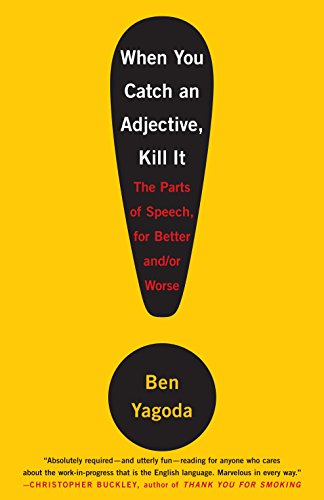
What do you get when you mix nine parts of speech, one great writer, and generous dashes of insight, humor, and irreverence? One phenomenally entertaining language book.
In his waggish yet authoritative book, Ben Yagoda has managed to undo the dark work of legions of English teachers and libraries of dusty grammar texts. Not since School House Rock have adjectives, adverbs, articles, conjunctions, interjections, nouns, prepositions, pronouns, and verbs been explored with such infectious exuberance. Read If You Catch an Adjective, Kill It and:
Learn how to write better with classic advice from writers such as Mark Twain (“If you catch an adjective, kill it”), Stephen King (“I believe the road to hell is paved with adverbs”), and Gertrude Stein (“Nouns . . . are completely not interesting”).
Marvel at how a single word can shift from adverb (“I did okay”), to adjective (“It was an okay movie”), to interjection (“Okay!”), to noun (“I gave my okay”), to verb (“Who okayed this?”), depending on its use.
Avoid the pretentious preposition at, a favorite of real estate developers (e.g., “The Shoppes at White Plains”).
Laugh when Yagoda says he “shall call anyone a dork to the end of his days” who insists on maintaining the distinction between shall and will.
Read, and discover a book whose pop culture references, humorous asides, and bracing doses of discernment and common sense convey Yagoda’s unique sense of the “beauty, the joy, the artistry, and the fun of language.”
Die Inhaltsangabe kann sich auf eine andere Ausgabe dieses Titels beziehen.
Über die Autorin bzw. den Autor
BEN YAGODA teaches English at the University of Delaware, and is the author of four books, including The Sound on the Page and About Town: The New Yorker and the World It Made. He has contributed to Slate.com, the New York Times Book Review, the American Scholar, Rolling Stone and Esquire, and writes an occasional column on language for the Chronicle of Higher Education. He lives in Swarthmore, Pennsylvania.
Auszug. © Genehmigter Nachdruck. Alle Rechte vorbehalten.
CHAPTER I
ADJ.
Look to the adjectives.
—Virgil Thomson
Kicking things off with adjectives is a little like starting a kids’ birthday party with the broccoli course. Because as far as not getting respect goes, adjectives leave Rodney Dangerfield in the dust. They rank right up there with Osama bin Laden, Geraldo Rivera, and the customer–service policies of cable TV companies. That it is good to avoid them is one of the few points on which the sages of writing agree. Thus Voltaire: “The adjective is the enemy of the noun.” Thus William Zinsser: “Most adjectives are…unnecessary. Like adverbs, they are sprinkled into sentences by writers who don’t stop to think that the concept is already in the noun.”
And thus the title of this book, a piece of advice traditionally attributed to Mark Twain.
Even the ancient Greeks seem to have been dismissive of the adjective; their term for it was epitheto, meaning “something thrown on.” In Latin, as previously noted, there are no adjectives, and such was the influence of that ancient language that the earlier English grammarians categorized these words as a subset of nouns. In 1735, John Collyer sensibly objected:
Words that signify the Quality of the Thing, cannot come under the same Denomination with those that signify the Name of the Thing; And seeing the Adverb, which signifies the Manner of the Verb is made a distinct Part of Speech, why should not the Adjective be so too, since it bears at least the same relation to the Noun, as that doth the Verb?
His reasoning could not really be disputed, and not long afterward the adjective became a full-fledged part of speech. The situation is not quite as simple as Collyer made it out, however. For one thing, “words that signify the Quality of the Thing,” as he puts it, come from a lot of different sources. There are not only the run–of–the–mill adjectives like good, bad, and ugly, but also various verb forms (a driving rain, a decorated cake); words created from suffixes like –ific, –ive, –ous, –ful, –less, and –ic; words that do double duty as nouns and adjectives (green); both cardinal (two) and ordinal (second) numbers; determiners or possessive pronouns like the, those, and my; hyphenated adjective phrases such as high–quality; and so–called attributive nouns, such as the first word in the phrases company man, wedding cake, and motel room.
Not all of these make the grade as full–fledged adjectives. One fairly reliable test is whether a word can be modified by an adverb—for example, very, almost, or absolutely. Colors certainly qualify and numbers are usually seen as doing so as well; we could say, “Susie is almost three.” But the, those, my, company, wedding, and motel (in the above examples) are not adjectives, despite the fact that they modify or describe nouns. Some words edge their way into the class over time, at which point they are looked down on by usage commentators. A classic example is fun, which started out as an attributive noun, in such phrases as fun house (in the circus) and Mayor John Lindsay’s much–mocked description of New York, Fun City. Fun was not a quality of the house or the city; the idea, rather, was that in these places one had fun (a noun). In the years since then, fun has stepped out into the footlights as an adjective, sparingly at first and now robustly. So you see and hear it modified by very and so, and used in comparative form as funner and funnest. (Key is traveling a similar road.) Journalist Barbara Wallraff quoted Steven Pinker as saying that he “can tell whether people are over thirty years old or under by whether they’re willing to accept fun as a full–fledged adjective.” I’m well over thirty but have no objection to fun being used this way, at least in speech. After all, the only alternative for “That was a really fun trip” is “That was a really enjoyable trip,” which is the kind of thing Eddie Haskell would say.
But, to reiterate, I am not one of those whatever–is–is–right loose constructionists; some new adjectives make me Sad to Be Alive. When someone says, “That’s very cliché,” my reaction is "That’s very icky.” Clichéd is a perfectly good adjective that was already in the dictionary. Equally grating is the shortening of the phrasal adjective high-quality to just plain quality, as in “He’s a quality individual.” Unfortunately, the trend is clearly going the other way: a Yahoo search for the phrase a quality individual yields more than 15,200 hits.
While we’re on the subject of Pinker’s “language mavens,” here’s their number one adjective–related complaint: the use of comparative or intensifying modifiers with supposedly “absolute” adjectives. The poster child here is unique. How would grammar geeks and English teachers spend their time if they were prohibited from tsk–tsking at more unique and very unique, or explaining that since unique means one–of-a–kind, there can be no degrees of uniqueness? But the mavens’ kvetching on this point won’t wash. The OED notes that since the nineteenth century, unique “has been in very common use, with a tendency to take the wider meaning of ‘uncommon, unusual, remarkable.’” The dictionary quotes Kenneth Grahame’s 1908 The Wind in the Willows: “ ‘Toad Hall,’ said the Toad proudly, ‘is an eligible self–contained gentleman’s residence, very unique.’” Other absolutes can profitably be modified as well. Orwell expressed his point perfectly when he wrote in Animal Farm, “All animals are equal, but some animals are more equal than others.” And the framers of the U.S. Constitution knew exactly what they were doing when they wrote, “We the People of the United States, in order to form a more perfect union…”
There are two main kinds of adjectives: attributive ones normally come right before the noun they qualify, while predicative adjectives come after to be or similar verbs such as become and seem. Most adjectives can serve either purpose: we can speak of a “happy family” and say “the family appeared happy.” But some work only one way. Take the sentence “Clergymen are answerable to a higher authority.” Answerable is exclusively a predicative; you could not refer to an “answerable clergyman.” And higher is strictly attributive; you wouldn’t normally say, “The authority is higher.”
Attributive adjectives sometimes follow the model of French and come after the noun, as when we refer to accounts payable, something important, proof positive, matters philosophical, paradise lost, a battle royal, the heir apparent, stage left, time immemorial, or a Miller Lite. And predicative adjectives appear before the noun when used appositively: “Tall, dark, and homely, he is a natural choice to play the part of Abraham Lincoln.”
That brings up another wrinkle. Attributive and predicative adjectives can both be listed in a series, but they behave in different ways. In normal...
„Über diesen Titel“ kann sich auf eine andere Ausgabe dieses Titels beziehen.
Suchergebnisse für When You Catch an Adjective, Kill It: The Parts of...

Beispielbild für diese ISBN
When You Catch an Adjective, Kill It
ISBN 10: 0767920783
ISBN 13: 9780767920780
Gebraucht
Paperback
Anbieter: World of Books (was SecondSale), Montgomery, IL, USA
Verkäuferbewertung 5 von 5 Sternen

Paperback. Zustand: Good. What do you get when you mix nine parts of speech, one great writer, and generous dashes of insight, humor, and irreverence? One phenomenally entertaining language book. In his waggish yet authoritative book, Ben Yagoda has managed to undo the dark work of legions of English teachers and libraries of dusty grammar texts. Not since School House Rock have adjectives, adverbs, articles, conjunctions, interjections, nouns, prepositions, pronouns, and verbs been explored with such infectious exuberance. Read If You Catch an Adjective, Kill It and: Learn how to write better with classic advice from writers such as Mark Twain (If you catch an adjective, kill it), Stephen King (I believe the road to hell is paved with adverbs), and Gertrude Stein (Nouns . . . are completely not interesting). Marvel at how a single word can shift from adverb (I did okay), to adjective (It was an okay movie), to interjection (Okay ), to noun (I gave my okay), to verb (Who okayed this?), depending on its use. Avoid the pretentious preposition at, a favorite of real estate developers (e.g., The Shoppes at White Plains). Laugh when Yagoda says he shall call anyone a dork to the end of his days who insists on maintaining the distinction between shall and will. Read, and discover a book whose pop culture references, humorous asides, and bracing doses of discernment and common sense convey Yagoda's unique sense of the beauty, the joy, the artistry, and the fun of language. Artikel-Nr. 00102767856
Gebraucht kaufen
EUR 5,56
Versand gratis
Versand innerhalb von USA
Versand innerhalb von USA
Anzahl: 3 verfügbar
Beispielbild für diese ISBN
When You Catch an Adjective, Kill It: The Parts of Speech, for Better And/Or Worse
Verlag:
Crown Publishing Group (NY), 2007
ISBN 10: 0767920783
ISBN 13: 9780767920780
Gebraucht
Paperback
Anbieter: ThriftBooks-Phoenix, Phoenix, AZ, USA
Verkäuferbewertung 5 von 5 Sternen
Paperback. Zustand: Very Good. No Jacket. May have limited writing in cover pages. Pages are unmarked. ~ ThriftBooks: Read More, Spend Less. Artikel-Nr. G0767920783I4N00
Gebraucht kaufen
EUR 6,09
Versand gratis
Versand innerhalb von USA
Versand innerhalb von USA
Anzahl: 1 verfügbar
Beispielbild für diese ISBN
When You Catch an Adjective, Kill It: The Parts of Speech, for Better And/Or Worse
Verlag:
Crown Publishing Group (NY), 2007
ISBN 10: 0767920783
ISBN 13: 9780767920780
Gebraucht
Paperback
Anbieter: ThriftBooks-Dallas, Dallas, TX, USA
Verkäuferbewertung 5 von 5 Sternen
Paperback. Zustand: Good. No Jacket. Pages can have notes/highlighting. Spine may show signs of wear. ~ ThriftBooks: Read More, Spend Less. Artikel-Nr. G0767920783I3N00
Gebraucht kaufen
EUR 6,09
Versand gratis
Versand innerhalb von USA
Versand innerhalb von USA
Anzahl: 1 verfügbar
Beispielbild für diese ISBN
When You Catch an Adjective, Kill It: The Parts of Speech, for Better And/Or Worse
Verlag:
Crown Publishing Group (NY), 2007
ISBN 10: 0767920783
ISBN 13: 9780767920780
Gebraucht
Paperback
Anbieter: ThriftBooks-Dallas, Dallas, TX, USA
Verkäuferbewertung 5 von 5 Sternen
Paperback. Zustand: Very Good. No Jacket. May have limited writing in cover pages. Pages are unmarked. ~ ThriftBooks: Read More, Spend Less. Artikel-Nr. G0767920783I4N00
Gebraucht kaufen
EUR 6,09
Versand gratis
Versand innerhalb von USA
Versand innerhalb von USA
Anzahl: 1 verfügbar
Beispielbild für diese ISBN
When You Catch an Adjective, Kill It: The Parts of Speech, for Better And/Or Worse
Verlag:
Crown Publishing Group (NY), 2007
ISBN 10: 0767920783
ISBN 13: 9780767920780
Gebraucht
Paperback
Anbieter: ThriftBooks-Atlanta, AUSTELL, GA, USA
Verkäuferbewertung 5 von 5 Sternen
Paperback. Zustand: Good. No Jacket. Pages can have notes/highlighting. Spine may show signs of wear. ~ ThriftBooks: Read More, Spend Less. Artikel-Nr. G0767920783I3N00
Gebraucht kaufen
EUR 6,11
Versand gratis
Versand innerhalb von USA
Versand innerhalb von USA
Anzahl: 1 verfügbar
Beispielbild für diese ISBN
When You Catch an Adjective, Kill It: The Parts of Speech, for Better And/Or Worse
Verlag:
Crown Publishing Group (NY), 2007
ISBN 10: 0767920783
ISBN 13: 9780767920780
Gebraucht
Paperback
Anbieter: ThriftBooks-Atlanta, AUSTELL, GA, USA
Verkäuferbewertung 5 von 5 Sternen
Paperback. Zustand: Very Good. No Jacket. May have limited writing in cover pages. Pages are unmarked. ~ ThriftBooks: Read More, Spend Less. Artikel-Nr. G0767920783I4N00
Gebraucht kaufen
EUR 6,11
Versand gratis
Versand innerhalb von USA
Versand innerhalb von USA
Anzahl: 1 verfügbar
Beispielbild für diese ISBN
When You Catch an Adjective, Kill It: The Parts of Speech, for Better and/or Worse
Anbieter: Wonder Book, Frederick, MD, USA
Verkäuferbewertung 5 von 5 Sternen
Zustand: Very Good. Very Good condition. A copy that may have a few cosmetic defects. May also contain light spine creasing or a few markings such as an owner's name, short gifter's inscription or light stamp. Artikel-Nr. L18A-03708
Gebraucht kaufen
EUR 6,43
Versand gratis
Versand innerhalb von USA
Versand innerhalb von USA
Anzahl: 1 verfügbar
Beispielbild für diese ISBN
When You Catch an Adjective, Kill It : The Parts of Speech, for Better and/or Worse
Verlag:
Crown Publishing Group, The, 2007
ISBN 10: 0767920783
ISBN 13: 9780767920780
Gebraucht
Softcover
Anbieter: Better World Books, Mishawaka, IN, USA
Verkäuferbewertung 5 von 5 Sternen
Zustand: Good. 1 Edition. Former library copy. Pages intact with minimal writing/highlighting. The binding may be loose and creased. Dust jackets/supplements are not included. Includes library markings. Stock photo provided. Product includes identifying sticker. Better World Books: Buy Books. Do Good. Artikel-Nr. 10191728-6
Gebraucht kaufen
EUR 6,57
Versand gratis
Versand innerhalb von USA
Versand innerhalb von USA
Anzahl: 1 verfügbar
Beispielbild für diese ISBN
When You Catch an Adjective, Kill It : The Parts of Speech, for Better and/or Worse
Verlag:
Crown Publishing Group, The, 2007
ISBN 10: 0767920783
ISBN 13: 9780767920780
Gebraucht
Softcover
Anbieter: Better World Books, Mishawaka, IN, USA
Verkäuferbewertung 5 von 5 Sternen
Zustand: Very Good. 1 Edition. Former library copy. Pages intact with possible writing/highlighting. Binding strong with minor wear. Dust jackets/supplements may not be included. Includes library markings. Stock photo provided. Product includes identifying sticker. Better World Books: Buy Books. Do Good. Artikel-Nr. 17187931-6
Gebraucht kaufen
EUR 6,57
Versand gratis
Versand innerhalb von USA
Versand innerhalb von USA
Anzahl: 1 verfügbar
Beispielbild für diese ISBN
When You Catch an Adjective, Kill It: The Parts of Speech, for Better And/Or Worse
Anbieter: WorldofBooks, Goring-By-Sea, WS, Vereinigtes Königreich
Verkäuferbewertung 5 von 5 Sternen
Paperback. Zustand: Very Good. The book has been read, but is in excellent condition. Pages are intact and not marred by notes or highlighting. The spine remains undamaged. Artikel-Nr. GOR006369163
Gebraucht kaufen
EUR 16,13
EUR 6,69 Versand
Versand von Vereinigtes Königreich nach USA
Versand von Vereinigtes Königreich nach USA
Anzahl: 1 verfügbar