
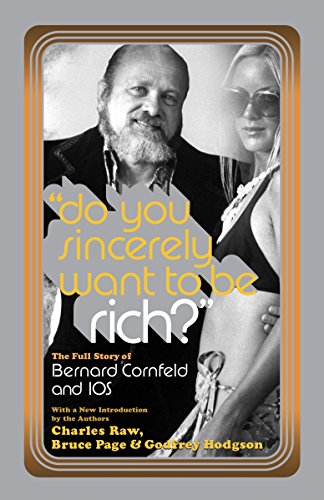
Do You Sincerely Want to Be Rich?: The Full Story of Bernard Cornfeld and I.O.S. (Library of Larceny) - Softcover
Inhaltsangabe
In the fall of 1955, Bernard Cornfeld arrived in Paris with scant money in his pocket and a tenuous relationship with a New York firm to sell mutual funds overseas. Cornfeld, a former psychologist and social worker, knew how to make friends fast and soon targeted two groups of people who could help him fulfill his economic ambitions: American expatriates who were looking to build their own fortunes and servicemen abroad who loved to live high-rolling lives and spend money. Using the first group as door-to-door salesmen and the second group as his gullible target, Cornfeld built a multi-billion-dollar and multi-national company, famous for its salesmen’s winning one-line pitch: “Do you sincerely want to be rich?” In this eye-opening yet entertaining book, an award-winning “Insight” team of the London Sunday Times examines Cornfeld’s impressive scheme, a classic example of good, old-fashioned American business gumption and guile.
Die Inhaltsangabe kann sich auf eine andere Ausgabe dieses Titels beziehen.
Über die Autorin bzw. den Autor
CHARLES RAW was financial editor of The Sunday Times (London) when this book was written. BRUCE PAGE, then executive features editor at The Sunday Times, was coauthor of two other bestselling "Insight" books. GODFREY HODGSON was a Washington correspondent for The Observer (London), where for two years he wrote the financial column "Mammon," and was foreign features editor of The Sunday Times. He also coauthored, with Page, American Melodrama: The Presidential Campaign of 1968.
Von der hinteren Coverseite
In the fall of 1955, Bernard Cornfeld arrived in Paris with scant money in his pocket and a tenuous relationship with a New York firm to sell mutual funds overseas. Cornfeld, a former psychologist and social worker, knew how to make friends fast and soon targeted two groups of people who could help him fulfill his economic ambitions: American expatriates who were looking to build their own fortunes and servicemen abroad who loved to live high-rolling lives and spend money. Using the first group as door-to-door salesmen and the second group as his gullible target, Cornfeld built a multi-billion-dollar and multi-national company, famous for its salesmen's winning one-line pitch: "Do you sincerely want to be rich?" In this eye-opening yet entertaining book, an award-winning "Insight" team of the London "Sunday Times examines Cornfeld's impressive scheme, a classic example of good, old-fashioned American business gumption and guile.
Auszug. © Genehmigter Nachdruck. Alle Rechte vorbehalten.
1
A Warning to Investors from Mr. Bernard Cornfeld
In which we introduce Bernard Cornfeld in the role of international economic statesman and give a preliminary statement of the real nature of Investors Overseas Services.
It was Bernard Cornfeld's declared ambition to make Investors Overseas Services the most important economic force in the Free World.
The game was mutual funds. Thousands of salesmen, calling themselves "financial counselors," combed the earth for people's savings, and put them into the funds which IOS managed, creaming off enough in the process to make the most successful of them wealthy men.
Mutual funds in themselves are an old and well-tried form of investment. A special variant was that IOS was the biggest and best-known of the "offshore" funds. That meant that these funds, and the companies that managed them, were carefully registered and domiciled wherever in the world they would most avoid taxation and regulation. There was nothing new about that either.
What was phenomenal about IOS was its success. On the foundation of its offshore mutual funds it built up a complex of banks, insurance companies, real-estate promotions, and every other kind of financial institution you can think of. "Total Financial Service" was the slogan. By the end of the 1960s, Cornfeld's men had a shade under two and a half billion dollars of other people's money to manage, and Cornfeld was publicly announcing plans to push that to $15 billion by the mid-1970s.
By the end of the 1960s, IOS had also made a fortune valued at over $100 million for Bernard Cornfeld personally. It had made around a hundred of his associates millionaires as well. Cornfeld was the most talked about financier in Europe since the Great Depression, and IOS was insistently--and on the whole successfully--asserting the right to sit at the golden table of the world's most respectable financial institutions.
The only trouble was that IOS was not a respectable financial institution. It was an international swindle.
That is not a word which should be lightly used about any organization, let alone one which acquired control over more than two and a half billion dollars of other people's money. We must, therefore, explain precisely what we mean by it.
IOS was the creation of Bernard Cornfeld and Edward M. Cowett. Together these two men built up an organization so steeped in financial and intellectual dishonesty and directed so recklessly that it was absurd that it should have been entrusted with so much of other people's money, let alone praised for the brilliance with which it was managed.
The organization which they built up has not, of course, disappeared without a trace, although the two men no longer have any say in it. At the time this is being written, men sit on the board of IOS Ltd. in Geneva who are responsible for safeguarding well over a billion dollars--which is what remains of the money that hundreds of thousands of investors were induced to part with. And of course IOS did a great deal of business which was perfectly honest in itself, and continues to do so. We have talked to many of the people who work for IOS, and there were a lot of decent, even idealistic, people among them. Few were aware of the essential dishonesty of the thing they worked for.
Most people have a good deal of difficulty in accepting the idea that a large and well-publicized international business could have been run in such a manner. "It can't be true," is the natural reaction, "because if it was true, how did they get away with it?" There are many answers to that question.
Charles Dickens suggested one, looking back on the career of the financier in Little Dorrit. "The next man," he wrote, "who has as large a capacity for swindling will succeed as well. Pardon me, but I think you have really no idea how the human bees will swarm to the beating of any old tin kettle; in that fact lies the whole manual of governing them. When they can be got to believe that the kettle is made of precious metals, in that power lies the whole power of men like our late lamented." The one thing IOS always did best was to beat the old tin kettle.
But there is another answer to the question why Cornfeld and Cowett were able to create the edifice they did. It can be summed up in the single word "offshore." By working in the interstices, so to speak, between the world's legal jurisdictions and administrative systems, they were able to do with impunity things that would have been illegal had their enterprise been located in any one place. Below are just some of the kinds of misbehavior that IOS committed under Cornfeld and Cowett:
1. Money which they said was held on trust for the customers was used to finance maneuvers for the benefit of IOS itself, its directors and employees, and their friends.
2. At many times, and in many parts of the world, the IOS sales force engaged in illegal currency transactions on a massive scale. Attempts have been made to pretend that this was somehow peripheral to the company's main activities--but as late as 1970 the IOS Board still acknowledged in their meetings that important sections of the IOS sales operations were illegal.
3. IOS consistently misrepresented the investment performance of its largest fund, and used the misrepresentation to sell hundreds of millions of dollars' worth of fund shares.
4. The basic nature of the best-known IOS fund, the Fund of Funds, was systematically disguised. It was supposed to offer the investors a diversity of investment advice. For most of the time, it did nothing of the kind--it merely charged its investors a double fee on the pretense of doing so.
5. The customers' money, in the funds, was frequently invested in unmarketable shares, and often in securities which IOS was floating for its own profit. There was a series of reckless speculations that culminated in a catastrophic venture into oil and gas exploration rights in the Canadian Arctic.
6. IOS paid itself a fee of nearly $10 million for having "revalued" those Arctic rights. Not only were the grounds for revaluation dubious, but in some cases the rights had not even been earned at the time they were "revalued."
7. As well as selling shares in the funds it managed, IOS eventually sold $100 million worth of its own shares to the public. These shares were sold on the basis of prospectuses which were misleading by reason of omission and misrepresentation.
8. Cash raised in this manner (see 7) from the public was used for the personal benefit of directors of IOS--and in the end the controllers of the company lent to themselves so large a proportion of the company's liquid cash that they brought it to the brink of collapse, and damaged the interests of thousands of their customers.
9. Ed Cowett, who had already left the IOS Board after an episode involving financial impropriety, was restored to power and given, by Cornfeld, complete day-to-day control of IOS and its system of banks and investment funds.
Bad as the particular items in this short summary of IOS's misdeeds are, they are only individual instances of a general proposition: IOS pretended to be creating wealth for the many when it was really making money for the few. That proposition will be demonstrated again and again in this book. But now it is time to take leave of generalities and to take a closer look at the remarkable figure of Bernard Cornfeld. There can be no better moment to savor the full absurdity of the contrast between the facade that IOS presented to the world, and the reality backstage, than the zenith of Cornfeld's power and reputation.
In the first week of February 1970, Cornfeld flew to New York to be the principal...
„Über diesen Titel“ kann sich auf eine andere Ausgabe dieses Titels beziehen.
Weitere beliebte Ausgaben desselben Titels

Suchergebnisse für Do You Sincerely Want to Be Rich?: The Full Story of...

Beispielbild für diese ISBN
Do You Sincerely Want to Be Rich?: The Full Story of Bernard Cornfeld and I.O.S. (Library of Larceny)
Anbieter: World of Books (was SecondSale), Montgomery, IL, USA
Verkäuferbewertung 5 von 5 Sternen

Zustand: Good. Item in good condition. Textbooks may not include supplemental items i.e. CDs, access codes etc. Artikel-Nr. 00104252319
Gebraucht kaufen
EUR 15,45
Versand gratis
Versand innerhalb von USA
Versand innerhalb von USA
Anzahl: 1 verfügbar
Beispielbild für diese ISBN
Do You Sincerely Want to Be Rich?: The Full Story of Bernard Cornfeld and I.O.S. (Library of Larceny)
Anbieter: Ria Christie Collections, Uxbridge, Vereinigtes Königreich
Verkäuferbewertung 5 von 5 Sternen
Zustand: New. In. Artikel-Nr. ria9780767920063_new
Neu kaufen
EUR 24,40
EUR 13,87 Versand
Versand von Vereinigtes Königreich nach USA
Versand von Vereinigtes Königreich nach USA
Anzahl: Mehr als 20 verfügbar
Beispielbild für diese ISBN
Do You Sincerely Want To Be Rich?: The Full Story Of Bernard Cornfeld And I.O.S.
Anbieter: Revaluation Books, Exeter, Vereinigtes Königreich
Verkäuferbewertung 5 von 5 Sternen
Paperback. Zustand: Brand New. reprint edition. 555 pages. 8.00x5.25x1.25 inches. In Stock. Artikel-Nr. x-0767920066
Neu kaufen
EUR 34,42
EUR 14,47 Versand
Versand von Vereinigtes Königreich nach USA
Versand von Vereinigtes Königreich nach USA
Anzahl: 2 verfügbar