
Verwandte Artikel zu The Film Snob*s Dictionary: An Essential Lexicon of...
Inhaltsangabe
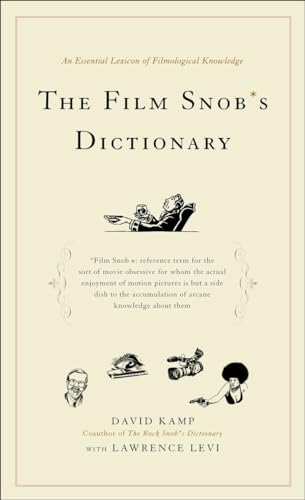
From the same brain trust that brought you The Rock Snob*s Dictionary, the hilarious, bestselling guide to insiderist rock arcana, comes The Film Snob*s Dictionary, an informative and subversively funny A-to-Z reference guide to all that is held sacred by Film Snobs, those perverse creatures of the repertory cinema. No longer must you suffer silently as some clerk in a “Tod Browning’s Freaks” T-shirt bombards you with baffling allusions to “wire-fu” pictures, “Todd-AO process,” and “Sam Raimi.” By helping to close the knowledge gap between average moviegoers and incorrigible Snobs, the dictionary lets you in on hidden gems that film geeks have been hoarding (such as Douglas Sirk and Guy Maddin movies) while exposing the trash that Snobs inexplicably laud (e.g., most chop-socky films and Mexican wrestling pictures). Delightfully illustrated and handily organized in alphabetical order for quick reference, The Film Snob*s Dictionary is your fail-safe companion in the video store, the cineplex, or wherever insufferable Film Snobs congregate.
Die Inhaltsangabe kann sich auf eine andere Ausgabe dieses Titels beziehen.
Über die Autorin bzw. den Autor
DAVID KAMP is a longtime writer for Vanity Fair, where short versions of The Film Snob*s Dictionary and the The Rock Snob*s Dictionary first appeared, and also contributes regularly to GQ. LAWRENCE LEVI has written about films and film culture for The New York Times, The Nation, and many other publications, and was a colleague of Kamp’s at Spy, the much-missed satirical magazine. Both Kamp and Levi live in New York.
ROSS MacDONALD’s illustrations have graced many major periodicals, including The New Yorker and Rolling Stone. He lives in Connecticut.
Auszug. © Genehmigter Nachdruck. Alle Rechte vorbehalten.
The Film Snob*s Dictionary
A * symbol indicates a Snob Vanguard item, denoting a person or entity held in particular esteem by Film Snobs.
Agee, James. Fast-living, Southern-born journalist-novelist-poet (1909-55) whose 1940s film criticism for Time and The Nation--posthumously compiled in the books Agee on Film and Agee on Film, Volume II--is better known to Snobs than his Depression-era masterwork, Let Us Now Praise Famous Men, or his Pulitzer-winning novel, A Death in the Family. Presciently recognizing movies as something more than disposable diversion for moony housewives, Agee was among the first writers to take the film beat seriously, glorying in the works of the silent-comedy masters at a time when they couldn't get arrested (and almost singlehandedly spearheading the resuscitation of HARRY LANGDON's reputation) and loosing zingers in print back when PAULINE KAEL was still vaguely girlish. (On Random Harvest: "I would like to recommend this film to those who can stay interested in Ronald Colman's amnesia for two hours and who could with pleasure eat a bowl of Yardley's shaving soap for breakfast.") Forming a mutual admiration society with John Huston, Agee collaborated with the director on the screenplay for The African Queen.
Ai No Corrida. High-toned Japanese skin flick from 1976, featuring actual intercourse, that dragged pornography from the GRINDHOUSE to the art house. Putatively the story of a 1930s brothel servant's affair with the madam's husband, the film legitimized the Snob's furtive desire for smut by allowing him to watch coitus out in the open under the guise of taking in "a study of desire." In the United States, the film carried the repertory-cinema-friendly title In the Realm of the Senses, rather than the direct translation, Bullfight of Love.
AIP. Commonly used shorthand for American International Pictures, a crank-'em-out production company, founded in 1954, that was among the first institutions to be exalted as a font of Important Kitsch; as far back as 1979, AIP was the subject of an adoring retrospective at the Museum of Modern Art. Unabashedly chasing the whims of fickle teens, AIP's mandate switched from Westerns (ROGER CORMAN's Apache Woman) to teen horror (I Was a Teenage Werewolf) to Vincent Price's Poe movies (House of Usher, The Pit and the Pendulum) to the Annette-and-Frankie Beach Party movies--though, in later years, AIP's output skewed ever more exploitatively toward GRINDHOUSE fare (e.g., PAM GRIER in Black Mama, White Mama). Kutcher exudes the bland hunkiness of a juvenile lead in an old AIP feature.
Aldrich, Robert. Tough-guy director (1918-83) who, despite his machismo-infused CV (Kiss Me Deadly, The Dirty Dozen, The Longest Yard), enjoys unlikely godhead status among Camp Snobs for his two hyper-macabre Bette Davis horror-melodramas, What Ever Happened to Baby Jane? (1962) and Hush, Hush, Sweet Charlotte (1965), which begat a whole movement of using aging female studio-system refugees as clown-makeup grotesques. Love that lunatic pirouette dance that Bette does with the ice-cream cone at the end of Baby Jane--pure, demented Aldrich.
Almendros, Néstor. Painterly Spanish cinematographer (1930-92) revered by Snobs for his purist's respect for natural light; worked with French New Wavers (ERIC ROHMER, Francois Truffaut) and American mavericks (MONTE HELLMAN, Martin Scorsese), and, most famously, gave TERRENCE MALICK's Days of Heaven the golden-hour glow that camouflaged the film's narrative lapses. Much as I admire Conrad Hall's work on In Cold Blood, I can't help but think that Nestor Almendros would have shot it better.
Altering Eye, The. Must-have Snob book, first published in 1983, that offers a cogent but sawdust-dry analysis of the modernist film movements in Europe and Latin America from ITALIAN NEOREALISM onward. Long a knapsack staple, the book has now been posted on the Web in its entirety by its author, Robert Kolker, a professor of film studies at the Georgia Institute of Technology.
Anger, Kenneth. Hollywood-reared child actor, ne Kenneth Anglemyer, turned trash-cinema auteur. Falling under the spell of Aleister Crowley, the suave English occultist, Anger, upon reaching young adulthood, took to making homoerotic, crypto-Fascist shorts such as Fireworks (1947) and Scorpio Rising (1964)--the latter a locus classicus of gay-biker chic, and a harbinger of Martin Scorsese and Quentin Tarantino in its juxtaposition of jukebox pop and ultraviolence. Still, Anger is best known as the author of Hollywood Babylon, his overamped 1960 compendium of scabrous Tinseltown gossip.
Anime. Catchall term for Japanese or Japanese-style animation, an understanding of which is said by Snobs to be crucial to understanding the future of cinema (yea, of our very culture!), since it, like CHOP-SOCKY, will inform all filmmaking visionaries worth a damn--even though it reliably focuses on species-nonspecific furry animals and childlike humanoids with enormous, saucery eyes. A societal subculture as much as it is a genre, anime takes many forms, including merchandise-shifting product (Pokémon), lyrical children's fare (the films of Hayao Miyazaki), and explicit pornography (the subgenre known as hentai, in which the childlike humanoids have enormous, R. Crumb-inspired bosoms to go with their enormous, saucery eyes). Anime has established an American beachhead with the Chicago-based Manga Entertainment (manga is the Japanese word for comics), the distributor behind the cult hits Ghost in the Shell and Blood: The Last Vampire.
Antihero. Film-crit term, borrowed from comp-lit studies, that achieved hypercurrency in the late 1960s and '70s when the EASY RIDERS, RAGING BULLS generation took wing, its auteurs constructing their films around morally compromised, usually runty, usually ethnic protagonists--such as Robert De Niro's Travis Bickle in Taxi Driver, Al Pacino's eponymous character in Serpico, and Dustin Hoffman's Ratso Rizzo in Midnight Cowboy. Vincent Gallo hustles and skitters like a real-life embodiment of a Scorsese antihero.
Antonioni, Michelangelo. Art-film director regarded, despite his age (he was born in 1912), as a sort of Italian auxiliary to the FRENCH NEW WAVE because of his audacious, conventional-narrative-shunning early-sixties trilogy, L'Avventura, La Notte, and L'Eclisse. For all the critical kvelling that these MEDITATIONS ON "aliention" and "disaffection" produced, it was Antonioni's English-language debut, 1966's Blow-Up, that earned him a gilt pedestal in the Snob pantheon, with its Austin Powers-inspiring Swinging London-photographer ANTIHERO, dolly-bird sex romps, Yardbirds-concert interlude, unresolved intrigue over a possible murder, and opening and closing scenes in which Antonioni, in his pursuit of profundity, actually deployed an unexplained gaggle of mimes. Regarded in some Snob circles as a painterly, betwitching allegory on the illusory
nature of modern life and in other circles as a full-on con (PAULINE KAEL wrote that old-timers like Ben Hecht banged out satirical comedies about vain, greedy jerks "that said most of what Antonioni does and more, and were entertaining besides"), Blow-Up was followed by two more English-language Snob causes célèbres--the train-wreck sixties-activist-tumult movie Zabriskie Point (1970) and the artiest Jack Nicholson movie ever made, The Passenger (1975).
Apparatus. Comically obtuse...
„Über diesen Titel“ kann sich auf eine andere Ausgabe dieses Titels beziehen.
Suchergebnisse für The Film Snob*s Dictionary: An Essential Lexicon of...

Beispielbild für diese ISBN
The Film Snob*s Dictionary: An Essential Lexicon of Filmological Knowledge
Anbieter: World of Books (was SecondSale), Montgomery, IL, USA
Verkäuferbewertung 5 von 5 Sternen

Paperback. Zustand: Good. From the same brain trust that brought you The Rock Snob*s Dictionary, the hilarious, bestselling guide to insiderist rock arcana, comes The Film Snob*s Dictionary, an informative and subversively funny A-to-Z reference guide to all that is held sacred by Film Snobs, those perverse creatures of the repertory cinema. No longer must you suffer silently as some clerk in a "Tod Browning's Freaks" T-shirt bombards you with baffling allusions to "wire-fu" pictures, "Todd-AO process," and "Sam Raimi." By helping to close the knowledge gap between average moviegoers and incorrigible Snobs, the dictionary lets you in on hidden gems that film geeks have been hoarding (such as Douglas Sirk and Guy Maddin movies) while exposing the trash that Snobs inexplicably laud (e.g., most chop-socky films and Mexican wrestling pictures). Delightfully illustrated and handily organized in alphabetical order for quick reference, The Film Snob*s Dictionary is your fail-safe companion in the video store, the cineplex, or wherever insufferable Film Snobs congregate. Artikel-Nr. 00086827969
Gebraucht kaufen
EUR 4,19
Versand gratis
Versand innerhalb von USA
Versand innerhalb von USA
Anzahl: 6 verfügbar
Beispielbild für diese ISBN
The Film Snob*s Dictionary: An Essential Lexicon of Filmological Knowledge
Verlag:
Crown (edition Illustrated), 2006
ISBN 10: 0767918762
ISBN 13: 9780767918763
Gebraucht
Paperback
Anbieter: BooksRun, Philadelphia, PA, USA
Verkäuferbewertung 5 von 5 Sternen
Paperback. Zustand: Very Good. Illustrated. It's a well-cared-for item that has seen limited use. The item may show minor signs of wear. All the text is legible, with all pages included. It may have slight markings and/or highlighting. Artikel-Nr. 0767918762-11-1
Gebraucht kaufen
EUR 4,20
Versand gratis
Versand innerhalb von USA
Versand innerhalb von USA
Anzahl: 1 verfügbar
Beispielbild für diese ISBN
The Film Snob's Dictionary: An Essential Lexicon of Filmological Knowledge
Verlag:
Crown Publishing Group (NY), 2006
ISBN 10: 0767918762
ISBN 13: 9780767918763
Gebraucht
Paperback
Anbieter: ThriftBooks-Atlanta, AUSTELL, GA, USA
Verkäuferbewertung 5 von 5 Sternen
Paperback. Zustand: Good. No Jacket. Pages can have notes/highlighting. Spine may show signs of wear. ~ ThriftBooks: Read More, Spend Less. Artikel-Nr. G0767918762I3N00
Gebraucht kaufen
EUR 6,04
Versand gratis
Versand innerhalb von USA
Versand innerhalb von USA
Anzahl: 1 verfügbar
Beispielbild für diese ISBN
The Film Snob's Dictionary: An Essential Lexicon of Filmological Knowledge
Verlag:
Crown Publishing Group (NY), 2006
ISBN 10: 0767918762
ISBN 13: 9780767918763
Gebraucht
Paperback
Anbieter: ThriftBooks-Dallas, Dallas, TX, USA
Verkäuferbewertung 5 von 5 Sternen
Paperback. Zustand: Very Good. No Jacket. May have limited writing in cover pages. Pages are unmarked. ~ ThriftBooks: Read More, Spend Less. Artikel-Nr. G0767918762I4N00
Gebraucht kaufen
EUR 6,04
Versand gratis
Versand innerhalb von USA
Versand innerhalb von USA
Anzahl: 1 verfügbar
Beispielbild für diese ISBN
The Film Snob*s Dictionary : An Essential Lexicon of Filmological Knowledge
Verlag:
Crown Publishing Group, The, 2006
ISBN 10: 0767918762
ISBN 13: 9780767918763
Gebraucht
Softcover
Anbieter: Better World Books, Mishawaka, IN, USA
Verkäuferbewertung 5 von 5 Sternen
Zustand: Good. Former library copy. Pages intact with minimal writing/highlighting. The binding may be loose and creased. Dust jackets/supplements are not included. Includes library markings. Stock photo provided. Product includes identifying sticker. Better World Books: Buy Books. Do Good. Artikel-Nr. GRP78279392
Gebraucht kaufen
EUR 6,09
Versand gratis
Versand innerhalb von USA
Versand innerhalb von USA
Anzahl: 1 verfügbar
Beispielbild für diese ISBN
The Film Snob*s Dictionary: An Essential Lexicon of Filmological Knowledge
Anbieter: Wonder Book, Frederick, MD, USA
Verkäuferbewertung 5 von 5 Sternen
Zustand: Very Good. Very Good condition. A copy that may have a few cosmetic defects. May also contain light spine creasing or a few markings such as an owner's name, short gifter's inscription or light stamp. Artikel-Nr. Q16P-00506
Gebraucht kaufen
EUR 6,33
Versand gratis
Versand innerhalb von USA
Versand innerhalb von USA
Anzahl: 3 verfügbar
Foto des Verkäufers
The Film Snob*s Dictionary: An Essential Lexicon of Filmological Knowledge
Anbieter: WeBuyBooks, Rossendale, LANCS, Vereinigtes Königreich
Verkäuferbewertung 5 von 5 Sternen
paperback. Zustand: Good. Most items will be dispatched the same or the next working day. A copy that has been read but remains in clean condition. All of the pages are intact and the cover is intact and the spine may show signs of wear. The book may have minor markings which are not specifically mentioned. Artikel-Nr. rev8358643071
Gebraucht kaufen
EUR 1,19
EUR 5,49 Versand
Versand von Vereinigtes Königreich nach USA
Versand von Vereinigtes Königreich nach USA
Anzahl: 1 verfügbar
Beispielbild für diese ISBN
The Film Snob's Dictionary: An Essential Lexicon of Filmological Knowledge
Anbieter: AwesomeBooks, Wallingford, Vereinigtes Königreich
Verkäuferbewertung 5 von 5 Sternen
Paperback. Zustand: Very Good. The Film Snob's Dictionary: An Essential Lexicon of Filmological Knowledge This book is in very good condition and will be shipped within 24 hours of ordering. The cover may have some limited signs of wear but the pages are clean, intact and the spine remains undamaged. This book has clearly been well maintained and looked after thus far. Money back guarantee if you are not satisfied. See all our books here, order more than 1 book and get discounted shipping. Artikel-Nr. 7719-9780767918763
Gebraucht kaufen
EUR 2,82
EUR 4,80 Versand
Versand von Vereinigtes Königreich nach USA
Versand von Vereinigtes Königreich nach USA
Anzahl: 2 verfügbar
Beispielbild für diese ISBN
The Film Snob*s Dictionary: An Essential Lexicon of Filmological Knowledge
Anbieter: WorldofBooks, Goring-By-Sea, WS, Vereinigtes Königreich
Verkäuferbewertung 5 von 5 Sternen
Paperback. Zustand: Very Good. The book has been read, but is in excellent condition. Pages are intact and not marred by notes or highlighting. The spine remains undamaged. Artikel-Nr. GOR002908846
Gebraucht kaufen
EUR 2,67
EUR 6,53 Versand
Versand von Vereinigtes Königreich nach USA
Versand von Vereinigtes Königreich nach USA
Anzahl: 3 verfügbar
Beispielbild für diese ISBN
The Film Snob's Dictionary: An Essential Lexicon of Filmological Knowledge
Anbieter: Bahamut Media, Reading, Vereinigtes Königreich
Verkäuferbewertung 4 von 5 Sternen

Paperback. Zustand: Very Good. This book is in very good condition and will be shipped within 24 hours of ordering. The cover may have some limited signs of wear but the pages are clean, intact and the spine remains undamaged. This book has clearly been well maintained and looked after thus far. Money back guarantee if you are not satisfied. See all our books here, order more than 1 book and get discounted shipping. Artikel-Nr. 6545-9780767918763
Gebraucht kaufen
EUR 3,92
EUR 8,14 Versand
Versand von Vereinigtes Königreich nach USA
Versand von Vereinigtes Königreich nach USA
Anzahl: 2 verfügbar