
Verwandte Artikel zu Career Comeback: Eight steps to getting back on your...
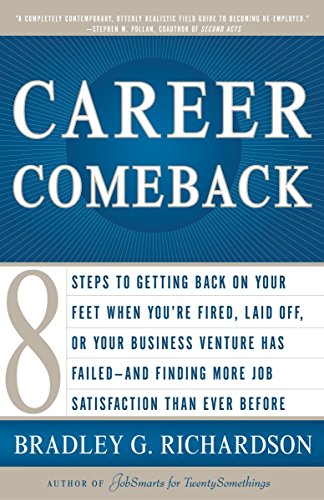
Career Comeback: Eight steps to getting back on your feet when you're fired, laid off, or your business ventures has failed--and finding more job satisfaction than ever before - Softcover
Inhaltsangabe
Career Comeback helps you create a powerful plan to get back on top
The author of the national bestseller JobSmarts for TwentySomethings, Bradley Richardson is one of America’s top career experts. But he also knows what it is like to experience a career setback. When an entrepreneurial effort failed and he was forced to become a job seeker himself, Richardson discovered firsthand the emotional, social, and financial stress that comes with losing a job. In Career Comeback, Richardson shares his years of expertise along with the hard lessons he learned in the trenches to give readers a realistic action plan for taking control of their careers—and their lives.
With empathy and humor, Richardson takes readers step by step through the challenging process of breathing life back into a languishing livelihood. Inside, readers will get indispensable, nuts-and-bolts advice on how to:
•Find solid ground
•Identify where things went wrong
•Establish a support system and stay energized
•Discover what matters most
•Find a new job that’s even better than the last
•Get in stride and stay on track
Job security is a thing of the past, but with Career Comeback readers learn how to rediscover their personal best.
Die Inhaltsangabe kann sich auf eine andere Ausgabe dieses Titels beziehen.
Über die Autorin bzw. den Autor
Bradley Richardson is the author of JobSmarts for TwentySomethings and JobSmarts 50 Top Careers. He has shared his expertise with thousands of job seekers and career changers through his speaking, consulting, and media appearences including Good Morning America, USA TODAY, Fast Company and NPR, and as Jobsmarts Coach and columnist for Monster.com. He is currenctly national manager of CareerJournal.com, the official recruitment website of the Wall Street Journal.
Von der hinteren Coverseite
"Career Comeback helps you create a powerful plan to get back on top
The author of the national bestseller "JobSmarts for TwentySomethings, Bradley Richardson is one of America's top career experts. But he also knows what it is like to experience a career setback. When an entrepreneurial effort failed and he was forced to become a job seeker himself, Richardson discovered firsthand the emotional, social, and financial stress that comes with losing a job. In "Career Comeback, Richardson shares his years of expertise along with the hard lessons he learned in the trenches to give readers a realistic action plan for taking control of their careers--and their lives.
With empathy and humor, Richardson takes readers step by step through the challenging process of breathing life back into a languishing livelihood. Inside, readers will get indispensable, nuts-and-bolts advice on how to:
-Find solid ground
-Identify where things went wrong
-Establish a support system and stay energized
-Discover what matters most
-Find a new job that's even better than the last
-Get in stride and stay on track
Job security is a thing of the past, but with "Career Comeback readers learn how to rediscover their personal best.
Auszug. © Genehmigter Nachdruck. Alle Rechte vorbehalten.
When Your Back
Is Against the Wall
The Boy Scouts Have a Point: Be Prepared
Those trustworthy, loyal, helpful, friendly, courteous, kind, obedient, cheerful, thrifty, brave, clean, and reverent Boy Scouts have the right idea. Their motto is "Be prepared," and you would be wise to make it your motto too, at least where your career is concerned.
It has been said that luck is when preparedness meets opportunity. When you are prepared, you will have more choices, and more influence and control over what happens to you. You still may not be able to control certain outcomes, but by knowing what to look for you can at least be prepared when the worst does occur.
People plan for their retirement, they plan for their vacation, they plan what they will do this weekend, they even plan for their estate after they die. But the sad fact is that people simply don't adequately plan for losing their job or hitting a dead end.
If you haven't planned for a career setback, don't be embarrassed. People don't plan for it for the same reason they find the idea of a prenuptial agreement sickening. They feel as though they are admitting failure before they get started.
You anticipate success. But it is like when you board an airplane. The pilot and crew certainly don't expect to crash, but they still show you where the exits are and let you know that your seat can be used as a flotation device.
You may not have any warning before a bad situation occurs. You may be caught totally off guard or in a situation where you have to leave quickly. What is stopping you from being prepared? Is it hubris, arrogance, laziness, fear? "Oh, this can't happen to me." "I'll be safe." "I know lots of people." "Maybe things will change." And then there's the greatest lie we tell ourselves: "They need me." If you are still working, here are a few steps that you can take to prepare yourself now in the event you need to make (or are asked to make) a dash for the door.
Back Up Everything . . . I Mean Everything
If you learn one thing from this section, it is this: BACK UP EVERYTHING THAT IS IMPORTANT TO YOU! Back it up and keep a copy offsite at home, in a safe deposit box, anywhere other than your office.
In the best-case scenario you might have a few minutes to retrieve your files. But don't count on it. You may be shown the door and have your things mailed to you later. There are no second chances to come back. You won't have time to go through files, forward or retrieve e-mail, and make copies. Files may be blown away from your computer.
If it is a layoff or firing situation, a company will likely shut down your network access and change your password while you are tucked away in a conference room learning about your fate. Companies assume that you might be a little hot under the collar since you were just let go, so they are reluctant to let you back on to the network or near a computer for fear that you might want to retaliate by sabotaging equipment, files, or information. You will also likely have your e-mail cut off immediately so you don't send a flaming message to everyone in the company or to your clients.
Respect what is proprietary and confidential to the company. But otherwise make copies or backups right now of any projects, letters, referrals, numbers, figures, and statistics you might need. Copy lists or directories that you think may help you later in a job search. Copy your personnel files and performance appraisals and reviews.
In the best of times, make sure to back up things at least once a month. When things are shaky, you should back up every week.
Make a Duplicate of Your Rolodex and Contacts
Careers are made on skills and contacts. Some would argue that depending on your profession, contacts are more important. Having access to those names, numbers, addresses, and vital data is critical not only to business, but to finding another job.
Make it a point to make a backup of all your contacts, databases, and important lists. This includes client and contact names, addresses, e-mail addresses, and phone numbers. Keep both a hard copy and a copy on a remote server, website, or disk.
Update Your Resume--Now
After backing up your information and contacts, this is the most important thing you can do to prepare. The last thing you want to do is to waste time trying to craft the perfect resume when you are stressed out and under pressure and you need to get something to an employer. It's like filling up the car with gas before a trip. When you are cruising down the highway, late for a meeting, you don't want to stop at the side of the road to fill up. Get it done now and forget about it.
Establish a Generic Personal E-mail Account
This is helpful not only to send your backup files to, but to use as a main contact for employers and job leads. Start using your new address for resumes and in all of your job search correspondence. Both Hotmail and Yahoo allow you to set up free e-mail accounts that can be accessed from any Internet browser.
Try to choose an e-mail address that is close to your name. Some people try to choose a name that reflects their profession, like SuperSalesman@xyz.com or Great Designer@xyz.com. I think it is cheesy, but it is certainly better than an e-mail address that reflects your personal habits or interests like Born2rock@xyz.com, ozzierules@xyz.com, or suprdad@xyz.com
Create an Achievement File
Create a folder that includes a running list and samples of your achievements, kudos, and successes in your position. After a successful achievement, write a one- or two-paragraph synopsis of the project, as well as the specific results and what you learned or the skills you used to successfully complete it. Keep this at home.
When you need to update your resume or make a case for yourself (internally or in a job search), your achievement file gives you accurate and specific information so you don't have to rely on your spotty memory.
Take Inventory
When the sky starts falling, you won't be in any mental condition to be reflective, so take a moment now to do a quick mental inventory of your career. Look at your recent accomplishments. What have you learned? How have you grown as a professional? What are you now qualified or equipped to do because of this experience? What is the likely next step if you were to leave? Could you easily go to a competitor? Do you want to stay in this field? What skills and experience can you transfer to other fields?
Renew Your Memberships and Subscriptions
Now might be a really good time to renew your subscriptions, association memberships, certifications, or anything that the company currently pays for that can help you professionally. This way they will remain active after you leave the company and you can still benefit.
Keep Up with Industry Contacts
These should include clients, people you have met at trade shows and through professional associations, even competitors. This doesn't have to be in-depth contact. It can be as simple as a phone call, voice mail, or even a "Hey, how are you?" e-mail. You want your name to be fresh on their minds in case they have an opportunity that might be a good fit for you, or so that if you need a favor during your job search they don't think, "Huh. Who is that? Oh yeah, I haven't heard from him in a year." Start priming the pump a little bit, by putting the word out that you "might be in the market soon," "are ready for a change," or "see the writing on the wall." Begin to raise your antenna for new opportunities.
Line Up Your Referrals, Letters, and Recommendations
It can be tough to locate people who are...
„Über diesen Titel“ kann sich auf eine andere Ausgabe dieses Titels beziehen.
Suchergebnisse für Career Comeback: Eight steps to getting back on your...

Beispielbild für diese ISBN
Career Comeback: Eight steps t
Anbieter: World of Books (was SecondSale), Montgomery, IL, USA
Verkäuferbewertung 5 von 5 Sternen

Zustand: Good. Item in good condition. Textbooks may not include supplemental items i.e. CDs, access codes etc. Artikel-Nr. 00082657167
Gebraucht kaufen
EUR 3,10
Versand gratis
Versand innerhalb von USA
Versand innerhalb von USA
Anzahl: 3 verfügbar
Beispielbild für diese ISBN
Career Comeback: Eight Steps to Getting Back on Your Feet When You're Fired, Laid Off, or Your Business Ventures Has Failed--And Finding More Job Sati
Anbieter: ThriftBooks-Dallas, Dallas, TX, USA
Verkäuferbewertung 5 von 5 Sternen
Paperback. Zustand: Very Good. No Jacket. Former library book; May have limited writing in cover pages. Pages are unmarked. ~ ThriftBooks: Read More, Spend Less. Artikel-Nr. G0767915577I4N10
Gebraucht kaufen
EUR 5,74
Versand gratis
Versand innerhalb von USA
Versand innerhalb von USA
Anzahl: 1 verfügbar
Beispielbild für diese ISBN
Career Comeback: Eight Steps to Getting Back on Your Feet When You're Fired, Laid Off, or Your Business Ventures Has Failed--And Finding More Job Sati
Anbieter: ThriftBooks-Phoenix, Phoenix, AZ, USA
Verkäuferbewertung 5 von 5 Sternen
Paperback. Zustand: Very Good. No Jacket. Former library book; May have limited writing in cover pages. Pages are unmarked. ~ ThriftBooks: Read More, Spend Less. Artikel-Nr. G0767915577I4N10
Gebraucht kaufen
EUR 5,74
Versand gratis
Versand innerhalb von USA
Versand innerhalb von USA
Anzahl: 1 verfügbar
Beispielbild für diese ISBN
Career Comeback : Eight Steps to Getting Back on Your Feet When You're Fired, Laid Off, or Your Business Ventures Has Failed--And Finding More Job Satisfaction Than Ever Before
Verlag:
Crown Publishing Group, The, 2004
ISBN 10: 0767915577
ISBN 13: 9780767915571
Gebraucht
Softcover
Erstausgabe
Anbieter: Better World Books, Mishawaka, IN, USA
Verkäuferbewertung 5 von 5 Sternen
Zustand: Good. 1st Edition. Former library copy. Pages intact with minimal writing/highlighting. The binding may be loose and creased. Dust jackets/supplements are not included. Includes library markings. Stock photo provided. Product includes identifying sticker. Better World Books: Buy Books. Do Good. Artikel-Nr. 2470960-75
Gebraucht kaufen
EUR 8,04
Versand gratis
Versand innerhalb von USA
Versand innerhalb von USA
Anzahl: 2 verfügbar
Beispielbild für diese ISBN
Career Comeback: 8 Steps for Getting Back on Your Feet When You're Fired, Laid Off, or Your Business Venture Has Failed--And Finding More Job Satisfaction Than Ever
Anbieter: Revaluation Books, Exeter, Vereinigtes Königreich
Verkäuferbewertung 5 von 5 Sternen
Paperback. Zustand: Brand New. 1st edition. 319 pages. 8.25x5.25x0.75 inches. In Stock. Artikel-Nr. x-0767915577
Neu kaufen
EUR 23,14
EUR 11,63 Versand
Versand von Vereinigtes Königreich nach USA
Versand von Vereinigtes Königreich nach USA
Anzahl: 2 verfügbar