
Verwandte Artikel zu Every Second Counts
Inhaltsangabe
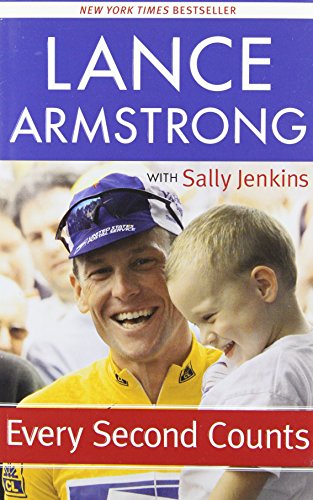
The much anticipated follow-up to the international bestseller It's Not About the Bike by cancer survivor and five-time winner of the Tour der France.
Die Inhaltsangabe kann sich auf eine andere Ausgabe dieses Titels beziehen.
Über die Autorin bzw. den Autor
Champion cyclist LANCE ARMSTRONG continues to make winning the Tour de France his annual cycling goal. He also oversees the Lance Armstrong Foundation, a nonprofit organization that assists cancer patients around the world with managing and surviving the disease. He lives in Austin, Texas.
Sally Jenkins is a columnist for the Washington Post. In 2002 she won the Associated Press’s Columnist of the Year Award. She has cowritten many bestselling sports books, including It’s Not About the Bike and, with Pat Summitt, Reach for the Summit (Broadway Books).
Auszug. © Genehmigter Nachdruck. Alle Rechte vorbehalten.
Chapter 1
Pitched Back
So, it looks as though I'm going to live--at least for another 50 years or more. But whenever I need to reassure myself of this, as I sometimes do, I go out to a place called Dead Man's Hole, and I stare down into it, and then, with firm intent, I strip off my shirt and I leap straight out into what you might call the great sublime.
Let's say it's my own personal way of checking for vital signs. Dead Man's Hole is a large green mineral pool gouged out of a circular limestone cliff, so deep into the hill country of Texas that it's hardly got an address. According to conflicting legends, it's either where Confederates tossed Union sympathizers to drown, or where Apaches lured unsuspecting cowboys who didn't see the fall coming. In any event, I'm drawn to it, so much so that I bought 200 acres of brush and pasture surrounding it, and I've worn a road into the dirt by driving out there. It seems only right that a place called Dead Man's Hole should belong to a guy who nearly died--and who, by the way, has no intention of just barely living.
I stand there next to a 45-foot waterfall and examine the drop--and myself, while I'm at it. It's a long drop, so long that it makes the roof of my mouth go dry just looking at it. It's long enough for a guy to actually think on the way down, and to think more than one thought, too. Long enough to think first one thing, A little fear is good for you, and then another, It's good for you if you can swim, and then one more thing as I hit the water: Oh fuck, it's cold. As I jump, there are certain unmistakable signs that I'm alive: the press of my pulse, the insistent sound of my own breathing, and the whanging in my chest that's my heart, which by then sounds like an insubordinate prisoner beating on the bars of my ribcage.
I come up whooping through the foam and swim for the rocks. Then I climb back up and towel off, and I drive home to my three kids. I burst through the door, and I shout at my son, Luke, and my twin daughters, Grace and Isabelle, and I kiss them on the necks, and I grab a Shiner Bock beer with one hand and an armful of babies with the other.
The first time I ever did it, my wife, Kik, just looked at me and rolled her eyes. She knew where I'd been.
"Was that clarifying for you?" she said.
At what point do you let go of not dying? Maybe I haven't entirely and maybe I don't want to.
I know they're out there, lying in their hospital beds, with those damn drip poles, watching the damn chemo slide into their veins, and thinking, This guy had the same thing I do. If he can do it, I can, too. I think of them all the time.
My friend Lee Walker says I got "pitched back." What he means is, I almost died, and possibly even did die a little, but then I got pitched back into the world of the living. It's as good a description as any of what happened. I was 25 when cancer nearly killed me: advanced choriocarcinoma spread to my abdomen, lungs, and brain and required two surgeries and four cycles of chemotherapy to get rid of. I wrote an entire book about death, called It's Not About the Bike, about confronting the possibility of it, and narrowly escaping it.
"Are you sure?" I asked the doctor.
"I'm sure."
"How sure?"
"I'm very sure."
"How can you be so sure?"
"I'm so sure that I've scheduled you for surgery at 7 a.m. tomorrow."
Mounted on a light table, the X-ray showed my chest. Black meant clear; white meant cancer. My chest looked like a snowstorm.
What I didn't and couldn't address at the time was the prospect of life. Once you figure out you're going to live, you have to decide how to, and that's not an uncomplicated matter. You ask yourself: now that I know I'm not going to die, what will I do? What's the highest and best use of my self? These things aren't linear, they're a mysterious calculus. For me, the best use of myself has been to race in the Tour de France, the most grueling sporting event in the world.
Every time I win another Tour, I prove that I'm alive--and therefore that others can survive, too. I've survived cancer again, and again, and again, and again. I've won four Tour titles, and I wouldn't mind a record-tying five. That would be some good living.
But the fact is that I wouldn't have won even a single Tour de France without the lesson of illness. What it teaches is this: pain is temporary. Quitting lasts forever.
To me, just finishing the Tour de France is a demonstration of survival. The arduousness of the race, the sheer unreasonableness of the job, the circumnavigation of an entire country on a bicycle, village to village, along its shores, across its bridges, up and over the mountain peaks they call cols, requires a matchless stamina. The Tour is so taxing that Dutch rider Hennie Kuiper once said, after a long climb up an alp, "The snow had turned black in my eyes." It's not unlike the stamina of people who are ill every day. The Tour is a daily festival of human suffering, of minor tragedies and comedies, all conducted in the elements, sometimes terrible weather and sometimes fine, over flats, and into headwinds, with plenty of crashes. And it's three weeks long. Think about what you were doing three weeks ago. It feels like last year.
The race is very much like living--except that its consequences are less dire and there's a prize at the end. Life is not so neat.
There was no pat storybook ending for me. I survived cancer and made a successful comeback as a cyclist by winning the 1999 Tour, but that was more of a beginning than an end. Life actually went on, sometimes in the most messy, inconvenient, and un-triumphant ways. In the next five years I'd have three children, take hundreds of drug tests (literally), break my neck (literally), win some more races, lose some, too, and experience a breakdown in my marriage. Among other adventures.
When you walk into the Armstrong household, what you see is infants crawling everywhere. Luke was born in the fall of 1999 to Kristin (Kik) Armstrong and me shortly after that first Tour, and the twins came in the fall of 2001. Grace and Isabelle have blue saucer eyes, and they toddle across the floor at scarcely believable speeds. They like to pull themselves upright on the available furniture and stand there, wobbling, while they plan how to make trouble. One of Isabelle's amusements is to stand up on the water dispenser and press the tap until the kitchen floods, while she laughs hysterically. I tell her, "No, no, no," and she just shakes her head back and forth and keeps laughing, while the water runs all over the floor. I can't wait for their teen years.
Luke adds to the bedlam by riding his bike in the living room, or doing laps in a plastic car, or tugging the girls around in separate red wagons. He is sturdy and hardheaded. He wears his bike helmet inside the house and refuses to take it off, even when we go out to dinner. We get some interesting stares--but anything is better than the fight that ensues if you try to remove the helmet. He insists on wearing it just in case he might get to go cycling with me. To him, a road is what his father does for a living. I'm on the road so much that when the phone rings, he says, "Daddy."
One afternoon I went to pick my family up at an airport. Luke gave me a long stare and said, "Daddy, you look like me."
"Uh, I look like you?" I said.
"Yeah."
"Are you sure it's not the other way around?"
"Yeah, I'm sure. It's definitely you that looks like me."
Also milling around our house are a cat named Chemo and a small white dog named Boone. I trip around all of them, watching my feet, careful...
„Über diesen Titel“ kann sich auf eine andere Ausgabe dieses Titels beziehen.
Suchergebnisse für Every Second Counts

Beispielbild für diese ISBN
Every Second Counts
ISBN 10: 0767914481
ISBN 13: 9780767914482
Gebraucht
Paperback
Anbieter: World of Books (was SecondSale), Montgomery, IL, USA
Verkäuferbewertung 5 von 5 Sternen

Paperback. Zustand: Good. Artikel-Nr. 00037897381
Gebraucht kaufen
EUR 3,95
Versand gratis
Versand innerhalb von USA
Versand innerhalb von USA
Anzahl: 15 verfügbar
Beispielbild für diese ISBN
Every Second Counts
ISBN 10: 0767914481
ISBN 13: 9780767914482
Gebraucht
Paperback
Anbieter: World of Books (was SecondSale), Montgomery, IL, USA
Verkäuferbewertung 5 von 5 Sternen
Paperback. Zustand: Fair. Artikel-Nr. 00096060215
Gebraucht kaufen
EUR 3,95
Versand gratis
Versand innerhalb von USA
Versand innerhalb von USA
Anzahl: 1 verfügbar
Beispielbild für diese ISBN
Every Second Counts
ISBN 10: 0767914481
ISBN 13: 9780767914482
Gebraucht
Paperback
Anbieter: World of Books (was SecondSale), Montgomery, IL, USA
Verkäuferbewertung 5 von 5 Sternen
Paperback. Zustand: Very Good. Artikel-Nr. 00095174583
Gebraucht kaufen
EUR 3,95
Versand gratis
Versand innerhalb von USA
Versand innerhalb von USA
Anzahl: 9 verfügbar
Beispielbild für diese ISBN
Every Second Counts
Verlag:
Three Rivers Press (edition Reprint), 2004
ISBN 10: 0767914481
ISBN 13: 9780767914482
Gebraucht
Paperback
Anbieter: BooksRun, Philadelphia, PA, USA
Verkäuferbewertung 5 von 5 Sternen
Paperback. Zustand: Very Good. Reprint. It's a well-cared-for item that has seen limited use. The item may show minor signs of wear. All the text is legible, with all pages included. It may have slight markings and/or highlighting. Artikel-Nr. 0767914481-11-1
Gebraucht kaufen
EUR 4,50
Versand gratis
Versand innerhalb von USA
Versand innerhalb von USA
Anzahl: 1 verfügbar
Beispielbild für diese ISBN
Every Second Counts
Anbieter: ThriftBooks-Atlanta, AUSTELL, GA, USA
Verkäuferbewertung 5 von 5 Sternen
Paperback. Zustand: As New. No Jacket. Pages are clean and are not marred by notes or folds of any kind. ~ ThriftBooks: Read More, Spend Less. Artikel-Nr. G0767914481I2N00
Gebraucht kaufen
EUR 6,37
Versand gratis
Versand innerhalb von USA
Versand innerhalb von USA
Anzahl: 1 verfügbar
Beispielbild für diese ISBN
Every Second Counts
Anbieter: Wonder Book, Frederick, MD, USA
Verkäuferbewertung 5 von 5 Sternen
Zustand: Good. Good condition. A copy that has been read but remains intact. May contain markings such as bookplates, stamps, limited notes and highlighting, or a few light stains. Artikel-Nr. H07A-01900
Gebraucht kaufen
EUR 6,41
Versand gratis
Versand innerhalb von USA
Versand innerhalb von USA
Anzahl: 4 verfügbar
Beispielbild für diese ISBN
Every Second Counts
Anbieter: Wonder Book, Frederick, MD, USA
Verkäuferbewertung 5 von 5 Sternen
Zustand: Very Good. Very Good condition. A copy that may have a few cosmetic defects. May also contain light spine creasing or a few markings such as an owner's name, short gifter's inscription or light stamp. Artikel-Nr. V16A-07747
Gebraucht kaufen
EUR 6,41
Versand gratis
Versand innerhalb von USA
Versand innerhalb von USA
Anzahl: 1 verfügbar
Beispielbild für diese ISBN
Every Second Counts
Anbieter: Better World Books, Mishawaka, IN, USA
Verkäuferbewertung 5 von 5 Sternen
Zustand: Very Good. Pages intact with possible writing/highlighting. Binding strong with minor wear. Dust jackets/supplements may not be included. Stock photo provided. Product includes identifying sticker. Better World Books: Buy Books. Do Good. Artikel-Nr. 3459663-6
Gebraucht kaufen
EUR 6,56
Versand gratis
Versand innerhalb von USA
Versand innerhalb von USA
Anzahl: 1 verfügbar
Beispielbild für diese ISBN
Every Second Counts
Anbieter: AwesomeBooks, Wallingford, Vereinigtes Königreich
Verkäuferbewertung 5 von 5 Sternen
Paperback. Zustand: Very Good. Every Second Counts This book is in very good condition and will be shipped within 24 hours of ordering. The cover may have some limited signs of wear but the pages are clean, intact and the spine remains undamaged. This book has clearly been well maintained and looked after thus far. Money back guarantee if you are not satisfied. See all our books here, order more than 1 book and get discounted shipping. Artikel-Nr. 7719-9780767914482
Gebraucht kaufen
EUR 3,39
EUR 4,89 Versand
Versand von Vereinigtes Königreich nach USA
Versand von Vereinigtes Königreich nach USA
Anzahl: 2 verfügbar
Beispielbild für diese ISBN
Every Second Counts
Verlag:
Broadway Books (A Division of Bantam Doubleday Dell Publishing Group Inc), United States, New York, 2004
ISBN 10: 0767914481
ISBN 13: 9780767914482
Gebraucht
Paperback
Anbieter: WorldofBooks, Goring-By-Sea, WS, Vereinigtes Königreich
Verkäuferbewertung 5 von 5 Sternen
Paperback. Zustand: Very Good. The book has been read, but is in excellent condition. Pages are intact and not marred by notes or highlighting. The spine remains undamaged. Artikel-Nr. GOR011555944
Gebraucht kaufen
EUR 2,72
EUR 6,65 Versand
Versand von Vereinigtes Königreich nach USA
Versand von Vereinigtes Königreich nach USA
Anzahl: 5 verfügbar