
Verwandte Artikel zu Great Mutual Fund Trap: An Investment Recovery Plan
Inhaltsangabe
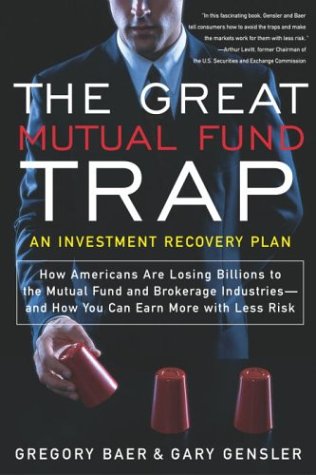
Drawing on years of experience, two financial experts warn investors of the potential financial hazards of mutual funds, discussing the hidden costs of such funds, providing realistic insights into how such funds operate, and offering helpful advice on how to protect one's investments. Reprint.
Die Inhaltsangabe kann sich auf eine andere Ausgabe dieses Titels beziehen.
Über die Autorin bzw. den Autor
Named by <i>Smart Money </i>magazine as one of the most powerful people in investing, <b>Gary Gensler</b> was the lead at the U.S. Treasury Department, responsible for policies in the areas of U.S. financial markets, debt management, and financial services. An eighteen-year veteran of Wall Street, he was co-head of finance at Goldman Sachs and one of the youngest partners in the history of the firm. <b>Gregory Baer</b> was Assistant Secretary for Financial Institutions at the U.S. Treasury Department and helped to modernize the nation’s financial service laws. He previously served at the Federal Reserve Board.<br><br><br><i>From the Hardcover edition.</i>
Auszug. © Genehmigter Nachdruck. Alle Rechte vorbehalten.
Chapter 1
Money Management in a Nutshell
Finance, N. The art or science of managing revenues and resources for the best advantage of the manager.
--Ambrose Bierce, The Devil's Dictionary
An Analogy
Every day there is a parade of money managers interviewed on CNBC or featured in Money or similar magazines. Every time we see them, we can't help but think of flipping coins.
Imagine that, instead of picking stocks, these scores of men and women each flipped one hundred coins per day, with the goal of producing the maximum number of "heads" possible. Viewers tune in to see who's doing well and bet on their favorite flippers.
Over time, the flippers' task is essentially hopeless: statistics doom them to an average performance of 50 percent heads. If you observe them on only one day, though, there will be winners and losers. While most will have around 50 heads, some will have 57 or 43.
Now suppose that some of the coin flippers are permitted to raise the stakes of each given flip by taping up to five coins together. For example, if one tapes four coins together, each flip will yield either four heads or four tails. Now, we might expect some of our flippers to produce 60 or 64 (or 40 or 36) heads in one day. By taping the coins, they are taking on risk (the possibility of four tails at once) in return for the possibility of reward (four heads).
Imagine, then, the Coin Flipping News Network (CFNN), giving us twenty-four-hour-a-day coverage of the flipping market. In comes coin flipper Lee with 56 heads, touting her latest tactic--say, many revolutions of the coin, with three taped together. Long forgotten is last week's guest, who had favored the few-revolution, one-coin-at-a-time tactic that worked so well during the last 500 flips but is now seriously out of favor. "Momentum" viewers favor those who have recently had more heads, while "value" viewers favor those who have recently had more tails.
Above all, viewers are assured that they are not capable of flipping the coins themselves--that they must rely on the experts to do it for them. And they are convinced that they should never be satisfied with just 50 percent heads--that is, "market" performance.
The Reality
The current state of money management is similar to this example--only worse. The returns for money managers are like those of our coin flippers. Most tend to stay close to the mean, while riskier funds tend to produce more volatile returns that balance out over time. The difference, though, is that whereas coin flipping is free, money management is not.
For that reason, the chances of your money manager beating the market are small. Evidence suggests that the average actively managed mutual fund underperforms the market three years out of five. According to data at Morningstar (which maintains a comprehensive database on fund performance):
* Through the end of 2001, there were 1,226 actively managed stock funds with a five-year record. Their average annualized performance trailed the S&P 500 Index (a measure of the U.S. stock market) by 1.9 percentage points per year (8.8 percent for the funds, and 10.7 percent for the index).1
There were 623 actively managed stock funds with a ten-year record. Their average annualized performance trailed the S&P 500 by 1.7 percentage points per year (11.2 percent for the funds and 12.9 percent for the index).*
* These figures include the sales loads charged by many funds. Loads are akin to brokerage commissions and come straight out of your returns. They are charged by many funds when you either buy or sell shares of the fund. Even with those loads excluded, however, the average five-year return trailed the S&P 500 by 1.4 percentage points per year, and the average ten-year return trailed by 1.4 percentage points per year as well.
Looking over a longer period of time yields a similar result. Excluding sales loads, the 406 actively managed stock funds that had been around for fifteen years or more trailed the S&P 500 Index by 1.5 percentage points per year.
* None of these aggregate numbers includes failed mutual funds, which would tend to have poorer performance and bring the averages down significantly. The exclusion of these mutual funds is called survivorship bias. The most comprehensive study of survivorship bias concluded that it inflates industry returns by 1.4 percent over a ten-year period and 2.2 percent over a fifteen-year period. With returns corrected for survivorship bias, the average actively managed funds trail the market by about 3 percentage points per year.
How can such a clever, hardworking group of fund managers trail the market by 3 percentage points per year? It's actually rather simple. The collective performance of stocks held by actively managed mutual funds, prior to any direct or indirect costs, generally will equal the performance of the market as a whole. With around $3 trillion in stock holdings, these funds basically represent the market.
But then along come management fees, trading costs, and sales loads. All of these costs weigh heavily on actively managed funds. The failure of almost all money managers to earn back their costs does not make them crooked or stupid. The problem is that their direct and indirect costs severely handicap their performance.
Nonetheless, each year some money managers will outperform the average fund, and even the market as a whole. The question is, can you identify these managers in advance of their market-beating performance? There is no reason to think so. As an individual investor, you have no comparative advantage in choosing those managers. In other words, there is no reason to believe that you will do any better a job picking stock pickers than you would picking stocks. If you can't do the latter, why would you expect to do the former?
Humorist Tony Kornheiser illustrated this point in a column about the trauma of the 2000-01 bear market.
My friend Tom, who has all of his money in mutual funds, panicked when somebody on the Today show said: "Your mutual fund is only as good as the manager investing the money. If your fund changes money managers, you need to check out the new manager." Tom pointed out, "If I was smart enough to check out my money manager, I wouldn't need a money manager."
Exactly!
Most investors simply choose funds based on past performance, but past performance truly is no guarantee of future results. The fact that a fund has outperformed the market for the past year, five years, or even ten years turns out to be a very poor predictor of whether it will outperform the market in the future. Funds that are above average for a time tend to regress to the below-market performance of the average fund.
Let's go back to our coin-flipping example. There were about 1,100 stock funds in 1991, and we know that each year about two out of five such funds (40 percent) have outperformed the market. If the identity of those 40 percent is just like coin flipping--that is, produced by random chance--how many funds would we expect to outperform the market each and every year over the next ten years? (In other words, how many beat the market in 1991, 1992, 1993, all the way to 2000?) Simple statistics tell us that by random chance between 0 and 1 fund should outperform the market each and every year.
That probably seems an improbably low number to you. But what has happened in reality? Over the ten years 1991-2000, only one fund (Legg Mason Value Trust) outperformed the S&P 500 every year. While we are happy for Legg Mason and its manager, Bill Miller, we view that outcome as roughly in line with random chance and as an indictment of active fund management. To the financial media, that outcome is a vindication of active fund...
„Über diesen Titel“ kann sich auf eine andere Ausgabe dieses Titels beziehen.
Suchergebnisse für Great Mutual Fund Trap: An Investment Recovery Plan

Beispielbild für diese ISBN
Great Mutual Fund Trap An Inve
Anbieter: World of Books (was SecondSale), Montgomery, IL, USA
Verkäuferbewertung 5 von 5 Sternen

Zustand: Very Good. Item in very good condition! Textbooks may not include supplemental items i.e. CDs, access codes etc. Artikel-Nr. 00100519791
Gebraucht kaufen
EUR 4,82
Versand gratis
Versand innerhalb von USA
Versand innerhalb von USA
Anzahl: 2 verfügbar
Beispielbild für diese ISBN
The Great Mutual Fund Trap : An Investment Recovery Plan
Anbieter: Better World Books, Mishawaka, IN, USA
Verkäuferbewertung 5 von 5 Sternen
Zustand: Good. Reprint. Former library copy. Pages intact with minimal writing/highlighting. The binding may be loose and creased. Dust jackets/supplements are not included. Includes library markings. Stock photo provided. Product includes identifying sticker. Better World Books: Buy Books. Do Good. Artikel-Nr. 17153249-6
Gebraucht kaufen
EUR 6,35
Versand gratis
Versand innerhalb von USA
Versand innerhalb von USA
Anzahl: 1 verfügbar
Beispielbild für diese ISBN
The Great Mutual Fund Trap : An Investment Recovery Plan
Anbieter: Better World Books, Mishawaka, IN, USA
Verkäuferbewertung 5 von 5 Sternen
Zustand: Good. Reprint. Pages intact with minimal writing/highlighting. The binding may be loose and creased. Dust jackets/supplements are not included. Stock photo provided. Product includes identifying sticker. Better World Books: Buy Books. Do Good. Artikel-Nr. 4582210-6
Gebraucht kaufen
EUR 6,35
Versand gratis
Versand innerhalb von USA
Versand innerhalb von USA
Anzahl: 1 verfügbar
Beispielbild für diese ISBN
The Great Mutual Fund Trap: An Investment Recovery Plan
Anbieter: ThriftBooks-Atlanta, AUSTELL, GA, USA
Verkäuferbewertung 5 von 5 Sternen
Paperback. Zustand: Good. No Jacket. Pages can have notes/highlighting. Spine may show signs of wear. ~ ThriftBooks: Read More, Spend Less. Artikel-Nr. G0767910729I3N00
Gebraucht kaufen
EUR 7,52
Versand gratis
Versand innerhalb von USA
Versand innerhalb von USA
Anzahl: 2 verfügbar
Beispielbild für diese ISBN
The Great Mutual Fund Trap: An Investment Recovery Plan
Anbieter: ThriftBooks-Dallas, Dallas, TX, USA
Verkäuferbewertung 5 von 5 Sternen
Paperback. Zustand: Good. No Jacket. Pages can have notes/highlighting. Spine may show signs of wear. ~ ThriftBooks: Read More, Spend Less. Artikel-Nr. G0767910729I3N00
Gebraucht kaufen
EUR 7,52
Versand gratis
Versand innerhalb von USA
Versand innerhalb von USA
Anzahl: 2 verfügbar
Beispielbild für diese ISBN
The Great Mutual Fund Trap: An Investment Recovery Plan
Anbieter: ThriftBooks-Atlanta, AUSTELL, GA, USA
Verkäuferbewertung 5 von 5 Sternen
Paperback. Zustand: Fair. No Jacket. Readable copy. Pages may have considerable notes/highlighting. ~ ThriftBooks: Read More, Spend Less. Artikel-Nr. G0767910729I5N00
Gebraucht kaufen
EUR 7,52
Versand gratis
Versand innerhalb von USA
Versand innerhalb von USA
Anzahl: 1 verfügbar
Beispielbild für diese ISBN
The Great Mutual Fund Trap: An Investment Recovery Plan
Anbieter: ThriftBooks-Reno, Reno, NV, USA
Verkäuferbewertung 5 von 5 Sternen
Paperback. Zustand: Good. No Jacket. Pages can have notes/highlighting. Spine may show signs of wear. ~ ThriftBooks: Read More, Spend Less. Artikel-Nr. G0767910729I3N00
Gebraucht kaufen
EUR 7,52
Versand gratis
Versand innerhalb von USA
Versand innerhalb von USA
Anzahl: 1 verfügbar
Beispielbild für diese ISBN
The Great Mutual Fund Trap: An Investment Recovery Plan
Anbieter: ThriftBooks-Phoenix, Phoenix, AZ, USA
Verkäuferbewertung 5 von 5 Sternen
Paperback. Zustand: Good. No Jacket. Pages can have notes/highlighting. Spine may show signs of wear. ~ ThriftBooks: Read More, Spend Less. Artikel-Nr. G0767910729I3N00
Gebraucht kaufen
EUR 7,52
Versand gratis
Versand innerhalb von USA
Versand innerhalb von USA
Anzahl: 1 verfügbar
Foto des Verkäufers
The Great Mutual Fund Trap An Investment Recovery Plan
Verlag:
Broadway, USA, 2003
ISBN 10: 0767910729
ISBN 13: 9780767910729
Gebraucht
Paperback
Erstausgabe
Anbieter: True Oak Books, Highland, NY, USA
Verkäuferbewertung 5 von 5 Sternen
Paperback. Zustand: Good. 5.45 X 0.71 X 8.2 inches; 335 pages; Yellowing to pages. Dog-earing to a few pages. Creasing to cover. Good overall condition otherwise. No other noteworthy defects. No writing. ; - We're committed to your satisfaction. We offer free returns and respond promptly to all inquiries. Your item will be carefully wrapped in bubble wrap and securely boxed. All orders ship on the same or next business day. Buy with confidence. 1st Trade Paperback Edition; First Printing. Artikel-Nr. HVD-33916-A-0
Gebraucht kaufen
EUR 22,18
Versand gratis
Versand innerhalb von USA
Versand innerhalb von USA
Anzahl: 1 verfügbar