
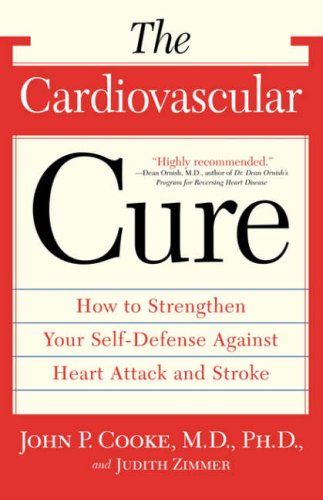
The Cardiovascular Cure: How to Strengthen Your Self-Defense Against Heart Attack and Stroke - Softcover
Inhaltsangabe
Outlines a diet, nutritional supplement, and exercise program, based on research by a Nobel Prize-winning scientific team, providing a two-week eating plan and additional information on how to bolster the cardiovascular system. Reprint.
Die Inhaltsangabe kann sich auf eine andere Ausgabe dieses Titels beziehen.
Über die Autorin bzw. den Autor
JOHN P. COOKE, M.D., Ph.D., is Associate Professor of Medicine and Director of the Section of Vascular Medicine at Stanford University’s Medical School. He trained at the Mayo Clinic, earning a Ph.D. in physiology there, and he was on the faculty of Harvard Medical School before he was recruited to Stanford to spearhead the program in Vascular Biology and Medicine. He is a sought-after consultant and has served on numerous national and international committees dealing with cardiovascular diseases, including those of the American Heart Association and the National Heart, Lung and Blood Institute. JUDITH ZIMMER has been a medical journalist for more than fifteen years. She has contributed to such publications as the New York Times, and Self and Fitness magazines, and she currently writes for academic medical centers in New York City.
From the Hardcover edition.
Auszug. © Genehmigter Nachdruck. Alle Rechte vorbehalten.
Chapter 1
Your Blood Vessels and NO (and Why You Need to Know about Them)
This is a story about the health of your blood vessels. If you are like most people, you have probably given some thought to the health of your heart, but not the 100,000 miles of blood vessels that run throughout your body. Wherever blood flows in your body, it flows through blood vessels.
Blood vessels have been given short shrift mainly because people think that they are nothing more than passive pipes. But we now know that they are much more important than anyone ever realized.
Your blood vessels are dynamic, living tissue just like any other organ in your body. And just like every other organ, they perform a vital function: in this case, controlling blood flow from one moment to the next. Every 60 seconds, your vessels are responsible for distributing five quarts of life-sustaining blood to your body. Just think, five quarts every minute, 1,800 gallons every day, a virtual river of life.
Composed of living cells, blood is alive. And like all living things, blood has its own complex functions. It carries the oxygen and nutrients your tissues need to survive. It removes the waste products of cellular metabolism, distributing these to the liver or kidney where the waste products can be excreted. Blood carries hormones from the brain and other glands to distant parts of the body where these hormones are needed for the growth and function of each organ. When you cut yourself, blood has the ability to clot and stop the bleeding. And when you lose blood, your body has the ability to make new blood, replacing what's been lost. Blood carries white blood cells, your body's major defense against infection. White blood cells course through all of the blood vessels, constantly patrolling for foreign invaders. If you think about it, blood is the unifying force within the body, both a link between distant parts and an intricate system of transportation that provides fuel, disposes of waste, and carries disease-fighting cells.
And all of this happens within the blood vessels.
As the conduit, blood vessels play a role in the ability of the blood to do its job. Blood vessels can control their own diameter and control the flow of blood from one moment to the next. They can open up to increase the flow of blood to where it is needed (such as to the muscles during exercise or to the pelvis during sexual intercourse). Blood vessels can also reduce the flow of blood to an area of the body. The blood vessels to the skin constrict or shut down completely when blood must be diverted (which is why a person may become pale with fear when blood is diverted from the skin to the muscles, heart, and brain where it is needed for fight or flight). Blood vessels can do this because their walls are made of muscle, similar to that of the heart muscle. This muscle responds to nervous impulses from the brain, to changes in pressure within the vessel, and to substances made by the endothelium, the inner lining of the blood vessel.
Blood vessels are always active and constantly in motion as they respond to the rhythms of the body: the heart, the flow of blood, signals from the brain, and signals from tissues of the body that need more blood. Like so many other parts of the body, blood vessels do their job without our conscious knowledge.
The small and large blood vessels perform different roles. The smaller vessels contract to restrict blood flow and dilate to increase it. They direct the flow of blood where it is needed. On the other hand, the larger vessels do not contract or dilate very much on their own, but instead respond to the beat of the heart. They expand with each beat, much as the inner tube of a tire expands when it is filled with air. When the heart relaxes between beats, the walls of the great vessels (the aorta, which carries blood from the heart to the rest of the body, and the pulmonary artery, which carries blood to the lungs) rebound, giving the blood an extra push forward, maintaining blood flow until the heart pumps again. (When you take your pulse, you are actually measuring the wave of energy that passes through the blood from the beating heart, expanding the vessels as the wave passes through.)
It is this dance between the heart and the great vessels that makes a smooth and efficient circulation system. To do their job properly--keeping pace with the heart, expanding and rebounding--vessels need to be pliable and elastic. You want your vessels to be as resilient as possible.
The problem is that--due to many factors, such as aging, genetics, poor diet, smoking, and sedentary lifestyle--the elasticity and flexibility of your vessels can become compromised. When vessels are the opposite of pliable and elastic, they are stiff and fixed in place like a pipe. When vessels are stiff, they can't comply with the beat of the heart and the waves of life-giving energy. When the heart pumps blood into stiff arteries, the heart must work harder. It takes more energy to pump blood through stiff vessels.
Although the smaller vessels do not harden like the larger ones, they can also become damaged and function poorly. Poor diet, lack of exercise, and risk factors such as aging, high blood pressure, high blood sugar, high cholesterol, and smoking all impair the ability of the smaller vessels to relax. The vessel wall becomes thicker and the bore of the vessels becomes smaller. The vessels tend to constrict rather than dilate and it is more difficult for blood to flow through them. Accordingly, to get the same amount of blood flow through these vessels, the heart has to pump harder. As a result, blood pressure rises.
For hundreds of years, we've known that blood pressure is a measure of the blood circulating through the body. It is determined by the amount of blood flow and the blood vessels' resistance to that blood flow. The pumping of the heart establishes the amount of blood flow. When the heart beats faster or contracts more vigorously, blood flow increases. The health of the blood vessels determines the resistance. When the vessels are relaxed and flexible, resistance is low. In about 90 percent of people with high blood pressure, blood pressure increases because the vessels are not relaxed or have thickened.
You are probably familiar with the way blood pressure is measured. The measurement is represented by two numbers, top and bottom. The top number is the systolic pressure, the pressure in the vessels at the time the heart beats and pumps blood into the arteries. The bottom number, or diastolic pressure, is a measurement taken when the heart is resting in between beats. The normal blood pressure reading for an adult is 140/80; anything over these numbers is considered elevated.
In my opinion, the lower your blood pressure, the better. Obviously, if your blood pressure is too low, you will faint. But I tell my patients that their blood pressure should be just high enough to keep them from falling over. Even if your blood pressure is as low as 90/60 but you can stand without trouble, this is healthy and, in the long run, better for your heart and vessels.
To understand the difference between arteries that are stiff and those that are compliant, think about the difference between a thick and thin balloon. It is difficult to blow air into a thick-walled balloon. Expanding a thick-walled balloon takes much more effort than expanding a thin one, and the thick-walled balloon doesn't recoil very far once it is stretched. Like the thick-walled balloon, arteries that have hardened take much more effort to expand--and that makes it more difficult for the heart to pump blood into them. When blood is pumped into vessels that are not compliant, blood pressure rises faster and higher. The vessels can't expand to accommodate the rush of blood. On the other hand, the thin-walled balloon expands,...
„Über diesen Titel“ kann sich auf eine andere Ausgabe dieses Titels beziehen.
Weitere beliebte Ausgaben desselben Titels

Suchergebnisse für The Cardiovascular Cure: How to Strengthen Your Self-Defense...

Beispielbild für diese ISBN
The Cardiovascular Cure: How to Strengthen Your Self Defense Against Heart Attack and Stroke
Anbieter: World of Books (was SecondSale), Montgomery, IL, USA
Verkäuferbewertung 5 von 5 Sternen

Zustand: Acceptable. Item in acceptable condition! Textbooks may not include supplemental items i.e. CDs, access codes etc. Artikel-Nr. 00099474191
Gebraucht kaufen
EUR 5,87
Versand gratis
Versand innerhalb von USA
Versand innerhalb von USA
Anzahl: 1 verfügbar
Beispielbild für diese ISBN
The Cardiovascular Cure: How to Strengthen Your Self Defense Against Heart Attack and Stroke
Anbieter: World of Books (was SecondSale), Montgomery, IL, USA
Verkäuferbewertung 5 von 5 Sternen
Zustand: Very Good. Item in very good condition! Textbooks may not include supplemental items i.e. CDs, access codes etc. Artikel-Nr. 00099830601
Gebraucht kaufen
EUR 5,87
Versand gratis
Versand innerhalb von USA
Versand innerhalb von USA
Anzahl: 1 verfügbar
Beispielbild für diese ISBN
The Cardiovascular Cure: How to Strengthen Your Self Defense Against Heart Attack and Stroke
Anbieter: Wonder Book, Frederick, MD, USA
Verkäuferbewertung 5 von 5 Sternen
Zustand: Good. Good condition. A copy that has been read but remains intact. May contain markings such as bookplates, stamps, limited notes and highlighting, or a few light stains. Artikel-Nr. A04A-03657
Gebraucht kaufen
EUR 6,99
Versand gratis
Versand innerhalb von USA
Versand innerhalb von USA
Anzahl: 2 verfügbar
Beispielbild für diese ISBN
The Cardiovascular Cure: How to Strengthen Your Self Defense Against Heart Attack and Stroke
Anbieter: ThriftBooks-Dallas, Dallas, TX, USA
Verkäuferbewertung 5 von 5 Sternen
Paperback. Zustand: Fair. No Jacket. Readable copy. Pages may have considerable notes/highlighting. ~ ThriftBooks: Read More, Spend Less. Artikel-Nr. G0767908821I5N00
Gebraucht kaufen
EUR 7,48
Versand gratis
Versand innerhalb von USA
Versand innerhalb von USA
Anzahl: 1 verfügbar
Beispielbild für diese ISBN
The Cardiovascular Cure: How to Strengthen Your Self Defense Against Heart Attack and Stroke
Anbieter: ThriftBooks-Dallas, Dallas, TX, USA
Verkäuferbewertung 5 von 5 Sternen
Paperback. Zustand: Very Good. No Jacket. May have limited writing in cover pages. Pages are unmarked. ~ ThriftBooks: Read More, Spend Less. Artikel-Nr. G0767908821I4N00
Gebraucht kaufen
EUR 7,48
Versand gratis
Versand innerhalb von USA
Versand innerhalb von USA
Anzahl: 1 verfügbar
Beispielbild für diese ISBN
The Cardiovascular Cure
Anbieter: WorldofBooks, Goring-By-Sea, WS, Vereinigtes Königreich
Verkäuferbewertung 5 von 5 Sternen
Paperback. Zustand: Very Good. The book has been read, but is in excellent condition. Pages are intact and not marred by notes or highlighting. The spine remains undamaged. Artikel-Nr. GOR003708940
Gebraucht kaufen
EUR 3,57
EUR 9,01 Versand
Versand von Vereinigtes Königreich nach USA
Versand von Vereinigtes Königreich nach USA
Anzahl: 1 verfügbar
Beispielbild für diese ISBN
The Cardiovascular Cure: How to Strengthen Your Self Defense Against Heart Attack and Stroke
Anbieter: GridFreed, San Diego, CA, USA
Verkäuferbewertung 5 von 5 Sternen
Paperback. Zustand: New. In shrink wrap. Artikel-Nr. 100-08916
Neu kaufen
EUR 13,09
EUR 5,91 Versand
Versand innerhalb von USA
Versand innerhalb von USA
Anzahl: 1 verfügbar
Beispielbild für diese ISBN
The Cardiovascular Cure: How to Strengthen Your Self-Defense Against Heart Attack and Stroke
Anbieter: Revaluation Books, Exeter, Vereinigtes Königreich
Verkäuferbewertung 5 von 5 Sternen
Paperback. Zustand: Brand New. reprint edition. 309 pages. 9.00x5.25x0.75 inches. In Stock. Artikel-Nr. 0767908821
Neu kaufen
EUR 42,52
EUR 11,55 Versand
Versand von Vereinigtes Königreich nach USA
Versand von Vereinigtes Königreich nach USA
Anzahl: 1 verfügbar