
Verwandte Artikel zu Letting Go of the Person You Used to Be: Lessons on...
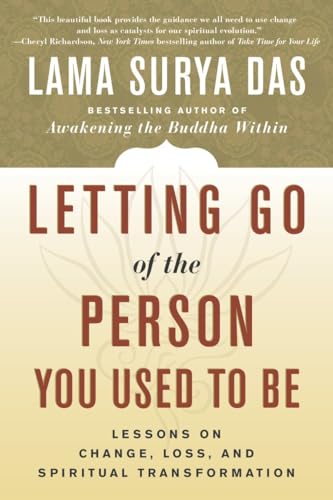
Letting Go of the Person You Used to Be: Lessons on Change, Loss, and Spiritual Transformation - Softcover
Inhaltsangabe
The beloved American Lama, a spiritual leader whose inimitable light and
lively universal teaching style has awakened the spirituality of thousands, now shares an enlightened approach to change and loss, dealing with difficult emotions such as fear, grief, and anger, and the role of crisis in uncovering our authentic selves.
For many people, recent years have been characterized by profound change, whether it relates to financial upheaval, political shifts, or even massive losses of life to disease and violence. Even on the personal level each person must confront the curves life throws his or her way. Buddhism has a great deal to say about change and impermanence and how to meaningfully deal with it. Change--whether on a large or small scale--provides our most important opportunity for learning about ourselves and the nature of reality. From this essential insight Lama Surya Das has crafted a fulfilling and important path to understanding and healing ourselves and finding peace.
Full of personal stories, anecdotes, practical exercises, guided meditations and reflections, and pithy original aphorisms, Letting Go of the Person You Used to Be addresses life's most universal difficulties in a way that is accessible to all. By using memorable concepts such as The Virtues of Adversity, The Pearl Principle ("No inner irritation, no pearl"), and Gaining through Loss, Surya reminds readers that hiding from change and loss is futile. Learning to consciously accept and embrace change leads to a better understanding of ourselves and our own innate divine light.
Die Inhaltsangabe kann sich auf eine andere Ausgabe dieses Titels beziehen.
Über die Autorin bzw. den Autor
A voice of clarity in difficult times, Surya Das offers timeless wisdom in a timely message of hope helpful for us today and tomorrow.
An authorized lama in the Dzogchen lineage of Tibet, SURYA DAS is a sought-after spiritual teacher and meditation master, poet, and spokesperson for the emerging American Buddhism. Founder of the Dzogchen Center, he is also the author of several popular books, including Awakening the Buddha Within, Awakening to the Sacred, and Awakening the Buddhist Heart, which comprise his bestselling Awakening Trilogy, the first trilogy of Buddhism for the West. He also writes regularly for Tricycle magazine and Beliefnet.com, is active in interfaith dialogue, and is a founder and board member of several Buddhist monasteries, centers, and charitable projects in refugee camps in Asia and the West. He lives outside Boston, Massachusetts.
Von der hinteren Coverseite
The beloved American Lama, a spiritual leader whose inimitable light and
lively universal teaching style has awakened the spirituality of thousands, now shares an enlightened approach to change and loss, dealing with difficult emotions such as fear, grief, and anger, and the role of crisis in uncovering our authentic selves.
For many people, recent years have been characterized by profound change, whether it relates to financial upheaval, political shifts, or even massive losses of life to disease and violence. Even on the personal level each person must confront the curves life throws his or her way. Buddhism has a great deal to say about change and impermanence and how to meaningfully deal with it. Change--whether on a large or small scale--provides our most important opportunity for learning about ourselves and the nature of reality. From this essential insight Lama Surya Das has crafted a fulfilling and important path to understanding and healing ourselves and finding peace.
Full of personal stories, anecdotes, practical exercises, guided meditations and reflections, and pithy original aphorisms, "Letting Go of the Person You Used to Be addresses life's most universal difficulties in a way that is accessible to all. By using memorable concepts such as The Virtues of Adversity, The Pearl Principle ("No inner irritation, no pearl"), and Gaining through Loss, Surya reminds readers that hiding from change and loss is futile. Learning to consciously accept and embrace change leads to a better understanding of ourselves and our own innate divine light.
Aus dem Klappentext
The beloved American Lama, a spiritual leader whose inimitable light and
lively universal teaching style has awakened the spirituality of thousands, now shares an enlightened approach to change and loss, dealing with difficult emotions such as fear, grief, and anger, and the role of crisis in uncovering our authentic selves.
For many people, recent years have been characterized by profound change, whether it relates to financial upheaval, political shifts, or even massive losses of life to disease and violence. Even on the personal level each person must confront the curves life throws his or her way. Buddhism has a great deal to say about change and impermanence and how to meaningfully deal with it. Change--whether on a large or small scale--provides our most important opportunity for learning about ourselves and the nature of reality. From this essential insight Lama Surya Das has crafted a fulfilling and important path to understanding and healing ourselves and finding peace.
Full of personal stories, anecdotes, practical exercises, guided meditations and reflections, and pithy original aphorisms, Letting Go of the Person You Used to Be addresses life's most universal difficulties in a way that is accessible to all. By using memorable concepts such as The Virtues of Adversity, The Pearl Principle ("No inner irritation, no pearl"), and Gaining through Loss, Surya reminds readers that hiding from change and loss is futile. Learning to consciously accept and embrace change leads to a better understanding of ourselves and our own innate divine light.
Auszug. © Genehmigter Nachdruck. Alle Rechte vorbehalten.
Chapter One
Making Sense of the Madness
Why does God allow guns? Why did Jonathan's daddy have to die? Why was Margaret born blind?
Amelia,
four years old
Why is there illness, death, and suffering? Why are we separated from those we love? Why is there pain? Why do bad things happen? Why do people hurt each other? Why is life so filled with loss? And the universal question: Why do bad things happen to me? Stuff happens--everyone knows that--but why does it happen to me, why am I so often in the midst of it!
No one has fully satisfactory or verifiable answers to any of these questions. We don't really know. This is part of the great mystery of life. Sure, there are many possible theories and explanations. I have friends, for example, who are astrology buffs. They say that the world events that began on September 11, 2001, were put in motion by an opposition between the planets Pluto and Saturn. It was written in the stars.
Some people are adamant about personifying evil. When we look around us we see leaders from all persuasions referring to those who disagree with them as being evil and followers of the devil. There are men and women who blame everything on Satan himself, who they envision as a real, albeit unseen, entity, who malevolently waltzes through our world, taking advantage of our weaknesses, which of course causes all varieties of havoc. I picked up the newspaper one day last year and read a statement from a fundamentalist preacher who said that some of our most serious problems are well deserved and come about because we are sinners with questionable sexual proclivities. This kind of simplistic fundamentalism has never had much appeal for me. It doesn't even make sense. In fact I think it is a crock, and I don't mind saying so.
Schopenhauer, one of my favorite philosophers, said: "Life is endless pain with a painful end." But is that all, I wonder? It's a sad and frustrating fact that much of the time we can't make sense of the unhappiness of our lives. Some events are easy to comprehend and can be directly attributable to cause and effect. We drive carelessly, for example, and we have accidents. This makes sense. But random events do occur, and cautious people are also in serious accidents. Cautious people are driving in the wrong place at the wrong time; cautious people are also hurt. Things happen that don't seem fair. Why? Are there underlying explanations for this? If I were to answer this question, I would have to say-- probably. Everything has a cause or causes, but I certainly don't always know what they are. Nor do I think that anyone else does. The reasons why we are hurt by life are often as mysterious as the reasons why we are graced with beauty and joy. This all belongs in the category of the unknowable. Much in the universe is inscrutable and unfathomable. Omniscience would help us grasp these matters, but it is in short supply in the human realm.
I am a Buddhist and, as such, I accept the reality of karma and the law of cause and effect. It makes good sense to me. But I also know that the laws of karma are far more complex than any simple sitcom version. We are living not only with our own personal karma, but also with the karma of every other being we meet. When my karma meets your karma, something happens. And, of course, it isn't only about individual karma; there is group karma as well. In this speeded-up world, where we have access to the CNN crawl and minute-by-minute news broadcasts from around the world, think about the karmic repercussions. Shooting breaks out between Israelis and Palestinians on the West Bank. A traumatized tourist with a video camera gives the footage to CNN. It is on the air within the hour. Someplace in Montana, a young mother, making a peanut butter and jelly sandwich for her five year old, is watching. She gets so upset that she drops the jar of jelly, which crashes to the floor. Her barefoot little girl walks in the kitchen at that moment and cuts her toe. More blood flows. How is this all karmically connected? It's impenetrable to mere mortals. "The beauty of the world has two edges, one of laughter, one of anguish, cutting the heart asunder." Virginia Woolf said that.
Only omniscient awareness can totally comprehend causation with all its details, interconnections, and ramifications. The Buddha said that only an omniscient Buddha, a perfectly enlightened and fully awakened being, could understand the myriad causes and conditions that bring about the color of a single peacock's feather.
Since we are not omniscient, since we have limited view and weak foresight, we don't know exactly why things happen. However we do know that it is impossible to avoid all of life's negative experiences. Recently I was standing in a corner coffee shop, waiting at the cash register to pay my bill when a distraught couple came into the restaurant. Both the man and the woman were very excited and talking rapidly. They reminded the cashier that when they left the restaurant about an hour earlier, they had been accompanied by their eighteen-month-old toddler. At the time the little boy had been clutching his favorite stuffed animal--a small purple cow. Whey they arrived home and tucked the sleeping child into his crib, they discovered that he had loosened his grip on his furry toy. Now the purple cow was missing! What could have happened to it?
The couple had hastily arranged for a neighbor to stay with the child, and they were now frantically retracing their footsteps in an attempt to recover the cherished toy. They were hoping against hope that someone had turned it in to the restaurant cashier.
"He's going to be so upset when he wakes up and finds that it's gone!" the father said.
"He loves that cow! He never goes anywhere without it. I knew I should have tried to find another one to buy just in case this happened," the mother said.
"I should have been paying more attention," the father blames himself. "How could I have let this happen?"
The cashier queried various employees. Everyone was very sympathetic. Who hasn't lost something precious and beloved? Who doesn't identify with the pain of childhood losses? Who couldn't empathize with these doting parents who wanted to spare their toddler the pain associated with loss?
More than 2,500 years ago in ancient India, on the border of what is now Nepal, there was another parent who wanted his child to live a pain-free life. His name was King Suddhodana, and he was the father of the man, born as Siddhartha, who we now know as Gautama, the Buddha. Suddhodana was a powerful leader, wealthy enough to build a walled castle filled with flower gardens, elegant food, gracious furnishings, beautiful music, and great luxury.
Legend has it that before Siddhartha, the child who was to become the Buddha, was born, his mother had a dream: She saw her son as a great spiritual warrior, a radiant Bodhisattva who was transformed into a white elephant. The elephant climbed a golden mountain, then a silver mountain, and finally, carrying a white lotus in his trunk, touched the mother on her side. The white elephant then dissolved like vapor into her pregnant womb.
The seers summoned to interpret the dream told the king that the child who was to be born would either be a universal ruler or an enlightened sage, a Buddha. Like many parents, the king wanted his son to follow in his footsteps; he didn't relish the notion of raising a child who would renounce the world in favor of monasticism and a homeless mendicant's begging bowl. With that in mind, the wise men issued a warning: If the king wanted his son to embrace a royal vocation, he must make certain that the young prince never left home, for if he went forth into the world, he would see suffering. Then he would most certainly...
„Über diesen Titel“ kann sich auf eine andere Ausgabe dieses Titels beziehen.
Suchergebnisse für Letting Go of the Person You Used to Be: Lessons on...

Beispielbild für diese ISBN
Letting Go of the Person You Used to Be: Lessons on Change, Loss, and Spiritual Transformation
Anbieter: World of Books (was SecondSale), Montgomery, IL, USA
Verkäuferbewertung 5 von 5 Sternen

Paperback. Zustand: Very Good. The beloved American Lama, a spiritual leader whose inimitable light and lively universal teaching style has awakened the spirituality of thousands, now shares an enlightened approach to change and loss, dealing with difficult emotions such as fear, grief, and anger, and the role of crisis in uncovering our authentic selves. For many people, recent years have been characterized by profound change, whether it relates to financial upheaval, political shifts, or even massive losses of life to disease and violence. Even on the personal level each person must confront the curves life throws his or her way. Buddhism has a great deal to say about change and impermanence and how to meaningfully deal with it. Change--whether on a large or small scale--provides our most important opportunity for learning about ourselves and the nature of reality. From this essential insight Lama Surya Das has crafted a fulfilling and important path to understanding and healing ourselves and finding peace. Full of personal stories, anecdotes, practical exercises, guided meditations and reflections, and pithy original aphorisms, Letting Go of the Person You Used to Be addresses life's most universal difficulties in a way that is accessible to all. By using memorable concepts such as The Virtues of Adversity, The Pearl Principle ("No inner irritation, no pearl"), and Gaining through Loss, Surya reminds readers that hiding from change and loss is futile. Learning to consciously accept and embrace change leads to a better understanding of ourselves and our own innate divine light. Artikel-Nr. 00104013457
Gebraucht kaufen
EUR 4,04
Versand gratis
Versand innerhalb von USA
Versand innerhalb von USA
Anzahl: 1 verfügbar
Beispielbild für diese ISBN
Letting Go of the Person You Used to Be: Lessons on Change, Loss, and Spiritual Transformation
Anbieter: World of Books (was SecondSale), Montgomery, IL, USA
Verkäuferbewertung 5 von 5 Sternen
Paperback. Zustand: Fair. The beloved American Lama, a spiritual leader whose inimitable light and lively universal teaching style has awakened the spirituality of thousands, now shares an enlightened approach to change and loss, dealing with difficult emotions such as fear, grief, and anger, and the role of crisis in uncovering our authentic selves. For many people, recent years have been characterized by profound change, whether it relates to financial upheaval, political shifts, or even massive losses of life to disease and violence. Even on the personal level each person must confront the curves life throws his or her way. Buddhism has a great deal to say about change and impermanence and how to meaningfully deal with it. Change--whether on a large or small scale--provides our most important opportunity for learning about ourselves and the nature of reality. From this essential insight Lama Surya Das has crafted a fulfilling and important path to understanding and healing ourselves and finding peace. Full of personal stories, anecdotes, practical exercises, guided meditations and reflections, and pithy original aphorisms, Letting Go of the Person You Used to Be addresses life's most universal difficulties in a way that is accessible to all. By using memorable concepts such as The Virtues of Adversity, The Pearl Principle ("No inner irritation, no pearl"), and Gaining through Loss, Surya reminds readers that hiding from change and loss is futile. Learning to consciously accept and embrace change leads to a better understanding of ourselves and our own innate divine light. Artikel-Nr. 00067837262
Gebraucht kaufen
EUR 4,04
Versand gratis
Versand innerhalb von USA
Versand innerhalb von USA
Anzahl: 3 verfügbar
Beispielbild für diese ISBN
Letting Go of the Person You Used to Be: Lessons on Change, Loss, and Spiritual Transformation
Anbieter: World of Books (was SecondSale), Montgomery, IL, USA
Verkäuferbewertung 5 von 5 Sternen
Paperback. Zustand: Good. The beloved American Lama, a spiritual leader whose inimitable light and lively universal teaching style has awakened the spirituality of thousands, now shares an enlightened approach to change and loss, dealing with difficult emotions such as fear, grief, and anger, and the role of crisis in uncovering our authentic selves. For many people, recent years have been characterized by profound change, whether it relates to financial upheaval, political shifts, or even massive losses of life to disease and violence. Even on the personal level each person must confront the curves life throws his or her way. Buddhism has a great deal to say about change and impermanence and how to meaningfully deal with it. Change--whether on a large or small scale--provides our most important opportunity for learning about ourselves and the nature of reality. From this essential insight Lama Surya Das has crafted a fulfilling and important path to understanding and healing ourselves and finding peace. Full of personal stories, anecdotes, practical exercises, guided meditations and reflections, and pithy original aphorisms, Letting Go of the Person You Used to Be addresses life's most universal difficulties in a way that is accessible to all. By using memorable concepts such as The Virtues of Adversity, The Pearl Principle ("No inner irritation, no pearl"), and Gaining through Loss, Surya reminds readers that hiding from change and loss is futile. Learning to consciously accept and embrace change leads to a better understanding of ourselves and our own innate divine light. Artikel-Nr. 00102402947
Gebraucht kaufen
EUR 4,04
Versand gratis
Versand innerhalb von USA
Versand innerhalb von USA
Anzahl: 9 verfügbar
Beispielbild für diese ISBN
Letting Go of the Person You Used to Be: Lessons on Change, Loss, and Spiritual Transformation
Verlag:
Harmony/Rodale/Convergent (edition First Edition), 2004
ISBN 10: 0767908740
ISBN 13: 9780767908740
Gebraucht
Paperback
Erstausgabe
Anbieter: BooksRun, Philadelphia, PA, USA
Verkäuferbewertung 5 von 5 Sternen
Paperback. Zustand: Very Good. First Edition. It's a well-cared-for item that has seen limited use. The item may show minor signs of wear. All the text is legible, with all pages included. It may have slight markings and/or highlighting. Artikel-Nr. 0767908740-11-1
Gebraucht kaufen
EUR 4,72
Versand gratis
Versand innerhalb von USA
Versand innerhalb von USA
Anzahl: 1 verfügbar
Beispielbild für diese ISBN
Letting Go of the Person You Used to Be: Lessons on Change, Loss, and Spiritual Transformation
Anbieter: ThriftBooks-Phoenix, Phoenix, AZ, USA
Verkäuferbewertung 5 von 5 Sternen
Paperback. Zustand: Very Good. No Jacket. May have limited writing in cover pages. Pages are unmarked. ~ ThriftBooks: Read More, Spend Less. Artikel-Nr. G0767908740I4N00
Gebraucht kaufen
EUR 5,96
Versand gratis
Versand innerhalb von USA
Versand innerhalb von USA
Anzahl: 3 verfügbar
Beispielbild für diese ISBN
Letting Go of the Person You Used to Be: Lessons on Change, Loss, and Spiritual Transformation
Anbieter: ThriftBooks-Atlanta, AUSTELL, GA, USA
Verkäuferbewertung 5 von 5 Sternen
Paperback. Zustand: Good. No Jacket. Pages can have notes/highlighting. Spine may show signs of wear. ~ ThriftBooks: Read More, Spend Less. Artikel-Nr. G0767908740I3N00
Gebraucht kaufen
EUR 5,96
Versand gratis
Versand innerhalb von USA
Versand innerhalb von USA
Anzahl: 4 verfügbar
Beispielbild für diese ISBN
Letting Go of the Person You Used to Be: Lessons on Change, Loss, and Spiritual Transformation
Anbieter: ThriftBooks-Phoenix, Phoenix, AZ, USA
Verkäuferbewertung 5 von 5 Sternen
Paperback. Zustand: Good. No Jacket. Pages can have notes/highlighting. Spine may show signs of wear. ~ ThriftBooks: Read More, Spend Less. Artikel-Nr. G0767908740I3N00
Gebraucht kaufen
EUR 5,96
Versand gratis
Versand innerhalb von USA
Versand innerhalb von USA
Anzahl: 4 verfügbar
Beispielbild für diese ISBN
Letting Go of the Person You Used to Be: Lessons on Change, Loss, and Spiritual Transformation
Anbieter: ThriftBooks-Reno, Reno, NV, USA
Verkäuferbewertung 5 von 5 Sternen
Paperback. Zustand: Fair. No Jacket. Readable copy. Pages may have considerable notes/highlighting. ~ ThriftBooks: Read More, Spend Less. Artikel-Nr. G0767908740I5N00
Gebraucht kaufen
EUR 5,96
Versand gratis
Versand innerhalb von USA
Versand innerhalb von USA
Anzahl: 2 verfügbar
Beispielbild für diese ISBN
Letting Go of the Person You Used to Be: Lessons on Change, Loss, and Spiritual Transformation
Anbieter: ThriftBooks-Reno, Reno, NV, USA
Verkäuferbewertung 5 von 5 Sternen
Paperback. Zustand: Very Good. No Jacket. May have limited writing in cover pages. Pages are unmarked. ~ ThriftBooks: Read More, Spend Less. Artikel-Nr. G0767908740I4N00
Gebraucht kaufen
EUR 5,96
Versand gratis
Versand innerhalb von USA
Versand innerhalb von USA
Anzahl: 3 verfügbar
Beispielbild für diese ISBN
Letting Go of the Person You Used to Be: Lessons on Change, Loss, and Spiritual Transformation
Anbieter: ThriftBooks-Reno, Reno, NV, USA
Verkäuferbewertung 5 von 5 Sternen
Paperback. Zustand: Good. No Jacket. Pages can have notes/highlighting. Spine may show signs of wear. ~ ThriftBooks: Read More, Spend Less. Artikel-Nr. G0767908740I3N00
Gebraucht kaufen
EUR 5,96
Versand gratis
Versand innerhalb von USA
Versand innerhalb von USA
Anzahl: 4 verfügbar