
Verwandte Artikel zu The Dig Tree: The Story of Bravery/Insanity/the Race...
The Dig Tree: The Story of Bravery/Insanity/the Race to Discover Australia's Wild Frontier - Hardcover
Inhaltsangabe
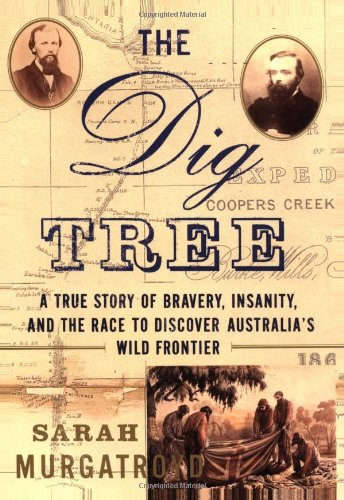
Describes the mid-nineteenth-century Burke and Wells expedition in which eighteen amateur explorers took on the task of charting a course across the vast unmapped interior of Australia from Melbourne to the northern coast, recounting the tragic, nightmarish results of that odyssey.
Die Inhaltsangabe kann sich auf eine andere Ausgabe dieses Titels beziehen.
Über die Autorin bzw. den Autor
A journalist and adventure traveler, SARAH MURGATROYD has covered current affairs for the BBC and produced a variety of radio documentaries, including a special series on Aboriginal issues. Her recent travels took her across Australia, where she trekked the route taken by Burke and Wills. A native of England, she now lives in Sydney. This is her first book.
Aus dem Klappentext
The harrowing true story of the Burke and Willis expedition team who took on the Australian wilds 150 years ago--and lost.
They departed Melbourne's Royal Park in the summer of 1860, a misfit party of eighteen amateur explorers cheered on by thousands of well-wishers. Their mission: to chart a course across the vast unmapped interior of Australia, from Melbourne to the northern coast. Months later, only one man returned alive--with tales of heroism, hardships, and lost opportunities that were by turns terrifying and darkly comic.
Drawing its title from one of the few remaining traces of the expedition, The Dig Tree combines the danger of Sebastian Junger with the irony of Bill Bryson to relive the tragic journey of these completely initiated adventurers. The cast of characters includes the expeditionleader; a reckless, charming Irish policeman known for getting lost on his way home from the pub; an eccentric nature enthusiast from Germany; an alcoholic camel handler; and a rogue American horse-breaker who is just in it for the money. For nine harrowing months, their quest for glory shifts from idiocy to perseverance and then inexorably toward tragedy. The nightmare culminates in a last haunting message left behind a group of desperate and dying men--the word DIG carved into what is now Australia's most famous tree.
The Dig Tree follows this compelling journey through a forgotten corner of history to examine a daring expedition that came unbelievably close to success only to let it slip away.
Auszug. © Genehmigter Nachdruck. Alle Rechte vorbehalten.
One
Terra Australis Incognita
Let any man lay the map of Australia before him, and regard the blank upon its surface, and then let me ask him if it would not be an honourable achievement to be the first to place foot in its centre.
--Charles Sturt, 1840
When Captain James Cook stood on the deck of the Endeavour in March 1770 and felt the hot dry winds filling her sails off Australia's southern coast, he declared that the country's interior would be nothing but desert. Nearly a century later, the same sultry breeze blew down from the heart of the continent, removing the morning chill from Melbourne's Royal Park. As the sun rose, a small group of men emerged from the row of new canvas tents pitched under the gum trees. The warm air in their faces reminded them of the task that lay ahead.
It was Monday, August 20, 1860--the day that Australia's most elaborate and audacious expedition would set out to solve a geographical mystery that had confounded the European settlers since their arrival in Botany Bay in 1788. The Victorian Exploring Expedition was charged with crossing the driest inhabited continent on earth--an island the size of the United States of America, home to such extraordinary creatures as the kangaroo, the emu, and the duck-billed platypus. What other strange beasts or lost civilizations might lie hidden in a land that had rebuffed European explorers for so long?
Despite the early hour, people were already making their way down Melbourne's elegant boulevards, determined to catch a glimpse of the men, whom journalists had already dubbed "pioneers of civilisation and progress, some of who perchance might never return." The crowds bustled toward the park expecting to see a highly organized operation. Instead, they found a scene of "picturesque confusion."
Men rushed about, cursing under their breath as they tripped over the twenty tons of equipment that lay scattered on the grass. Artists jostled to find the best view and newspaper journalists elbowed their way through to examine the chaos. The Argus reported:
At one part, might be observed a couple of "associates," already dressed in their expeditionary undress uniform (scarlet jumper, flannel trousers, and cabbage-tree hat), busily engaged in packing; at another, a sepoy might be seen occupied in tying together the legs of a sheep. Orders were being rapidly issued and rapidly executed, and there was, indeed, every indication of the approach of a movement of an extraordinary character.
Many spectators made straight for the specially constructed stables on one side of the park. They were intrigued by the strange bellowing noises and peculiar odor emanating from the building. Those who managed to thrust their way inside were rewarded with a glimpse of four "Indian" sepoys, attired in white robes and red turbans, trying to calm a small herd of camels. Mochrani, Matvala, Gobin, Golah Singh, Linda, Tschibik, and their companions had been imported to conquer the deserts of central Australia. The animals were the pride of the expedition and enjoyed a level of care normally reserved for visiting English opera singers. In preparation for the journey, they had each been fitted with a waterproof rug, complete with a hole for the hump, along with two sets of camel shoes, "each made of several folds of leather, and shod with iron," designed for traveling over stony ground. Even river crossings had been prepared for. "If it becomes necessary to swim the camels," boasted the Argus, "air bags are to be lashed under their jowls, so as to keep their heads clear when crossing deep streams."
People milled about stroking, patting, and getting in the way. Then, as the police tried to evict the inquisitive onlookers, pandemonium erupted outside. A passing horse had smelled the new beasts, and displaying the customary equine revulsion for the camel, it bolted through the crowd, throwing its rider and breaking her leg. Not to be outdone, a camel broke loose and chased a well-known police officer across the park:
The gentleman referred to is of large mould, and until we saw his tumbling feat yesterday, we had no idea that he was such a sprightly gymnast. His down-going and uprising were greeted with shouts of laughter, in which he good-naturedly joined. The erring camel went helter-skelter through the crowd, and was not secured until he showed to admiration how speedily can go "the ship of the desert."
In the center of the turmoil, standing on top of a wagon, was a tall, flamboyant Irishman, with flashing blue eyes and a magnificent black beard. Shouting orders in a strong Galway accent, he was trying (and failing) to impose order on the mayhem below. Expedition leader Robert O'Hara Burke grew ever more impatient as he tried to squeeze too much equipment onto too few camels, horses, and wagons.
The expedition was already running hopelessly behind schedule, but as fast as his men tried to organize the stores, more people descended in a frenzy of curiosity. They inspected the rifles and ammunition, sat down at the cedar-topped dinner tables, and discussed the relative advantages of the bullock cart versus the American wagon. The expedition doctor, Hermann Beckler, recalled later, "no member of the expedition could see another, none could work with another, none could call another--such was the crush among the thousands who thronged to see our departure."
The Victorian Exploring Expedition had been organized by a committee of Melbourne's most important men. In July 1851 Victoria had proudly severed its ties with its parent colony of New South Wales and this grand enterprise was designed to show off the achievements of a new and ambitious colony. Every eventuality was prepared for using the latest inventions. One "hospital camel" was fitted with an enclosed stretcher, which would "afford capital accommodation for invalids, should sickness unfortunately visit the party." In order to cope with dry conditions, each man carried a "pocket charcoal filter, by means of which he will be able to obtain drinkable water under the most unfavourable circumstances," and should anyone get lost, the party carried "an abundance of signals, from the rocket and the blue light to the Union Jack and the Chinese gong." As the Age remarked, "Never did an expedition set forth under, on the whole, brighter auspices. Everything that could possibly be furnished, as in any way useful or auxiliary to the expedition, has been given it." The problem was--where to put it all?
By lunchtime the crowd had swelled to around 15,000, a good turnout for a city of 120,000. An impromptu band was formed and a carnival atmosphere swept through the park, compounding the general disarray and giving the proceedings "a very gay and animated appearance." Whispers began to circulate that certain "entertainments" could be procured in the bushes around the edge of the park and a "sly grog shop" opened up behind the camel stables.
By mid-afternoon an expedition member confirmed one of those rumors by appearing amongst the crowd "a little too hilarious through excess of beer." Burke had already dismissed two of his party for disobedience and he now fired ex-policeman Owen Cowan on the spot. The expedition was three men down--and it had not even finished packing.
One man avoided the revelry. Refusing to be interviewed or to have his photograph taken, a neatly dressed young Englishman stayed inside his tent, wrapping his scientific instruments and placing them inside custom-built mahogany boxes. Surveyor, astronomer, meteorologist, and third in command, William John Wills packed his nautical almanacs, sextant, compass, theodolite, chronometer, barometer, thermometer, anemometer,...
„Über diesen Titel“ kann sich auf eine andere Ausgabe dieses Titels beziehen.
Suchergebnisse für The Dig Tree: The Story of Bravery/Insanity/the Race...

Beispielbild für diese ISBN
The Dig Tree: A True Story of Bravery, Insanity, and the Race to Discover Australia's Wild Frontier
Anbieter: World of Books (was SecondSale), Montgomery, IL, USA
Verkäuferbewertung 5 von 5 Sternen

Zustand: Very Good. Item in very good condition! Textbooks may not include supplemental items i.e. CDs, access codes etc. Artikel-Nr. 00110192338
Gebraucht kaufen
EUR 4,46
Versand gratis
Versand innerhalb von USA
Versand innerhalb von USA
Anzahl: 1 verfügbar
Beispielbild für diese ISBN
The Dig Tree: A True Story of Bravery, Insanity, and the Race to Discover Australia's Wild Frontier
Anbieter: World of Books (was SecondSale), Montgomery, IL, USA
Verkäuferbewertung 5 von 5 Sternen
Zustand: Acceptable. Item in acceptable condition! Textbooks may not include supplemental items i.e. CDs, access codes etc. Artikel-Nr. 00103180869
Gebraucht kaufen
EUR 4,46
Versand gratis
Versand innerhalb von USA
Versand innerhalb von USA
Anzahl: 2 verfügbar
Beispielbild für diese ISBN
The Dig Tree: A True Story of Bravery, Insanity, and the Race to Discover Australia's Wild Frontier
Anbieter: BooksRun, Philadelphia, PA, USA
Verkäuferbewertung 5 von 5 Sternen
Hardcover. Zustand: Very Good. 1. With dust jacket. It's a well-cared-for item that has seen limited use. The item may show minor signs of wear. All the text is legible, with all pages included. It may have slight markings and/or highlighting. Artikel-Nr. 0767908287-11-1-29
Gebraucht kaufen
EUR 5,60
Versand gratis
Versand innerhalb von USA
Versand innerhalb von USA
Anzahl: 1 verfügbar
Beispielbild für diese ISBN
The Dig Tree: A True Story of Bravery, Insanity, and the Race to Discover Australia's Wild Frontier
Anbieter: ThriftBooks-Dallas, Dallas, TX, USA
Verkäuferbewertung 5 von 5 Sternen
Hardcover. Zustand: As New. No Jacket. Pages are clean and are not marred by notes or folds of any kind. ~ ThriftBooks: Read More, Spend Less. Artikel-Nr. G0767908287I2N00
Gebraucht kaufen
EUR 5,83
Versand gratis
Versand innerhalb von USA
Versand innerhalb von USA
Anzahl: 1 verfügbar
Beispielbild für diese ISBN
The Dig Tree : A True Story of Bravery, Insanity, and the Race to Discover Australia's Wild Frontier
Anbieter: Better World Books, Mishawaka, IN, USA
Verkäuferbewertung 5 von 5 Sternen
Zustand: Very Good. Pages intact with possible writing/highlighting. Binding strong with minor wear. Dust jackets/supplements may not be included. Stock photo provided. Product includes identifying sticker. Better World Books: Buy Books. Do Good. Artikel-Nr. 5784374-6
Gebraucht kaufen
EUR 6,55
Versand gratis
Versand innerhalb von USA
Versand innerhalb von USA
Anzahl: 1 verfügbar
Beispielbild für diese ISBN
The Dig Tree : A True Story of Bravery, Insanity, and the Race to Discover Australia's Wild Frontier
Anbieter: Better World Books, Mishawaka, IN, USA
Verkäuferbewertung 5 von 5 Sternen
Zustand: Good. Pages intact with minimal writing/highlighting. The binding may be loose and creased. Dust jackets/supplements are not included. Stock photo provided. Product includes identifying sticker. Better World Books: Buy Books. Do Good. Artikel-Nr. 862896-6
Gebraucht kaufen
EUR 6,55
Versand gratis
Versand innerhalb von USA
Versand innerhalb von USA
Anzahl: 1 verfügbar
Beispielbild für diese ISBN
The Dig Tree: The Story of Bravery, Insanity, and the Race to Discover Australia's Wild Fontier
Anbieter: AwesomeBooks, Wallingford, Vereinigtes Königreich
Verkäuferbewertung 5 von 5 Sternen
Hardcover. Zustand: Very Good. The Dig Tree: The Story of Bravery, Insanity, and the Race to Discover Australia's Wild Fontier This book is in very good condition and will be shipped within 24 hours of ordering. The cover may have some limited signs of wear but the pages are clean, intact and the spine remains undamaged. This book has clearly been well maintained and looked after thus far. Money back guarantee if you are not satisfied. See all our books here, order more than 1 book and get discounted shipping. Artikel-Nr. 7719-9780767908283
Gebraucht kaufen
EUR 4,52
EUR 4,81 Versand
Versand von Vereinigtes Königreich nach USA
Versand von Vereinigtes Königreich nach USA
Anzahl: 2 verfügbar
Beispielbild für diese ISBN
The Dig Tree: A True Story of Bravery, Insanity, and the Race to Discover Australia's Wild Frontier
Verlag:
Broadway Books, New York, 2002
ISBN 10: 0767908287
ISBN 13: 9780767908283
Gebraucht
Hardcover
Erstausgabe
Anbieter: Abacus Bookshop, Pittsford, NY, USA
Verkäuferbewertung 5 von 5 Sternen
hardcover. Zustand: Fine copy in fine dust jacket. 1st. 8vo, 355 pp. Artikel-Nr. 105404
Gebraucht kaufen
EUR 6,70
EUR 3,47 Versand
Versand innerhalb von USA
Versand innerhalb von USA
Anzahl: 1 verfügbar
Foto des Verkäufers
The Dig Tree: The Story of Bravery/Insanity/the Race to Discover Australia's Wild Frontier
Anbieter: WeBuyBooks, Rossendale, LANCS, Vereinigtes Königreich
Verkäuferbewertung 5 von 5 Sternen
hardcover. Zustand: Very Good. Most items will be dispatched the same or the next working day. A copy that has been read, but is in excellent condition. Pages are intact and not marred by notes or highlighting. The spine remains undamaged. Artikel-Nr. rev4977296194
Gebraucht kaufen
EUR 2,41
EUR 7,85 Versand
Versand von Vereinigtes Königreich nach USA
Versand von Vereinigtes Königreich nach USA
Anzahl: 1 verfügbar
Beispielbild für diese ISBN
The Dig Tree: The Story of Bravery, Insanity, and the Race to Discover Australia's Wild Fontier
Anbieter: Bahamut Media, Reading, Vereinigtes Königreich
Verkäuferbewertung 5 von 5 Sternen
Hardcover. Zustand: Very Good. This book is in very good condition and will be shipped within 24 hours of ordering. The cover may have some limited signs of wear but the pages are clean, intact and the spine remains undamaged. This book has clearly been well maintained and looked after thus far. Money back guarantee if you are not satisfied. See all our books here, order more than 1 book and get discounted shipping. Artikel-Nr. 6545-9780767908283
Gebraucht kaufen
EUR 4,86
EUR 8,15 Versand
Versand von Vereinigtes Königreich nach USA
Versand von Vereinigtes Königreich nach USA
Anzahl: 2 verfügbar