
Verwandte Artikel zu Why Men Don't Listen and Women Can't Read Maps:...
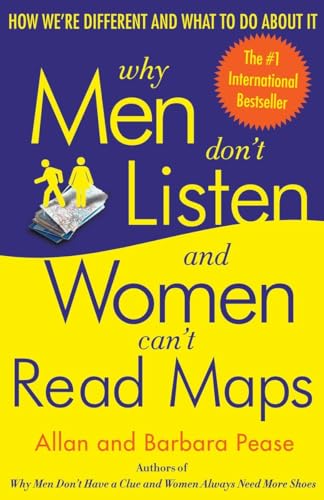
Why Men Don't Listen and Women Can't Read Maps: How We're Different and What to Do About It - Softcover
Inhaltsangabe
Have you ever wished your partner came with an instruction booklet? This international bestseller is the answer to all the things you've ever wondered about the opposite sex.
For their controversial new book on the differences between the way men and women think and communicate, Barbara and Allan Pease spent three years traveling around the world, collecting the dramatic findings of new research on the brain, investigating evolutionary biology, analyzing psychologists, studying social changes, and annoying the locals.
The result is a sometimes shocking, always illuminating, and frequently hilarious look at where the battle line is drawn between the sexes, why it was drawn, and how to cross it. Read this book and understand--at last!--why men never listen, why women can't read maps, and why learning each other's secrets means you'll never have to say sorry again.
Die Inhaltsangabe kann sich auf eine andere Ausgabe dieses Titels beziehen.
Über die Autorin bzw. den Autor
Barbara Pease is CEO of Pease Training International and the author of the international bestseller Memory Language. She divides her time between England and Australia, trying to find her way home from the airport. Alan Pease is a full-time speaker, conducting seminars in thirty countries with a client list that includes IBM, McDonald's, and the BBC. He is also the author of five #1 bestsellers, and spends most of his free time practicing listening when he's being spoken to.
Von der hinteren Coverseite
Have you ever wished your partner came with an instruction booklet? This international bestseller is the answer to all the things you've ever wondered about the opposite sex.
For their controversial new book on the differences between the way men and women think and communicate, Barbara and Allan Pease spent three years traveling around the world, collecting the dramatic findings of new research on the brain, investigating evolutionary biology, analyzing psychologists, studying social changes, and annoying the locals.
The result is a sometimes shocking, always illuminating, and frequently hilarious look at where the battle line is drawn between the sexes, why it was drawn, and how to cross it. Read this book and understand--at last!--why men never listen, why women can't read maps, and why learning each other's secrets means you'll never have to say sorry again.
Auszug. © Genehmigter Nachdruck. Alle Rechte vorbehalten.
Why Men Don't Listen and Women Can't Read Maps
How We're Different and What to Do about ItBy Barbara PeaseBroadway Books
Copyright ©2001 Barbara PeaseAll right reserved.
ISBN: 9780767907637
Chapter One
Men and women are different. Not better or worse?different.Just about the only thing they have in common isthat they belong to the same species. They live in differentworlds, with different values and according to quite differentsets of rules. Everyone knows this, but very few people, particularlymen, are willing to admit it. The truth, however, is most definitelyout there. Look at the evidence. Around 50 percent ofmarriages end in divorce in Western countries, and most seriousrelationships stop short of becoming long-term. Men and womenof every culture, creed, and hue constantly argue over their partners'opinions, behavior, attitudes, and beliefs.
Some Things Are Obvious
When a man goes to a rest room, he usually goes for one reasonand one reason only. Women use rest rooms as social lounges andtherapy rooms. Women who go to a rest room as strangers cancome out best friends and lifelong buddies. But everyone wouldbe instantly suspicious of the man who called out, "Hey Frank,I'm going to the toilet. You wanna come with me?"
Men dominate TV remote controls and flick through the channels;women don't mind watching the commercials. Under pressure,men drink alcohol and invade other countries; women eatchocolate and go shopping.
Women criticize men for being insensitive, uncaring, not listening,not being warm and compassionate, not talking, not givingenough love, not being committed to relationships, wanting tohave sex rather than make love, and leaving the toilet seat up.
Men criticize women about their driving, for not being able toread street directories, for turning maps upside down, for theirlack of a sense of direction, for talking too much without gettingto the point, for not initiating sex often enough, and for leavingthe toilet seat down. Men can never find a pair of socks, but theirCDs are in alphabetical order. Women can always find the missingset of car keys but rarely the most direct route to their destination.Men think they're the more sensible sex. Women know they are.
How many men does it take to change a roll of toilet paper?
It's unknown It's never happened.
Men marvel at the way a woman can walk into a room full ofpeople and give an instant commentary on everyone; women can'tbelieve men are so unobservant. Men are amazed at how a womancan't see a red flashing oil light on the car dashboard but can spota dirty sock in a dark corner 20 feet away. Women are bewilderedby men who can consistently parallel park a car in a tight spotusing a rearview mirror but can never find the G spot.
If a woman is out driving and gets lost, she'll stop and ask for directions.To a man, this is a sign of weakness. He'll drive around incircles for hours, muttering things like, "I've found a new way to getthere" or "I'm in the general area" and "Hey, I recognize that gasstation!"
Different Job Specs
Men and women evolved differently because they had to. Menhunted, women gathered. Men protected, women nurtured. As aresult, their bodies and brains evolved in completely differentways.
As their bodies physically changed to adapt to their specificfunctions, so did their minds. Men grew taller and stronger thanmost women, while their brains developed to suit their tasks.Women were mostly content for men to work away as they kept thecave fires burning, and their brains evolved to cope with their functionin life.
Over millions of years, the brain structures of men andwomen thus continued to change in different ways. Now we knowthe sexes process information differently. They think differently.They believe different things. They have different perceptions, priorities,and behaviors.
To pretend otherwise is a recipe for heartache, confusion, anddisillusionment all your life.
The "Stereotype" Argument
Since the late 1980s, there has been an explosion of research intomale and female differences and the way both the male and femalebrains work. For the first time ever, advanced computer brain-scanningequipment has allowed us to see the brain operating"live" and, with that peek into the vast landscape of the humanmind, has provided us with many of the answers to the questionsabout male and female differences. The research discussed in thisbook has been collected from studies in scientific, medical, psychological,and sociological studies, and it all points clearly to onething: All things are not equal; men and women are different. Formost of the twentieth century those differences were explainedaway by social conditioning; that is, we are who we are because ofour parents' and teachers' attitudes, which in turn reflected the attitudesof their society. Baby girls were dressed in pink and givendolls to play with; baby boys were dressed in blue and giventoy soldiers and football jerseys. Young girls were cuddled andtouched while boys were thumped on the back and told not to cry.Until recently, it was believed that when a baby was born its mindwas a clean slate on which its teachers could write its choicesand preferences. The biological evidence now available, however,shows a somewhat different picture of why we think the way wedo. It shows convincingly that it is our hormones and brain wiringthat are largely responsible for our attitudes, preferences, and behavior.This means that if boys and girls grew up on a desertedisland with no organized society or parents to guide them, girlswould still cuddle, touch, make friends, and play with dolls, whileboys would compete mentally and physically with each other andform groups with a clear hierarchy.
The wiring of our brain in the womb and the
effect of hormones will determine how we think
and behave.
As you will see, the way our brains are wired and the hormonespulsing through our bodies are the two factors that largelydictate, long before we are born, how we will think and behave.Our instincts are simply our genes determining how our bodieswill behave in given sets of circumstances.
Is It All a Male Conspiracy?
Since the 1960s a number of pressure groups have tried to persuadeus to buck our biological legacy. They claim that governments, religions,and education systems have added up to nothing more thana plot by men to suppress women, colluding to keep good womendown. Keeping women pregnant was a way of controlling themeven more.
Certainly, historically, that's how it appears. But the questionneeds to be asked: If women and men are identical, as thesegroups claim, how could men ever have achieved such total dominanceover the world? The study of how the brain works nowgives us many answers. We are not identical. Men and womenshould be equal in terms of their opportunities to exercise theirfull potential, but they are definitely not identical in their innateabilities. Whether men and women are equal is a political or moralquestion, but whether they are identical is a scientific one.
The equality of men and women is a political
or moral...
„Über diesen Titel“ kann sich auf eine andere Ausgabe dieses Titels beziehen.
Suchergebnisse für Why Men Don't Listen and Women Can't Read Maps:...

Beispielbild für diese ISBN
Why Men Don't Listen and Women Can't Read Maps: How We're Different and What to Do About It
Anbieter: World of Books (was SecondSale), Montgomery, IL, USA
Verkäuferbewertung 5 von 5 Sternen

Paperback. Zustand: Fair. Have you ever wished your partner came with an instruction booklet? This international bestseller is the answer to all the things you've ever wondered about the opposite sex. For their controversial new book on the differences between the way men and women think and communicate, Barbara and Allan Pease spent three years traveling around the world, collecting the dramatic findings of new research on the brain, investigating evolutionary biology, analyzing psychologists, studying social changes, and annoying the locals. The result is a sometimes shocking, always illuminating, and frequently hilarious look at where the battle line is drawn between the sexes, why it was drawn, and how to cross it. Read this book and understand--at last!--why men never listen, why women can't read maps, and why learning each other's secrets means you'll never have to say sorry again. Artikel-Nr. 00082186561
Gebraucht kaufen
EUR 3,71
Versand gratis
Versand innerhalb von USA
Versand innerhalb von USA
Anzahl: 12 verfügbar
Beispielbild für diese ISBN
Why Men Don't Listen and Women Can't Read Maps: How We're Different and What to Do About It
Anbieter: World of Books (was SecondSale), Montgomery, IL, USA
Verkäuferbewertung 5 von 5 Sternen
Paperback. Zustand: Good. Have you ever wished your partner came with an instruction booklet? This international bestseller is the answer to all the things you've ever wondered about the opposite sex. For their controversial new book on the differences between the way men and women think and communicate, Barbara and Allan Pease spent three years traveling around the world, collecting the dramatic findings of new research on the brain, investigating evolutionary biology, analyzing psychologists, studying social changes, and annoying the locals. The result is a sometimes shocking, always illuminating, and frequently hilarious look at where the battle line is drawn between the sexes, why it was drawn, and how to cross it. Read this book and understand--at last!--why men never listen, why women can't read maps, and why learning each other's secrets means you'll never have to say sorry again. Artikel-Nr. 00094095804
Gebraucht kaufen
EUR 3,71
Versand gratis
Versand innerhalb von USA
Versand innerhalb von USA
Anzahl: 16 verfügbar
Beispielbild für diese ISBN
Why Men Don't Listen and Women Can't Read Maps: How We're Different and What to Do About It
Anbieter: BooksRun, Philadelphia, PA, USA
Verkäuferbewertung 5 von 5 Sternen
Paperback. Zustand: Very Good. 1. It's a well-cared-for item that has seen limited use. The item may show minor signs of wear. All the text is legible, with all pages included. It may have slight markings and/or highlighting. Artikel-Nr. 0767907639-8-1
Gebraucht kaufen
EUR 5,82
Versand gratis
Versand innerhalb von USA
Versand innerhalb von USA
Anzahl: 1 verfügbar
Beispielbild für diese ISBN
Why Men Don't Listen and Women Can't Read Maps: How We're Different and What to Do about It
Anbieter: ThriftBooks-Dallas, Dallas, TX, USA
Verkäuferbewertung 5 von 5 Sternen
Paperback. Zustand: Good. No Jacket. Pages can have notes/highlighting. Spine may show signs of wear. ~ ThriftBooks: Read More, Spend Less. Artikel-Nr. G0767907639I3N00
Gebraucht kaufen
EUR 5,94
Versand gratis
Versand innerhalb von USA
Versand innerhalb von USA
Anzahl: 1 verfügbar
Beispielbild für diese ISBN
Why Men Don't Listen and Women Can't Read Maps : How We're Different and What to Do about It
Verlag:
Potter/Ten Speed/Harmony/Rodale, 2001
ISBN 10: 0767907639
ISBN 13: 9780767907637
Gebraucht
Softcover
Erstausgabe
Anbieter: Better World Books, Mishawaka, IN, USA
Verkäuferbewertung 5 von 5 Sternen
Zustand: Very Good. 1st Edition. Pages intact with possible writing/highlighting. Binding strong with minor wear. Dust jackets/supplements may not be included. Stock photo provided. Product includes identifying sticker. Better World Books: Buy Books. Do Good. Artikel-Nr. 6450826-6
Gebraucht kaufen
EUR 6,55
Versand gratis
Versand innerhalb von USA
Versand innerhalb von USA
Anzahl: 3 verfügbar
Beispielbild für diese ISBN
Why Men Don't Listen and Women Can't Read Maps : How We're Different and What to Do about It
Verlag:
Potter/Ten Speed/Harmony/Rodale, 2001
ISBN 10: 0767907639
ISBN 13: 9780767907637
Gebraucht
Softcover
Erstausgabe
Anbieter: Better World Books, Mishawaka, IN, USA
Verkäuferbewertung 5 von 5 Sternen
Zustand: Good. 1st Edition. Pages intact with minimal writing/highlighting. The binding may be loose and creased. Dust jackets/supplements are not included. Stock photo provided. Product includes identifying sticker. Better World Books: Buy Books. Do Good. Artikel-Nr. GRP102388155
Gebraucht kaufen
EUR 6,55
Versand gratis
Versand innerhalb von USA
Versand innerhalb von USA
Anzahl: 2 verfügbar
Beispielbild für diese ISBN
Why Men Don't Listen and Women Can't Read Maps : How We're Different and What to Do about It
Verlag:
Potter/Ten Speed/Harmony/Rodale, 2001
ISBN 10: 0767907639
ISBN 13: 9780767907637
Gebraucht
Softcover
Erstausgabe
Anbieter: Better World Books: West, Reno, NV, USA
Verkäuferbewertung 5 von 5 Sternen
Zustand: Good. 1st Edition. Former library copy. Pages intact with minimal writing/highlighting. The binding may be loose and creased. Dust jackets/supplements are not included. Includes library markings. Stock photo provided. Product includes identifying sticker. Better World Books: Buy Books. Do Good. Artikel-Nr. GRP23659692
Gebraucht kaufen
EUR 6,55
Versand gratis
Versand innerhalb von USA
Versand innerhalb von USA
Anzahl: 2 verfügbar
Beispielbild für diese ISBN
Why Men Don't Listen and Women Can't Read Maps: How We're Different and What to Do About It
Anbieter: Wonder Book, Frederick, MD, USA
Verkäuferbewertung 5 von 5 Sternen
Zustand: Very Good. Very Good condition. A copy that may have a few cosmetic defects. May also contain light spine creasing or a few markings such as an owner's name, short gifter's inscription or light stamp. Artikel-Nr. H20J-01203
Gebraucht kaufen
EUR 7,13
Versand gratis
Versand innerhalb von USA
Versand innerhalb von USA
Anzahl: 2 verfügbar
Beispielbild für diese ISBN
Why Men Don't Listen and Women Can't Read Maps: How We're Different and What to Do About It
Anbieter: Wonder Book, Frederick, MD, USA
Verkäuferbewertung 5 von 5 Sternen
Zustand: Good. Good condition. A copy that has been read but remains intact. May contain markings such as bookplates, stamps, limited notes and highlighting, or a few light stains. Artikel-Nr. R13B-03441
Gebraucht kaufen
EUR 7,13
Versand gratis
Versand innerhalb von USA
Versand innerhalb von USA
Anzahl: 3 verfügbar
Beispielbild für diese ISBN
Why Men Don't Listen and Women Can't Read Maps: How We're Different and What to Do About It
Anbieter: BooksRun, Philadelphia, PA, USA
Verkäuferbewertung 5 von 5 Sternen
Paperback. Zustand: Very Good. 1. It's a well-cared-for item that has seen limited use. The item may show minor signs of wear. All the text is legible, with all pages included. It may have slight markings and/or highlighting. Artikel-Nr. 0767907639-8-6
Gebraucht kaufen
EUR 7,64
Versand gratis
Versand innerhalb von USA
Versand innerhalb von USA
Anzahl: 1 verfügbar