
Verwandte Artikel zu Climbing Jacob's Ladder: One Man's Rediscovery...
Inhaltsangabe
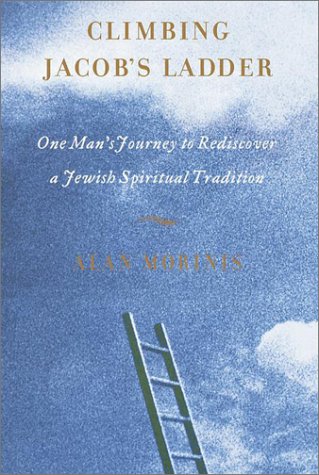
Disenchanted with his life, the author, along with the help of Rabbi Alan Perr, finds enlightenment in Musar, a thousand-year-old discipline that was buried in his Jewish heritage, in an exhilarating true account of one man's illuminating spiritual journey that reveals the valuable lessons of Musar.
Die Inhaltsangabe kann sich auf eine andere Ausgabe dieses Titels beziehen.
Über die Autorin bzw. den Autor
ALAN MORINIS completed his doctorate at Oxford University, which he attended on a Rhodes Scholarship. His research was published by Oxford University Press as Pilgrimage in the Hindu Tradition. He has held posts at several universities, been a founder and director of nonprofit organizations, and produced award-winning feature films, documentaries, and television programs. He lives in Vancouver, B.C., with his wife, Dr. Bev Spring, and their two daughters.
Aus dem Klappentext
Jewish by birth, though from a secular family, Alan Morinis took a deep journey into Hinduism and Buddhism as a young man. He received a doctorate for his study of Hindu pilgrimage, learned yoga in India with B. K. S. Iyengar, and attended his first Buddhist meditation course in the Himalayas in 1974. But in 1997, when his film career went off track and he reached for some spiritual oxygen, he felt inspired to explore his Jewish heritage. In his reading he happened upon a Jewish tradition of spiritual practice called Mussar. Gradually he realized he had stumbled on an insightful discipline for self-development, complete with meditative, contemplative, and other well-developed transformative practices designed to penetrate the deepest roots of the inner life.
Eventually reaching the limits of what he could learn on his own, he decided to seek out a Mussar teacher. That was not easily achieved, since almost the entire world of the Mussar tradition had been wiped out in the Holocaust. In time, he did find an accomplished master who stood in an unbroken line of transmission of the Mussar tradition, and who lived at the center of a community of Orthodox Jews on Long Island. This book tells the story of Morinis s journey to meet his teacher and what he learned from him, and reveals the central teachings and practices that are the spiritual treasury and legacy of Mussar.
Alan Morinis has written this book because the wisdom and practices that helped him so much have not penetrated the world beyond the confines of Orthodox Judaism, and may not be fully appreciated even there at this time. His hope is that Jews and non-Jews alike will find in Mussar a time-tested path of spiritual practice that will help them discover the hidden radiance within.
Auszug. © Genehmigter Nachdruck. Alle Rechte vorbehalten.
chapter one
The Gate of Starting Out
In a classic Jewish story, a student tells his friend that he is going to study with a teacher. "What do you hope to learn?" his friend asks him. "I want to see how he ties his shoes," he answers.
The streets of New York streamed with people, and the stairs to the subway were like a giant drain sucking up the wash of a human rainstorm. I boarded a train at Penn Station on my way to my first meeting with Rabbi Yechiel Yitzchok Perr at his yeshiva in the unlikely mecca of Far Rockaway, on Long Island. It was a warm day in the early spring of 1999, and I had already traveled a long way.
I had spent the night with a friend in Manhattan, having arrived the day before after a five-hour flight from my hometown of Vancouver, British Columbia. I had hugged my girls good-bye when they went off to school in the morning, and my wife had driven me to the airport. Our farewells were subdued. I could feel that my family was happy for me as I finally stepped out on this journey that had been in the making for two years, and yet there was more than a touch of apprehension in the air as well. None of us, including me, really knew where I was going or what I was about to find there. Would I come back as the dad and husband they loved, or different in ways that might drive wedges into our close relationships?
It had been an even longer journey emotionally from the brutal moment of awakening I had suffered two years before. Little by little my heart had healed, helped along by the reading and learning I was doing in the classic texts of the Mussar tradition. At first the dense and archaic philosophical language in these centuries-old books had been a barrier to me, but in time I had developed ways to connect myself to their wisdom. When a writer said "men," for example, I would think "people." When he talked about "sin," I would take this to mean ignorant or mistaken actions that led to suffering. In this way, I had read and reread, reinterpreted, and come up with images and metaphors that were meaningful to me while still remaining true to the core of their insights. Although it was the brilliance of these insights that had drawn me deeper into Mussar, I had now come to the point where I needed more than books. The theory was great, but it appeared to me like still-life paintings of a distant land. I needed to see how the wisdom of Mussar translated into the living qualities of someone who walked its path, and I hoped to find that person in Rabbi Perr.
On the flight and again on the train, I nervously ran through all the preparations I had made. I knew I was guaranteed to be as much of an "odd duck" in the regimented yeshiva environment as a Canada goose among penguins, but still, I had tried to remember to bring all the special things I knew I would need. I had brought a hat, because men in Orthodox communities wear hats--though I knew theirs would be black and mine was sort of grayish, which made me wonder if, instead of helping me "blend in," it would only point up just how much of an alien I was in their world. I had packed my prayer shawl, my tallis, and borrowed tefillin, the little black leather boxes with thongs that observant men strap on daily, which I had put on a grand total of twice in my life. I expected that the men would all have beards, though I had decided not to grow one myself. Even if they were all bearded, I had told myself, I wasn't on this journey to become one of them, certainly not before I had even set foot among them. I was on my way to deepen my learning of Mussar, and when I remembered that fact, a bright swell of happiness rolled through me. But bang behind it came a wave of hot anxiety, as the reality of what I was doing actually hit home. I'd never even laid eyes on a yeshiva in my life, and now I was on my way to meet the senior rabbi of one on his own turf.
As the train rocked me closer to that first meeting, I wondered what Rabbi Perr would be like. I had had only that first cold-call conversation with him and then one other to set the date and time of my visit, so I really had no clues to go on. Would he be warm and friendly or stand-offish and detached? Joyous or austere? Approachable or remote? And I also wondered--and worried--how he would welcome an outsider like me. Would he be the kind of person to judge me on my cleanshaven cheeks and funny hat, or would he focus at a deeper level to see me as just another soul out on God's road?
By this time I had already come to see myself as a soul. That's one of the first things any student of Mussar needs to understand and acknowledge, deeply and clearly. Each of us is a soul. Mostly we have been told that we "have" a soul, but that's not the same thing. To have a soul would indicate that we are primarily an ego or a personality that in some way "possesses" a soul. It's an early step on the path of Mussar to unlearn that linguistic misconception and to realize that our essence is the soul and that all aspects of ego and personality flow from that essence. At its core the soul is pure, but habits, tendencies, and imbalances often obscure some of that inner light. The Mussar discipline was devised to help us correct whatever shortcomings may be preventing the light of our soul from shining through.
At last the train pulled into the Lawrence station, where I'd been told to get off, and I knew all my questions would be answered soon enough. A short taxi ride through tree-lined suburban streets took me to the squat, red-brick building that housed the yeshiva. For a moment I stood outside and stared at the bunkerlike facade, hoping to make some connection between this ordinary, American-looking place and the ancient world of Mussar I knew from books. As I stood there, all the nervousness and uncertainty I had been feeling suddenly welled up into a tidal wave of anxiety that washed over me and left me feeling drained and totally unprepared for this meeting. In that moment, like a little kid being ushered toward his first day at a new school, I had the overwhelming urge simply to turn and flee. Except, I reminded myself, no one was making me come here. I had made the journey to the bottom of these stairs only because I really wanted to be here, maybe even needed to be. And so, with hat on head and trepidation in hand, I walked up the steps and pushed open the door to find myself in a long, narrow hallway teeming with boys in black yarmulkes rushing, jostling, and yelling at one another.
The door labeled office was right there, so I quickly made for refuge and found myself in a tiny room with a woman sitting at a desk. I asked for Rabbi Perr, and she wordlessly nodded over her shoulder toward another short hallway. Students and bearded teachers in ties and dark suits popped in and out of the several offices that opened onto the narrow passage. At the end I came to a door that stood partially ajar and was marked with a plaque that read rosh yeshiva, "head of the yeshiva." My way was blocked by a man leaning through the opening and talking to the person inside. Finally he left, and I poked my head into the small room.
Directly across from me sat a man whom I judged to be in his sixties wearing a round-brimmed black hat that tilted backward when he raised his head to look at me. His neck, collar, and the upper half of his shirt were hidden by a thick, wiry graying beard, and as he rose to greet me the tails of his black frock coat fell to the backs of his knees. He presented an imposing, even patriarchal figure, though his eyes, peering out between the brim of his hat and the top of his beard, were large, dark, and warm.
I introduced myself and he responded enthusiastically "Welcome!"
Slowly he crossed to me. Then, taking my hand in both of his, those soft eyes...
„Über diesen Titel“ kann sich auf eine andere Ausgabe dieses Titels beziehen.
Suchergebnisse für Climbing Jacob's Ladder: One Man's Rediscovery...

Beispielbild für diese ISBN
Climbing Jacobs Ladder One Man
Anbieter: World of Books (was SecondSale), Montgomery, IL, USA
Verkäuferbewertung 5 von 5 Sternen

Zustand: Good. Item in good condition. Textbooks may not include supplemental items i.e. CDs, access codes etc. Artikel-Nr. 00103788038
Gebraucht kaufen
EUR 4,99
Versand gratis
Versand innerhalb von USA
Versand innerhalb von USA
Anzahl: 1 verfügbar
Beispielbild für diese ISBN
Climbing Jacobs Ladder One Man
Anbieter: World of Books (was SecondSale), Montgomery, IL, USA
Verkäuferbewertung 5 von 5 Sternen
Zustand: Very Good. Item in very good condition! Textbooks may not include supplemental items i.e. CDs, access codes etc. Artikel-Nr. 00106062509
Gebraucht kaufen
EUR 4,99
Versand gratis
Versand innerhalb von USA
Versand innerhalb von USA
Anzahl: 1 verfügbar
Beispielbild für diese ISBN
Climbing Jacob's Ladder: One Man's Rediscovery of a Jewish Spiritual Tradition
Anbieter: ThriftBooks-Dallas, Dallas, TX, USA
Verkäuferbewertung 5 von 5 Sternen
Hardcover. Zustand: Good. No Jacket. Pages can have notes/highlighting. Spine may show signs of wear. ~ ThriftBooks: Read More, Spend Less. Artikel-Nr. G0767906454I3N00
Gebraucht kaufen
EUR 6,41
Versand gratis
Versand innerhalb von USA
Versand innerhalb von USA
Anzahl: 1 verfügbar
Beispielbild für diese ISBN
Climbing Jacob's Ladder: One Man's Rediscovery of a Jewish Spiritual Tradition
Anbieter: ThriftBooks-Dallas, Dallas, TX, USA
Verkäuferbewertung 5 von 5 Sternen
Hardcover. Zustand: Very Good. No Jacket. May have limited writing in cover pages. Pages are unmarked. ~ ThriftBooks: Read More, Spend Less. Artikel-Nr. G0767906454I4N00
Gebraucht kaufen
EUR 6,41
Versand gratis
Versand innerhalb von USA
Versand innerhalb von USA
Anzahl: 1 verfügbar
Beispielbild für diese ISBN
Climbing Jacob's Ladder: One Man's Rediscovery of a Jewish Spiritual Tradition
Anbieter: ThriftBooks-Reno, Reno, NV, USA
Verkäuferbewertung 5 von 5 Sternen
Hardcover. Zustand: Good. No Jacket. Pages can have notes/highlighting. Spine may show signs of wear. ~ ThriftBooks: Read More, Spend Less. Artikel-Nr. G0767906454I3N00
Gebraucht kaufen
EUR 6,41
Versand gratis
Versand innerhalb von USA
Versand innerhalb von USA
Anzahl: 1 verfügbar
Beispielbild für diese ISBN
Climbing Jacob's Ladder: One Man's Rediscovery of a Jewish Spiritual Tradition
Anbieter: ThriftBooks-Phoenix, Phoenix, AZ, USA
Verkäuferbewertung 5 von 5 Sternen
Hardcover. Zustand: Very Good. No Jacket. May have limited writing in cover pages. Pages are unmarked. ~ ThriftBooks: Read More, Spend Less. Artikel-Nr. G0767906454I4N00
Gebraucht kaufen
EUR 6,41
Versand gratis
Versand innerhalb von USA
Versand innerhalb von USA
Anzahl: 1 verfügbar
Beispielbild für diese ISBN
Climbing Jacob's Ladder: One Man's Rediscovery of a Jewish Spiritual Tradition
Anbieter: ThriftBooks-Atlanta, AUSTELL, GA, USA
Verkäuferbewertung 5 von 5 Sternen
Hardcover. Zustand: Good. No Jacket. Pages can have notes/highlighting. Spine may show signs of wear. ~ ThriftBooks: Read More, Spend Less. Artikel-Nr. G0767906454I3N00
Gebraucht kaufen
EUR 6,41
Versand gratis
Versand innerhalb von USA
Versand innerhalb von USA
Anzahl: 1 verfügbar
Beispielbild für diese ISBN
Climbing Jacob's Ladder : One Man's Rediscovery of a Jewish Spiritual Tradition
Anbieter: Better World Books, Mishawaka, IN, USA
Verkäuferbewertung 5 von 5 Sternen
Zustand: Very Good. Pages intact with possible writing/highlighting. Binding strong with minor wear. Dust jackets/supplements may not be included. Stock photo provided. Product includes identifying sticker. Better World Books: Buy Books. Do Good. Artikel-Nr. 12721757-20
Gebraucht kaufen
EUR 7,04
Versand gratis
Versand innerhalb von USA
Versand innerhalb von USA
Anzahl: 1 verfügbar
Beispielbild für diese ISBN
Climbing Jacob's Ladder : One Man's Rediscovery of a Jewish Spiritual Tradition
Anbieter: Better World Books: West, Reno, NV, USA
Verkäuferbewertung 5 von 5 Sternen
Zustand: Good. Pages intact with minimal writing/highlighting. The binding may be loose and creased. Dust jackets/supplements are not included. Stock photo provided. Product includes identifying sticker. Better World Books: Buy Books. Do Good. Artikel-Nr. 5099338-6
Gebraucht kaufen
EUR 7,04
Versand gratis
Versand innerhalb von USA
Versand innerhalb von USA
Anzahl: 1 verfügbar
Beispielbild für diese ISBN
Climbing Jacob's Ladder: One Man's Rediscovery of a Jewish Spiritual Tradition
Anbieter: Roundabout Books, Greenfield, MA, USA
Verkäuferbewertung 4 von 5 Sternen

hardcover. Zustand: Near Fine. Condition Notes: Excellent, unmarked copy with little wear and tight binding. We ship in recyclable American-made mailers. 100% money-back guarantee on all orders. Artikel-Nr. 1763276
Gebraucht kaufen
EUR 9,38
Versand gratis
Versand innerhalb von USA
Versand innerhalb von USA
Anzahl: 1 verfügbar